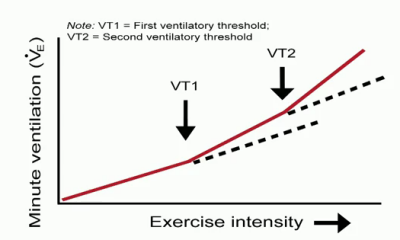
Here is the continuation of my interview with Master Instructor Tom Scotto where we discuss if the 2 Threshold / 3 Zone system could have application in a power based class.
During our conversation we discuss the idea of recruiting a number of our very intelligent Instructors to experiment with using a 2 Threshold / 3 Zone system to find a student’s low power threshold and use it to create a their training zones. Essentially crowd-sourcing the development of a new method of helping everyone discover a specific metabolic marker that’s unique to each student and that could be found as part of every class.
Is that something you would be interested in being part of? Leave a comment below if you are.
Recomended by ACE – The American Council on Exercise
I asked Master Instructor Tom Scotto for his thoughts on Part 1 – Part 2 and Part3 of Is a 20 Minute Threshold Field Test realistic for your class?
Specifically I wanted to discuss the third article where I introduced the Two Threshold / Three Zone (2T/3Z) Heart Rate training system. This is the system that ACE is recommending to Personal Trainers and Group Fitness Instructors.
This interview ran a bit long so I have split it into two parts. (my preference is to keep each Podcast to around 20 minutes when possible)
Love to know your comments on this.
Does the Two Threshold / Three Zone Heart Rate training system make sense to you?
Would you be willing to try it in your class?
Do you see this as a better of worse alternative to what you are using now?
We’ve added a new category (which are one of the ways we organize content) called Best Practices – clicking that link will display all posts and Podcasts that we feel are the Best Practices for that particular subject.
One of our objectives here at ICI/PRO is, with the guidance of our very knowledgeable ICI/PRO Team, is to sift through the mountains of information on the Internet tained by; Myths, Misinformation, Self-Promotion, Branding/Sales/Marketing Messages and just pure nonsense. The plan going forward to deliver to information that we feel are Best Practices that you can easily and effectively apply to improving your craft as a Fitness Professional.
But deciding what makes a Best Practice requires some specific guidelines or tests.
First on the list; a Best Practice must be Practical…
…contrasted with just Theoretical.
My first example of a Best Practice, defined by it’s practicality, is the Three Heart Rate Training Zone system – 2T/3Z for short. Anchored by Two Thresholds (Lt1 Aerobic and Lt2 Anaerobic) and advocated by no less than; ACEThe American Council on Exercise, Sally Edwards and Dr. Carl Foster, I firmly believe 2T/3Z to be the most practical Zone Based Heart Rate training system available for use in our classes. Here is a series where I lay out my original arguments, and supporting facts, for 2T/3T.
Five or Seven Heart Rate Zone systems, promoted by Endurance Coaches the likes of Joe Friel or Chris Carmichael, may “theoretically” be more accurate than a simpler Three Zone system, but be honest here. How many of your students, with a high degree of certainty, can tell you their Zone 5B Heart Rate? What’s the number based on? An estimated Max HR or a field test they completed 4 months ago? If your entire teaching career has been in a little boutique studio, filled with committed athletes, then maybe you’ll feel they could. If not, then I’ll bet we can agree that cueing a 5 minute interval that starts at 5A and ladders up to 5C isn’t very practical. You’ll may also agree that a Five or Seven Heart Rate Zone systems fails the second test…
… a Best Practice must be Applicable.
Most of us are instructing a vast demographic of students, that range from; Cat 2 cyclists to four times a week Club Athletes to first-time-to-exercise newbies. I believe that what we do in our classes should be relevant and/or appropriate to the majority of our students.
I’d encourage you [wlm_firstname] to review some of the posts we’ve now categorized as Best Practices and let me know if you agree. Also feel free to suggest other Best Practicesfor consideration by our team.
If you’ve followed indoorcycleinstructor.com for any length of time you know that I’m a huge fan of the 2T/3Z method of Heart Rate training which is the basis for Zoning. That simple Blue/Yellow/Red response from my Blink Heart Rate monitor is (to me) the perfect way to introduce zone based heart rate training into your class.
Here’s some proof of it’s success – OK it’s a bit rough, but Diana presents a powerful truth that Zoning has worked for her in this video. Your students are in your class to lose body fat and Diana losing 100 pounds and finishing the Danskin Triathlon is a testament to the effectiveness of 2T/3Z Heart Rate training.
For the past two year’s or so I have been lobbying for a universal “Standard” for the description of Heart Rate Training Zones. The purpose is to get all of us talking with a common language, so we aren’t confusing our students and help them reach their weight loss goals by training more effectively.
I love what we have been calling 2T/3Z or Two Thresholds / Three Heart Rate Zones and feel it is perfect for the “Club Athletes” who make up the majority of our classes.
Now there is a multi-week Heart Rate training program, designed around 2T/3Z & the Blink Heart Rate monitor, that you can offer to the clients at your club or studio. Zoning was developed by Ms. Zone Based Heart Rate Training herself; Sally Edwards, along with her partner (and ICI/PRO member) Chuck Cali.
Zoning is literally a Turn-Key fitness program in a can. I mean it will actually arrive at your studio in a can 🙂 The Zoning can contains everything you need:
Handouts and training video to educate your instructors
Promotional materials to help you sell your 6 week Zoning program to your clients
Class plans for leading each of the 6 weekly small group classes
Having seen the complete program I’m confident you will want to offer Zoning
Zoning is due to be released on November 15th and they are currently interviewing potential Beta sites. If you own or manage a fitness studio and would like to be considered as an early test facility (or you would like to be contacted when the program is released) follow this link to submit your contact information.