by John | Dec 24, 2020 | Engage Your Students, Heart Zones USA, KEEPING IT FUN
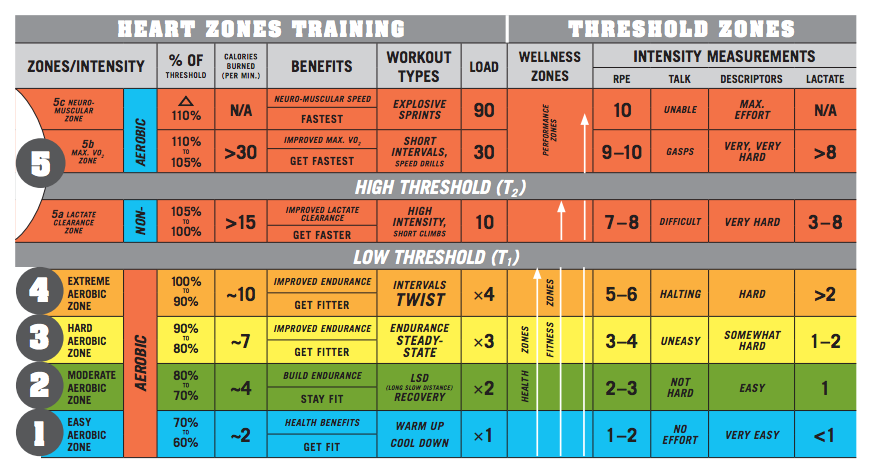
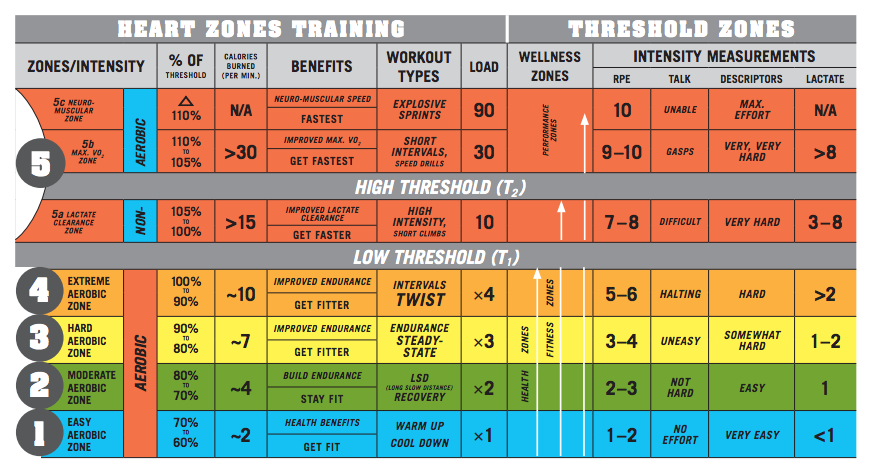
My friend Sally Edwards makes an excellent point here that applies equally to any endurance athlete and affirms our discussion from Podcast 368 — Does Intensity Trump Duration?.
It turns out that very fast runs are good for you–and that moderately fast runs (those just above threshold, in the Black Hole) are not. That’s because Black Hole runs are too slow to cause enough stress to make your body want to strengthen itself, and too fast to allow you to go long enough to improve your endurance. Studies of top runners find that they (by design or not) minimize their time in the Black Hole.
How fast is the Black Hole? In terms of pace, heart rate, and the Heart Zones chart, the Black Hole is actually a very narrow band. It starts at threshold, right as you enter Zone 5, and goes about 5 percent higher. So, if your threshold heart rate is 150 bpm, your Black Hole would extend from 150 to 157 bpm. That means if you really want to improve, your fast runs should roughly start at a second threshold: 158 bpm.
**This post is one of several in an excerpt series from the book, Be a Better Runner by Sally Edwards & Carl Foster**
But don’t discount fun exercise = running/cycling that you enjoy just for how it makes you feel. Many people have no interest in structured “training”, they exercise because they find it fun.
Why There’s No Such Thing as Junk Miles
Whether you’re in training or not, every ride has a purpose–and just about every one is legit
Fun, however, is a legitimate purpose. Stress relief is a legitimate purpose. The fact that you can finally ride outside after being trapped inside by a wall of snow and ice for six weeks, structure be damned, is a legitimate purpose. The only non-legitimate purpose I can think of is if you’re out there joylessly slogging through some self imposed workout because you feel like you need more miles when those miles are not a) making you happy b) making you faster or c) building your reserves, but rather a) making you miserable, b) making you slower and c) breaking you down.
As an A type male, it was difficult to understand the whole “fun exercise” concept. What’s the point of taking this class, if you’re going to talk through it?
Once I understood that for some folks, Keeping It Fun is the objective, it became a lot easier to accept the appeal of SoulCycle type classes… and their wild success 🙂
Originally posted 2017-03-12 08:40:23.
by John | Oct 31, 2020 | Best Practices, Big Box Instructor, Boutique Instructor, Instructor Training, KEEPING IT FUN
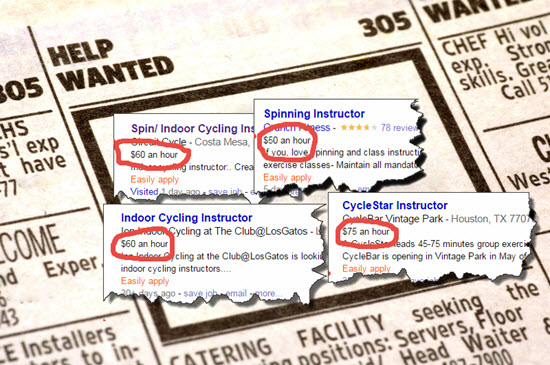
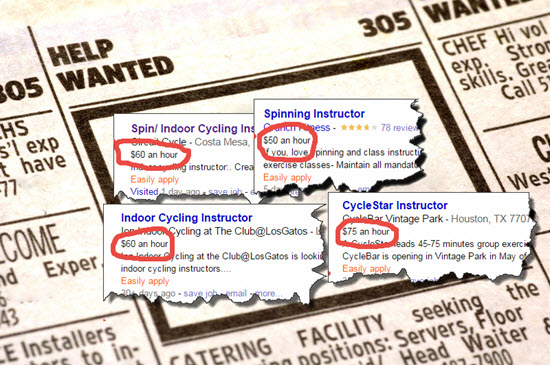
What I’ve described as the “SoulCycle Effect” appears to have caused a nice jump in the starting rate for IC Instructors. At many new boutique studios, the $50 – $75 per class rate advertised is the starting base pay rate. Consistently fill the room and the added $’s per-head incentives you’ll receive could push your pay to $125.00 or more per class. Teach just six classes a week and you’ll be making $15,000 to $37,500 a year… for a part-time job.
I don’t know about you, but that’s real money to me!
Big Box Clubs are feeling the labor pinch
Large health clubs are sensing competitive pressure from small/boutique fitness studios and it scares them. Not only are they losing customers, they’re also watching their best Instructors walk out the door to join a startup down the street.
How do I know this? Because it was a common theme voiced by multiple club owners and equipment distributors I spoke with last month at IHRSA.
Which is a 180° flip from six or so years ago. That’s when the small/boutique studio boom was ramping up. Then a fitness entrepreneur’s primary strategy was differenciation. What can I do to be different from the local Big Box? Now it’s the owner’s and managers of these same large fitness clubs asking the same thing – LOL!
If it’s been awhile, you’re probably due a raise
If it’s been a few years since your last review, now is probably as good a time as any to ask for an increase in your per-class rate.
Do a little research to learn what other studios near you are offering. It wouldn’t hurt to graph out your class attendance and possibly list all of the times you agreed to sub other Instructors classes – so you can demonstrate your value to the business. Then be brave, schedule an appointment and politely ask for a raise. Unless you’re a real flub, or there’s no other option where you can teach, your current employer will want to retain your services = will want to keep you satisfied and offer you some additional $$$.
If that doesn’t work – you can always check indoorcyclinginstructorjobs.com to find a studio who would love to have you on their team 🙂
Originally posted 2016-04-12 13:52:10.
by John | Oct 16, 2020 | Engage Your Students, Instructor Training, Master Instructor Blog, Training With Power, Zone based Heart Rate Training
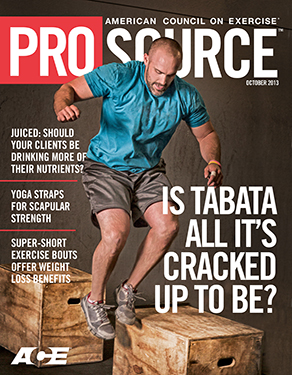
Image from http://www.acefitness.org/prosource/71/
I just read a press release and accompanying article from the ACE – The American Console on Exercise PRO SOURCE magazine about their study to gauge the effectiveness of High Intensity Training (HIT).
Is Tabata All It’s Cracked Up To Be?
“It seems like everything high-intensity is now called Tabata Training,” says John Porcari, Ph.D., head of the Clinical Exercise Physiology Program at the University of Wisconsin, La Crosse. “The original Tabata study was done on a bicycle, but people are now doing that 20-second/10-second format with resistance training, plyometrics, calisthenics…with almost anything.”
Because of all of this recent interest in Tabata-style workouts, the American Council on Exercise enlisted Porcari and his research team to gauge just how effective a Tabata-style workout really is.
THE BOTTOM LINE
“The great thing about Tabata is it’s a short workout–only 20 minutes–and it incorporates your total body, so it’s working every muscle group that you possibly can,” says Embert, referring specifically to the Tabata-style workout she designed.
You can download the article for printing here.
But what to do during the remainder of your 60 minute class?
There was a trainer at Life Time who told me years ago something I’ve never forgotten; First give them (your class) what they WANT… and then give them what they NEED.
The WANT he was referring to are very intense/anaerobic intervals. There’s no secret sauce IMO at SoulCycle > they’re just teaching very intense classes because they know that’s what people WANT.
The NEED is for solid aerobic training. Not necessarily base building, but solid work below threshold HR / FTP.
There are a lot of serendipity going on here at ICI/PRO. A quick check back to our latest Audio PROfile is another – Bad A*s Intervals Audio Class PROfile from Schwinn Master Trainer Rachel Buschert Vaziralli could be a perfect work set you could add to an existing profile.
Instructor Kathy Palkaninec was a past winner of our profile contest and her profile follows a similar WANT & NEED format.
You may want to announce your intentions to crush them (WANT) during a 20 minute Tabata round that will start fifteen minutes into class. Don’t worry about telling them what follows. Keep everyone focused on doing their best effort during the Tabatas.
Give everyone a full 5 minutes or more of complete recovery. It’s during this time that I talk about the “Golden Hour” and how most of us have 90 minutes where we can really perform well, before fatigue really limits our performance. The Golden Hour doesn’t begin for most of us until ~30 minutes in. At the end of the recovery we’re only @ the 40 minute mark of a 60 minute class and I explain how we’re only 10 minutes into our Golden Hour – just now ready to perform. It’s here where you can coach them through a 10 or more minute sub-threshold effort (NEED) to conclude the class. Here’s where you can put that stage button to work if you have one – encourage everyone to ramp up to a big number, Stage Button, now maintain it by keeping your instantaneous wattage at or above the average 🙂
Make sense?
Originally posted 2013-10-10 08:28:16.
by John | Jul 9, 2020 | Best Practices, Engage Your Students, KEEPING IT FUN, Master Instructor Blog, Your Fitness Business
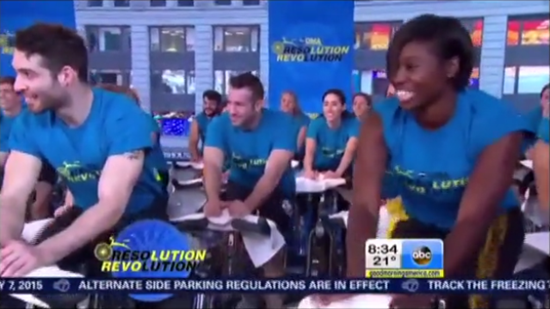
Five million viewers of ABC’s “Good Morning America” TV program were treated to a wonderful promotion for Indoor Cycling this past week. As I watched I just couldn’t help myself and began humming REM’s Shiny Happy People. That was exactly what I was seeing > hundreds of shiny, happy people enjoying riding inside. I can’t think of a better way to kick off 2015!
I’m of course describing the nationwide 2015 SoulCycle resolution ride that aired Jan 7th live on “Good Morning America.
What a way to jumpstart January! SoulCycle joined Good Morning America today for its Resolution Revolution. We tapped it back on SoulCycle bikes in their dressing rooms and hallways as well as in Times Square – while GMA showed live feeds from Soul classes happening in Bethesda, Chestnut Hill, Coral Gables, Short Hills and West Hollywood! Check out this video clip of all the action, including an interview with instructor ANGELA DAVIS on how to stay motivated as well as an update on our SoulScholarships Program. It was a good morning, indeed!
Here’s the video of the event if you haven’t seen it.
http://vimeo.com/116184911
Originally posted 2015-01-11 13:54:43.

by John | Apr 16, 2020 | Instructor Training, Master Instructor Blog

Remember these?
This question from a prospective ICI/PRO member got me thinking today, while out on my early AM training ride…
I’m interested in signing up for your programs, but I have a few questions about the information that is received. When you receive the classes, are there instructions included with how to teach each song; meaning what to do when?
Good question.
I answered her saying that the majority of our Audio Class Profiles are Intensity based – segments of time at a specific level of effort defined by RPE, HR Zone or Power/Watts.
After I hit send I started to reconsider my response – are our profiles mainly intensity based? So I took a one of our most popular profiles (Welcome to the Jungle from Krista Leopold) with a specific focus on how much movement/position/cadence change she had included.
It turns out not much… here’s what I found in the PDF download.
Krista’s introduction is all about intensity:
Welcome to the Jungle is a high-intensity class. For the student, the prescribed intensity gradually increases from below threshold to maximum effort, which is advisable only for students with previous experience and solid fitness levels. Just as in any class, new and deconditioned students will be coached to ride only where they feel comfortable. This ride is best taught to a group that you already know, and is not a ride to use on a day when you are subbing or just starting out in a new setting. Ideally, you would have announced it in advance so that they are prepared and rested for it. Instead of using heart rate numbers for this ride, we will rely on good ‘ole RPE. You and your students will benefit from having 1-10 scale RPE chart displayed. We will work through four rounds of intervals separated by a complete recovery. Each round will increase in intensity and the recovery time will decrease.
Page two includes this:
For all of the work efforts I recommend the Spinning® movement called “Running with Resistance,” but any movement can be substituted. Running with Resistance is particularly effective because it is a move that is specifically done for short periods. It allows you push a higher resistance at a higher intensity in a way that is different from a sprint. Done correctly, you can easily push your heart into the high end anaerobic zones.
In the description for song #2
Toward the end of the warm-up, we will accelerate as we leave the saddle, almost like jumping,
to finish raising our exertion to right around 6 on the RPE scale.
Then there are a few random suggestions:
It’ll be a fun, high-cadence climb that will be as easy or
as hard as they want it to be.
For this final effort you are mostly cheering them on, reminding them that their cheering squad is
cheering them on, and giving them their starts and stops. Be very clear with every start and stop (of the Tabata intervals) because you don’t want them to miss it. I find that a “3-2-1-Stop” countdown at the end of every
segment helps them by giving them a regular pattern to follow.
Krista’s Welcome to the Jungle Quick PROfile only includes one reference to movement
Created by: Krista Leopold, aka GroupFitPower
Training Type: High-Intensity Intervals Working HR Zones: Zones 4-5c
Total Class Length: 60 minutes
Warm-up: 12 minutes Start with a long warm-up to help settle them in. After 8-9 minutes, bring them out of the saddle to get them energized.
1:3 Intervals Round: 11 minutes 30 seconds “Hard” (RPE 7) + 90 seconds “Moderate” repeated 4 times, followed by complete recovery of 2 minutes.
1:2 Intervals Round: 9 minutes 30 seconds “Very Hard” (RPE 8) + 60 seconds “Moderate” repeated 4 times, followed by a complete recovery of 3 minutes.
1:1 Intervals Round: 10 minutes 30 seconds “Very, Very Hard” (RPE 9) + 30 seconds “Moderate” repeated 4 times, followed by a complete recovery of 6 minutes.
2:1 Tabata Intervals: 4 minutes 20 seconds “All-Out Maximum” (RPE 10) + 10 seconds “Moderate” repeated 8 times.
Cool Down and Recovery
After reviewing a few more it appears that I was right, our profiles are primarily intensity (not movement) based. But is that a good thing?
Wasn’t the original Johnny G programming nearly all movement based? Jim Karanas made some interesting points about movement based classes in his Non-Authentic Indoor Cycling post.
It won’t last. Silly trend. Dance parties on bikes with music videos can’t last. You can’t even call it training. It’s just physical movement, not sure it’s even considered exercise. It’s totally without direction.
And yet SoulCycle is packing them in and as near as I can tell they’re using a whole lot of movement in their classes.
Jim ends his post with this:
If non-authentic IC is going to make a mark, why not embrace it for what it is — a way to train on the bike that makes (some) people fit and happy? Assuming it’s validated as safe and effective (ICG has already contacted the American Council on Exercise and proposed a study), then shouldn’t every indoor cycling education body offer a program on how to teach non-authentic indoor cycling? Why shouldn’t any and every indoor cycling program be taught by those who are truly qualified to teach indoor cycling? That would be the likes of us. We know indoor cycling best. We could create a program — inauthentic fluff, if you will — that’s still authentic in its safety, structure and cardiovascular benefit. Why not?
Could the solution, that many of us are looking for, be as simple as just sprinkling some fun movement into a solid profile that’s intensity based?
Originally posted 2013-07-17 12:22:34.