
by Gino | Mar 30, 2012 | Master Instructor Blog

I’ve decided to start a new Blog. It will be a cacophony of Rants, Research and Reality Checks. In 2007 I took the proverbial “red pill” see original Matrix movie if you are not familiar with that reference — it will be good for you :), for Indoor Cycling and the science of training, and ever since I’ve been wondering if I wouldn’t have been better off taking the blue pill. Ignorance is bliss after all.
Truthfully, I have no regrets. As in much of life, there is good news and bad news. The good news is that there is a very real difference between exercise and training, and that difference can be felt through and through; body, mind and spirit. Furthermore, the science behind creating this change in our fitness and performance on the bike is thoroughly captivating; compelling me to want to learn more and more.
However (you knew the other shoe would drop eventually, right?), the bad news is that seemingly opposite techniques can sometimes yield the same results. Educated, respected and credible sources can, and often do, disagree vehemently with each other with regards to methodology, technique and overall approach to training.
Each one will site well vetted and published research, making their respective cases as to why their methods are superior, or at least founded on science and therefore the proper way to achieve their desired results. So what’s the big deal you might ask. Everyone has their own way of doing things, right? The “big deal” is that I want to make sense out of this stuff, and it gets dog gone hard to separate fact from fiction, or formula from philosophy.
For example, there are studies showing VO2 increases from very intense H.I.T. type training, and there are studies showing VO2 increases from doing a ton of steady state riding in the low heart zones like zone 1 and 2. Likewise there are coaches that swear by weight training to augment your strength objectives, while there are others who won’t let their athletes near the gym; both siting research to support their position.
Yet we can see these extremely different methods produce equally successful athletes in many cases. It’s as if the body is somehow affected by the belief the athlete and coach have about what they are doing, and not the science behind it. Am I the only one that thinks this is completely illogical, weird and by the way, maddening?
So what’s a coach or educator supposed to do? Well, I’m not throwing up my hands… at least not on this account. Actually, not on most accounts. Instead, I have been doing the only thing we control freaks know how to do in the face of confusing facts and information. That is to take matters into our own hands, and do our own research. If one or more of these philosophies seems to ring true, we do our own homework, set up controlled studies, and we base our methods and techniques on the reality of our own findings – of what works — where we can see it, feel it, record it, and repeat it.
On my next post, I’ll try to explain how we wash this red pill down with enough spring water to yield this fruit.
by Gino | Apr 17, 2011 | Training With Power
It’s time to start thinking about developing our power, but what do we do if we don’t have a power meter?
First, you will want to build on that good cardiovascular foundation that you now have underneath you from base building this winter. What’s that? You mean you didn’t do any base building during the heart of the winter season? Oh well, this may hurt a bit, but, you’ll get over it. Most riders don’t do base building and figure that the “Man, am I outa’ shape” feeling is an annual ritual all cyclists must endure. So you won’t be alone.
As we north easterners are joined by the other snow and cold winter states across the continent, it’s time to start developing our climbing legs. If you live in a flat state, consider this work applicable to time trials and power that will become useful for spitting people “out-the-back.”
The first question I get whenever I begin addressing a mixed crowd (not men & women, but power bike & non-power bike users) is “How do we do this if we don’t have Watts on our bikes?”
Developing power without a Power meter is not as hard as you might think. But we will require the other training tool; the Heart Monitor. This should not be a surprise since our cardiovascular system (especially our VO2 max) is our biggest limiter to power generation. Even the most zealot non-heart rate monitor cardiovascular atheist will tell you that. Look at their power workouts and you will find a lot of their power improvement drills are aimed at boosting VO2.
But enough side-bar fun, let’s get to the nitty gritty. Ideally, even if your main class or health club does not use Power bikes, you will want to find out where your power now stands, as a baseline. This will help you validate the upcoming training afterwards so that you can learn what works for you, what doesn’t and how your unique physiology reacts to training. Since we are talking about power, let’s do before and after tests on a power bike. You may just have to call around and locate a health club or studio that has them. This will give you the most accurate analysis of your results. However, barring that, we will use your speed and heart rate while riding outside to analyze your results. If you only ride inside, and you don’t have access to a Power bike at all… well,… you will have to look for some other manifestation of your power increases – longer hair on your chest? I guess that wouldn’t work for everyone :-0
Step 1: Establish T2 or “High Threshold”
Get a heart rate monitor and determine your high threshold. If you can’t get a metabolic / VO2 type test, here is a quick link to the standard field test that we use at Cycling Fusion compliments of Sally Edwards founder of Heart Zones® – its’s the complete protocol as well a Threshold chart.
Step 2: Sustainable Power Test
Ride for 20 minutes at the highest power you are able to hold steady or fairly steady for the entire 20 minutes, keeping your cadence between 75 and 90. Note when your heart rate hits T2 and does not come back (continues increasing or staying steady above threshold). Also record your approximate HR Average for the final 5 minutes of the test.
Step 3: Recovery
Recover for 5 minutes – Zone 1 at 85-100 RPM, just spinning the legs out.
Step 4: Repeat Test At A Lower Cadence (Climbing Power)
Maintain no more than 75 RPM (say 60 to 75), hold the same watts, and yes, that means you will be using a higher/heavier gear. Note when your heart rate hit T2 and once again doesn’t retreat. Also record your approximate HR Average for the final 5 minutes of the test.
Step 5a: Recreate The Power Requirements Outdoors
Label the 1st test Long Seated Climbs and the second one Standing Climbs (which you can do either seated or standing – the position is your call). Take these notes with you on an outside ride and when you are presented with a mild grade of a hill (say 5 to 7 percent), stay in the saddle find a speed that gets your heart rate to the average of your last 5 minutes of test 1. On this hill, do not let your cadence drop below 75. Try to hold that speed for at least 5 minutes or more (unless you run out of hill). You will likely need to stay in the big ring. You will need a bike computer that will tell you how fast you are going, or you will have to do the math based on how far you traveled in a given time period (meaning you will also need to make note of the exact time you started, and the exact time you finished) to derive your speed mathematically. This will establish your seated climbing speed for that specific hill.
While you will not be able to determine speed on an indoor bike (no matter what anyone tells you to the contrary) when you go to your next indoor class, you will have to do your best to simulate the relative resistance of a rolling or mild grade of a hill.
Step 5b: Recreate The Power Requirements Indoors
Regardless if you ride exclusively indoors or out, it is assumed that you will be still taking indoor classes from time to time. When your instructor calls for a seated climb, execute the Sustainable power numbers; HR of final 5 min of your Sustainability test, within the 75-90 RPM. Similarly, you can extrapolate this procedure for standing climbs when the instructor calls for a Standing Climb.
These type of workouts (indoors or out) should have you producing at least 4 to 8 climbs in or out of the saddle during each workout.
Getting Results
You are using cadence and heart rate to work on your power indoors and you are adding speed to the equation outside. After a couple of weeks of recreating these power requirements for your workouts (at least twice per week) some riders may begin to see speed increases, but this will vary greatly by individual. More likely the results will come after 4 to 6 weeks. This will be an easy indicator that your power is increasing. However, make sure you don’t work at holding the initial speed when you repeat the same route outside. Your focus must be on managing the heart rate and cadence, and let the speed be what it is, even if it is less on a given day. These drills call for a focus on cadence and resistance, and not speed per se. Speed will be a by-product; a hopeful bit of evidence that you put in the time, and did the hard work.
If you are an indoors-only rider, the only way you will know for sure that you have increased your power, is to go back to the power bike you did your initial test on, and repeat the effort. Make sure to do the test on the same exact bike by bike ID, and not just any bike of that brand – power can vary bike to bike in older models of some manufacturers. This time you should be able to hold a higher number of watts for each test. The results will speak for themselves.
Why It Works
The repeated physiological stress at and above T2 will eventually produce an adaptation in your cardiovascular system, and the cadence guidelines are meant to guide you to gears that will help develop the muscular endurance as well.
However, it your watts are not higher or if you hold only the same power numbers, you should note the time you hit T2 or higher in the test. The Threshold should now be encountered later (during the 20 minute re-test) than the first test, and the average heart rate should also be lower both overall, and especially in the last 5 minutes.
I’d be very interested in specific feedback from riders who give this training a try, and how they went about assessing their changes without an actual power meter. After all, there were many a year that the pros themselves never trained with a power meter, and somehow they were able to get stronger and more powerful along their data-less journey.
by Gino | Jan 21, 2011 | Training With Power
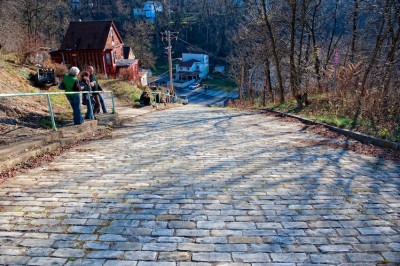
Training for improved climbing is one thing. Training for the Dirty Dozen is another. Given the fact that probably less than 1% of the hills one normally climb are as steep as those of the Dirty Dozen, it doesn’t make sense to train for this level of power requirement. That is, unless you actually want to survive the 5 plus hours in November as you climb more steep ascents in one day than you normally do in an entire season. Throw in the fact that I am prone to cramping if I don’t really keep the legs fresh, and this is not something I can take lightly.
When I put a training plan together for myself or a student, I’ve gotta’ work backwards. Where do we want to end up, and then back it up to where we are, and the rest will fill in by measured and deliberate progression. As an endurance rider, and someone who helps people do their first epic ride or century, we have the luxury of focusing on a slow periodized program from start to finish with more and more time in the saddle.
However, this total event is only about 50 miles in length, with 3 food breaks. Endurance is not what I need to train for. My focus needs to be on producing the required power for each grade of hill I will encounter, sustaining heart rates above threshold for varying amounts of time, and keeping the legs from siezing up in the process.
Consequently, instead of a 6 day a week riding schedule with rides between 1 and 3 hours long, I’ll be training 3 to 4 days per week where all but one of those days each week will be fairly intense; very little time in Zone 1 & 2, about 50% in Zone 4, and a progressive increase of time above threshold. In most cases, I will want a day off or activer recovery after each day of training.
I will be focusing on improving lactate buffering, and increasing my threshold. Starting my “pre-training” routine a couple weeks ago, I’ve already begun to feel an increase in my threshold, but I will do a New Leaf metabolic test this week to establish a true baseline.
While at first blush this doesn’t seem like a lot of training, the intensity creates a significant challenge. In fact, I’ve averaged over 1000 points per week just for the pre-training weeks. So, I’ll be using 1150 training load points as my starting baseline, and shoot for a 5% increase each week to keep the body honest. This will get to about 1800 points at the week I will begin to taper. I need to get fitter, stronger and more tolerant of the inevitable pain, and this seems to be the right approach.
So here’s the outline of the training plan:
3 days intense training: 2 days outside, 1 day inside
1 day of active recovery riding inside
1150 starting points, and % splits: Zones 1: 0%, 2:10%, 3:30%, 4:50%, 5:10%
Ending targets 1800 points, 20% in Zone 5, Threshold increase of 10 – 15 BPM
by Gino | Sep 24, 2010 | Training With Power

As is customary, I’ve opened my big mouth and am faced with the proverbial “put up or shut up”. Don’t get me wrong, I’m not one to trash talk and overstate my abilities. However, I am one that is always challenging others to accomplish things they think are bigger than themselves; to push past their own perceived limits and discover things about themselves they never knew. Sounds all good so far, but I have a basic life philosophy that tends to get me in trouble. To wit, I believe that whatever you teach, you should experience first. Consequently, all my challenges to others end up first putting me to the test.
Way back in January when our annual Winter Training Program kicked off, each participant was required to have a goal to train for. Goals ranged from doing a 50 mile charity ride to having 2 separate peaks during the race season. For me however, having just finished filming the Pittsburgh Dirty Dozen as a charity project for Livestrong, and watching some of the strongest riders I know struggle just to finish, that event seemed to be the logical choice. So I said it, I would train to complete – NOT COMPETE – in the Pittsburgh Dirty Dozen Race.
Starting this weekend, September 4th, I will have exactly 12 weeks to prepare for The Pittsburgh Dirty Dozen. I’m going to post my training plan (both Heart Zones® as well as Power Training), and pre-ride schedule on this blog for others in the Pittsburgh area who would like to train along with me. The training plan will provide some structure to follow even though we will train in different areas. Every 2 weeks I will take on at least 2 (or more) of the 13 climbs as part of the overall training plan as well. Exact times and dates will also be posted here so riders who want to share the pain can join me if they like.
Point of fact is: this IS a race. Point of reality is: only about 10 to 15 of the 180 riders that rode last year were strong enough to garner any points at all. The format of this “race” is that the entire field is together at the bottom of every hill, and then the organizer, Danny Chew blows the whistle (by the way, someone needs to buy him a new whistle this year, it was sketchy at best last year), and the first 5 riders to the top get points.
While a few supermen and wonder women surge to the top like they have hidden motors in their bikes, the rest of the field climb at varying speeds, with an inevitable group on every hill pushing their way if they can’t maintain at least 4 to 5 mph. In surveying the group last year, it was clear that a lot of the field were experienced amateur racers, and that this was not bringing out the average casual rider. So when I say people were pushing, and there are always people pushing, it does not mean they were weak or inexperienced riders.
The graphic above is from the training DVD we created (Global Ride Productions) from last year’s race. It is slated to be released in 2 to 3 weeks, just in time to mix up some great indoor cycling with the outdoor application. Stay tuned, as I will endeavor to keep this updated once per week as we head towards this epic event.
by Gino | Mar 11, 2010 | Heart Zones USA, Training With Power
 Being a Power Training fanatic that I am, I also regularly monitor the forums and various blogs about power on the internet. I came across a fantastic thread of conversations on the Google Wattage forum (a place where serious cyclists, with serious money, talk about serious power). If you don’t ride outside, you might not be aware that there is a general disdain from cyclists about indoor cycling, and especially Spinning®. They lump all indoor riding into the same bucket and consider it a last resort for getting their ride on.
Unfortunately, they have missed more than the point. If you are a member of ICI/PRO, you already know how much fun riding indoors can be. This alone is a good enough reason to give indoor cycling a second look if you live in a climate that locks you out of riding outside for months on end. However, it’s the performance improvements that are the real draw of indoor cycling. There a number of cycling workouts that are nearly impossible to accomplish outside. This applies to both Heart Zone® centric workouts as well as Power workouts. Many of these workouts are designed to accomplish some of the coveted objectives of higher VO2, greater power, and an elevated threshold.
(more…)
