Response to the survey on Heart Rate Training has been fantastic! I want to thank the 474 of you have expressed your experiences 🙂 We would still love to hear from you. Here's the link to take the short, anonymous survey.
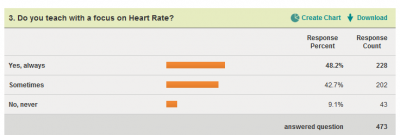
I asked the question; Do you teach with a focus on Heart Rate?
And it appears that the majority (~90%) of you do. Congratulations… but many of you seem to be swimming against the tide and not getting much help from your club or studio 🙁
Does your club/studio promote Zone based Heart Rate Training?
38.7% of clubs where you teach don't promote Heart Rate training? Why is that? Actually it could make for another survey.
I do realize that I may have squed the question by adding “Zone based” but assuming it didn't, why wouldn't a club or studio want to promote Heart Rate training? Is it because;
Management doesn't see the value?
They don't think the members will see the value?
Their instructors don't want to talk about it in class? Obviously we are ready, willing and able.
Management doesn't care about their members?
Management doesn't think they will get any return $$$ on the effort?
I can't speak to the first four, but I have seen how the promotion of Zone based Heart Rate training can (and will) bring additional revenue to a club or studio. I'm not the only one. Spinning Master Instructor Janet Toussaint published this article on the benefits clubs and studios will see back in 2003. My top three reasons are:
Increased Member Retention = $$$ – Member's who feel that are reaching their goals are more likely to stay members. This is so obvious to me I can't understand why a club isn't completely focused on doing everything they can to help members achieve their goals… the most important being body weight maintenance.
Increased Referrals = $$$ – Members who reach their goals tell their friends!
Increased Earnings Per Member = $$$ – An understanding of HR training leads to interest in purchasing a HR monitor, Metabolic testing and potentially participation in specialized (fee based) programs like weight loss boot camps or small group training. All of this adds to the success of the member, which leads back to the increase in retention and referrals.
If you've followed indoorcycleinstructor.com for any length of time you know that I'm a huge fan of the 2T/3Z method of Heart Rate training which is the basis for Zoning. That simple Blue/Yellow/Red response from my Blink Heart Rate monitor is (to me) the perfect way to introduce zone based heart rate training into your class.
Here's some proof of it's success – OK it's a bit rough, but Diana presents a powerful truth that Zoning has worked for her in this video. Your students are in your class to lose body fat and Diana losing 100 pounds and finishing the Danskin Triathlon is a testament to the effectiveness of 2T/3Z Heart Rate training.
Now I think we can start working on some solutions. While researching this article I learned that the the 80/20 rule is also called the Pareto principle. It's more of a rule of thumb drawn from multiple examples where roughly 80% of the effects come from 20% of the causes. Group dynamics frequently follow this rule and here's some examples:
In business it's typical to see 80% of profits coming from only 20% of all customers.
Inversely 80% of most complaints tend to come from about 20% of members.
80% of sales come from the top 20% of sales people.
80% of the mess at a party comes from 20% or the party-goers… and a different 20% will help clean up at the end while 80% will just watch.
Is it exact and does it apply in every situation? No
When it comes to Heart Rate Monitor usage in our classes, it looks more like 90/10.
Maybe 20% HR usage could be our goal?
This creates some interesting questions;
Are we wasting our time promoting HR training to those who are currently not using a monitor, i.e… should we be content with 20%?
Should we be focusing our teaching efforts on the 10%-20% who get it?
Or should we be more focused on the 80%-90% who don't?
I don't pretend to know the answer, but I believe understanding where we are today is the first step to making changes, if any.
Each of us has to answer the first question for ourselves; are we wasting our time promoting HR training? I don't mean wasting our teaching to HR, but rather should we just stop trying to sell HR to our class?
I say no.
You may have heard the term “Tipping Point” which is illustrated above. The concept was popularized by Malcolm Gladwell in his best selling book The Tipping Point: How Little Things Can Make a Big Difference to show how different segments (or groups) of people adopt to a new concept and at what stages they are willing to do so.
The Innovators sit in the the front row, way off to one side. They can use their new Garmin HR Monitor to tell you the altitude and GPS location of their bike, in your studio, down to the nearest meter. They have the best shoes and cycling kits. They've read every book on training and are typically so focused that they aren't really following your class. If, on the slim chance they ever ask you a question, understand that it's a setup to test you. Be prepared for a debate. Your answers should often begin with “well that depends” to give yourself an out. I would put most ICI/PRO members into this group.
The Early Adopters sit front & center, watching you and the Innovators. Once they see that its safe/fun/beneficial/cool they jumped on the HR thing with both feet. You know these students by their big smiles and waving hands when you ask; “who is wearing their HR monitor today?” Somemay not even know how to use their monitor, it's just important to them that they have it on. You've heard the expression “I'm as smart as the last person I talked with” ? Well these students will believe (and act) on most everything you say… and then will believe (and act) on what the next Instructor tells them. This is why I see having a common language is so important.
Scattered through the middle of your class are the Early Majority – the group that's willing to try something new, but need more than just the social proof of seeing others wearing a monitor. It took a few years and now they have cycling shoes and shorts. They're attentive, but cautious and looking for clarity from you. I feel students in the Early Majority are ready to adopt HR training if you show them a very tangible benefit, recommend a clear action and assure them that they are making a good decision.
When you see a student wearing gym trunks over his bike shorts, you should instantly think Late Majority.
The guy in the far back with a tattered T-shirt and Discount Store “fitness shoes” is a Laggard. Be thankful that he comes to class but you will never see him with a monitor.
This worked for me –
A few years ago Dave Lang, one of the Personal Trainers at the club where I teach, came to me with the idea to demonstrate a New Leaf Metabolic Assessment in front of my Sunday Endurance class. The majority of students in your class you would call cyclists are probably Early Adopters along with a few Innovators. Who better than have one of the Instructors (Innovator) show everyone exactly what happens during an assessment. I myself hadn't been tested, so I agreed.
The following Sunday Dave set up the test and connected his laptop to the big screens in the studio. Now ~40 people in class could watch in real time what was happening during my test. Dave began with a short lecture / explanation of the testing protocol and then lead me through the assessment.
Two things happened as a result:
The Innovators in class congratulated me (I felt like I had joined their club) and wanted to compare “war stories” of their test.
Over the next few weeks Dave scheduled and conducted over 20 assessments with students who moved into the Early Majority.
Why did this happen?
I asked a number of them later and their responses were similar. They knew they wanted the understanding that a Metabolic Assessment would bring them, but something stood in the way of taking action. It may have been some fear, concern, confusion or maybe they just needed a complete understanding of the process. Whatever it was it did the trick.
The computer industry has an acronym: G.I.G.O which stands for:
GARBAGE IN = GARBAGE OUT
It refers to the idea that if your input data/information is inaccurate (GARBAGE IN), then any computations, using that inaccurate data/information can't be anything other than GARBAGE OUT.
Over the years I've come to believe that you should carefully consider G.I.G.O as it could apply to the Heart Rate & Power training you offer in your classes.
Spinning® Master Instructor Danielle Foster alerted me to this article: Three Reasons To Rethink Heart-Rate Training from running.competitor.com. While they don't identify G.I.G.O by name as the cause of their concerns, a quick read through their list shows, and I'm confident you'll agree, that's the case…
1. Fluctuations Do Not Correspond To Effort Levels
Perhaps the biggest limitation to heart-rate training is that many changes in your heart rate do not correlate to your fitness level. Sleep, stress, and dehydration can all raise or lower heart rate on any given day. As normal people with jobs, families, and otherwise busy lives, these outside influencers are common and can have a drastic affect on your heart rate readings.
“Sleep, stress, and dehydration can all raise or lower heart rate on any given day.” I don't know about you, but if I don't get enough sleep I can feel like >>> GARBAGE. So anything my HR Monitor or Power Meter shows me will be potentially inaccurate. Same goes for; stress, hydration levels, illness, training frequency / amount and also if you're in the doghouse… because you forgot your wedding anniversary.
2. Lack Of Concrete Data Needed To Establish Training Zones
Another inherent drawback to heart-rate training is how difficult it is to establish your max heart rate and the accurate training zones that result from that figure. While a quick Google search reveals a myriad of formulas to help you find your max heart rate, the problem with formulas is that they are based on an average. What if you’re not average? Not only that, but is maximum heart rate really the best predictor of training zones?
Sally Edwards says using shoe size would be as accurate a predictor of maximum heart rate as any age predicted formulas. So what should you use to determine your training zones? If you're really serious, I'd take a graded exercise metabolic assessment. Yes they're expensive and you might have to travel a ways to find a provider.
What about a the 20 minute threshold field tests other's promote? They may work for the true endurance athletes in your classes. It's only after hours and hours of training that most have the fitness, and have learned to tolerate (and enjoy) the pain, that is working at threshold continuously for 20 minutes. Without either, your riders are probably not really finding their actual threshold HR or watts = G.I.G.O. Any zones they build from GARBAGE will be… GARBAGE.
Were always adding new members, so in case you missed (or haven't found) my series of posts from 2011. They describe why I don't feel long threshold field tests get the results we intend.
Thank You to the 354 of you who have completed our survey!
It is greatly appreciated. Because I chose to keep the survey anonymous, if you asked me to contact you I don't know who's who. Please contact me directly.
My goal is to collect 1,000 responses. If you haven't yet, so please take two minutes to share your experiences. Click here to take the survey
This jumped out at me right away. 61% of respondents are reporting that the primary reason people aren't riding and training with heart rate monitors is that they don't see or understand the value.
Click image to enlarge
Which begs the questions; why not? and as Instructors and Studio Owners is there anything we can do to correct or effect this in a positive way?
My Grandfather loved this quote from Albert Einstein: The significant problems we have cannot be solved at the same level of thinking with which we created them. John Sr. (I'm actually the third John in my family) would typically remind me of this concept when I would come to him with some problem I had identified. I was interested in his ideas for creating an “Invention” that would be seen as the ultimate solution.
Back in the 90s I was coaching my daughters youth soccer teams. I, like most of the other dad-coaches, was going crazy trying to coordinate which player on the team played when, at what position and for how long. The basic requirement was each kid get equal playing time. With some help from another Dad, I had devised a rather complicated spread sheet at home. I was so proud of my solution 🙂 Now I'm prepared I thought. But when I would get to the game, someone would always be late, or wouldn't show up at all, messing up spreadsheet to the point of being useless. I then resorted to just randomly assigning players during the game. Inevitably some player (or parent) would feel that they weren't treated fairly… not good. I needed a solution and went to John Sr. looking for help.
After discussing and brainstorming solutions, we applied Einstein's thinking; where was my current thinking possibly preventing me from finding a solution to this problem? My desire to treat all the kids on my team fairly made sense and it was the leagues policy that each player receive equal playing time. So we decided that wasn't it. Maybe I could demand that parents have their kids there on time? I'd already tried that without success. How about my need to be prepared before the game? What if I could find a way to create the spread sheet a few minutes before the game actually started? No way. This was years before laptops were popular. What we decided I needed was some type of chart, where I could add the names of the players who were there on time, right before game time. It would also be necessary for me to adjust for players who showed up late or needed to leave early. The end result was the FairTurn Coaching Tool U.S Patent #6,260,845 which I have since sold to another company.
My goal with this survey was to begin applying this process of creative problem solving to the issue of why our students don't see the value of wearing a Heart Rate Monitor. The first step is understanding what we and our club's are doing now. Then we can step back to see if there is anything we are or are not doing currently, that could be contributing to this problem. The next step will be to think differently, in search of some potential solutions. Stay tuned.
Recommended by ACE – The American Council on Exercise
In Part 1 and Part 2 of Is a 20 Minute Threshold Field Test realistic for your class? I was trying to make the point that although completely appropriate for Endurance Athletes, these 20 minute assessments aren't really appropriate for the typical students in our Indoor Cycling classes.
So if the old 220 – your age is a waste of time, Metabolic Testing is unavailable / too expensive, RPE scales are too subjective and a 20 Minute Field Test isn't practical, what should we use to establish a students Heart Rate Training Zones? And then how do we communicate training intensities in our classes?
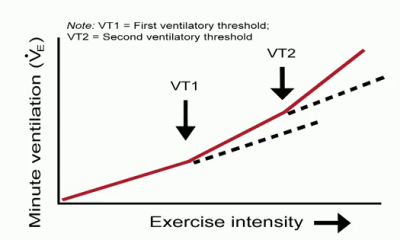
I suggest that WE look very strongly at what The American Council on Exercise (ACE) is now recommending with their ACE Integrated Fitness TrainingTM (ACE IFTTM) Model. Follow that link to an exhaustive article on the Two Threshold / Three Zone ACE IFT Model for Cardiorespiratory Training.
Watch this video and then let me know what you think.
A few things that I feel are important to note:
– After watching the video, do you see how you could be conducting a VT1 (Low Threshold) assessment as part of every class you teach?
– This Two Threshold / Three Zone system and the Talk Test method of determining VT1 & VT2 is based on research by Dr. Carl Foster who is presenting at this years conference. Dr. Foster is lecturing on this exact subject 🙂
– The Zoning Blink Heart Rate monitor, with it's Blue – Yellow – Red lights, is based on this same Two Threshold / Three Zone system.




 to show how different segments (or groups) of people adopt to a new concept and at what stages they are willing to do so.