Recommended by ACE – The American Council on Exercise
In Part 1 and Part 2 of Is a 20 Minute Threshold Field Test realistic for your class? I was trying to make the point that although completely appropriate for Endurance Athletes, these 20 minute assessments aren't really appropriate for the typical students in our Indoor Cycling classes.
So if the old 220 – your age is a waste of time, Metabolic Testing is unavailable / too expensive, RPE scales are too subjective and a 20 Minute Field Test isn't practical, what should we use to establish a students Heart Rate Training Zones? And then how do we communicate training intensities in our classes?
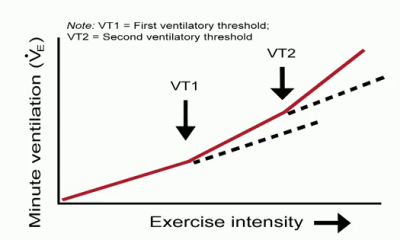
I suggest that WE look very strongly at what The American Council on Exercise (ACE) is now recommending with their ACE Integrated Fitness TrainingTM (ACE IFTTM) Model. Follow that link to an exhaustive article on the Two Threshold / Three Zone ACE IFT Model for Cardiorespiratory Training.
Watch this video and then let me know what you think.
A few things that I feel are important to note:
– After watching the video, do you see how you could be conducting a VT1 (Low Threshold) assessment as part of every class you teach?
– This Two Threshold / Three Zone system and the Talk Test method of determining VT1 & VT2 is based on research by Dr. Carl Foster who is presenting at this years conference. Dr. Foster is lecturing on this exact subject 🙂
– The Zoning Blink Heart Rate monitor, with it's Blue – Yellow – Red lights, is based on this same Two Threshold / Three Zone system.
So what's the potential ROI on the Zoning program?
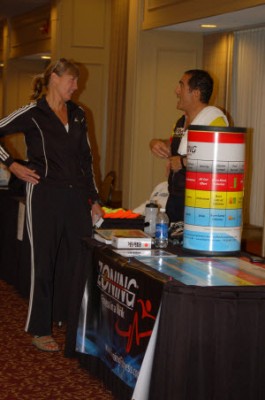
If you teach “Club Athletes”, what many of us see as the majority of the student in our classes, and want to educate your students / clients on Heart Rate training program, I highly recommend you look into Zoning Fitness. In the video below, Chuck Cali and Sally Edwards present the Zoning Can – a complete 6 week heart rate training program that actually comes in a can.
I'm aware of two ICI/PRO Member Instructors who are part of the initial Beta review of this new 6 week program. They will be taking their class through the complete 6 week Introduction to Heart Rate Training.
“What's the purpose behind a 6 week program?” and “Why not just introduce these concepts during a normal class?” were common questions I heard at the conference. The purpose of a separate program (actually 6 classes) is so you can focus on a small group of students who are truly interested in learning how to use Zone based Heart Rate training, over a six week period of time – so they really learn and understand the core concepts.
If you operate a studio or club and are looking to add Heart Rate training to a multi-week Boot Camp or Weight Loss program, I suggest looking into Zoning Fitness.
As is customary, I’ve opened my big mouth and am faced with the proverbial “put up or shut up”. Don’t get me wrong, I’m not one to trash talk and overstate my abilities. However, I am one that is always challenging others to accomplish things they think are bigger than themselves; to push past their own perceived limits and discover things about themselves they never knew. Sounds all good so far, but I have a basic life philosophy that tends to get me in trouble. To wit, I believe that whatever you teach, you should experience first. Consequently, all my challenges to others end up first putting me to the test.
Way back in January when our annual Winter Training Program kicked off, each participant was required to have a goal to train for. Goals ranged from doing a 50 mile charity ride to having 2 separate peaks during the race season. For me however, having just finished filming the Pittsburgh Dirty Dozen as a charity project for Livestrong, and watching some of the strongest riders I know struggle just to finish, that event seemed to be the logical choice. So I said it, I would train to complete – NOT COMPETE – in the Pittsburgh Dirty Dozen Race.
Starting this weekend, I will have exactly 12 weeks to prepare for The Pittsburgh Dirty Dozen. I’m going to post my training plan (both Heart Zones® as well as Power Training), and pre-ride schedule on this blog for others in the Pittsburgh area who would like to train along with me. The training plan will provide some structure to follow even though we will train in different areas. Every 2 weeks I will take on at least 2 (or more) of the 13 climbs as part of the overall training plan as well. Exact times and dates will also be posted here so riders who want to share the pain can join me if they like.
Point of fact is: this IS a race. Point of reality is: only about 10 to 15 of the 180 riders that rode last year were strong enough to garner any points at all. The format of this “race” is that the entire field is together at the bottom of every hill, and then the organizer, Danny Chew blows the whistle (by the way, someone needs to buy him a new whistle this year, it was sketchy at best last year), and the first 5 riders to the top get points.
While a few supermen and wonder women surge to the top like they have hidden motors in their bikes, the rest of the field climb at varying speeds, with an inevitable group on every hill pushing their way if they can’t maintain at least 4 to 5 mph. In surveying the group last year, it was clear that a lot of the field were experienced amateur racers, and that this was not bringing out the average casual rider. So when I say people were pushing, and there are always people pushing, it does not mean they were weak or inexperienced riders.
The graphic above is from the training DVD we created (Global Ride Productions) from last year’s race. It is slated to be released in 2 to 3 weeks, just in time to mix up some great indoor cycling with the outdoor application. Stay tuned, as I will endeavor to keep this updated once per week as we head towards this epic event.
Master Instructor Tom Scotto ends the year with another excellent Audio PROfile. ICI/PRO members can look forward to another 12 NEW PROfiles in 2012.
“This is one of my favorite rides because it puts us under some “good” stress for long periods of time. We are going to be targeting a very uncomfortable level of intensity — just above our endurance effort and below the point we start to become breathless. It can be tough because, mentally we either want to shut it down or step on the gas and blow up. Neither is an option.”
“For those of us that know our thresholds, we are going to be working between ventilatory threshold 1 (VT1) and ventilatory threshold 2 (VT2).”
“Before you get prideful and think this is not going to be a hard ride, keep in mind that very little recovery will be provided in order to keep this steady level of stress on our body. Usually I tell you to take some time to recovery if you over-shoot your ability, but today I want you to take a different approach. During this ride, if you over-shoot your ability, I ONLY want you to back down a little bit and see if you can re-establish your effort. If not, back down a little bit more until you can stabilize.”
“One last note to those of you that are outdoor riders building base. This is a great workout to assist in your aerobic conditioning but NOT a substitute for those long hours in the saddle. 60- minute indoor cycling classes are not the place to building that kind of endurance so make sure you are getting your saddle time in addition to this class.”
Tom Scotto from Stage 5 Cycling joins me as the “pinch hitter” Master Instructor for this weeks Audio PROfile. I'm calling this a sort of Hybrid Audio PROfile/PRO Podcast as Tom goes into a lot of additional detail that you will enjoy learning. Here is the link to the companion .pdf
Here's your Spotify PRO/Playlist!Deezer. We have made every attempt to replicate the original playlist. In some instances the tracks specified were unavailable in Spotify. When necessary we have substituted individual songs of similar length and tried to maintain the Instructor's intent. [/private_PRO-Seasonal] [/private_PRO-Platinum]