JANUARY 10, 2017 I received the following text message from a customer… Your new employee Boomer Rose. He has a history of drug use. On supervised probation. Everyone deserves a second chance. We all make mistakes but just want you to be aware.
MEET BOOMER
Boomer works at TheBarn.
************************************
I used to be 300 pounds. I used to be an alcoholic. I used to be addicted to heroin. I used to be homeless. I have spent time in jails and rehabs. I have spent half my life unable to look in the mirror hating the person I was. Those days have passed, however, they remain fresh in my mind. Now I am a grateful recovering addict. A proud member of a 12-Step Fellowship. A proud member of TheBarn.
I’ve spent a good portion of my morning reading articles debating what Indoor Cycling should and shouldn’t be. In one of the articles, Karen Casler of CB CycleBarn® discusses her childhood, constantly searching for a place to fit in and trying to find acceptance. As an adult, she yearned for a place where others like her could find a safe environment and where they could be themselves. A place that no matter what or who they were … they BELONGED. It is under that principle, that CB CycleBarn® … aka … TheBarn was born. I too have spent most of my life trying to find somewhere that I felt accepted. The moment that I walked into TheBarn I found that place. A place that is more than just an Indoor Cycling and Fitness studio. A place that I take pride in being a member of. I walk in everyday proud to be apart of the primary purpose: Bettering ourselves “one pedal stroke at a time”.
NOW … LET’S BACKTRACK
I had never met Karen Casler before February of 2016.
I had known that we have a sister for most of my life and that she had been given up for adoption at birth. I almost came to tears on the Jail phone in a pod full of 50 strangers when I heard the news that our sister had used DNA to piece together her past and to find us. 3 Days later, on February 5th, I was released from Jail. It was my first stint in Jail and it was Her birthday. When the offer was made for me to move from Virginia to California in November of 2017 I didn’t even have to think it over. I instantly agreed.
Looking back, the decision was somewhat crazy considering Karen and I had just recently met each other and collectively spent less than 24 hours around each other our ENTIRE LIVES. The opportunity to get to know my sister and her family was one that I simply could not pass up. I packed my whole life in a suitcase (36 pounds in total) and left my 4-year-old son and everything I have ever known behind. I awoke on January 8th and looked out on the Pacific Ocean for the first time in the daylight I felt as though I was dreaming. “I don’t deserve to be here” I thought to myself.
That morning Karen and I loaded into the car and headed off for my first trip to TheBarn. In the car on the way there we talked and she mentioned “I bet you would be a great cycling instructor.” I agreed with her. Coming from a theater and athletic background, it might be a possibility but I didn’t take it seriously. At TheBarn, I took my first cycling class. I clipped in and within the first 5 minutes I realized this was It. This was the CHEESE I had been looking for. A dark room, filled with loud music, full of people silently moving together. Working together. For the same common purpose. To better ourselves. That first class I was able to check out of my life and all my wrong doings for 45 minutes and everything that was weighing on me disappeared. It was just me and the bike. Nothing else mattered.
FAST FORWARD … 7 WEEKS
Today is February 26th.
I have been in California almost 2 months.
Four weeks ago, I celebrated my 1st year in recovery. Today, I am 399 days clean. I work at TheBarn. It is a place that is more than a job to me. I spend my time working, going to meetings, being active in my new church and getting to know Karen and my new family. The experience has been the greatest blessing I have ever received. Being apart of TheBarn Family brings me a feeling of pride I have never felt. After much thinking the past few weeks I have decided to embark on the journey of becoming a cycling instructor. The thought I brushed aside has now become a reality. I’m driven to help others who are like me, to find a healthy outlet for their addictive personalities in their recovery. My goal: to offer fun, safe and donation based rides to those suffering from the same disease as me. To give others a healthy way to release the same emotions and endorphins that we found with drugs and alcohol. The ability to safely work on our Mind, Bodies and Spirits. I have found in recovery it is important to focus on all three. The first thing you should do when you get clean, is change everything. I am excited for this adventure, humbled at the opportunity and grateful to be apart of TheBarn family. So here I am, outing myself to the masses as an addict. Hoping that those that are struggling know that they have someone safe to reach out too, and somewhere safe to work on themselves. It’s about progress not perfection.
I sit here watching the waves of the Pacific Ocean crash against the shores of Calafia and reminisce on the events in my life that have brought me here, to THIS place, paradise. My story isn’t over yet. This is just the beginning.
If you're teaching with power, there's a good chance you'll have a participant ask you this simple question; how many watts should I be making when I'm working at my threshold? Same goes for any new studio or one that is upgrading to indoor Cycles with power/watts. You will be asked for a number from many of your riders. The reason is pretty simple, many people naturally want to know how they compare.
There are two schools of thought on if, or how, you should answer this question:
There's the “Don't give them a number – ever” school that believes whatever you tell them could be wrong and potentially upsetting. You don't want to demoralize riders, or hurt their feelings, especially with a new rider with no/limited fitness, by suggesting anything. The recommendation is to respond with a question; how many watts did you see today? Then respond positively to any response.
Then the “give them something to work with” approach. My preference is to start with the suggestion of one watt per pound or a little bit over 2 watts per Kg.
They're adults = tell them the truth… they can handle it.
Have you ever had someone lie to or mislead you, under the pretense that they didn't want to hurt your feelings? Did it make you feel valued and respected? If you have experienced a situation where you weren't told the truth, did you feel you would have acted differently, if you had been given accurate information?
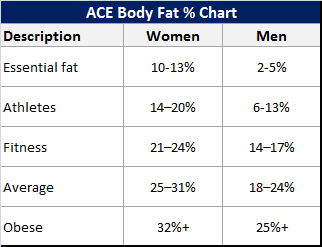
Imagine for a moment you're a personal trainer and your client asks you this question; what percentage of body fat should I have? A common question I'm sure. Is the correct response; “what is your body fat percentage now?” And then to positively affirm what ever answer they give? I don't think so… do you? There are established ranges for body fat %, published by credible fitness authorities like ACE. Here's their chart.
Let's see where you fall on this chart…
If your female client told you their body fat is 34% – would you smile and say; “that's great!” ? Of course not. You would probably suggest a diet and exercise program directed toward reducing their fat percentage down, with a goal to get into the average range. The person standing in front of you may not like hearing that they're obese, but don't they need to learn the truth so they can decide to do the work needed to change their body composition?
What about running a 5k? Or bowling for that matter? They both have metrics that define a reasonably achievable level of proficiency for an able-bodied person. Would it be wrong to suggest a goal time of 36 minutes (12 minute mile) for a 5K or 120 pin score in a bowling game?
Teaching with power for two years has me in the “give them something to work” with camp. And that something is a goal of one watt per pound of body weight*. I've asked multiple dozens of riders; “are you close to your body weight in watts?” Are they all there? No, but it's been very few. I'll bet if you were to privately poll your regulars, at the end of a 3-4 minute sustainable threshold effort, you would hear wattage #s around body weight.
At the end of the PST (Personal Spinning Threshold) assessment I did at WSSC, MI Janet Toussaint allowed me to ask the class this exact question. The majority agreed that their PST was at or above their body weight. Now a room full of fit Instructors may not be a representative sample, but it reaffirmed my experiences.
If you'd like to learn more about this concept – listen to this podcast where I first learned about it.
*I've heard other Instructors suggest using lean / goal body weight, which would reduce the number slightly. This calculator provided by ACE might be helpful.
I need to publicly thank both Cameron Chinatti, the Education Director for Stages Indoor Cycling along with Marketing Director at Foundation Fitness & Stages Indoor Cycling, Laurel Mylin for believing in ICI/PRO and co-sponsoring our conference this year.
Cameron will be conducting the Stages Essentials Instructor Certification as a Pre-Con on Friday 9/30 and will also be presenting four sessions during the conference.
Of course this turns our conference planning on it's head. I plan to have the final registration details completed by Monday 5/9 night for ICI/PRO members to make their selections.
I have opened early registration for those of you wanting to get a jump on everyone else. This year we are offering you the chance to make multiple payments, rather than one lump sum. Here is the link to register.
Last year the hotel sold out. Even if you are thinking about sharing a room I would suggest that you reserve a room here’s the phone number to the hotel 978-750-7987 and tell them you are in the Indoor Cycling group. We will be helping connect those looking for room-mates. NOTE: Our block of reserved rooms extends from September 28th to October 4th for those of you wanting to come early or stay a day or two longer.
Listen to the Podcast below for more information about Stages Indoor Cycling and their participation in the conference.
Star Trac had the new Spinner® Blade Ion on display at IHRSA. I rode one during Josh Taylor's 6:30 am demonstration ride this past Thursday. After the class I discussed the Ion's new features with Josh. I then got an overview of Spinning's new Spinpower™ education from Program Director Angie Sturtevant, which I'll share as a separate article.
Basics
The “Ion” differentiates this bike with Power from the conventional Spinner Blade. It uses the same chain drive and friction resistance system, found on all Spinner® Indoor Cycles.
Console / Monitor
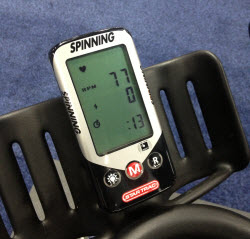
Very simple… and I'm a huge fan of simple, so right away I appreciated how easy it was to use the Ion's console. I was told they are making a few minor changes so the final version may look different. Working down from the top, the display shows:
Heart Rate
Cadence
Power
Elapsed Time
Just three buttons
Left button turns the back-light on/off. It doesn't time out because it doesn't need to preserve battery life. It will stay on until you want it dark or you stop pedaling. I might not have this completely right – but you get the point – the light will shine all class 🙂
Center button scrolls through screens displaying; real time and averages + calories
Hold down the Right button for 2 seconds resets the Elapsed Time – Josh explained that this button will also add a “digital marker” to any Ant+ enabled devise, identifying the beginning or end of an interval, similar to the “Stage” button found on other consoles.
Josh made the point during his demo ride that their console will show ZERO watts when there's no resistance, regardless of the cadence = this will show all of our “spinners” that they aren't doing any real work until they've added some load.
Free Registration Required to read the rest — Click Here. Opens in a new tab.
[wlm_ismember]
Measured Power
Strain gauge measures the amount of pull on the brake pad.
The Blade Ion measures power with a strain gauge connected to the brake pad – again more simplicity. This technique is actually over 100 years old and how the horsepower of early engines was measured; by measuring the force acting on the brake, as the flywheel tries to drag the brake around it's circumference.
If you have an NXT available you can see exactly what they are doing. Remove any resistance and start the pedals turning slowly. Now carefully touch the slowly turning flywheel with one finger. Feel how it wants to drag your finger along? Can you see how the harder you press against the flywheel, the more effort it takes to hold your finger in place? By measuring that force, the speed of the rotating flywheel and then doing a bit of math, we could calculate Power.
That Black Box contains the strain gauge and replaces the normal brake pad holder on the standard Blade or NXT – which begs the question; will they ever offer a retrofit power meter for older NXT's?
What about Calibration?
I was told that the Ion will be factory calibrated and that no other calibration will be necessary – which I find very hard to believe.
This isn't the right time to get into a lengthy discussion over what I see as fundamental differences between; how the Ion measures the amount of Power coming out vs. how FreeMotion (and also any bicycle crank arm/spider or pedal based power meter) is measuring the amount of Power the rider is putting into the cycle. Or if it's really of any value…
So I don't leave you hanging here, the factory calibration may indeed accurately display the amount of coming out of the Ion forever… but does that precisely reflect the amount of power the rider is putting into the cycle?
What I'm questioning is there's a lot of drive train (multiple bearings and the chain) between the pedals (work in) and the brake mechanism (work out). This engineering article describes the efficiency of bicycle chain drive system and how losses can vary between 2% and 20%. I'm sure Star Trac's engineers have a very sophisticated algorithm to work all this out on a new Ion – but what happens over time? Worn chains and bearings, sprocket alignment and chain tension will all have an effect. Potentially some of the Ion's in your studio could become favorites because they display a higher wattage, relativity to the amount of work introduced by the rider, simply because its chain is in better alignment. Does that make sense?
No Batteries Required
Angie said she likes this because it's “green” (no batteries to throw out) – this blue light is a very cool touch.
Hands down my favorite feature of the Ion is how it charges itself. Josh told me that it incorporates a smart charging system that will allow the batteries to discharge before recharging. That wire runs from the hub charging unit & cadence counter up to the handle bars.
Phone cord allows adjustment.
How it felt to ride & my overall reaction.
Adding a cool blue Instructor platform will be de rigueur for any studio with Blade Ions
Let me start by saying Star Trac makes a phenomenal Indoor Cycle. Solid and smooth – I'm sure Jeff Wimmer had his hands on these. They fit me perfectly – or after riding & teaching on them for all these years do I fit them perfectly? Either way they're very nice to ride… and you hear the yeah-but coming… but I've really become a fan of magnetic resistance over the past 4 years. I understand how Spinning's® brand goes to the “feel” of a Spinner® and that “feel” comes in part from a friction based resistance system. I prefer riding magnetic and was disappointed that the Ion still uses a friction brake.
I also felt weak/less powerful on the Spinner Blade Ion. Or said differently, for a given amount of effort, I was seeing a lower wattage number than I'm used to seeing from a recently calibrated FreeMotion or a Schwinn AC. You could add embarrassed to my list of feelings. I actually felt compelled to cover my readings while Josh was off the bike checking in with his class 🙁
Thinking it may just be me, I went directly to FreeMotion's area and jumped into a class with Cameron Chinatti. Nope, it wasn't me. There on a familiar cycle, I was seeing/feeling my normal ~250 FTP. So back to the Ion (different bike this time) but the same results. A similar effort/HR and only saw ~180 watts.
I talked to Angie about this and she suggested that you just can't compare the two, they're different. I've asked Angie to join me on the Podcast to discuss this in detail and will let you know if/when she'll come on as a guest.
Later that morning I also tried a little experiment that I've wanted to do for years…
What happens to your Power / Wattage when you accelerate from a set point, say; 100 watts @ 60 rpm to 90 rpm on friction based system, as compared to a magnetic system? Do they react the same way?
In a previous post we talked specifically about the reasons why “non-outdoor riders” would want to train with power. There needs to be incentive for all populations, and thus our focus on those that don’t ride outside was appropriate as a starting point. However, we can’t forget about how powerful (pun intended) this training is for those of us who do ride outside.
Whether it is mountain biking, road cycling, or even touring, power can be the gateway to a new experience on two wheels. You’ll be able to “hang with the faster group”, climb the hills you used to walk, or climb with speed where you used to get dropped, or just feel fresh throughout a touring ride while your companions are “suffering”.
Let’s define power just a little more precisely. It is not simply the amount of “work” you are doing. That is a different measurement. Sure many people say “I worked hard today in class”. You are also admonished by instructors to “Work it!”. In fact, the entire industry uses the term “work out” to refer to exercise. However, when it comes to Power, in terms of work, it is the RATE of performing that work; how fast you do it.
The easiest example is walking up a set of steps. If you walk up the steps, or run up the steps, it’s the same amount of work. However, running will require a different amount of power. To perform the same work faster, requires more Power. Hence, to make a bike go faster, you need more power. The same concept applies to climbing. The same hill will require the same “work” for a given individual, but if they climb it faster, it will require more power.