I'm going to need a pair of these so I can see when Amy is slacking off on the Tandem.
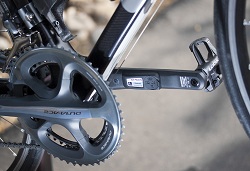
Stages Cycling has taken the technology they developed for the FreeMotion S11 series Indoor Cycles and is now offering the StageONE Power Meter to outdoor cyclists.
I don't have any direct experience other than a heads-up email announcing the launch of this , but there are two very informative posts from bloggers who are at Eurobike earlier this summer.
Stages Cycling readily admits that it's not necessarily trying to go head-to-head with established players such as SRM, Powertap, and Quarq in terms of outright technology, instead preferring to go after so-called ‘blue collar' riders who merely want a consistent means of tracking progress for training purposes.
Using a Bluetooth enabled device (the StageONE doesn't come with any display) you can add power and cadence for $699.00 which is less than half that of other systems = outdoor power gets a bit closer to being real for many of us 🙂
Will Grossman from Stages Cycling has promised me more information soon. Right now they are swamped with their launch and Interbike which starts tomorrow. Their website is supposed to go live today. http://www.stagescycling.com/
Are you going to be in Miami for WSSC? I'll be there all weekend and would love to meet you while I'm there.
There are a bunch of sessions that I'm excited to see:
On Friday our very own Barbara Hoots is giving a presentation: Studio Design: Empowering Emporiums to Increase Profits
Presented by Barbara Hoots Whether opening a new studio or renovating an existing one, this lecture will offer new trends in studio design. Evaluate common design flaws that lead to lawsuits and slow growth, and explore the latest in sound systems, lighting, wall treatments and marketing.
I'm really excited to take these Ugi classes – from what I can see, Ugi could be a great strength compliment to any boutique Indoor Cycling Studio
Ugi® Fit Presented by Sara Shears Undo your laces and strip off your socks! Join Ugi creator Sara Shears for the ultimate 30- minute barefoot workout. A series of 30 one-minute intervals combining strength, core and cardio are efficient enough to change your body completely. From warm-up to cool down Ugi is fun, challenging and makes U feel good about your body, energy and health.
U-SPIN Me Right Round Presented by Nadine Stewart “Combine the benefits of a high-cadence endurance ride with non-linear sculpting exercises using the Ugi® ball. This well-rounded workout will cover your cardio and cross-training needs and give you new ideas to change up your Spinning® and resistance training classes.
My main focus will be the Spin Power sessions and there's a lot of them on the schedule! Especially those that are including a specially designed Performance IQ display system, customized for the Spin Power Program.
Team Time Trial with Performance IQ Presented by Angie Sturtevant In team time trials, riders take turns either at the front or ‘sitting in’ behind, conserving enough team energy for an all-out pull toward the finish. In this workout you will compete as part of a team, as accumulated power output is displayed on the big screen using Performance IQ. This gives all teams the energy to chase and spectators something to cheer about!
Spinpowerâ„¢: Personal Spinning® Threshold Presented by Martin Timmerman The Personal Spinning Threshold (PST) is the key to Spinpower success–once PST is determined, you have a baseline threshold marker that can be used to create a unique training program and track student progress. This workshop will teach you the protocol of the Personal Spinning Threshold test and how to administer this test to your students. You will establish your own Spinpower Zones and then experience a ride which will criss-cross these zones. WS NEW
Spinpowerâ„¢ Race Day Winners Presented by Dino Pedras All athletes know that we must be efficient and well-organized to get the most out of our training, and a Race Day ride is how we see the results of that hard word. In this workshop, you will learn how to create a successful Race Day using Spinpower to help you determine what variables you should integrate into your training program and how to best periodize your time to reach your maximum potential and find the way to victory!
And that's just Friday's sessions – I'll be reporting more from WSSC as time permits. If you'll be there any of the three days, please text me so we can connect 612-868-0064!
The computer industry has an acronym: G.I.G.O which stands for:
GARBAGE IN = GARBAGE OUT
It refers to the idea that if your input data/information is inaccurate (GARBAGE IN), then any computations, using that inaccurate data/information can't be anything other than GARBAGE OUT.
Over the years I've come to believe that you should carefully consider G.I.G.O as it could apply to the Heart Rate & Power training you offer in your classes.
Spinning® Master Instructor Danielle Foster alerted me to this article: Three Reasons To Rethink Heart-Rate Training from running.competitor.com. While they don't identify G.I.G.O by name as the cause of their concerns, a quick read through their list shows, and I'm confident you'll agree, that's the case…
1. Fluctuations Do Not Correspond To Effort Levels
Perhaps the biggest limitation to heart-rate training is that many changes in your heart rate do not correlate to your fitness level. Sleep, stress, and dehydration can all raise or lower heart rate on any given day. As normal people with jobs, families, and otherwise busy lives, these outside influencers are common and can have a drastic affect on your heart rate readings.
“Sleep, stress, and dehydration can all raise or lower heart rate on any given day.” I don't know about you, but if I don't get enough sleep I can feel like >>> GARBAGE. So anything my HR Monitor or Power Meter shows me will be potentially inaccurate. Same goes for; stress, hydration levels, illness, training frequency / amount and also if you're in the doghouse… because you forgot your wedding anniversary.
2. Lack Of Concrete Data Needed To Establish Training Zones
Another inherent drawback to heart-rate training is how difficult it is to establish your max heart rate and the accurate training zones that result from that figure. While a quick Google search reveals a myriad of formulas to help you find your max heart rate, the problem with formulas is that they are based on an average. What if you’re not average? Not only that, but is maximum heart rate really the best predictor of training zones?
Sally Edwards says using shoe size would be as accurate a predictor of maximum heart rate as any age predicted formulas. So what should you use to determine your training zones? If you're really serious, I'd take a graded exercise metabolic assessment. Yes they're expensive and you might have to travel a ways to find a provider.
What about a the 20 minute threshold field tests other's promote? They may work for the true endurance athletes in your classes. It's only after hours and hours of training that most have the fitness, and have learned to tolerate (and enjoy) the pain, that is working at threshold continuously for 20 minutes. Without either, your riders are probably not really finding their actual threshold HR or watts = G.I.G.O. Any zones they build from GARBAGE will be… GARBAGE.
Were always adding new members, so in case you missed (or haven't found) my series of posts from 2011. They describe why I don't feel long threshold field tests get the results we intend.


 Are you going to be in Miami for WSSC? I'll be there all weekend and would love to meet you while I'm there.