
by Gino | Aug 31, 2026 | Master Instructor Blog
 [plulz_social_like width=”350″ send=”false” font=”arial” action=”like” layout=”standard” faces=”false” ]
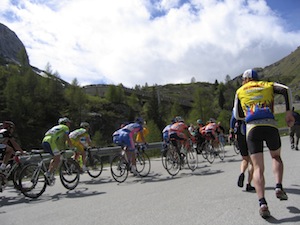
Long climbs of modest grades are the ideal terrain for Muscular Endurance
There are really two types of research available on virtually any topic related to cycling performance or physiology. There’s the research regarding what people are doing or what they think about a topic. These are people from many different perspectives; coaches, authors, bloggers, and we know that last category can include as many levels of proficiency that exist. A google search with the key terms will deliver plenty of results.
Then there is research regarding what the “Science” says. This research is found in medical and educational journals. Most often you must be a member of one of the governing bodies such as the ACSM (American College of Sports Medicine). While you might get some of the highlights in Google searches, the full studies are usually only able to be read by those who are members to the organization and have paid for access to said journals.
While you can simply use the free resources available, there is a distinct risk of basing your own work or conclusions on opinions or popular trends instead of hard science. However, that being said, this is part of the rationale for why Evidence Based Medicine is the only approach that makes sense for coming to conclusions that you will use for your own training or for that of your students. At the end of the day, EBC will be your own personal “proof in the pudding” as they say.
Muscular Endurance — Some Of The Science
I like to start with the science perspective — university, medical community, etc. I like to read the journals that the professional researchers read to get a solid foundation before I begin to let Mr. Google tell me he (and all of his many followers) think.
The first place I started was a position statement by the ACSM:
“Muscular strength and endurance are developed by the progressive overload principle, i.e., by increasing more than normal the resistance to movement or frequency and duration of activity. Muscular strength is best developed by using heavier weights (that require maximum or near maximum tension development) with few repetitions, and muscular endurance is best developed by using lighter weights with a greater number of repetitions (1).”
While this is clearly directed towards weight training, the application to cycling is also pretty obvious — the additional weight is represented by heavier gears (or steeper hills) and the greater number of repititions is represented by increasing cadence ranges.
In another article from the Journal of Medicine & Science in Sports & Exercise it says:
“…the extent of neuromuscular fatigue during pedaling exercise varies among different cadences and minimal fatigue is obtained at a considerably higher cadence (2).”
So from the above two statements we see the standard stress and adaptation principle being referenced and that there are cadence levels that result in lower muscular fatigue. Therefore this allows us to infer that there are cadence levels that encounter greater muscular fatigue, and hence it will be those levels that will promote the “progressive overload” we will need to force the adaptation or improvements in our muscular performance — either strength or endurance.
Muscular Endurance — Some Of The Practice
Here it is super easy to find out what so many coaches and instructors are doing to work on Muscular Endurance (ME). We see cadence guidelines that range between 65 RPM and 85 RPM across may different coaches, where the sweet spot is probably 70 to 80 RPM. However, when it comes to intensity or heart rate, there is considerable variation. The range typically starts at a low of T1 or Low Zone 3 (based on a 5 zone system with bottom of zone 5 your High Threshold), and goes to High zone 4. If we also throw out the lowest low and the highest high, we have an intensity level “sweet spot” that puts us between the middle of Zone 3 and the middle of Zone 4.
So in summary, the science confirms that we can create or promote the improvements in muscular endurance by specifying training rides within a cadence range of 70 to 80 RPM while working at an intensity level of Mid Zone 3 to Mid Zone 4.
The next question to look at is duration of the training, the amount of recovery between ME drills, and the number of ME workouts in a given week. Also, this begs the question if we workout at the low ends of both Cadence and Heart rate, would it take longer to see the training effects than if we worked at the high ends of both. In other words, if we do two weeks of 80 rpm (actually the higher RPM represents lower muscle fatigue) and mid Zone 3 work, will this produce less of an improvement than working at 70 rpm while in mid Zone 4.
If that would be true, then we can use this information to prescribe varying levels of ME work based on the fitness level or the time frame a coach and student are working with. Even more interesting would be the possibility of creating a numeric scale that we could use to “measure” the amount of ME work a student has been doing over a given period of time.
The next post will discuss how we can set up a study to do just that.
Originally posted 2012-05-26 08:25:31.
by Gino | Aug 5, 2021 | Master Instructor Blog
 Long climbs of modest grades are the ideal terrain for Muscular Endurance
Before we get to the fun of actually conducting our experiments (from a nearby but unknown location comes the sound… “Moo hoo hoo ha ha ha” said with a deep and ominous voice) — sorry about that — when we get close to actually conducting our experiments… well, you know — my lab assistants gets very excited. As I was saying, before we conduct our experiments, we must define the specific method of testing or measuring what we are studying.
To do this, we must think like a researcher. A good researcher wants a good definition of what we are studying, how we will study it, and specifically how we will know if there is a change as a result of our study’s inputs. Consequently, we need a way of “baselining” our subjects such that the way we measured their baseline can be easily repeated later to see if our hypothesis was valid or invalid.
Identify or Create the Drill That Reflects the Research Topic
To create a drill or performance test that can be conducted to reflect our research topic (in this case Muscular Endurance) I like to start with the science perspective — university, medical community, etc. I like to read the journals that the professional researchers read to get a solid foundation — to help me think the way they think. The first place I started was a position statement by the ACSM:
“Muscular strength and endurance are developed by the progressive overload principle, i.e., by increasing more than normal the resistance to movement or frequency and duration of activity. Muscular strength is best developed by using heavier weights (that require maximum or near maximum tension development) with few repetitions, and muscular endurance is best developed by using lighter weights with a greater number of repetitions (1).”
So first we have some confirmation of our approach in their statement that Muscular Endurance is best developed with lighter weights and higher repetitions (translating into a lower Heart Zones and a higher cadence). This answers the question of HOW we will execute the training, but we still need to know how they chose to measure Muscular Endurance.
Create the Performance Test To Measure Before & After
From the same study referenced above, we read this (paraphrased):
“At 0, 10, and 14 weeks, subjects performed maximal repetition tests; designed such that a similar number of repetitions were performed during each set, the second set to failure. “
While this is pretty easy to accomplish with weights and repetitions in a set, it takes a little bit of “translation” to apply this to cycling. As such, we will need to use heart rate and power as our gauges and metrics as we push our test subjects to “failure”. In our current study, failure will be defined by the point the rider goes above Zone 3 in Heart Rate and/or what power level they are not able to maintain for a full 10 minute stage.
For Example:
Subject A does a baseline test (the test at 0 weeks) where he holds cadence steady at 85 RPM, a heart rate in the middle of Zone 3, and power at 150 Watts for 10 min. We then increase his Power to 175 Watts, and he is told to keep his cadence and HR nearly the same. He does this by increasing his gear or resistance. He handles this without a problem, despite a slight increase in HR (but not over zone 4). We then increase his power in a similar fashion to 200Watts, and within the 4th minute he exceeds Zone 3 and thus reaches failure within our definition of Muscular Endurance.
Upon retesting at say week 8 or 10, he does the exact same test but this time he is able to go to 225 Watts before he reaches failure. Without getting into the concept of “statistical significance”, let’s just say that we could deduce that the training used had the effect of improving his Muscular Endurance.
Make It Fun:
The good thing about not being paid to do this research, and not being part of a university lab, is that we can actually have some fun doing this research. I always like to integrate Performance Tests into our training or even our Indoor Classes. In my next post, I will discuss just how you can do that and what other aspects need to be controlled as well.
[plulz_social_like width=”350″ send=”false” font=”arial” action=”like” layout=”standard” faces=”false” ]
Originally posted 2012-06-21 08:51:09.
by Gino | Mar 26, 2021 | Training With Power

Indoor Cycling 2.0 is about POWER
It’s Official.
With CEU credits being given, and accomplished indoor instructors being challenged, educated and motivated to train with power… I can confidently say we have the real deal. We spent 6 hours off the bike exploring the foundation, science and practical tools of Power Training, and 2 hrs on the bike putting theory into practice. Those that are fortunate enough to have power bikes to go back to, have not merely a few more arrows in their quiver, they have a whole new quiver. The others will have to do the work of change agents, and try to motivate their clubs to action, or find other places to train and/or teach.
With this post, I will begin a weekly posting of the bulk of what I covered in one intense day (as well as embellishments along the way). If you follow along, you’ll get “powerized” over time. As a member of ICI/PRO you will also be permitted to download a host of tools week to week, that I charge for on my Cycling Fusion site. This is part of the ICI/PRO pledge to provide value for your membership. As we move into the Winter months, we will switch to more Heart Zones training, but power will never be far behind.
Let’s start with the basics: What is Power, and Why Should I Care?
What is Power?
In cycling, (indoors or out) it is simply the product or combination of the torque applied to the crank arm, and the RPM or cadence of rotation; think resistance and cadence combined. It is measured in Watts, as the product is indeed energy, and it is manifested as speed — the more power you apply, the faster you will make the bike go. ICI/PRO Members continue reading here.
Originally posted 2009-11-10 13:06:54.
by Gino | Mar 26, 2021 | Training With Power

As is customary, I’ve opened my big mouth and am faced with the proverbial “put up or shut up”. Don’t get me wrong, I’m not one to trash talk and overstate my abilities. However, I am one that is always challenging others to accomplish things they think are bigger than themselves; to push past their own perceived limits and discover things about themselves they never knew. Sounds all good so far, but I have a basic life philosophy that tends to get me in trouble. To wit, I believe that whatever you teach, you should experience first. Consequently, all my challenges to others end up first putting me to the test.
Way back in January when our annual Winter Training Program kicked off, each participant was required to have a goal to train for. Goals ranged from doing a 50 mile charity ride to having 2 separate peaks during the race season. For me however, having just finished filming the Pittsburgh Dirty Dozen as a charity project for Livestrong, and watching some of the strongest riders I know struggle just to finish, that event seemed to be the logical choice. So I said it, I would train to complete – NOT COMPETE – in the Pittsburgh Dirty Dozen Race.
Starting this weekend, I will have exactly 12 weeks to prepare for The Pittsburgh Dirty Dozen. I’m going to post my training plan (both Heart Zones® as well as Power Training), and pre-ride schedule on this blog for others in the Pittsburgh area who would like to train along with me. The training plan will provide some structure to follow even though we will train in different areas. Every 2 weeks I will take on at least 2 (or more) of the 13 climbs as part of the overall training plan as well. Exact times and dates will also be posted here so riders who want to share the pain can join me if they like.
Point of fact is: this IS a race. Point of reality is: only about 10 to 15 of the 180 riders that rode last year were strong enough to garner any points at all. The format of this “race” is that the entire field is together at the bottom of every hill, and then the organizer, Danny Chew blows the whistle (by the way, someone needs to buy him a new whistle this year, it was sketchy at best last year), and the first 5 riders to the top get points.
While a few supermen and wonder women surge to the top like they have hidden motors in their bikes, the rest of the field climb at varying speeds, with an inevitable group on every hill pushing their way if they can’t maintain at least 4 to 5 mph. In surveying the group last year, it was clear that a lot of the field were experienced amateur racers, and that this was not bringing out the average casual rider. So when I say people were pushing, and there are always people pushing, it does not mean they were weak or inexperienced riders.
The graphic above is from the training DVD we created (Global Ride Productions) from last year’s race. It is slated to be released in 2 to 3 weeks, just in time to mix up some great indoor cycling with the outdoor application. Stay tuned, as I will endeavor to keep this updated once per week as we head towards this epic event.
Save
Save
Originally posted 2017-10-10 09:00:23.
by Gino | Dec 15, 2020 | Instructor Training, Training With Power
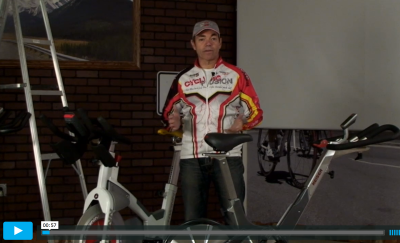
Gino introduces the Power Pedals research study
My last blog post was ended with this statement: “This blog represents the first in a series that will be exploring power and how we can make it more accessible, more understandable, more reliable, and more straight forward to teach with.”
To live up to those lofty goals, as an outdoor coach, an indoor instructor, and in general a man dedicated to getting the science right, the only place I can start from is one of credibility and truth. In other words, however I am going to try and lead someone to apply power and ultimately teach with it, it must be done with reliable and repeatable techniques. This is my only hope of also producing reliable and repeatable results in both indoor cycling instructors as well as our students.
The variability of how the same power levels feel on different bikes (specifically the Keiser m3 that we have used predominantly for the last 5 years) is something that has actually prevented us from doing lots of more engaging and/or fun training in groups. I don’t want to push someone to work hard only to have the fact that they chose a “hard bike” today instead of the easy one be what determines their ultimate success in any competitive or group activity.
I knew that until there was a way to objectively verify what power I was pushing on the m3 I could not know what the truth was, and so I waited for an way to implement this objective measurement. It finally was made possible when the Garmin Vector power pedals were released. This video is the initial launch of this research study.
Video Agenda
After an initial introduction as to why I took on this huge research project, I show the details as to how the Vector Power Pedals were fit on each bike and the nitty gritty steps on calibrating these pedals before I could begin testing the bike. This calibration method had to be done for each bike, and repeated each time I repeated the test.
This video also is the first in a series of video blogs that will allow you to take this journey with me as I discover what is possible and what is not in the pursuit of establishing real power levels of the Keiser m3.
Watch the first video blog.
Indoor Cycling Power Accuracy Research from Cycling Fusion on Vimeo.
Originally posted 2014-01-14 04:25:50.
