by Gino | Sep 16, 2020 | Training With Power
 So we’ve talked about why Indoor only riders will benefit from Power Training, and in the last post we reminded the avid outdoor cyclist just why Power is a must for their continued growth and improvement riding outside… but how to get started. That’s the question I’ve heard from a number of folks that have just gotten new Keiser M3 Power bikes (even though our Power Training system from Cycling Fusion works for all indoor bikes – it is what we use at Global Ride Training Center). The inevitable first question is like one from a new blogger sitting in front of a blank computer screen. Where do I start!?!
Introduce Power With Games
While most indoor cyclists still don’t wear heart monitors when they ride, most know what it is and why it is used. However, when it comes to training with Power, that’s a different matter altogether. Unfortunately, this is also why many clubs do not consider bikes with Power. Their ignorance leads them to feel it is too complicated or worse – intimidating. In this case ignorance isn’t bliss, it’s just plain ignorance. The goal here is to show that riding with Power is fun, interesting, and easy to do. This will help to beat back a consensus of complexity, which right now, threatens to slow the growth of Power bikes in our industry. Consequently, it’s best to just let students begin to play with Power before they really begin to train with it.
We do this by offering structured and methodical Power Games that make training with Power more fun. These are just a sample of Power Training games one can play. With feedback like Watts, Heart Rate and Cadence, (typical tools that come with any bike already equipped with Power) one is only limited by their own imagination. Here are some games that might help “break the ice” when it comes to training with Power.
Ten Songs To 10 Gears
Let your students warm up, encouraging them to increase their gears slightly as they “warm up with purpose”, but to keep it light and easy during the warmup. Once they have warmed up for at least 5 or 6 minutes, ask them to check their gear number, and the Watts they are genearting. This will represent their “baseline” or the bottom gear or Wattage for them today. This concept of establishing a Power “baseline” will apply to all of the games we discuss here, except for our last game; the 5 X 5.
Each of the next 9 songs then you should direct them to increase it 1 gear. The first 3 or 4 should be easily handled in the saddle. The final 3 or 4 may need to be out of the saddle, and some students might not be able to negotiate a gear much more than 7 or 8 above their warmup, depending on how high they start, and the type of Power indicator your bike uses.
Outside of the first couple and last couple, you should have plenty of leeway for what position to be in for all the other Power levels. Continue to work on form, and draw their attention to how each gear affects the Power, and how it probably also affects their cadence and certainly heart rate. This is a good exploratory exercise to help students see just how far they can go. Some may never go beyond a few gears without this slow and methodical increasing of Power. Others might find that they haven’t really stressed themselves, or at least not to the max. This is good too, as it helps to show your students a wide range of Power levels and helps them to understand what kind of Power range they have.
(more…)
Originally posted 2018-12-04 06:00:02.
by Gino | Dec 8, 2019 | Training With Power

Note: Gino's articles are supposed to be for ICI/PRO members only. He feels very strongly about this subject and asked that I make it available for everyone. – John
As an Indoor Cycling / Spinning® instructor, you know how important good air flow is. Don’t you? What??? You LIKE your students to sweat buckets!?! It proves how “kick-ass” your class is? Uh… well… not so fast. If that were true, then just build a bunch of steam rooms and saunas and let people sit and sweat. Ah, but it’s not that simple is it? You know they don’t lose real weight that way. It’s just water. But really, it’s worse than that.
(more…)
Originally posted 2009-09-18 16:46:12.
by Gino | Nov 22, 2019 | Instructor Training, Master Instructor Blog, Training With Power

Coach Gino gets an assist from a professional statistician.
Let’s Try This Another Way
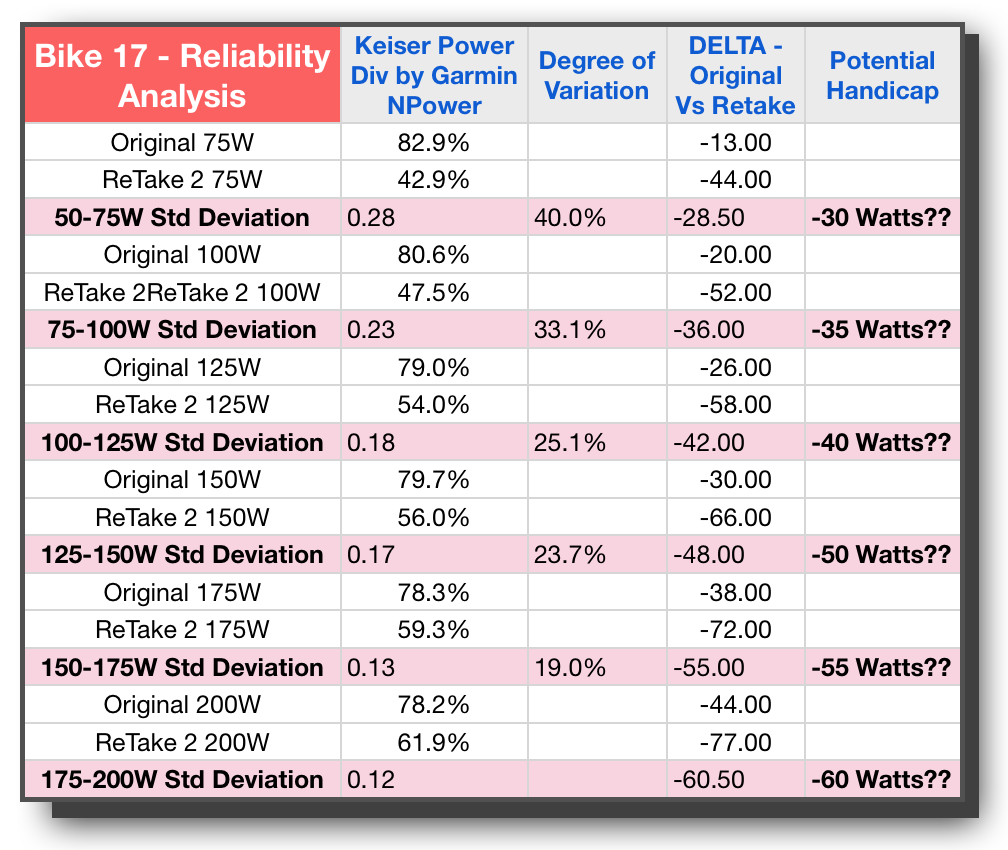
After testing 14 different bikes, with 6 of them also being repeat tested at least twice, I was pretty disappointed to see the data I reported in our last blog. This was never meant to be just an academic exercise. This had pure practical motivation. I wanted to be able to do real and reasonable competition in class. I wanted to encourage more tantalizing trash talk among my most competitive riders. I wanted to let some of my “little old ladies” throw it down against some of the guys who think bigger is better. I needed the bikes to be on an even scale to do this in good conscience, and handicapping them against a reputable objectively measured power meter seemed like a no-brainer to do just that.
But alas, the numbers from my work up to this point lead me to a conclusion I simply had not anticipated; that each bike within itself may vary day to day with regards to what power it will display given the same force being applied. This was an assumption that myself and many other “defenders of calculated power” have held on to for these past 4 years or so – that it doesn't really matter if the power is accurate compared to what would be measured with a real power meter, as long as that power was consistent. In other words, we could know if our training was making us better or not by pre and post testing on the same bike. It would simply generate a relative value so we could know if we improved a lot, a little or not at all. Each year at Winter Training we would assign bikes so that we could be assured of this “fact”. This was indeed the fundamental assumption that prompted the entire notion that a handicap could indeed be created, if we had a objective way to get at power simultaneous to seeing the bike's power display.

Unfortunately, as you could see from the numbers reported the last time, they varied so much within the same bike, from one testing episode to the next (even despite painfully recreating the same circumstances of a consistent rider, environment, time of day, method of execution and all the like), that this assumption was not true for at least 50% of the bikes. Undaunted by this surprisingly sad turn of events, I started to ask around for an available statistician that might be interested in this research. I wanted a more experienced extra set of eyes and less personally invested perspective so that they could let me know if I am doing something wrong. Was I measuring the wrong way, perhaps working with false assumptions, not controlling enough variables, etc. I didn’t want to give up just yet — I had already invested too much time and energy.
3 More Bikes Tested, 3 Times Each
One of my regulars referred me to Sarah who is both a cyclist and teaches statistics at a nearby university. We met a couple of times to discuss what I had done so far, and she spent some time and thought on the issue, and created a new protocol. We would focus on just 3 bikes, took them out of commission so no one else would ride them, made sure she conducted/directed me as I rode/tested each bike. These trials would be done on three different days, in random order as generated from a random table of numbers. This video takes us through one of those three sessions.
In the next blog post, we will discuss the results of these 9 trials.
http://vimeo.com/82319421
Indoor Cycling Power Accuracy & Validation Research from Cycling Fusion on Vimeo.
Originally posted 2014-02-19 03:04:24.
by Gino | Nov 18, 2019 | Instructor Training, Master Instructor Blog

* n'at a “general extender”[2][3] (http://en.wikipedia.org/wiki/Pittsburgh_English)
For those of you not well versed in the language of “Pittsburghese”, we use the phrase “n’at” for a variety of reasons, but in this case it means “along with some other stuff”. Consider this a “side-bar” to the story I’ve been building in this Evidence Based Cycling blog. John Macgowan wrote an article on incorporating the “grade of a climb” into your Indoor Cycling classes, and it seemed like a great topic to write a follow up for.
Power, Speed & Grade of the Hill
While writing the first book on Training with Power for the Indoor Cycling environment, it became imperative to create a system that was both practical and easy to teach from Indoors, but that could also be directly applicable outdoors. After all, the mission of Cycling Fusion™ from day 1 has been to bring these two worlds together, and the validation of how our training translates while riding on 2 wheels continues to be a Start Trek level “Prime Directive”.
To that end, my crew and I followed the same approach I have been describing each week through this blog. . So, I purchased an outdoor power meter (the iBike was the cheapest that had about a 5% tolerance for accuracy — plenty for our application. Getting 100% accuracy is absolutely necessary indoors, since we won’t have the same power gauges outside anyway, and we just need to know that we are improving it, not that we are at 200 or 300 or 225 or some other arbitrary power number.
When I would ride outside, I would compare the wattage I was seeing indoors with wattage figures while riding outdoors. This led to a variety of research undertakings with myself and my study participants. This work on Power truly marked the beginning of Evidence Based Cycling, I just had not put a name and more structure to it at that time.
1 Watt per Pound
One of the key principles presented in the book is the notion that if we want to ride outside, or more specifically, if we want to be able to climb typical hills that cyclists normally climb outside, we need to be able to achieve a minimum of about 1 Watt per pound of weight you are carrying up the mountain (rider wt + bike wt).
Through existing math equations, we were able to create a chart that showed how many Watts/lb would be required on hills with specific grades, given specific speeds. It turns out that under 1 Watt/lb there are few hills that can be ridden at a speed of 5 MPH or greater. Below 5 MPH it becomes increasingly hard to hold the bike upright. One can just about walk at 4mph, and that’s not “speed walking”.
Willing Guinea Pigs… er Volunteers
I was lucky enough to have a bunch of regular members that embraced the whole EBC approach to training and learning, and they were more than willing to help with the research. We first wanted to know if the chart and our math seemed to bear itself out in the real world. We used different people, at different riding and fitness levels to climb various hills with differing grades with our power meter, and we found that the numbers seemed to jive. While the testing of our own clients and fellow coaches/instructors would have been enough for us to build our training with, in writing a book for “the masses” we were compelled to go a bit further.
We wanted to establish some early credibility with both the book and our own research, so we commissioned a University Study to validate the formula and the chart in a different state with different riders, and with a Power Tap that would directly measure power instead of our inexpensive model that only calculated it.
Independent Validation
Carl Foster, Ph.D., FACSM; is the director of the Performance Lab at the University of Wisconsin. His team independently validated the chart that our 1 Watt/Lb principle is based upon, and thus we have a solid foundation for using this as a good target Power goal for the average rider. Here are the final excerpts from their published paper:
Results: Predicted PO and measured PO (within the range of 140-400W) were highly related (r=0.989), with an essentially zero value for intercept (Figure).
Conclusions: Without correction for wind, altitude or the effect of additional riders, the relationship between predicted and measured PO during cycling was very strong, supporting the value of published climb equations.
Comparison of Predicted and Measured Power Output During Uphill Cycling
Carl Foster, Ph.D., FACSM; Jacob Cohen, Gene Nacey University of Wisconsin-La Crosse and Cycling Fusions.

Comparison of Predicted and Measured Power Output During Uphill Cycling Carl Foster, Ph.D., FACSM; Jacob Cohen, Gene Nacey University of Wisconsin-La Crosse and Cycling Fusions.
Implications for Indoor Cycling Instructors
Given that there are no real hills and real grades in an indoor cycling room, one must artificially create the feeling by adding resistance. With the spate of power indoor cycles there are now on the market, using the Speed & Power Chart, and specifically 1 Watts/Lb as a target, and the concept of Watts/Lb as a training parameter can provide a ton of useful options for cueing climbs or even entire classes.
Originally posted 2012-06-14 05:42:48.
by Gino | Oct 23, 2019 | Keiser Cycling, Training With Power
 –
–
My original objective of the Power blog here in ICI/PRO was to build the case for power precept upon precept, slowly but surely. Good idea, except for folks who already find themselves teaching on power bikes and are anxious to get to the meat & potatoes. So, as the line in Monty Python’s Holy Grail said (whilst preparing to throw the Holy Hand Grenade) “Skip ahead brother…”
The most fundamental principal in power training is that you can sustain higher power output for shorter periods. This is common sense of course, but when trying to train or “hone in” on power levels you will use for different types of riding outside, one needs to identify these time periods, and develop power based on the length of those efforts.
For example, outside of the long mountain passes in Colorado, or Europe, your standard “hill climb” will often be only 3 to 5 minutes. This is also met with generally a steeper grade than those more gradual, longer climbs, and thus there is a measure of power required to climb those that is significantly higher, and requires different training.
In addition, if you race (or simply want to just impress your friends at every opportunity), you may want to develop significant sprinting or break away skills. To do that, you will want power that is even higher than climbing power, but may only be needed for as little as 60 seconds. This may seem quite short, but it is often all that is needed to achieve a real break away, or triumph in a race ending sprint.
Consequently, we have built the Cycling Fusion Power Training system on 3 zones of power; Sustainable Power (7 to 20 minute efforts), Climbing Power (3 to 6 minute efforts) and Explosive Power (1 to 2 minute efforts). These ranges are quite large, and there are 7 power levels within each zone. Rather than bore you with all the details, let’s just jump in and conduct a class that provides a sample of each of these zones.
The class design below is based on the Keiser M3 bike, since it is what we use at my club (Global Ride Training Center) in Pittsburgh. Since we also speak specifically to how we can reset our power numbers, I’ve written this class specifically to this model, and thus I call the class: The Keiser Tour De Power. For those that do not have a Keiser M3, but do have power, simply replace the portion of this workout that speaks to resetting the bike to get your average power numbers for one of the zones, and it will work just as well on any other bike.
Download the PROfile here.
Please post any comments or questions here, and I’ll do my best to answer them all.
Originally posted 2010-02-10 05:22:00.