
by John | Oct 24, 2026 | Instructor Training, Master Instructor Blog
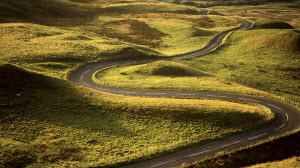
The road isn't segmented into definable sections… it flows along as one continuous, undulating strip of asphalt. Your cyclists may appreciate your class more if it flows like the road they ride. Here's why & how…
Common practice for many of us is to construct a class profile out of a playlist of songs:
- Warmup songs followed by
- Songs that communicate Flats
- Songs the communicate Climbs
- Interval songs
- Recovery songs
- Cooldown songs
- etc…
The end of each song signals a transition. We'll use that brief change to cue the next segment “now we're going up!” or “nice flat road ahead” or something similar. A gap follows the end of each track – before a new section of road begins.
But the road really doesn't work that way, especially when it comes to random rollers or out-right climbs. Everything is connected. Flats flow into climbs, the downhills back to flats and the flats are broken up by rollers. Your; speed, heart rate, power and even your ability to recover once over the summit, was determined long before you needed to shift down with the increase in grade.
I wish I was wearing a recording Heart Rate monitor this past Tuesday night, because a graph that showed the 2 1/2 hours of my HR would have told the tale much better than I can describe here in words.
Everything on the road is connected… there are few, if any, gaps… I'm realizing now that I had been training my class (and myself) like there were.
It was the first Tuesday night Life Time Fitness outdoor group ride. Me and my very fast VeloVie Vitesse showed up with a just a little bit of anxiety. “Which group are you riding with, John… the “B's” or will you being going out with the “A” group?” Great question and at that point I hadn't really decided. Of the 40 or so riders in attendance, I recognised almost everyone as either other Instructors or past participants. Maybe it was just me, but I got the sense that some of my regulars were watching to see what I was going to do.
These are well organized rides, with designated “Ride Leaders” who are paid LTF employees. After a brief welcome and introduction of the A, B and C leaders it was time to roll out. “A' group goes first. “Riding with us John?” Of course I was. My pride and ego didn't leave me with any other choice 🙁
The LTF “A” group has a well deserved reputation as an ego driven, hammer fest. Even though this was night #1 you wouldn't have known it. They start out fast and only get faster. The first 30 minutes are spent working our way out of town, to some very nice rural country roads. Here's where the fun begins and the reality of how everything on the road is connected came front & center to me.
If I can slot in tight behind a big guy, hanging with a paceline @ 26mph is a near threshold, continuous effort. Challenging, but doable. CoRd 6, as it winds west of the cities, flows through a series of rollers. Each change in grade required a substantial increase in power to maintain my sheltered place in the group.
The downhills that follow aren't for recovery. Nope. They're for building back your average speed. Well that's my theory anyway because once I crossed each summit I was forced to shift up to keep with the acceleration that followed each short climb.
I found myself trying to do two things at once (well three if you count staying focussed on my chosen wheel);
- Fight to recover from the previous effort…
- While mentally preparing for would come next
I've described this as “recovering on the run” to my class. How your group doesn't slow/stop at the top of a climb to give you a chance to rest. They keep going. If you're committed to stay with them, you need to accept whatever reduction in effort you're offered and use it to recover as best you can. Over time, with a slight reduction on power output, your HR will come down. You just need to wait for it – or slip off the back and soft pedal until the “B” group catches you.
I told this story to my class this morning. How out on the road everything is connected. There are no “gaps” between segments. Only small changes in effort. And while I talked about my ride… we rode a class without gaps. Flats flowed into rollers and we accelerated down the back. Slight reductions in effort on the flats, followed by more of the same.
Over and over, just like the road.
Originally posted 2013-05-02 09:56:10.
by John | Oct 21, 2026 | Master Instructor Blog

I'd like to welcome Chuck Cali as an official member of the ICI/PRO Team! – John
By Team ICG® Master Trainer Chuck Cali
When asked by ICG® to write a post for ICI/PRO, I thought, “OMG.” 🙂 Seriously, as Jim Karanas or John Macgowan can attest, I have a lot to say. So choosing the topic for my first post was daunting. I’m the new guy, after all — now sharing screen space with some of the country’s premier indoor cycle instructors.
What could I say that would be of value to the indoor cycle instructors out there in the trenches?
It felt right to start with the simple things that mean so much, the least common denominator, the place from which you can become a star, ‘the’ instructor everyone talks about.
John calls it community. I say connections. Making everyone feel part of something bigger. No matter how great your music, how structured your profiles, how clearly stated the class objectives, or how perfectly timed your cues, the success of your class comes down to how well you connect with your riders.
When I talk about connections, I can’t help but think of James Cameron’s great movie Avatar. Consider how the avatar learned to fly the winged beast. Plugging in solved only half the problem. Once plugged in, the two had to become as one. Showing up prepared and on time and engaging the crowd is plugging in. CARING is becoming one with your class.
This simple fact seems to get lost in the training: class focus, music, lighting, power, heart rate, base, strength, cadence, climbing, speed, endurance, ad infinitum. Showing up and executing the perfect profile to the best music, with spot-on cueing, the best indoor cycles, the best studio set-up will get you nada from your class if you don’t connect with them.
Dr. Shannon’s earlier posts on being “the instructor your students can’t wait to see again” discussed how to connect with our riders. Ultimately, as she points out, passion, honesty, encouragement and gratefulness create the connectivity. My word for all that is “caring.” It’s not about you.
The recipe for connecting is caring. How do you run a great class? By caring. How do you get your riders to connect with you? By caring. The fact that you’ve set the world record for climbing L’Alpe d’Huez is of little importance to them 10 minutes into class. This is indoor cycling.
My experience may be somewhat different from others posting here. I’ve spent many years studying this industry and the people who make it work. The best of the best were incredibly adept at connecting. It seemed that they spoke to and cared for everyone in class on a personal level.
Only when this connection is made, so that the riders understand at the most fundamental level that you care about them first, can you successfully demand the highest efforts or introduce complex profiles.
How do I do it?
1. I remember it’s not about me — except to establish that I’m running the class through unambiguous yet non-inflammatory requests.
2. I try hard to get to know my riders: Introduce myself. Ask their names. Find out if they’re new to indoor cycling. Give as much personal attention as possible.
3. I keep it simple and explain in simple, fun terms what I plan for the ride.
4. I empower the class with options that accommodate all fitness levels. I steadfastly encourage good form and never use contraindicated moves.
5. I give positive feedback during class to as many as possible, using their names (which I mostly get wrong).
6. I let them know they can do it. I believe in recovery and let them know when it’s coming, so they don’t have to hold back or fear they won’t last.
7. I lead by example. I’m happy to see them and, as a general rule, work as hard as I ask them to work.
8. I’m sensitive and don’t go on autopilot. I recognize early when I’m losing them and adjust.
9. I never take myself too seriously. I poke fun at my mistakes — when I blow a cue or get the timing wrong.
For new instructors, I suggest learning and integrating these skills before going for the complicated ride profiles. Once you do, your class will confidently follow you.
For veterans, look back and revisit what got you to the front of the room. We like being there, but shine does fade. Reconnect.
Trying to reach the pinnacle of our profession is important. The journey teaches me so much. What I’ve learned can be distilled down to one word: Caring.
Nothing surpasses the feeling of seeing the enjoyment my riders take from my efforts — not only during class, but what went into making it great. “Great class!” are words we never tire of hearing.
Care. Connect. Teach.
[plulz_social_like width=”350″ send=”false” font=”arial” action=”like” layout=”standard” faces=”false” ]
Originally posted 2012-05-29 05:03:49.
by Jim Karanas | Oct 18, 2026 | Master Instructor Blog
By Team ICG® Master Trainers Jim Karanas and Joan Kent
Over 12 years ago, Jim developed an athletic training program that eventually earned the tagline “Stop exercising. Start training.” At ICG®, we think there’s a difference between the two, one that people ask about frequently. Training encompasses more than the physical aspect of the ride.
Currently, training versus exercise is a popular topic. An internet search readily reveals the ongoing discussion, with suggestions and ideas as to the difference.
According to some sources, training is based on having a purpose, setting goals and achieving specific results. Exercise, in contrast, has been said to lack focus, goals or purpose. Training is said to be intense and engaging. Exercise is said to lack intensity and even be boring.
But are those really the differences? Say someone wants to lose weight and begins the following process: an indoor cycling class on Monday, an elliptical workout on Tuesday, a kickboxing class on Wednesday, Bikram yoga on Thursday, treadmill running on Friday, and body conditioning on Saturday morning.
Is that exercise or training? There’s a goal/purpose. The activities listed would provide intensity, plus variety to prevent boredom. Yet the weekly plan looks more like random exercise than structured training, so the differences must lie elsewhere.
We think the above distinctions are only part of the difference between training and exercise, and not necessarily the key points.
First, for a workout plan to be training, it probably needs to be progressive. Progressive training might start with foundation-level workouts and move into more intense levels of effort that are also designed to make the participant stronger in the activities. For that to be effective, the activities might need to be limited (say, to indoor cycling and treadmill running), rather than a hodge-podge of many unrelated things. Specific adaptations occur more consistently when the activities are specific, too.
Limiting the activities and following an overall progression wouldn’t preclude changing the format. But changes would be designed to elicit a specific training outcome for each session, rather than simply to prevent boredom, and the student is made aware of that objective.
The progression might culminate in performance events. A lot can be said about athletic performance, and will be in another post, but maximum efforts differ from what could be called “pseudo-hard.” People who love to work hard are typically talking about pseudo-hard efforts, rather than max.
Attitude or mindset is also important. It’s not simply working out to drop a few pounds, but training to develop our consciousness, nourish our body, change and quiet our thoughts, and balance our mind. Let that be the philosophy. Workouts without philosophy lack consciousness. Training is about bringing consciousness into the process. When we focus on what we’re doing and stay highly conscious of all of it, it’s never boring. It’s simply what is.
To maintain presence, we need to recognize the intrusion of thought immediately and bring awareness back to the moment, no past, no future. A sense of self in the moment is the way to turn off the mind. If we project into the future, the mind comes in like a tidal wave and sucks us into a stream of thought. Thoughts create time, make minutes feel like hours, and rob us of the desire to continue.
Then there’s pain. Or more precisely, the approach to it. We’re all familiar with “no pain, no gain” and the attitude that pain — certain types, at least — can be good because it means the workout is beneficial.
There’s also the “Hulk Will Smash” approach: the more it hurts, the more I like it. Grrr. Fanatics with no sense beyond the muscle of exercise may use that to complete their workouts, but addiction to pain isn’t training.
Training is a more mindful approach to pain that involves feeling it, fully understanding it, being sensitive to it — and putting a space around it, becoming nonreactive.
In what we do, pain is inevitable. But it’s just a trigger. It may stimulate resistance that compares to an emotional state. As our emotional threshold rises, our reaction to the pain changes. It doesn't feel any better. It just doesn't bother us as much. The warrior chooses death. Athletes choose physical pain, or at least non-avoidance of pain. As the polarization in our mind diminishes, our emotional reaction to the pain becomes one of acceptance or even dismissal.
Any athlete can recall having had the time of his/her life despite feeling pain during an event. A couple of decades in the fitness industry make it clear that anyone who wonders why an athlete would do something unpleasant, like push through pain to reach a goal, can’t adhere to a fitness program for any length of time.
Tools such as consciousness, presence in the moment, attentiveness, curiosity, non-reactivity, and so on are ultimately ways to add balance. Training tests our effectiveness with them. Exercise lacks these tools.
Originally posted 2012-03-26 09:52:29.
by Jim Karanas | Oct 15, 2026 | Master Instructor Blog, Mental Toughness
By Team ICG® Master Trainer Jim Karanas
As you may know from reading these posts, I’ve written about motivation in several of them. I’m often asked to speak to groups about motivation, or write about it in newsletters that go out to athletes. It typically happens in January, because the expectation is that everyone has de-tuned over the holiday season and let their fitness and discipline slide. Since I don’t look at motivation or athletic training in that way, there doesn’t seem to be any reason not to write about it in July.
True, motivation probably is a good topic for the first newsletter of a new year, but I still consider it somewhat ludicrous. I’ve read too many articles about “getting started again” or “staying motivated”. In my mind, training never stops. You can be in an ICU after having open-heart surgery to repair a malfunctioning mitral valve with a congenital defect, and still train. You may not be logging miles, but you can train.
Physical training seems to me to be a natural process that incorporates conscious development and the integration of mind, body and emotions. It’s a form of human development that produces greater insight. If you approach your training in this way, it can and will enhance virtually every endeavor you undertake. You may even improve your performance as an athlete. At the very least, you’ll get more and take more (i.e., use more) from the experience.
When you understand this, training becomes an experience that engages you throughout your life regardless of circumstance. If for some reason you can’t train your body, you can still train your mind. If for some reason you can’t focus your mind, you can practice firing your emotions, or stimulating your will, or reducing your anger, or accepting what you are and are capable of doing.
Once you head down that path, there is no more stopping and starting. You may take a physical break, but, if you lose touch with what your training means to you, you’re simply exercising. Not that there’s anything wrong with that. It just has the capacity to be so much more. (See The Tao of Training, Part 1 and Part 2.)
If you tend to take a physical break during the holidays — and that could even include the long Independence Day weekend some may recently have taken — hopefully you feel rejuvenated when you return, rather than “out of it”. If you’re beginning a training cycle, you need to plan your competition phase: which races you will enter and your specific goals for each race. Decide which races are the most demanding and/or the ones in which you wish to perform best.
If you find metrics motivating, it could be worthwhile to find out where to obtain a fitness assessment that you know how to interpret, or that a coach can interpret for you. If not, begin with your base. Keep your training relaxed and comfortable and enjoy this phase.
Re-establish your drive by committing time and energy to understanding the motivation behind your training. If your motivation has not evolved, and you find yourself training for the same reasons you did last year, say hello to a plateau.
Maybe instead of turning your attention to getting back in shape, your first priority should be to determine the reasons you will log more miles — or train with greater commitment — this year.
Then do it because you know exactly why you want to.
Originally posted 2013-07-21 08:19:37.
by Joey Stabile | Oct 9, 2026 | Audio PROfiles, Best Practices, Class Work-Sets, Creativity Indoor Classes, Instructor Training, KEEPING IT FUN, Master Instructor Blog, PRO/Playlists, Training With Power
Welcome to the The Weekly Ride by Cycling Fusion
Welcome to our new era of The Weekly Ride, you get:
- Full Ride PDF
- Apple Music Playlist
- Spotify Playlist
- File to Download the Ride directly into My Fitness DJ (Yes, no Programming)
- The Ride will be available for purchase in the iClass Builder Store (No Programming)
- A Podcast of the ride being delivered by a master instructor.
(more…)
Originally posted 2019-04-14 09:00:25.

by Dennis Mellon | Sep 24, 2026 | Dennis Mellon, Featured Articles, Master Instructor Blog

On Wednesday March 11th around 2:00pm I arrived in LAX to take part in my first IHRSA as a Master Educator for Stages Indoor Cycling. I was so excited that I went straight to the convention center to help the Stages team finish setting up our booth. I had been to the IHRSA convention before but never as an exhibitor. This time I got to see what happens “backstage” before all booths and exhibits are shipshape and the red carpet is laid.
As I walked into the Los Angeles Convention Center the place was buzzing with activity as all the exhibitors were putting the finishing touches on their booths, some of the Stages team had been setting up since Monday morning. Our booth is a reconditioned shipping container, that was bound for the landfill, and it’s floor and stage are built out of Colorado beetle-kill pine. Most of the heavy lifting had already been done but we still needed to lay down our floor, test the audio/visual system, check and recheck all our bikes and make sure everything was spotless for this so very important new product launch.


I also got to spend some time with my friend John Macgowan whom I credit with getting me noticed and hired by Stages Indoor Cycling. John is one of the most influential voices in indoor cycling and Stages was so confident that he would approve of their new indoor cycling bike that they sponsored his trip to IHRSA and gave him an exclusive first look. John and I talk weekly, but I was sworn to secrecy about this new bike so it was with great relief that I could finally share it with him. Here are the links to John's review of the new Stages SC Series Indoor Cycling Bike; Part 1, Part 2.
After the Stages team dinner we all made our way over to the IHRSA Opening Reception. For the past few years I have been very active on social media and “met” many smart and passionate people, some of them were here at IHRSA and I wanted to officially meet as many of them as possible. As I worked my way around the room catching up with some old friends and meeting new ones I saw John and Amy Macgowen chatting with the self proclaimed spokesperson for KEEPING IT FUN Indoor Cycling, Karen Casler. Karen may have been the most influential personality in indoor cycling this past year. She is the founder of CB CycleBarn in San Clemente California and has found a way to bridge the gap between Rhythm and Technical indoor cycling classes. The staff at CB Cycle Barn has taken the motto of “Give them what they want AND what they need” to a whole new level. Karen and I had been corresponding through e-mail and social media for some time now so it was great to finally meet her. When I learned I was going to be in California for IHRSA I contacted Karen to see if I could get a spot in one of her classes to experience the magic they were creating at The Barn. After a few conversations she invited me to not only take a class, but to teach one as well. Karen's energy and passion for fitness and indoor cycling are infectious, the rest of the evening was spent discussing how we can change lives on a bike that goes nowhere with John, Amy and Karen.
Early Thursday morning the Stages Education/Presenter team of Cameron Chinatti, Pam Benchley, Dunte Hector and I arrived at the Stages booth long before the rest of the team to discuss how we were going organize and present our early morning workouts. The Thursday morning workout was going to be for just the Stages team. The bike was so new that most of the team had never ridden it and we wanted to give them some saddle time as well as an opportunity to ride together as a team and burn off some of the pre-launch anxiety. This a very fit and competitive bunch so when you include the accountability of power and the ability to race with technology like Performance IQ you can expect to see some superhuman efforts. Some of our team ended up laid out on the floor recovering from max efforts, it was so much fun. After the ride we all gathered together for for short talk with our owner Jim Liggett. Jim spoke about the long process of building and bringing this bike to market. He also spoke about how hard it must have been for each of us to keep this amazing new product a secret for so long and that now it was our time to climb to the top of the cycling world, to show the world that we believe we have built the best indoor cycling bike in the industry. It felt like we were “popping the cork”, all that pent-up energy was about to finally be released. We all excitedly rushed back to our hotels to get cleaned up and ready for “The Show”.
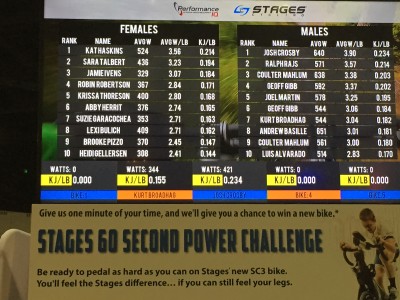
The doors opened for the IHRSA attendees at 10:00am and the rest of the day went by like a blur. So many people, so much excitement, so much energy. We were't sure what to expect, but the positive feedback was so much more than expected. People loved the bike! The team at the Stages booth included the engineers who built the bike, the sales people who sell the bike, the education team who teach on the bike and the owner who paid for everything. There was not a question asked that could not be answered. Our marketing team also came up with a brilliant idea to keep the buzz around our booth throughout the day, The 60 Second Challenge! This challenge was very simple. The convention attendee, male and female, who could produce the highest 1 minute average wattage handicapped by weight (watts/kg or watts/lb) would win a Giant bike complete with a Sages Power Meter. Every few minutes we had attendees stepping up to the challenge and the entire Stages team, equipped with cowbells and clappers cheered them on, this made for a huge crowd around our booth for the entire day. By the end of the day we had all lost our voices, our feet were hurting, we were tired, dehydrated and hungry but we loved every minute of it and all agreed the day was a HUGE success. After a bite to eat and a few celebratory toasts it was time for bed. Tomorrow we had another early morning and the eduction team had two sold out early morning workouts to show the world just what could be done on these new bikes.
Cameron, Pam, Dunte and I were once again some of the first exhibitors to enter the convention hall. We knew this was a big day for all of us, this was our chance to show all the industry decision makers how this new bike was going to change the way people looked at indoor cycling and especially how to use power to create a fun and effective class experience. Our classes were a huge success, we did some basic sets and drills that showed everyone the special features of the bike, but we also included some relay races that got everyone really fired up and pushing it. Our two classes were sold out, but we also had at least 30-40 more people just observing the workouts, all in all we felt like the morning was another huge success. After a bunch of high fives and hugs we ran back to the hotel to shower and get ready for another day of proudly showing off the bike we believe will change the way we look at indoor cycling.
Friday was much like Thursday, lots of 60 Second Challenges and short demos, but it was a little slower and that gave me some time to explore the rest of the exhibits in the convention hall. I work for Stages Indoor Cycling but I teach indoor cycling at multiple locations and on many different bikes, though I would love it for all the facilities I instruct at to to purchase the new SC Series bikes I also know this is not a reality and this was my opportunity to check out the changes each manufacture was making to their bike. The changes I found were subtle but welcome like console improvements, handlebar shape, belt drives and pedals. The one technology that most every manufacturer was embracing is heads up displays like Performance IQ and Spivi. I believe this is the next “Big Thing” in indoor cycling and in a future post I'll write about my experience with Performance IQ at CB Cycle Barn.
As the show wound down we awarded Josh Crosby and Kat Haskins The 60 Second Challenge winners performed our last few demos for prospective buyers or other exhibitors who where only now getting a chance to check out our bike. It was now time to break down our booth. Many companies call in a group of laborers to do the grunt work for them, not the team at Stages, we all put on our work gloves and got busy. After about 3 hours the stage, booth, bikes and everything in it was packed up and ready to go to the next show and we were all ready for dinner and drinks.
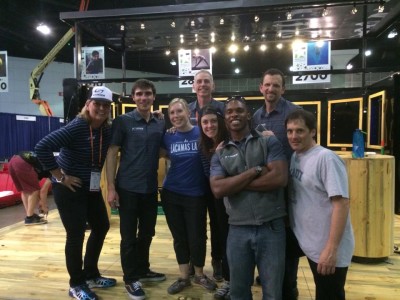
My first experience at IHRSA as an educator/presenter was not all glamor and glitz, but I wouldn't change a thing about it. I'm so excited to part of the Stages team that is so passionate about cycling both indoors and out and to be working in an industry that has to the power to change lives every day.
Podcast: Play in new window | Download
Originally posted 2015-03-22 14:44:52.
