Can the sounds of breathing identify the metabolic changes during exercise that are described as VT1 aerobic threshold & VT2 anaerobic threshold?
There's promising research conducted by Breath Research and Dr. Carl Foster at UW Lacrosse. Here's your chance to support this cutting edge technology that could potentially replace conventional metabolic testing, for the purposes of determining Heart Rate training zones.
In an earlier post I asked the question; “Could Breath Acoustics be our answer?” I also promised you an interview with Nirinjan Yee, the CEO and Founder of BreathResearch. Nirinjan's early work in Breath Acoustics (literally recording and analyzing the sounds of breathing) has lead to her Indiegogo crowd-sourcing campaign. Its purpose is to raise the funds needed to fully develop and build the headset microphone worn during exercise.
It's important that Nirinjan reaches her goal of $30,000 by September 29th – not the end date listed of October 29 – because there's a second contest she could win. Phillips Electronics is hosting the “Innovation Fellows” competition and are calling for innovators to submit their #BIGIDEA to address the current innovation gap in the areas of living well, being healthy and enjoying life. With its constant commitment to people-focused innovation, Philips aims to make a difference in people’s everyday lives, and is offering $100,000 of its own money, plus mentoring from Philips leaders, to help the best ideas come to market faster.
This help from Phillips will be huge. So while you are listening to my Interview with Nirinjan, please go to the project page and help her meet her funding goal 🙂
The debate over cardio vs. high-intensity interval training (HIIT) usually assumes that the issue is an either/or choice. In that debate, HIIT is usually compared to absurdly low levels of cardio exercise — not to the kinds of classes ICI-PRO instructors probably teach.
This post explores the evolutionary value of combining cardio and HIIT.
In his book Born To Run, Christopher McDougall reveals the blend of morphology, paleontology, anthropology, physics, and math that led to understanding how humans became the greatest distance runners in the animal kingdom.
There’s no way this short article could do justice to McDougall’s fascinating and detailed description of the emergence of homo sapiens over Neanderthals (they were parallel species), and the evolution of humans as supreme hunters — hundreds of thousands of years before the creation of the tools we associate with hunting (spearheads, bows and arrows).
A few of the evolutionary changes include:
– upright posture to allow deeper breathing and limit retention of sun heat
– the ability to release body heat through sweat, rather than panting like other mammals until they must rest or die of hyperthermia
– the ability to accelerate when the pursued animal has been run to exhaustion.
So human “persistence hunting” combined endurance running primarily, with some sprints. Humans evolved to run in conditions that no other animals can match, and it’s easier for us.
Good At Endurance, and For a Long Time
Endurance athletes can typically continue into what would be considered old age in other sports. In many cases, such as distance running, they can still out-perform teenagers or 20-year-olds until their mid-60s.
At his first double-marathon, the most notable thing my then-35-year-old coach, Jim Karanas, saw was the age of most of the runners, who were 45 to 55. He said it told him immediately that the ultra-run was more of a mental than a physical challenge.
When workouts are always high-intensity, over-training is likely. So are failure to recover fully and a high incidence of injury.
It’s also likely that someone will burn out after constant high-intensity work, making it feel like drudgery, instead of something to look forward to each day. Why not work out in a way that you’d enjoy making part of your schedule long-term? Why not create classes like that to bring your participants back over and over again?
Matt Fitzgerald, noted marathon runner and author, suggests endurance training primarily with 2 to 3 high-intensity trainings per week.
McDougall quotes researcher Dr. Dennis Bramble, who said, “If you don’t think you were born to run, you’re not only denying history. You’re denying who you are.”
But let’s not limit this to running. Endurance athletes of other types display similar results. Countless stories describe master’s cyclists in their 50s and up outperforming younger cyclists.
In his 50s, my coach raced against the cyclists in the 30-year-old category — because he found he could perform better against them than against the experienced racers his own age! Those guys kicked his butt when he was first starting to race.
He was also one of the few (and the oldest that weekend) to ride the notorious Furnace Creek 508 fast enough to qualify for RAAM.
So the choice isn’t really between short, intense intervals and long, slow cardio with a magazine. The right kind of training is not either/or, but both.
(The cardio, of course, should be hard enough to cause a training effect, not help you catch up on your reading.)
This perfect combination is effective, enjoyable, sustainable over the long haul, and entirely in sync with our evolutionary nature.
So what's the potential ROI on the Zoning program?
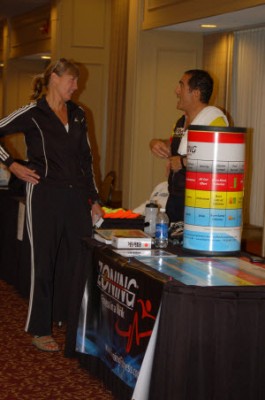
If you teach “Club Athletes”, what many of us see as the majority of the student in our classes, and want to educate your students / clients on Heart Rate training program, I highly recommend you look into Zoning Fitness. In the video below, Chuck Cali and Sally Edwards present the Zoning Can – a complete 6 week heart rate training program that actually comes in a can.
I'm aware of two ICI/PRO Member Instructors who are part of the initial Beta review of this new 6 week program. They will be taking their class through the complete 6 week Introduction to Heart Rate Training.
“What's the purpose behind a 6 week program?” and “Why not just introduce these concepts during a normal class?” were common questions I heard at the conference. The purpose of a separate program (actually 6 classes) is so you can focus on a small group of students who are truly interested in learning how to use Zone based Heart Rate training, over a six week period of time – so they really learn and understand the core concepts.
If you operate a studio or club and are looking to add Heart Rate training to a multi-week Boot Camp or Weight Loss program, I suggest looking into Zoning Fitness.
I became a huge fan of New Leaf Fitness Metabolic Testing a few years ago after I had my first Metabolic Assessment. Before that I was convinced that my AT (Anaerobic Threshold) was 155 BPM, only to learn it was actually 162 BPM.
If you can stand the poor audio quality of one my earlier Podcasts I have a very informative discussion with Jessica Christiansen, the Education and Training Manager for New Leaf Fitness.
Pro Cycling Team Garmin Transitions has just announced that they are using New Leaf Metabolic Testing as a part of their training.
Now that more of your students wear heart-rate monitors (HRM) (see previous post “How To Get Your Students To Wear a HRM”), you must teach them how to use one.
An important first step is sometimes lost when introducing HRMs. Instructors immediately start estimating maximum heart rate and discussing zones. But the first measurement of intensity, how hard the students are exercising, must always be perception.
Relating perceived exertion to heart rate is a fascinating personal discovery for the indoor-cycling student. If it’s done correctly, the student will immediately ask at what heart rate he/she should be training. Then a discussion of training zone estimates makes perfect sense.
The following protocol, developed by Team ICG®, provides a template for a “first HRM experience” that the student won’t forget. Initially, you want the HRM to help the student link a given heart rate with a perception, which enhances awareness. The student feels his/her body go through changes in perceived exertion, along with a visible numerical progression.
Resting HR — 2 minutes
Once the students are wearing their HRMs, have them sit quietly on the bike. No pedaling, no talking, just sitting still. Tell them to breathe deeply, relax and see how low they can drop their HRs. This is not a true resting value, but shows them how relaxation and breathing affect their HR. It also gives them a numeric indication of how prepared the body is to receive training. It may well dictate an alteration of their plan for the day.
Warm-Up — 15 minutes
Roll the legs with no resistance on the bike. Feel the ease of motion, the momentum. Get into a rhythm with it: no effort, just smooth, continuous, even circles. Before taking the HR up, we want to accomplish two things. First, we must shunt blood to the leg muscles. Fifteen minutes of easy spinning will do that. Second, we want the students to sense what’s happening in the body as they get warm.
For the first 5 minutes, set the cadence at 90-100 rpm. Have the students increase the resistance just enough to feel as if their legs are working, without changing cadence. This isn’t much effort. Just bring the HR up slightly.
The first change in perceived exertion is an increase in body temperature. Assuming the room is appropriately cooled, the air temperature initially felt cool or cold. Ask them to notice the change — the air no longer feels cold — and note at what heart rate that occurred. Was it 5 beats up from resting? 10 beats?
For the second 5 minutes, have them make another small increase in the resistance. The second sensation in perceived exertion is awareness of breath. Their breathing pattern has not really changed. Their breathing is not hard or labored. They’ve just become aware that they’re breathing, something we’re unconscious of most of the time. At what HR did they become aware of their breathing?
For the third 5 minutes, bring on a little more resistance without changing cadence and raise the HR again slightly. Two things must happen here. They must notice that all momentum is gone from their pedaling. There’s a distinct point, especially on chain-driven bikes, where the sensation of momentum is replaced by effort. This is very visible to the instructor — the “looseness” is gone from the pedaling — however, it’s still not hard.
The other thing they need to notice is a sudden spike in body temperature. They now feel hot. We experience discomfort just before we begin to sweat because the cooling of evaporation hasn’t begun. What’s the heart rate when this happens?
Settle the cadence down to 90 rpm as they continue to work and begin to sweat. This is the next level of perceived exertion. At what HR did they begin to sweat? They’ll notice the hot feeling leave, then a cool sensation against their skin. They might feel perspiration on the brow, under the arms, or elsewhere.
Their warm-up is done.
As you can see, this isn’t an elaborate or complicated warm-up, just a gradual awareness process for the students. The next step is a heart rate ladder, again to connect the students with their perception of the effort.
Heart-Rate Ladder — 20 minutes
Now that the students are warmed-up, it’s time to take them through levels of greater exertion, while connecting their perception of the effort with the HR at which it occurs. Most of this work takes place seated, so give them periodic breaks from the saddle.
Level 1
Level 1 continues the intensity that they reached by the end of the warm-up. All feeling of momentum has been replaced by a feeling of effort. They’re aware of their breathing and have cracked a sweat.
Their HRs should be consistent. Tell them the first lesson of heart-rate training is stabilization. They should be at a HR that they could maintain for hours. Forget about mechanical difficulties, how the saddle feels, whether they need water, fuel, etc. Ask them to settle into a HR that — in terms of the effort level — they could hold for hours.
Maintain that intensity for 5 minutes.
It’s not uncommon for them to be unsure about whether they’re at the right level of effort. Tell them to check their HR, sense their effort level and ask themselves, “Could I maintain this for 1 hour? 2 hours? 3 hours?” If the effort is too high, they’ll have an internal reaction to the question and should adjust as necessary.
Keep the cadence at 90 rpm; this is important. Let them know that the HR they’re training at is called a target HR. Their job is to maintain that target at 90 rpm.
At this point, it’s helpful to explain what’s going on metabolically. Discuss aerobic vs. anaerobic metabolism and changes in the use of fat and carbohydrate as fuel.
As mentioned above, Level 1 is of the same intensity as the final part of the warm-up. From here, the progression builds to greater levels of effort, which will be covered in the next post.
This came in the mail yesterday and all I could think was, “this has to be for my dad. It can't be for me.” 🙁
No, I'm not going to apply…
I guess it just one more predictable thing that comes with reaching the half-way-point. (I'm 50 at the end of the month and I've taken to telling people that it will be me turning the corner for the other half of the race.)
The hardest thing for me about this age is now needing to wear reading glasses, after ~48.5 years without. Many of us are around this same age and I'm guessing you may have similar problems.
I have about 30 pairs of Dollar Store readers scattered around my house… and yet I'm constantly searching for a pair to wear. What a hassle. I can feel for those of you who wear glasses or contacts.
But what do you do while you are teaching, when you can't see the small numbers on your watch?
I'm one who prefers to ride at the same intensity as my class, but found my trusty Polar's display was no longer readable (by me) once the lights dimmed. Do I really need a heart rate monitor to know my intensity? Not really. 15 years of training has me knowing the feeling of both my T1 and T2 with a pretty high rate of accuracy. But I like to set a good example for everyone else… so I faked it.
Really I did. For about a year I would make a display of lifting my jersey and strapping on my chest belt. Then I would raise my monitor and ask; “how many of you are wearing your monitors?”
I don't have to fake it anymore. No, I don't bring my $1.00 readers into class. I'm using a Blink Heart Rate Monitor. 🙂
If you haven't (forgive the pun) seen this new Blink Heart Rate monitor yet, here's the link to their site. Very simple: it blinks BLUE below T1, YELLOW between T1 and T2, and then RED when you are above T2. T1 is your aerobic threshold and T2 is your anaerobic threshold / LT.
Chuck Cali manages ZONING, which is the educational program that sells the Blink. Chuck sent me one a few months ago to try and I'm in love with it. Now not only can I see what zone I'm in, but my class sees the little blinking light as well. 🙂 I have a new model that's a little different from what they show on their web site. The Blink I have has only one button, and it takes all of about a minute to program.
I love the simplicity of the Three Zone system and feel it will work well for the majority of the students in my class. It may also go a long way toward my desire for a standardized method of describing HR training zones. More about this in the future.







 This came in the mail yesterday and all I could think was, “this has to be for my dad. It can't be for me.” 🙁