
by Tom Scotto | Jan 3, 2020 | Master Instructor Blog
 Before we talk about how to get a beginner class started, the first question you need to answer is why? Not, why does my club need a beginner class, but why do YOU want to lead one (if this is your plan)? As an instructor starting a beginner class you need 3 main criteria: (1) The absolute desire to work with new riders, (2) the ability to teach appropriate classes for beginners and (3) excellent foundational knowledge of bike setup and form and technique.
Working with beginners is very gratifying but it does take a special individual to have the patience to work with those who may not have the conditioning or who arrive needing all kinds of help and have tons of (basic) questions. Many people never enter indoor cycling classes because they are intimidated by what they’ve witness through the class door of the studio (instructor yelling, riders sweating profusely and everyone limping out of the room). You will need to help beginners feel comfortable and confident that they will not only survive the class, but actually enjoy it. These classes REALLY need to be designed for beginners. This does not mean we do the same drills as our regular classes, just at a lower intensity. Some riders may have trouble (or are not confident) standing, while others may find pedaling above 60 RPM a challenge. Many beginner riders I’ve witness struggle to remain comfortable on the bike regardless of how hard they are working.
One of my biggest pet peeves is bike setup, particularly when working with beginners. This is often their first experience on the bike and it should be positive and pain-free. A few months ago a new rider entered my class (not a beginner class). I asked if she needed help with her setup because I saw her sitting in a very odd position. She told me she was experiencing some knee pain after a few classes. Once I corrected her position and gave her some pointers on proper posture, she confessed that she had taken 2 other classes earlier in the week and those instructors setup her bike in a much different position. She was also given some incorrect instruction on form, including straddling the stem of the handlebars when standing (she used a blunt sexual reference inappropriate for most audiences). So whether you are a fitness director recruiting an instructor for a beginner class or THE instructor, please make sure you are grounded in the fundamentals so we start our aspiring riders the right way and the safe way.
So now that we’ve got that off the table, what is the best way to start a beginner class at your club? I’m going to present a few tips to put you on the road to success, but also look forward to our indoor cycling community (YOU) to share experiences.
(1) What I the best time of day?
I’ve seen late morning indoor classes (9 — 10am) receive good attendance. However those who attend at this timeslot are often stay-at-home parents that do not have a desire to join the primetime classes. The best conversion rate (beginners who become indoor cycling enthusiasts) has been seen from classes that are offered just before the primetime class. For example, a 6:00am beginner class before the regular 6:30am class or a 5:30pm beginner class just before the 6:00pm evening class. The back-to-back beginner to regular class combo has proven successful for a number of reasons: (1) most do not require a separate instructor since the instructor for the regular class is often able to arrive early (for some extra $$ as well), (2) beginners who become confident and conditioned can stay and try to take the regular class and (3) “advanced” riders can take the beginner class as a warm-up and for more saddle time. NOTE: please advice advanced riders (especially those who dress in full pro-team clothing) to sit in the back so they don’t intimidate the newbies.
(2) Advertise with the Right Words
When you promote these beginner classes, it is important not to insult nor frighten people. Make sure you don’t advertise the class as “for those people that can handle a regular class”. Instead focus on what they will learn and/or experience. Also, don’t send them running in fear because the flyer posted at the club lists “Threshold Management” and “Anaerobic Capacity” as some of the benefits they will get from this neuromuscular, cardiovascular class. What da….?? Yeah, those training terms may arouse us, but a beginner will assume that if they don’t understand the description of the class, they will certainly not understand what is going on once they get their. Use general fitness and cycling terms. Keep it simple.
(3) Dress Down. Make sure the photos and advertising you use to promote the beginner class is not littered with pro cyclists or riders digging into “the suitcase of pain”. It doesn’t need to include pictures of people in lawn chairs on the deck of a cruise ship either, but just take time to consider the apprehension people can have to the perceived intensity of a class and lean towards a “fun workout”. On a side note, the instructor teaching the class should also dress down. I do recommended cycling shorts, but maybe a non-cycling top (but still athletic) to put new riders at ease.
(4) At Cycling Fusion, we have found that 30 minutes is the perfect amount of time for a beginner class. 30 minutes is long enough for those without the conditioning to feel like they’ve received a good workout while keeping them from fatiguing (physically or mentally) in a position they are not yet used to.
So, go and start that beginner class. Give them a good workout, start them off the right way and have fun!
Originally posted 2011-07-15 07:00:00.
by Tom Scotto | Dec 6, 2019 | Master Instructor Blog
 Short of provoking a sexual harassment suit, this maybe the best way to get your class excited about what you have in store for them.
I’m grateful because my riders often take the time to leave comment cards at the club’s front desk after class and my group fitness directors continually share the feedback with me. One “positive” comment that has been consistent is that members feels that I “set them up for success” from the start. When pushed further, they said, “Tom always tells us what his goal for us is and then how we are going to accomplish it”.
I — MUST — HAVE — AN – OBJECTIVE
As an indoor cycling instructor, I’m a slave to my coaching tendencies. Simply put, I can’t design a ride unless I have a clear objective. Because of my cyclist tunnel vision, I consider indoor classes either a training session or event (something we have trained for). So before I start selecting drills or music, I first determine my overall goal for the ride. Am I trying to help them develop some aspect of their fitness (if so, what is it)? Is the goal to climb to the top of a feared moutain? Are we racing in a stage of the Tour de France or a local criterium? I can’t help myself — I MUST HAVE A PURPOSE! Fortunately, this seems to be viewed as a positive.
Do You Have An Objective For Your Class?
Instructors often mistake all of the tedious work that goes into a profile as the objective. I do not doubt that a tremendous amount of time was invested in creating our ride profile, but more specifically, was the class designed around an objective. To find out, ask yourself, “What is the purpose of this ride? What does it produce or help my riders achieve?” Unfortunately, an answer of “to develop general fitness” usually doesn’t cut it.
Do You Explain the Objective To Your Class?
I proctor numerous auditions for instructors and sometimes sit in on classes (usually spying). In most cases, I’ll take a moment to talk with the instructor afterwards to introduce myself and ask a few questions about the ride. I’ve been pleasantly surprised to discover that many instructors have some cool objectives for their ride, but never told the class. They were equally surprised that riders would be interested in that level of detail. “Absolutely, it demonstrates not only a purpose for the ride, but the amount of thought and planning that went into designing it. Your class wants to know what to expect (physical demands), as well as, what (long-term) value it will provide.”
A Sample From This Week’s Ride
Here is the objective I communicated to my class for this weeks leg speed development ride:
“One key element of cycling fitness is steady, fast and powerful leg speed. Since we are in our base training mode, this is a perfect time to focus on it. We are going to approach this by first performing a drill that helps engage more muscle followed by a series of drills that trains the brain to send the signal to the muscle quicker so we can pedal faster and stronger.
Keep in mind, as you look at today’s profile (I hang an 11”x17” color laminated chart for each class) you will see a number of consecutive drills before we receive more substantial recovery. So pace yourself. Finally, remember that leg speed is a skill that must be trained. Be patient as you develop your own leg speed. It takes time.”
———————————
If you are in the habit of creating classes with a specific focus or training objective, make it known to your riders AND reiterate after class the value they received. If you have not been approaching your rides with a specific purpose, I want to encourage you to start. You don’t have to be “Joe Coach”, but it should be something that can be explained to your riders. Practice saying your objective out-loud and to yourself. If you are finding it difficult to come up with an objective for an existing class, well…. you may want to revisit the profile and tweak it until you can explain its purpose.
Just to clarify, “fun” is not a purpose, but rather how you deliver it. So Have fun! Really!
Originally posted 2012-01-19 14:19:42.
by Tom Scotto | Oct 11, 2019 | Master Instructor Blog
 The beginning of class can be disjointed at times. Riders are trying to get settled. Some people are still chatting (loudly) and we are trying to establish that official “class has started” moment. Then 5 new people show up and need to be setup on their bikes.
Yesterday I’m teaching at a club I’ve taught at for over 7 years. The cycling class is held in a multi-purpose room, so each member is responsible for pulling their bike onto the floor from the side of the room. The class starts right on time (I’m a stickler for punctuality). Five minutes into the class, 5 “new” riders enter the room. All of them have on running type sneakers and they are standing next the to the remaining bikes and appear confused.
I meet them at the back of the room and immediately understand their hesitation. The bikes are equipped with Schwinn Triple-Link pedals, which allow for the standard SPD clip on one side and then a removable toe cage on the other side, which accepts a LOOK compatible cleat. The problem was that none of the available bikes had toe cages. I found a set of cages thrown to the side. One cage was missing a strap, which I found and re-threaded. Then I went around the room to other riders who were not using their cages and started removing them from their bikes to allow the remaining 4 people to ride. Throw in a few bike setups and now we were 15 minutes into class before I re-emerged back at the front of the room.
Obviously, the big challenge was not the pedal hunt, but trying to teach the class and keep everyone focused while controlled chaos was unfolding in the back of the room. At the time my 5 newbies entered the room, I had just finished my opening spiel. So while I was getting them situated, I was simultaneously leading the class through some Spin-Ups (short 10-second accelerations followed by 20 seconds of easy pedaling) and then a set of 30-second speed intervals. In addition to staying on top of the timing, I found myself continually pushing the headset mic onto the top of my head so I could talk with the new riders without our conversation bombing over the sound system.
As chaotic as all of this was, I actually love this kind of challenge. As a cycling coach, I spend a good amount of time coaching off the bike. I’m constantly leading drills while speaking one-on-one with riders to help them with specific issues and technique. But it made me think, “how could an instructor train themselves to handle a situation like I experienced gracefully?” Here is a suggestion:
Try teaching your entire intro and warm-up off the bike. But don’t just stand at the front of the room. Instead walk around from rider to rider. Pace the isles (if you have them). Provide encouragement and make suggestive corrections as you go. Try to keep track of the timing and any intervals. See how it goes. Remember, it is all about experience. Obtaining the ability to stay on task and keep your riders focused in this way will provide some great preparation when those 5 new riders show up at the last minute.
Also, please share any other tips you have used to stay in control and command when all hell breaks loose.
Originally posted 2017-03-30 18:50:10.
by Tom Scotto | Jul 26, 2018 | Master Instructor Blog
 Over the last 8 years, I’ve come across a number of indoor cycling studios that don’t provide a microphone for the instructor. Albeit, these studios are generally small (but not all were) and all of the instructors appeared confident that a microphone wasn’t needed. “My voice really projects” was the common response I got from instructors. I dare say that not one of the classes I’ve seen taught without a microphone (near 100 from around the country) was acceptable. Now I’m not saying the instructors were not good. Many were excellent. However, the absence of a microphone stole their effectiveness as an instructor and robbed the riders of a much better experience.
I Don’t Feel No Music!
One of the ways instructors can compensate from lack of vocal support is to lower the volume of the music. Makes sense. However, music is a major motivator and an excellent tool when training indoors and out. Without a microphone, the music was so weak that any emotional component was lost. Although I am biased on this point (being a musician), many research studies have been conducted that prove the body’s response to pulse, volume and emotion of music. This is the reason we spend so much time on our playlists. The music is an inseparable part of the workout.
The Angry Instructor
If the music volume is appropriate, then most-often the instructor is simply yelling at the class the entire time. I’ve even seen instructors try to smile the entire time (while they yelled). This just made them look mad (not as in angry). Even with the yelling, which is NOT projecting by the way, I could still barely make out what they were saying. Forget giving any audible instruction, they were just short guttural tones “SAANN…….SIIAA……SAANN…..SIIAA!” This was the instruction given for 8 MINUTES of jumps. Of course it didn’t help that I don’t do jumps (not in the way they have been traditionally taught) which made all of the harsh yelling and ineffective movement all the more aggravating.
Effective Vocal Inflection
It is not just that we need to be heard clearly, our voice is an instructional tool that guides riders through the physical and emotional profile of the class. Yelling or even speaking at the same volume and/or tone for the entire class is not only boring, eventually riders will tune you out. We need to build a vocabulary (pun sort of intended) of vocal volume, emotion and even cadence (the speed and rhythm at which we speak) that keeps riders engaged and matches the intensity, focus and characteristics of our class. You should have a vocal inflection for educating, recovering, steady-state work, hard efforts and the like. I honestly think more instructors have the ability to do this, but they are either hindered by lack of sound reinforcement of they’ve never been taught properly how to mix their voice and the music.
We Want to KEEP Teaching
One of the major reasons I was distracted watching these instructors unknowingly strain to deliver their class, was the potential vocal damage they were causing. As a drummer, I didn’t experience much of the vocal issues personally, but have watched a good many singers in my bands suffer. They experienced vocal nodules, polyps, cysts (these are all lesions or bumps on the vocal folds), and even vocal fold hemorrhage (blood vessels on the surface of the vocal fold ruptures and bleeds). As indoor cycling instructors (microphone or not), we may be at a greater risk due to a lack of vocal training, high physical exertion while teaching, temperatures and improper breathing (I’ll talk about this more in another post).
Dr. Lee M. Akst, director of the John Hopkins Voice Center, said “Red flags for an over-used voice are frequent hoarseness, a sense of strain while talking, or discomfort while speaking. Chronic hoarseness is an occupational hazard not just for singers, but for coaches, teachers, broadcast journalists, clergy, attorneys and other people who use their voices a lot as part of their professional responsibilities.” Some of his suggestions for protecting your voice: drink plenty of water, don’t overuse your voice (like talking too much on a cell phone), don’t smoke, pay attention to how your voices feels and sounds so you know when it needs time to recovery AND use a microphone.
We do what we do because we love it. We love the fitness, the teaching and seeing people's lives change for the better because of what we give. Let’s ensure we can keep giving buy protecting one of our needed assets — our voice.
I beg you…PLEASE, PLEASE, PLEASE…if you do not teach with a microphone, talk to your facility about obtaining the proper sound equipment. It's not about being loud(er), it is about being safe and professional.
TIP: Place a recording device somewhere in your class and listen back to what your riders are hearing and pay attention to how your voice sounds. Our voice and ability to teach and coach is such an important part of our effectiveness as instructors. Let’s continue to sharpen our skills together.
by Tom Scotto | Aug 5, 2017 | Master Instructor Blog
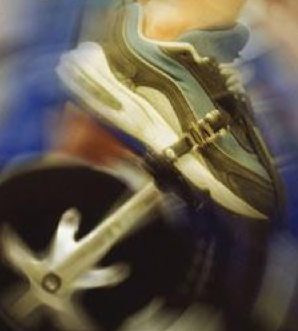 With the increase of those interested in getting a healthy start to 2012, more and more people are joining health clubs and attending indoor cycling classes. This is great! It provides a perfect opportunity to foster good technique and skills as these new members acclimate to our classes. One topic I have found myself addressing more than usual lately is proper footwear.
Multi-Purpose?
It is definitely a delicate balance at times as we try to encourage new or beginner riders to regularly return to class while guiding them toward good clothing and equipment choices. The more prominent issue lately is people riding with running shoes. I totally understand their mindset and appreciate their determination. They are starting this new exercise routine, which may incorporate running, weight training and cycling. Without understanding the nature of cycling, it would seem logical to just purchase a pair of running shoes and kill 3 birds with one stone (a terrible expression). As we know, this approach is not ideal when cycling is concerned.
Protect the Feet
As many of us know, the forces applied to the feet during an indoor cycling class can be great. These forces can be created by both resistance and speed alike. Simply put, if someone is wearing a running shoe, which is probably one of the worst options (besides those barefoot running shoes and Vibrams), the sole will flex placing stress on the feet. Under heavy resistance, a shoe with a soft sole will bend over the pedal, straining the intrinsic muscles of the foot plus ligaments, tendons and joints. In a similar fashion, high speeds can encourage riders to dorsiflex (angle their foot and toes upward) in order to stabilize the pedal. This exaggerated (and unnecessary) dorsiflexion can stress the extensors on the top of the foot and lower leg. To protect the feet from injury (and fatigue) from these strenuous forces, cycling shoes were created with stiff soles.
You Don’t Even Need Cleats
It can be very intimidating to learn all there is to know about the different types of cycling shoes, cleats, pedals, etc. Even though to us it appears very simple, to a person new to exercising in general, this can be overwhelming. We toss out terms like “SPD pedals” and “clipless”. Just think how confusing that can be…you “clip” into your “clipless” pedals. I try to put new riders at ease and tell them the most important reason to purchase a cycling shoe is to protect the feet. So I will often encourage the seemingly overwhelmed person to just by the shoes WITHOUT the cleats. I’ll of course educate them on the benefits of having a cycling shoe designed for walking when off the bike and write down “SPD” for them as they venture to the wilds of the local bike shop (where a techy geek with too much knowledge and not enough education may lurk in the darkness). Once they wrap their minds around the shoes and experience the vast difference, we take the next step toward cleats.
Bring on the Power and Performance
The rigidity of the soles on cycling shoes provides a more stable platform for delivering force to the pedals. Remember the foot is a “lever” and both the ankle and attachment to the crank arm (pedal axle) are the fulcrums. If the sole of the shoe is not firm, the power being delivered to the pedals will be affected.
In addition, without proper support or a firm platform, the muscles of the feet can fatigue. This muscle fatigue can lead to burning, pain and/or injury.
SPECIAL NOTE: If your cycling shoes are more than 3 years old, consider getting a new pair. Over time (considering the amount of use), the upper part of the shoe can stretch and the sole of the shoe can develop small, often unseen, cracks in the plastic, or breaks in the fibers (carbon soles). As the shoe loses its rigidity, its ability to support the foot and transfer power to the pedals diminishes.
————————————————
Whether it is spurring on the newcomer or persuading the veteran rider, help them understand the safety and performance benefits of using proper cycling shoes. If all else fails, convince them to at least switch to a tennis or basketball sneaker, which provide far more support than running shoes.
Originally posted 2012-01-26 17:14:35.
