
by Tom Scotto | Jul 3, 2021 | Master Instructor Blog

ICI/PRO member question from ICI/PRO Podcast #203 Cycle Strong Audio PROfile
What exactly should the “openers” in the warm-up consist of? In Tom's “Getting Started with Intervals” audio profile, he described them as 30 seconds of maximum effort followed by 30 seconds of recovery, which to me sounds the same as the first Muscular Strength interval in this audio profile (30s effort/30s recovery). I would appreciate help understanding the difference.
As always, I greatly appreciate the audio profiles!!! And Marc, thank you for the playlist suggestions!
Kristi
Kristi,
Thanks for you question. It is a good one. Many people don't understand the purpose of openers and thus never do them or benefit from them. Simply, they are all-out, maximum efforts for the prescribed period of time (openers can be different lengths depending on their purpose and what one is preparing for). How do we define the “all-out” maximum effort? Think of it as the most resistance you can use at the highest cadence. I would recommend a cadence of 85 RPM or greater (I personally prefer 100+ RPM). You should find yourself through into the high-end of Zone 5!
So what's the difference between the openers and muscular strength efforts? The muscular strength efforts are limited by the cadence. In order to more effectively develop strength in the legs, the cadence needs to be slower (60-70 RPM) in order to provide the necessary stress (I.e. Force) on the muscle. This in many cases will not produce the highest heart rates (but pretty high). Simply put, what is the most resistance/stress/force I can place on my legs at for example, 60 RPM.
Openers push every limit for a short period of time in an attempt to activate systems such as your anaerobic energy pathway and lactate buffering. If you prepare and active these systems BEFORE the structured part of the workout, the body will not be behind the 8-ball and will respond more consistently and repeatedly.
Does this answer your question?
Cheers, Tom.
Originally posted 2017-03-28 09:04:06.
by Tom Scotto | Jun 24, 2021 | Master Instructor Blog
 Last week I was asked to sub a couple of classes for another instructor and friend. It was at a club that I used to teach at and where I still knew a number of the members. I always like teaching at this particular club because the riders throw out some good energy and appreciate a structured workout — my specialty. Since I was going to be covering both the 9:30am and 12:30pm timeslots, I decided to bring my laptop and camp out in the lounge area between classes to get some work done.
The energy of the 9:30am class was great and the room was full. I taught on and off the bike walking around the room to encourage riders I hadn’t seen in a while and meet some new faces. After class, a few people hung out. I also took the time to make a few adjustments to the bike setup of a couple of riders. It was definitely one of those classes that often gives you (the instructor) more back than one feels was given. I left energized and refreshed and was now looking forward to the 12:30pm class.
I settled down in the lounge area and fetched myself a cup of complimentary coffee. As I was checking emails and eating a Pop-Tart (yes, I got grief for that – “What, Coach Tom Scotto is eating junk food”) one of the riders approached my table and asked if she could interrupt me. Sure, I love talking with people at the club and particularly about cycling. These were her exact words: “Your class and workout was great, but your music sucks”. She said it in such a genuine, yet straight-forward way, that I could do nothing but smile. “Wow, that is quite a range of feedback. Would you mind bridging the gap for me? What did you like and why such a strong response to the music?”
She sat down and told me how the workout was perfect and how she felt the exact challenge I had presented during the intro. She remembered each of the drills and told me her heart rate ranges for each. I was quite impressed with her detail and assessment of how she felt during each effort. “So what’s up with the music?” I said. She said it was just awful. “I hate all of that electronic stuff”. Now I was quite certain the instructor I subbed for played very similar music, so I asked what she thought of the music the regular instructor plays. “Oh, his music is terrible too. I can’t stand that electronic junk”. She told me she liked popular music with vocals. I asked her how she was able to make it through the entire class with that brutal noise. She said that, although she hated the music, it somehow fit the flow of the class and matched the workout. “I just focused on what we were supposed to be doing and blocked out the music”.
I thought this was very interesting. How could someone who had such a violent reaction to the music actually enjoy a class — to the point where her overall assessment of the class was “great”. Being a musician, I’m particularly sensitive to music and would find it hard to enjoy a class if I “hated” the music. Her feedback demonstrated the importance of delivering sound training. It is so important that a 50% Great plus a 50% Sucks stills equals “great”.
Now I don’t think she was speaking to the soundness of the “physiological training concepts”, but what I took away from her comments was that she appreciated the thought and structure that went into designing the class. I thought this was great news. As a coach, I have all kinds of workouts just waiting to pour out of my head. The challenge is always the music. It can take me hours to pull together just the right songs. So, as I said, this is good news. It doesn’t mean we don’t have to focus on the music, but if we take the time to put together a sound workout, it can overshadow our music choices.
So what does this really mean for us? It is a call for each of us to take the time to design a solid ride profile. How much time and effort do we take to construct our workouts or rides or whatever we call them? Could your profile stand on its own WITHOUT music? Wow, that’s a challenge! I’m sure there is quite a bit more that we can pull out of this experience, but I’m more interested in hearing your feedback and thoughts?
I’m off to download some new music. Apparently, my tunes suck.
Originally posted 2011-04-15 15:03:17.
by Tom Scotto | May 22, 2021 | Master Instructor Blog
 As I hit the streets after teaching at one of my downtown clubs, I bumped into a friend of mine who appear to have been run over by a car. She had a large gym bag clawing at her shoulder with cycling shoes peeking out of the end pocket. The bag apparently weighs over 50 pounds, because she appears to be struggling just to lug it to the corner.
“Hey, how are you?” I said in apparently too chipper a tone. She turns only her head and glares at me with one eye bigger than the other. Assuming that were her response, I prodded some more in order to jump start an under-powered conversation. “Did you just get out of a cycling class? How was it?” She released the gym bag as if tossing a heavy sack of potatoes off her shoulder. “You can say that. The instructor was a maniac”.
Being a coach for 10 years, one realizes that everyone has their own perception of what is hard, what is easy or when they are tired. Often times it is different that my interpretation, so it is usually best to get things defined. Plus, I was particularly interested in her definition of a “maniac” instructor. “Wow, sounds pretty extreme, what happened?”
Her stare became intense and her tone aggravated: “Our regular instructor was away this week, so we had a sub. I think he was either new, insecure or just terrible. Our usual instructor’s class is quite popular. People really respect her workouts because she has a reputation of giving a hard class, that provides just the right amount of work and recovery. So maybe this guy felt he had some big shoes to fill and decided to show us how hard he can make us work. We barely had a warm-up and we were led into a hard climb followed by 10-minutes of jumps. Then some long sprints where he only provided 15-seconds of recovery followed by another climb and more jumps. He ran us ragged with no rhythm or reason until 2 minutes before the end of class and then told us to cool down and stretch on our own.” With the exception of those 15-second recovery periods, I don’t think he gave us any other break. I don’t know why I tried to keep up. I think I was just aggravated and just kept hammering away. Oh well, I’m late for work so I’ve gotta run. I just hope he never subs our class again.”
She heaved her bag back on her shoulder like it was a limp body and headed in the opposite direction. This is not the first time I’ve heard this unfortunate tale, but my mind started connecting a few of the stories. Many of them involved a sub which people deemed “horrible”. Now I don’t think all subs are horrible, I’m sure we’ve subbed many classes ourselves (I hope). I know I have. However, I do think there can be a greater tendency to put on our “A” game when walking into a cycling studio with new or unfamiliar stares. Let’s face it, it can be intimidating to enter a room when you’re NOT the person everyone is expecting. I’ve even had a person walk out of a class I was subbing seconds after I walked through the door. I hadn’t even make it to the stereo yet or said a word. So I understand the pressure of feeling you have to overcompensate for not being THE instructor. It doesn’t even matter whether the instructor you are covering for is good or not. It is their class. Their riders. Their style.
So what’s my advice? you can’t be THEM, so be yourself. When you sub for another instructor, teach, instruct and coach with that same style that has won your riders over year after year. Sure, bring your “A” game, why not? But teach a sound workout. Take that extra energy (albeit, nervous energy) and excitement and direct it toward getting to know some of the riders in class. Connect. Be real. Don’t be a Maniac!
PS. No one who has every subbed one of my classes has been accused of this. Just incase “you” were wondering.
Originally posted 2011-03-03 13:56:51.
by Tom Scotto | May 4, 2021 | Master Instructor Blog
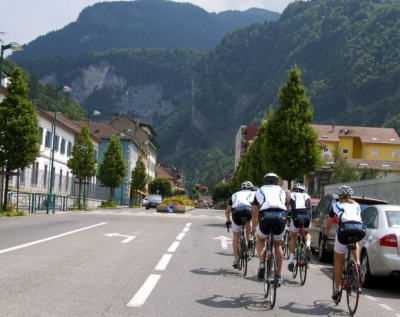
So I decided to lead my first virtual ride this past week. In my true style, I didn’t just try it in one of my classes but at all 5 clubs. I like to just throw myself into things so I can learn and experience while the iron is hot. For those not familiar with a “virtual ride”, this is when the class rides to a video. In most cases the video is designed to simulate the road the riders are on to provide a more realistic “visualization” and experience. I’ve seen this attempted in the past but never with much success. I contributed the lack of success to a number of things:
(1) The screen or TV was too small to allow riders to feel like they were “there”. Even large screen LCD TVs will not cut it.
(2) The video was not stimulating enough and/or the camera angles were not realistic.
(3) The instructor either said nothing and just let the riders roll along to the music OR gave not-so-exciting (and obvious) dialog to accompany the video like “OK, now we are climbing so let’s add some resistance…….now we are going downhill so let’s take some of the resistance off”.
The Equipment
I decided that if I was going to do a virtually ride, I wanted to give it a fair shake. Besides the video or DVD, I needed to have good equipment. But it needed to meet a couple of criteria if I was going to start incorporating these rides on a regular basis. First, everything needed to by uber-portable. I don’t want to be lugging in a mini production crew to pull this off. Second, I need to be able to setup in less than 30 minutes with minimal disruption to the room and finally, the picture quality needs to be captivating. Here is what I put together:
- HD Projector with Tripod mount
- Tripod
- 25’ Electrical Extension Cable
- 25’ iPod Audio Extension Cable
- HDMI Cable/Adapter from Laptop to Projector
- Laptop (with DVD Player)
- White Queen-size Cotton Bed Sheet
- 2” wide Black Duct/Gaffers Tape
I was able to successfully setup everything 20 minutes. This included having to shift a few bikes to make room for the projector and tripod and in 2 cases, move the bike and rolling stereo cabinet off the instructor platform. The cycling studios I teach at all have mirrors so I was not able to project on the wall. This is where the white sheet and tape came in. I simply taped the sheet to the mirror and it worked great. By my fifth class on Friday, I clocked the setup at 14 minutes. Taking everything down only took 10 minutes.
Hey Mikey, I Think They Liked it!
It was an absolute hit across all clubs (each with a very different demographic) and at different timeslots from morning to evening. With no big surprise, I performed my virgin virtual ride experience with one of Global Ride Productions’ France DVDs which included the ascent up the Col de la Columbiere. There was some added excitement with this particular choice since we had just come off the heels of 3 weeks of indoor Tour de France rides with riders left in a post-TDF depression.
Before I led the ride, I watched the DVD and wrote a script of how I was going to approach the class. I incorporated early warm-up drills, climbing intervals and some attacks with grueling muscular strength efforts. In addition to great (multiple) camera angles, the video included riders on the road which we (the class) intermingled with along the way. I led the same class all week. Yes, the researcher in me wanted to compare apples to apples with each class.
The virtual ride received rave reviews. Riders felt it was the best experience they had ever had and one of the hardest workouts. As an instructor, I found it very easy to lead. The Global Ride DVDs are divided into consecutive sections that make sense as a single ride and there is a timer at the bottom right of the screen so it is hard to get lost. I decided to use the music provided (Whoa….I know) just to see how it would fly right out of the package per se. Needless to say I had a ton of fun last week and got some great “energizing” feedback.
ZONE 5 ALERT: As many of you know, I tend to fake it through many of these classes. Basically, I don’t work as hard as my riders in order to coach them on and off the bike. I found these virtual rides hard to fake. My heart rate ran into zone 5 (capacity) with my riders as we hit the summit of the Col de la Columbiere.
If you’ve done virtual rides in your classes, add some comments below and share your experiences and what you’ve learned. I spoke to ICI/Pro member/instructor Shirin Beckett (CA) last week who has a lot of experience with virtual rides. I’m hoping she will add some gems to this topic as well. I’m also including a link to the cue sheet I created for DVD 3 “TDF Climbing in FRANCE” so you can how I organized and approached the ride – Download Cue Sheet
Give it a try! But be careful, you may just get addicted to indoor cycling all over again!
Originally posted 2011-08-23 05:00:26.
by Tom Scotto | Mar 26, 2021 | Master Instructor Blog
 If you are one of those instructors who loves to bring the experience of riding outdoors to your indoor riders, now is the time to get them excited. Give them a taste of the Tour de France and introduce them to some of the fun we enjoy during this special time of year. Maybe we want to learn more about all of that tour lingo so we can share more with our classes. Here are some recommendations I have to wrap your mind and riders around one of the greatest sporting events of all time.
This year is the 98th edition of the Tour de France (twitter: #TDF). With it’s 21 Stages (days) of racing over the next 3 weeks. The riders will cover an astounding 3,430.5 kilometers (2132 miles) which is even more amazing considering the speed at which they are traveling (stages can average over 25 mph for 6+ hours of riding — Yikes!). Now there are all kinds of tidbits we can share, but I like to give my riders homework to help them better understand how to ride during class. Here are a few of my homework assignments:
(1) Watch just 1 complete Stage of the TDF (YouTube is OK for partial credit)
(2) Notice how riders stand (out of the saddle) and move their bikes back and forth when climbing — Let’s imitate that!
(3) Look at how balanced riders are between the handlebars and seat when they are standing. They are not leaning back over the seat or hanging forward over the bars.
(4) Try to catch a glimpse of a rider’s stomach from the side. Notice how it balloons out? One minute they look pregnant and the next not. This is how our stomachs should look during class — relaxed and moving in and out as we breathe.
(5) Notice how relaxed they appear on the bike (shoulders, arms and hands).
(6) Watch how smooth their pedal stroke is. A gentle waving (ankling) movement where the heel of the foot is not forced down. Let’s imitate that!
Just listening to the voices of the Tour de France, the announcers, Phil Liggett and Paul Sherwen will give you enough knowledge of the race to fill a set of encyclopedias, but if you are craving more, I recommend the following:
(1) Boy Racer : My Journey to Tour de France Record-Breaker (Book)
This is a great book that will not only get you to fall in love with Mark Cavendish, the Max-Missile from the “Isle of Man”, but will teach you a great deal about the TDF. Mark not only mentions 100s of aspects of the race, but takes the time to explain each one in laymen's terms.
Amazon: http://www.amazon.com/Boy-Racer-Journey-France-Record-Breaker/dp/1934030643/ref=sr_1_1?ie=UTF8&qid=1309973467&sr=8-1
(2) Chasing Legends (DVD)
This is 2 DVD set that follows the team HTC Highroads through the TDF. You will get a unique perspective of what happens amongst the riders, in the team cars and when the riders are off the bike.
Amazon: http://www.amazon.com/Chasing-Legends-DVD-Mark-Cavendish/dp/B004DR4VHE/ref=sr_1_1?ie=UTF8&qid=1309973282&sr=8-1
There is no greater time than the present to enjoy/learn about the Tour de France and share it with those in your classes. They will feed off your energy, so if you are excited — they will be excited!
Originally posted 2011-07-06 05:30:00.
