FTP, a concept refined by power authority, Dr. Andy Coggan, is an estimation of the amount of work you are able to do in an hour. It serves as the basis for loads of other important metrics (e.g. TSS, CTL, ATL, TSB, etc.) that will be covered in future entries. Most immediately, the FTP value serves as the cornerstone to setting up training zones.
Rather than asking athletes to attempt a one hour maximal effort to determine FTP, I prescribe the method that Hunter Allen, co-author with Dr. Coggan of Training and Racing with a Power Meter, has developed. The protocol itself is actually quite simple: after a substantial warmup, start a lap on your head unit, and smash it for 20 minutes, as hard as you can. The average power recorded for the 20 minute test is multiplied by .95 to estimate what your “hour of power” (or FTP) would be.
The ideal terrain for a 20 minute test is a moderate (3-5%) steady climb that can be ridden safely without interruption (e.g. no stop lights). Of course, most of us might not have access to terrain that meets these requirements. A flat road (with the same requirement for safety) will do and of course, riding the test on a stationary trainer indoors is a great alternative.
“Smashing it” for 20 minutes might sound pretty straightforward but, to get the most out of your test, some smart pacing will be required. When prescribing an FTP test to my athletes, I encourage them to break the test down into smaller, more manageable chunks, like four-five minute efforts. For each five-minute time period, have a soft goal for average wattage. Trying to increase the average power for each five-minute segment (compared to the segment prior) will go a long way to helping you achieve proper pacing. As you get to the end of each five-minute portion, take an assessment based on your rate of perceived effort (RPE) and ask yourself, “Can I keep up this intensity? Can I increase the intensity for the next five minutes and the remainder of the test?” When it comes to the last few minutes, you should be at full effort, eking out every last bit of energy to assure that you have averaged the highest power possible. I refer to the wattage goal as “soft” because no matter what the goal power might be, you are going to be limited by your feeling on a given day. You might be able to do more work than you anticipate and you might not be having the absolute best day and will potentially fall short of your expected power output. Don’t let expectations get in the way of having your best test. Remember, the goal of testing isn’t to meet a particular number but rather, to measure your best performance you can do on a given day. Being in tune with your RPE is critical.
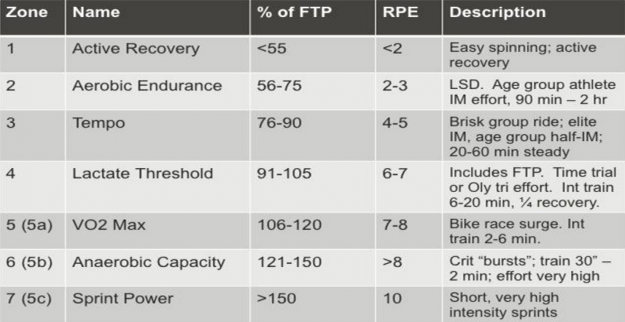
With your new FTP number in hand (best 20 minute power x .95), you can create training zones. With some simple calculations, you will be able to determine your training zones based on Allen and Coggan’s chart below.
Now that you are armed with your training zones, I suggest you record some of your regular rides and take a look at the files afterward to see how much time you are spending in each of your zones. This information can go a long way to helping determine what the demands of a ride/race/event are and potentially guide your training a bit, to meet those demands.
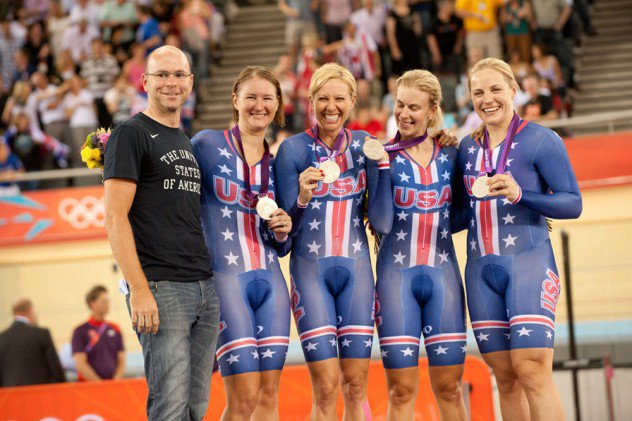
ABOUT BEN SHARP: Formerly a program director for USA Cycling, Benjamin Sharp is the resident Power Education Specialist for Stages Cycling. Prior to joining the Stages Cycling team, Benjamin spent seven years coaching the USA Cycling National Team. Under Benjamin’s guidance, riders racing for various national programs won 13 World Championships, and stood on 8 additional World Championship podiums. Benjamin’s crowning achievement was coaching the US women’s team pursuit team to the silver medal at the London Olympic Games in 2012. An accomplished athlete in his own right, Benjamin has amassed more than a dozen national championships in a cycling career that has spanned three decades. Benjamin is a USA Cycling Level 1 coach and has earned the USA Cycling Power Certification. As a coach, Benjamin’s strength is making accessible to the masses, the science of high performance elite athletics. As a Continuing Education provider for Stages Cycling, Benjamin now spends his time educating professional, amateur, and indoor athletes alike on the virtues of training with power.
Micro Intervals simulate the demands of racing. In this video Power Education Specialist Benjamin Sharp explains how to athletes preparing for an event, but haven’t the opportunity to ride in a group or to do training races beforehand can get the intensity. Micro intervals are a great way to jump start the system to simulate the demands necessary during a race.
Most often Benjamin Sharp prescribes micro intervals that are 10-15 minutes sets of 15 seconds on and 15 seconds off. The ON portion is VO2 (zone 5) and the OFF portion is a little below your FTP (zone 3). Then you “simply” follow this ON/OFF pattern continuously for the entire 10-15 minutes. Note, that you are never at rest during this 10-15 minutes.
These micro intervals are to be performed on flat to rolling terrain so you can stay in the same gearing/cadence throughout the entire interval. That means you won’t have to shift as you switch from the ON to OFF portions. Rather, during the ON portion you’ll accelerate and increase power and cadence and during the OFF portion you’ll ease up, decreasing force and reducing cadence.
The most important part of these intervals is to make sure you’re hitting the zones during each portion. This means not over powering the ON portions to the point at which you’re having to reduce your power below Zone 3 during the OFF portions.