by Joan Kent | Oct 12, 2015 | Engage Your Students, Health and Wellness

My client was crying. She was upset about what she thought I had just asked her to do. She was afraid she’d have to go hungry all day and starve herself. She was afraid she’d end up over-compensating with a binge the following day — or even for several days afterward.
It wasn’t true that she’d have to starve, but her emotional reaction was genuine.
What had I asked her to do? Simply to try an exercise that I’ll share with you in a moment.
I knew the exercise would ground her in a solid awareness of her body’s signals of when to eat. I expected a bit of pushback, but not quite like this. As she cried, I addressed her concerns point by point.
So What Was The Scary Food Exercise? [private PRO-Platinum|PRO-Monthly|PRO-Gratis|PRO-Seasonal|Platinum-trial|Monthly-trial|PRO-Military|30-Days-of-PRO|90 Day PRO|Stages-Instructor|Schwinn-Instructor|Instructor-Bonus]
I won’t keep you in suspense. The client picks one day — or even half a day — to try this. Here’s what you might tell him or her to do:
The goal is to get hungry as often as possible during the day. Eat only small amounts each time you feel hungry. That will ensure as many hunger experiences as possible throughout the day.
BUT!! Every time you feel hungry, it’s time to eat! Eat only enough to take away the hunger, rather than to satiate yourself completely. But do eat.
One of the points of this exercise is to develop body awareness. Part of that is avoiding eating on autopilot. So before eating when you usually do — say, first thing in the morning or when it’s “time” for lunch or dinner — check in with your stomach first to see if you’re really hungry. Discover what hunger feels like.
Another key is to avoid “preventative eating” (eating now to prevent hunger later). Stay in the moment with your hunger and your eating. Keep the behavior logical and predictable: I’m hungry. I eat. I get hungry again. I eat.
Important suggestion: If you have a cycling participant try this, suggest that he/she do it on a day that with a light schedule — or no set schedule at all — to really tune in to the process.
I Didn’t Invent This “Mean” Food Exercise
Many years ago, I read about this process in a book. Unfortunately for me — the PhD who always cites her sources! — it was a long time ago, and I’ve forgotten whose exercise it is. I’m definitely not trying to claim it as my own; I simply can’t recall who came up with it. My apologies (and thanks) go to the author.
This Exercise Is Great Because It Works
What happens? Every client I’ve taken through this process — every single client without exception — has reported feeling grounded and aware of the hunger/eating cycle after trying it.
My clients report that they now feel confident in their ability to tune in to signals that tell them when their bodies need food — and when they don’t. They feel confident that they can trust what their bodies are telling them. They feel confident that they can respond appropriately.
I have never asked a client to eat this way longer than one day. But it has never been necessary. Each and every client who follows the instructions seems to have the same positive experience.
To be clear, your participants don’t have to go through life eating only a bite or two of food at a time — just the day of the process.
And What Happened To My Crying Client?
She did understand what I had really asked her to do and agreed to try it for half a day. She ended up doing the whole day — and said she “got” what I’d been trying to help her discover regarding hunger, food intake, and much more.
Anything that helps my clients feel more aware and sure of their decisions is a boon to their self-knowledge, self-esteem, self-image, and self-efficacy. This “scary” exercise makes them more effective in following my system and getting results.
The exercise is also in keeping with one of my favorite quotations. It’s from Simone de Beauvoir: “Confidence in the body is confidence in the self.” [/private]
by Joan Kent | Oct 5, 2015 | Engage Your Students, Health and Wellness

This brief post will cover a seemingly minor point that sounds like nothing but does a lot.
If you’d like to move your students a major step closer to a lifetime of healthful eating, you can do that in a single step.
The key is to get your students to ask one question before they eat anything – pre-workout, post-workout, breakfast, lunch, dinner, or snack.[private PRO-Platinum|PRO-Monthly|PRO-Gratis|PRO-Seasonal|Platinum-trial|Monthly-trial|PRO-Military|30-Days-of-PRO|90 Day PRO|Stages-Instructor|Schwinn-Instructor|Instructor-Bonus|PRO-Studio]
The question is simply this: “Will eating this stabilize me or destabilize me?”
In this context, stability refers to two things – blood glucose and brain chemistry.
Stabilizing Glucose
Stabilizing glucose refers to keeping things in a normal range with gentle and gradual “ups” after meals or snacks, and gentle and gradual dips when hunger is about to occur.
“Gradual” is the operative word.
Stable glucose levels don’t rise to a sharp peak, as they might after, say, a sugary pre-workout “breakfast” and then plummet right after that.
They might plummet in those who are susceptible. Those folks are called carb sensitive because they secrete extra insulin when they eat certain carbs.
Sugar would be one of the key triggers of that extra insulin, but it’s not the only one. Junk like white flour – and even fruit – can trigger too much insulin, as well.
Stabilizing Brain Chemistry
Stabilizing brain chemistry involves several chemicals that change with the food we eat.
The 4 chemicals are dopamine, norepinephrine, serotonin and beta-endorphin (which most people call endorphins).
When those chemicals are at optimal levels, they prevent cravings and keep us feeling pretty good.
But some people have lower baseline levels of one (or more) of the 4 chemicals. That makes them feel a bit worse (sometimes a lot worse) than someone whose brain levels are even.
It also makes them more sensitive to the effects of junky foods like sugar.
When they eat those junky foods, they get an exaggerated reaction of those brain chemicals – either through an extra-high release or through extra-high production. Or both.
The exaggerated reaction might feel great for a while.
It’s also where addiction comes in, making someone who has experienced it want more junk that will give them that great feeling – and take away the blah feeling they could have day to day.
As you can probably tell, that’s almost guaranteed to cause a repeat of the whole cycle.
Which Foods Will Help?
Stabilizing foods are wholesome fats (such as nuts) and protein foods – or even protein powder.
If you can get your students to eat something from each of those categories every time they eat, you’ll help them stabilize glucose and brain chem.[/private]
At first, your students may not like having to go to a little extra trouble in this way, but – in the long run – they’ll feel great, perform better in your classes, and give you the credit you will deserve for changing their eating habits in a simple way.
by Joan Kent | Sep 15, 2015 | Health and Wellness

Here’s some information about sugar and appetite that most people don’t know. Of course, those of you on ICI/PRO may know it if you’ve read my posts.
Anyway, here’s the info.
Endorphins
Sugar triggers beta-endorphin, usually called endorphins. Endorphins inhibit the part of the brain that causes satiety — the feeling that we’ve had enough food and don’t need to eat more. That part of the brain is the VMH.
When we eat sugar, the VMH is blocked by the endorphins that sugar triggers. So we want more food at a given meal. Or we may want to eat again sooner than we normally would.
Endorphins can also change which foods we want, as mentioned in a previous post. They’ll probably make you want more endorphin-triggering foods — those would be sugars or fats.
Either way, sugar is likely to change your food landscape.
Priming
Endorphins from sugar trigger another brain chemical, dopamine — just enough to make us want to eat more sugar. This is probably the best reason not to follow the common advice to eat a little bit of sugar when you crave it. (Terrible advice!)
Some people are more susceptible to this ‘priming’ effect than others. If it affects you, you may find yourself wanting more sugar after you’ve eaten just a little bit.
Withdrawal
People joke about being chocoholics or sugar addicts, but people who are affected by it know it isn’t a joke. If you eat sugar often, you may find that you crave sugar when it’s not around — or when some time has passed since you’ve had any. That could be a sign of withdrawal.
If you’re also feeling a little (or a lot) cranky, it most likely is withdrawal. If so, you’ll probably crave sugar and eat more of it.
Bottom Line
Sugar can impact appetite dramatically. As covered in a previous post, it can also increase fat in our diets. Think of all the sugary foods — such as ice cream or chocolate cake — that contain a lot of fat, along with sugar. Those fats are typically not healthful ones, making a bad nutrition slam even worse.
By the way, alcohol can affect appetite in similar ways, and sometimes with even more impact than sugar. But that’s a different post.
by Joan Kent | Sep 1, 2015 | Engage Your Students, Health and Wellness
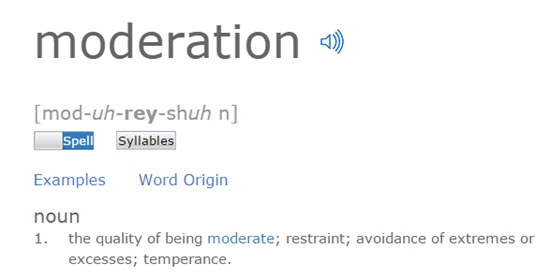
When it comes to food, no doubt you’ve heard, read, or even said something along these lines: Everything’s fine in moderation.
Many famous people have said that they’ve never been successful at achieving moderation.
Professionally, I never recommend moderation in sugar intake.
Instead, I favor this quotation by Saint Augustine: “To many, complete abstinence is easier than perfect moderation.”
Clinical experience has taught me that some people simply can’t achieve moderation around certain foods.
Sugar addiction is real. Encouraging a sugar addict to eat sugar “moderately” makes no sense. It makes as much sense to tell a recovering alcoholic to drink in moderation — or a smoker who’s just quit to smoke in moderation.
In fact, when you’re talking about addiction of any type, moderation makes no sense at all.
Many Of Us Should Abstain From Moderation
In cases of addiction, moderation may be an impossible goal. For some of my clients, a small amount of any addictive substance — alcohol, sugar, whatever — simply leads to more. In addiction literature, the phenomenon is known as “priming.”
When I’ve brought up priming and sugar, self-styled censors have chastened me online. Apparently, researchers have not yet tested such a thing on sugar.
My dissertation study, however, showed priming among women with binge eating disorder who were also sugar-sensitive. Sugar was a primary food trigger for their binges.
Yet lab research is often behind the curve — which seems exactly the opposite of the way things should be. Scientific research happens when a need, a problem, is perceived. It’s my strong hope that researchers will soon realize that we need to acknowledge and start testing priming and sugar.
The research delay isn’t surprising. I’ve been speaking and writing about sugar addiction for almost 25 years — and only now is it becoming mainstream thinking.
Better late than never, of course. A lack of abundant scientific study in the past didn’t make the notion false, though — just ahead of its time. Research existed back then but was limited. Much was done on animals, but not all. Chocolate studies, for example, were always conducted with human participants. But I digress.
The Moderation Myth Makes Clients Feel Crummy
The main reason I dislike the myth of moderation is it makes my sugar-sensitive clients feel as if something’s wrong with them. That bothers me.
When sugar addicts can’t eat certain foods in moderation, no one’s to blame. Certainly not the sugar addicts — it’s a brain chemistry thing.
Brain chem is largely genetic. You got what you got. I’m old enough to recall the public service announcements that used frying eggs to show us “This Is Your Brain On Drugs.”
‘Your Brain On Sugar’ isn’t your fault.
People now agree that sugar is addictive, yet the implications remain a mystery to some. Who cares who says what about moderation? Do what works for you.
If it’s easier for you to abstain completely than to try moderation … then fail … and then feel crummy about yourself, I strongly encourage you to abstain.
Saint Augustine would support you, too.

by Joan Kent | Aug 18, 2015 | Engage Your Students, Health and Wellness, Master Instructor Blog

My coach, Jim Karanas, used to say that athletic performance triggers the ego. It brings forward conflict, discomfort, anxiety, self-defeating thoughts, and doubts about what’s possible and what’s not.
In athletics, you do what’s necessary. You have the above thoughts without reacting to them — and stay with the event. The athletic objective is to learn to be nonreactive to distractions, including pain.
Giving up sugar can also bring forward discomforts — withdrawal symptoms, cravings — plus the anxiety, doubts, and self-defeating thoughts that may go with them. Like the athletic distractions, none of them is permanent.
You do what’s necessary to eliminate them and stay with the plan.
One difference is that, in athletics, it helps not to derive an identity from your performance. That identity, my coach said, is just ego.
In contrast, I say, what’s good about going through the process of quitting sugar is the sense of identity you develop when you do it. Your identity shifts.
You become The Person Who Doesn’t Eat Sugar, and things change.
– You stop finding sugary foods tempting. They’re Not Food.
– You consciously stop putting junk into your healthy body.
– People stop trying to persuade you to eat what you’d rather avoid.
– People stop giving you gifts of tempting sugary treats.
It’s not that the foods don’t look or smell appetizing. But they don’t bother us because we view them as something we simply don’t eat.
They’re no longer who we are.
Brain Chemistry Puts a Space Around Sugar
Eckhart Tolle, who wrote The Power of Now, talks about putting a space around pain, thoughts and memories — especially negative ones — by staying present in the moment.
Basically, that’s becoming nonreactive.
Once addictive foods — like sugar — have been removed from your diet, the right foods you’ve added along the way can, and will, enhance dopamine and improve your focus.
Meanwhile, serotonin will put a space around what’s happening — and make you less reactive — by literally increasing the time between thought and action.
The non-reactivity holds true whether the trigger is external — seeing chocolate cake, smelling freshly baked cinnamon buns — or internal — having a taste that triggers the desire for lots more.
I talk to my clients about stability, which applies to both brain chemistry and glucose.
When both are stable and even, my clients are able to make decisions about food, instead of reacting to every treat.
They make decisions, instead of succumbing to junk they know won’t do them good, just because they can’t resist or think they have “decision-making fatigue.”
Once my clients are stable, I know they’re on the ‘Zen path’ — as described in my last post — to making clear decisions about food and sugar.