Cameron Chinatti from Stages Indoor Cycling alerted me to this Indiegogo project: BreathAcoustics All-in-One Headset. She was excited by it and I can see why.
I've spoken with the inventor Nirinjan Yee who's the CEO and Founder of BreathResearch and we will be recording an interview this coming Thursday morning – I'll try to have it posted by Friday so there's still time for you to help fund this project.
Nirinjan has some big hitters on her team including Sally Edwards and Dr. Carl Foster. Dr. Foster is conducting clinical research at UW Lacrosse to validate if this headset can accurately identify VT1 (first ventilatory/aerobic threshold) and VT2 (second ventilatory/anaerobic threshold) by measuring the distinct changes in breathing that occur with changes in intensity.
Here's why I feel this project is worthy of your support.
Perhaps the hardest part of teaching/Coaching Indoor Cycling / Group Fitness classes is effectively communicating your intended intensity.
Effective communication requires a common language between you and your participants.
How hard is HARD? What exactly does MODERATE feel like? Is my perception of an “8”… the same as yours? All of those descriptions are subjective = they only mean what I (me/you) think or feel they mean.
Walk into a Home Depot and ask for a gallon of Red paint – or – visit Amy at the makeup counter and ask for Red lipstick. Both Amy and the paint salesperson will ask; “we have quite a few different Red's… which shade are you looking for?” Then they'll show you a chart with all the different shades of Red for you to choose from.
With out realizing it, you're probably doing the same thing in your classes. In our attempts at getting our classes to work where we want them, we introduce more object descriptors = we'll probably be cuing to breath & breathing patterns; you've first noticed your breathing, need to open your mouth, jaw dropped, lost interest in speaking, sound like a freight train, gasping for air! etc… to help our riders understand the intensity we're looking for in class.
Next, we try to correlate those breathing patterns to a Heart Rate number or HR Zone; when you feel that early change in your breathing you're crossing your Aerobic Threshold T1… That strong, rhythmic breathing (without feelings of distress) has you in the middle of Zone 3; etc…
So why do we try to tie breathing (direct indication of intensity) to a Heart Rate number? Because it's really (beyond watts) the only objective measurement we can easily (and repeatably) make and we do so by using a heart rate monitor. We then assign a range of HR BPMs to a “Zone”. These HR Zones* become the common language between you and your students. If everyone knows their HR at VT2 (AT/LT) I can simply cue; “I need everyone at threshold” and the class understands.
Is there something magical about a specific Heart Rate BPM? Not at all… your heart is just responding to requests for more or less O2 and energy from the muscles it serves. Those requests are based on intensity and IMO anything that could improve the connection between intensity and Heart Rate BPM will help us to more effectively communicate with all those smiling faces riding in front of us.
Improving that connection (without needing to wear one of those awful New Leaf masks) sounds like something we should be supporting. That's exactly what BreathAcoustics is trying to accomplish with their Indiegogo project.
*I'm continuing my crusade advocacy toward the fitness industry adopting a common HR Zone system and have a number of expert interviews planned for later the Fall.
Allen Jones from EpicPlanet.tv always sends me an advance copies of new Indoor Cycling DVDs he produces. Allen does this because – A) he knows I frequently use video in my class, B) there is no better place on the internet to promote videos for your next Spinning class and C) because yours truly did the ride profile for his latest video – Epic Wine Country.
Actually I had received an advanced, advance copy that he burned by hand, so I could use it in my class before writing the profile.
I have a brand new copy of Epic Wine Country indoor cycling dvd that I want to give it to an ICI/PRO member along with an official ICI/PRO long sleeve t-shirt.
So I devised a little contest 🙂
What is my favorite David Bowie Song?
Now I realize that there are a lot of Bowie songs, so I will give you a few hints:
It was produced before 1980
I would sing a song to my two girls when they were very young, but not if Amy was around – you don't want to hear me sing 🙁
It had a little Doo-Wop in it.
On the the album it transitioned to a song with a title (actually a statement) that I would prefer my two girls say NO to.
It wouldn't work in any Indoor Cycling class – way to slow.
Now I realize that the majority of ICI/PRO members were born after 1980, but just the same I'm guessing there are a few Bowie fans in our community.
How would Tom Scotto lead a virtual Indoor Cycling class? You're about to find out. In our latest Audio PROfile, Tom walks your through teaching to Club Ride In France – DVD #1 of the three part France Series of videos from Global Ride.
Past Audio PROfiles, that are the companion to Indoor Cycling DVDs, have been very popular and we plan to offer more of these in the future.
The music used in the Global Ride DVDs is actually quite good and I suggest you follow Tom's advice and used it – just be sure to choose the “No Coaching” option. Or you might try using the coaching track and ride along with everyone else.
Info about Club Ride In France DVD
Coaching Tracks
Since the first DVD made in Hawaii, Global Ride has been providing coaches from all over the world to help you get the most out of these virtual rides. Each coach having their own style and objectives. With the France series you can ride to the DVD's Featured Coach, Fiona Ford, a British Triathlon coach, National Championship and International Gold medallist for World & European Triathlon, Aquathlon & Duathlons.
This DVD also explores a bit of role-playing to help transport the rider into the scene both mentally and visually. For a different coaching track, Gene Nacey & Tom Scotto play two coaches out for a ride with their students, each vying for open spots with Triathlon Europe.
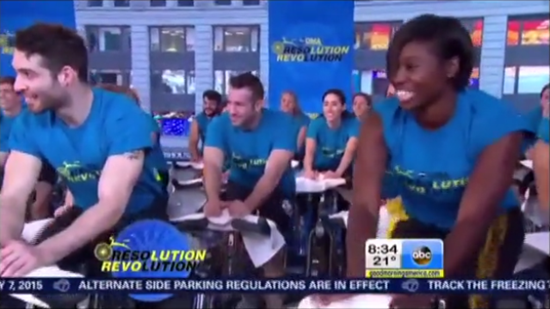
Five million viewers of ABC's “Good Morning America” TV program were treated to a wonderful promotion for Indoor Cycling this past week. As I watched I just couldn't help myself and began humming REM's Shiny Happy People. That was exactly what I was seeing > hundreds of shiny, happy people enjoying riding inside. I can't think of a better way to kick off 2015!
I'm of course describing the nationwide 2015 SoulCycle resolution ride that aired Jan 7th live on “Good Morning America.
What a way to jumpstart January! SoulCycle joined Good Morning America today for its Resolution Revolution. We tapped it back on SoulCycle bikes in their dressing rooms and hallways as well as in Times Square – while GMA showed live feeds from Soul classes happening in Bethesda, Chestnut Hill, Coral Gables, Short Hills and West Hollywood! Check out this video clip of all the action, including an interview with instructor ANGELA DAVIS on how to stay motivated as well as an update on our SoulScholarships Program. It was a good morning, indeed!
Here's the video of the event if you haven't seen it.
I see multiple hacked emails each week, that are sending out links to Malware sites to everyone in their contact lists, coming from the accounts of ICI/PRO members and subscribers to our weekly newsletter.
I've had websites that I personally maintain hacked in the past and sending out SPAM, as if it's coming from me.
I'm aware of friends and family who's identity was stolen, creating enormous hassles and expenses to clear their good name.
I'm also very aware the many of us spend a great deal of time online – actually it's not many… we all do. The truth is that there are Hackers watching and waiting for an opportunity to steal your identity and have you pay for their trip to Hawaii, or buy them a new 60″ flat screen TV.
Most importantly, I'm aware that many of you appreciate learning of these hazards, here from a trusted source.
So when I received this advisory from www.trustedsec.com, advising me that the healthcare.gov has serve security issues, I felt it was important to share this with you – so you can protect yourself and your family.
TrustedSec’s CEO David Kennedy released a written and oral statement for the Congressional meeting with the House Committee on Science, Space and Technology at Capitol Hill today (November 19). The meeting was to discuss the security concerns with the healthcare.gov infrastructure. The purpose was not to point out flaws to negatively show the website in any political view. TrustedSec remains neutral and agnostic to anything political related in regards to the Affordable Health Care Act. The purpose was to show that there are serious security concerns with the website. Our concern always remains the protection and security of the United States and it’s allies.
TrustedSec’s CEO David Kennedy will be presenting to Congress on Tuesday November 19, 2013 at 10:00AM ET on the security concerns around the Affordable Healthcare Act — healthcare.gov website. The website has been under scrutiny lately with not only performance issues but a number of glitches and security flaws that have been identified by TrustedSec as well as other independent security researchers.
David will present both a written and oral presentation to the Congressional committee on the security concerns around the website as well as a live demonstration on how an attacker could use information from the site to attack individuals that have registered.
It really is a big deal. There are people finding the personal information they entered at healthcare.gov, using a Google search, if they are even finding healthcare.gov in the first place 🙁
Our recommendation is to stay clear of healthcare.gov until these these security issues have been addresses and unbiased security experts give the all-clear.