
by Tom Scotto | Mar 24, 2026 | Master Instructor Blog
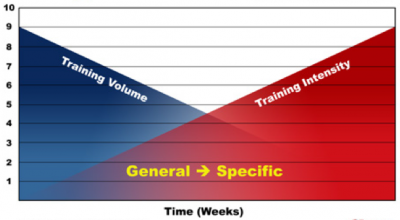 The purpose of my last article was to spur you on to start thinking about the approach to your classes at the beginning of the year. Being a coach, my natural tendency is to sway you toward a periodized approach. I was definitely very happy with the responses from the last article which could be summed up as “so, how do we do it?” As promised, here is a simple approach to early season periodization for indoor cycling that I have been using for the last 10 years.
Quickly….What is Periodization?
Periodization is a process of structuring training into progressive phases or blocks of time. In addition to the structure, there is a determined progression to the training from week to week and month to month. The progression manipulates a variation of Training Volume, Training Intensity and Training Specificity with a focus on the end goal (which could be anything from a pure fitness goal to preparing for a charity ride, century, cycling vacation or competitive event) or peak fitness. Although we are going to focus on the early season (or Base period), here is a simplified periodization plan I use for indoor cycling so you have a picture of how the Base period fits into the rest of the year:
- BASE Period: January – March
- BUILD Period: April — May
- PEAK Period: June — September
- TRANSITION Period: October — December
Keep in mind that how long and when each of these periods occur throughout the year is purely a function of the goals of a specific person or athlete. The above is a generalized approach I found suitable for indoor cycling classes.
Another DISCLAIMER
I’m going to reference 5 to 6 different ride profiles in the upcoming paragraphs. Unfortunately, I’m not going to be able to go into the details of each of these profiles for the sake of time and sanity. Each of these profiles could be an article or AudioPROfile in and of itself.
The Benefits of this Approach
Having a plan engages riders more because they often feel obligated to join in or continue. And it doesn’t matter which point a rider enters your plan. You may start your periodization plan in January and then get a new rider each week all the way through to March. No problem. Although each of the workouts is challenging, the overall intensities and specificity will be lower than usual, making it easy for new-comers to jump-in. The fact that they walked into a “plan” many times keeps them coming back because they don’t want to miss anything else. Plus, a periodized approach is a smart, proven training method which appeals to the cycling community as a whole and will draw more cyclists to your classes.
As a side note: Most of the classes I teach meet only once per week and thus there is only 1 training focus per week. The class that I have that meets twice a week gets the same ride twice. They appreciate a second chance at it, as they are often better prepared (mentally) to be successful the next go-around. Plus in the “real” world of cycling, many of these workouts/rides would be done 2-3 times during the week anyway.
The Plan
First I’ll layout the weekly plan and then I will give a brief explanation of each ride. Notice that in this plan, the same ride is not repeated for 6 weeks and the schedule takes you right into April.
- WEEK 1: Threshold Test
- WEEK 2: Aerobic Development
- WEEK 3: Leg Speed / Cadence Work
- WEEK 4: Muscular Endurance
- WEEK 5: Aerobic Endurance
- WEEK 6: Muscular Strength
- WEEK 7: Test / Review
- WEEK 8: Aerobic Development
- WEEK 9: Leg Speed / Cadence Work
- WEEK 10: Muscular Endurance
- WEEK 11: Aerobic Endurance
- WEEK 12: Muscular Strength
- WEEK 13: Threshold Test
Threshold Test
There are a number of ways to do a threshold test. My preference is the Foster Talk test which identifies 2 ventilatory inflexion points: VT1 (ventilatory threshold 1) and VT2 (ventilatory threshold 2). I’m going to use VT2 (or approximately 80% perceived effort) as the upper limiter on all of the remain class profiles below. Here is another method of performing a 20-Minute Threshold Field test posted on June 25, 2011 – https://www.indoorcycleinstructor.com/icipro-instructor-training/zone-based-heart-rate-training/is-a-20-minute-threshold-field-test-realistic-for-your-class-part-3/.
Another side note: I use the early part of the Threshold class to talk about proper form and technique while taking time to walk around the room and make necessary (wanted) adjustments.
Aerobic Development
This class consists of short aerobic intervals of 30 seconds to 2 minutes. It is easiest to break these intervals into sets using a 1 to 1 (work to recovery) ratio. The target intensity for each effort is VT2.
Leg Speed / Cadence Work
Another interval structure where the variable is now leg speed. Two common ways to structure these intervals is to either do a set of 1-2 minute efforts at 90 RPM, then do a set of 1-2 minute efforts at 100 RPM, etc. You can also approach it like a pyramid and design a set that starts with an effort at 90 RPM, then 100 RPM, etc. There are dozens of cadence drills one could use to build a nice varied class. Keep in mind that the speeds you target should be appropriate for your demographic of rider. The goal of these classes is to obtain the leg speed, while maintaining a smooth pedal-stroke technique, and without driving one’s heart rate above VT2.
Muscular Endurance
These are basically long climbs of moderate intensity ranging from 7 to 30+ minutes each. I tend to mix up the class giving them a climb closer to 7 minutes, than another at 14 minutes and yet another at 21+ minutes. It gives them a nice (duration) goal. The cadence range is closer to 65-75 RPM and heart rates should stay below VT2.
Aerobic Endurance
These are long steady-state efforts (with some gentle rolling roads) ranging from 4 to 10 minutes. This time the target intensity is VT1 or closer to 70% of their perceived effort. Like in most base building workouts, the stimulus is “volume” or duration and NOT intensity. And believe you me, if done correctly, are equally as challenging (physically and mentally).
Muscular Strength
Similar to the format of Aerobic Development, these are shorter interval sets of 30 seconds to 2 minutes, but the focus is on workload or heavy force on the legs. Cadence should range closer to 55 to 70 RPM. Be sure to caution riders who may have injuries before you introduce these. As always, rides should be instructed to work at their own pace and strength.
Test / Review
This is what I call a “Freebee”. I build a class consisting of 1 or 2 drills from each of the preceding weeks (same music and all) and present it as a test. “Let’s see how we have been progressing over the last 5 weeks. Take note of which drills are your strengths and which are you weaknesses. I’m happy to talk with you after class if you would like some guidance on how to adjust your training based on what you’ve learned.”
Rinse and Repeat
Yup, go through the previous 5 profiles again as you help your riders continue to build their fitness base. I like to leave the second threshold test to the very end. One generally gets a better result (or noticeable progress) after 10-11 weeks of focused workouts, and it is a great segue into the next phase of training.
Remember, BASE training is not boring but dynamic, varied and purposeful. Although the intensities are not near-max, the duration of time spent during each effort is longer and recoveries are often shorter (because…well…the intensities were not as high). Have Fun!
Originally posted 2011-11-18 17:54:48.
by Tom Scotto | Mar 4, 2026 | Master Instructor Blog
 Indoor cycling has had a reputation of being a good cardiovascular workout. And that is absolutely true. However, when an aspect of any activity is touted vigorously, the reputation that is created can become definition. Even a recent indoor cycling certification workshop I attended spoke of the aerobic benefits while going as far as to say other training approaches on the indoor bike are not recommended because they lack the aerobic focus. There is nothing farthest from the truth. Although cycling does not contain the weight-bearing qualities needed for holistic fitness, it requires the strength and conditioning of the entire body.
Building Strength
Building strength on an indoor bike requires a specific focus. Just this morning I trained a dozen cyclists on their road bikes and indoor trainers on muscular strength. This is one of the rare cases where our power meters can work against us. To develop strength, the muscles need to be stressed with great force. Due to the amount of resistance needed to apply this force, legs speeds are considerably lower (50 to 70 RPM). Anyone who has experimented with power quickly figures out that faster leg speeds are best for producing higher levels of power output (more watts). This knowledge and the presence of a power meter can be a hindrance to developing muscular strength. Why? Because riders will look at their power meters during a strength interval and see that they are generating less power, which often causes them to panic. To fix what they believe is a problem, they will reduce the resistance (force) and then increase their leg speed to increase their power output. This in effect will reduce the needed stress on the muscles and greatly decrease the effectiveness of the effort.
Power Per RPM
To set riders up for success, have them focus on how much force they can apply or power they can produce at a given leg speed or RPM. Let them know up front that this may be considerably less then they would produce during a steady-state threshold effort or high-tempo climb, but the “purpose” is to build muscular strength which will in turn allow them to produce more power when it counts.
Have your riders perform an interval (30 seconds to 2 minutes) and see how much force they can apply to their legs at 60 RPM, then 65 RPM and then 70 RPM. Use the cadence on your bike or the speed of the music to set the tempo. If your bikes have power meters, what is the maximum or average power sustained at the specific speed for the determined duration?
Strength intervals are usually done in sets with 1 to 1 recovery. So if you are performing 30-second intervals, riders should receive 30 seconds of recovery between each effort (and 3+ minutes of recovery between sets). The number of intervals you perform per set can also vary depending on who is in your class and if they are accustomed to strength training (WITHOUT weights) on the bike. As you and your riders become more conditioned, advanced combinations of repetitions, duration and recovery can be used.
Start incorporating some on-the-bike strength training and help your riders develop the muscular fitness they need. Indoor Cycling is not just for Cardio anymore.
Originally posted 2012-01-12 10:55:13.
by Tom Scotto | Jul 21, 2021 | Master Instructor Blog
 In my last article entitle “Make Recovery Work” we looked at how we as instructors can efficiently use recovery time to our advantage. Two of the main points were to use recovery as a time to provide instruction to prepare our riders for what is ahead and as a way to administer the “Recovery Litmus Test”. The biggest question that was prompted by the article was “so how long should recovery be?”.
An Excellent Question!
Not only and excellent question, but the right question. The subject of recovery ranks high on my “ticked off” list as an area needing much education and improvement. This is not just an indoor cycling issue, it is a dilemma I’ve seen in training as a whole. We live in a world of the 1-hour training block. To take it a step further, we are constantly asking (or being asked) “HOW MUCH can we jam into 60 minutes”. Well, as usual……it depends.
You Can’t Fake Reality
Many of us have experienced those indoor cycling classes where the instructor yells “GO!” within the first 2 minutes of the start of class and continues to pour on the intensity until the hour is up. Recovery….eh….stretching….eh…..wipe down the bike time is also reduced to barely 2 minutes. The goal is to “maximize” our class and our workout — squeeze the hour for what it’s worth. What an absolute waste of a class AND a bad sales practice (what?).
Instructors and riders alike often think that if you push hard through the entire class you will gain more fitness and lose more weight (the sales pitch). Because many have bought into this misconception, insane indoor cycling classes are still the rage (pun intended). Enter REALITY! The (physiological) reality is that most riders are not going to be able to hold 80-90% for an entire hour. One to 3 minutes is more like it. And then what happens? Their intensity decreases and decreases as their muscles continue to fatigue while their mental toughness dwindles. After 10 minutes of this insanity (being ridiculously generous), riders are reduced to 70% of their ability. The real fake out here is that the rider “perceives” that they are still working at 90+%. This is where having a power meter on your bike can sprinkle a does of the real world.
Top Performance Requires Adequate Recovery
Top performance is not just for the pros. It simply means to work at the best level of intensity for the given drill or effort. For example, if an interval requires that we maintain 80% of our ability for 5 minutes, maintaining only 70% will not provide the needed stress and will not yield the desired benefit. The sad part is, without recovery, our riders will never know they are getting gypped out of fitness. To them it stills feels like (is perceived as) a hard 80% effort.
Due to the time constraints (and lack of attention span of some riders), providing the same amount of recovery indoors, as we would when riding outdoors, may be unrealistic. But that doesn’t mean we throw out the baby with the bath water. For example, it may be ideal to provide 5 minutes of recovery after a hard 2 minute interval. In an indoor class, recovering for that long may cause riders to mentally tune out. Remember, we are trying to adhere to the best practices of exercise science, but not everyone in our classes are elite level athletes. So what do we provide? Considering the indoor environment and our demographic, 3 minutes to recovery can work. Let me provide some guidelines that may allow you to make better decisions. Keep in mind these are just “guidelines” and there are numerous variables.
I’ll break these down by using the common cycling zones 1 to 5:
ZONE 1 — ACTIVE RECOVERY (RPE 1-2 or Easy):
This IS recovery so one should not need to recover from recovery 🙂
ZONE 2 — ENDURANCE (RPE 3-4 or Fairly Light):
Endurance efforts can generally be held for longer times (1 hour +). In many cases, providing 1-2 minutes of recovery after an 8-20 minute steady-state endurance effort may provide more “mental” recovery than physical.
ZONE 3 — AEROBIC FITNESS (RPE 5-6 or Moderate):
Although aerobic fitness efforts can be sustained for 6 — 10 minutes by some, they can be considered very challenging for beginner and intermediate level riders. Depending on your class demographic, I would provide 1 — 2+ minutes of recovery depending on the length of the effort. If the duration of the effort is less than 3 minutes, 1 minute of recovery may be suitable.
ZONE 4 — SUB-THRESHOLD (RPE 7-8 or Hard):
Even though some fit outdoor riders can sustain this level of intensity for much longer, indoors these efforts are generally from 4 to 6 minutes in length and could require 2 — 4+ minutes of recovery respectively.
ZONE 5 — CAPACITY (RPE 9-10 or Extremely Hard):
These efforts can range from 30-second explosive sprints to 2+ minute anaerobic endurance efforts. If a rider is “truly” working at capacity, 3-5+ minutes of recovery should be well received.
Like most things that involve both the human body and science, there are many variables and options. One of them is Tabata training. In general, Tabata training provides a shortening (starving) of recovery between high intensity efforts to increase aerobic fitness and stamina. This type of training is best maximized by those with a higher level of fitness and should be “seasoned” into our training and not BE our training. And DON”T use Tabata training as an excuse to provide inadequate recovery in all of your classes. I WILL find you.
So as you can tell by my emotional state while writing this article, I’ve got issues surrounding this topic. Over the last 15+ years of coaching, I’ve seen numerous riders put at risk from over-reaching and over-training, as well as, a general loss of fitness. The biggest shame is that people don’t get to the fitness level they could achieve because they are working to hard to much of the time.
Give your riders Quality Training! Give your class the Real Thing!
Originally posted 2011-10-27 11:35:42.
by Tom Scotto | Jul 3, 2021 | Master Instructor Blog

ICI/PRO member question from ICI/PRO Podcast #203 Cycle Strong Audio PROfile
What exactly should the “openers” in the warm-up consist of? In Tom's “Getting Started with Intervals” audio profile, he described them as 30 seconds of maximum effort followed by 30 seconds of recovery, which to me sounds the same as the first Muscular Strength interval in this audio profile (30s effort/30s recovery). I would appreciate help understanding the difference.
As always, I greatly appreciate the audio profiles!!! And Marc, thank you for the playlist suggestions!
Kristi
Kristi,
Thanks for you question. It is a good one. Many people don't understand the purpose of openers and thus never do them or benefit from them. Simply, they are all-out, maximum efforts for the prescribed period of time (openers can be different lengths depending on their purpose and what one is preparing for). How do we define the “all-out” maximum effort? Think of it as the most resistance you can use at the highest cadence. I would recommend a cadence of 85 RPM or greater (I personally prefer 100+ RPM). You should find yourself through into the high-end of Zone 5!
So what's the difference between the openers and muscular strength efforts? The muscular strength efforts are limited by the cadence. In order to more effectively develop strength in the legs, the cadence needs to be slower (60-70 RPM) in order to provide the necessary stress (I.e. Force) on the muscle. This in many cases will not produce the highest heart rates (but pretty high). Simply put, what is the most resistance/stress/force I can place on my legs at for example, 60 RPM.
Openers push every limit for a short period of time in an attempt to activate systems such as your anaerobic energy pathway and lactate buffering. If you prepare and active these systems BEFORE the structured part of the workout, the body will not be behind the 8-ball and will respond more consistently and repeatedly.
Does this answer your question?
Cheers, Tom.
Originally posted 2017-03-28 09:04:06.
by Tom Scotto | Jun 24, 2021 | Master Instructor Blog
 Last week I was asked to sub a couple of classes for another instructor and friend. It was at a club that I used to teach at and where I still knew a number of the members. I always like teaching at this particular club because the riders throw out some good energy and appreciate a structured workout — my specialty. Since I was going to be covering both the 9:30am and 12:30pm timeslots, I decided to bring my laptop and camp out in the lounge area between classes to get some work done.
The energy of the 9:30am class was great and the room was full. I taught on and off the bike walking around the room to encourage riders I hadn’t seen in a while and meet some new faces. After class, a few people hung out. I also took the time to make a few adjustments to the bike setup of a couple of riders. It was definitely one of those classes that often gives you (the instructor) more back than one feels was given. I left energized and refreshed and was now looking forward to the 12:30pm class.
I settled down in the lounge area and fetched myself a cup of complimentary coffee. As I was checking emails and eating a Pop-Tart (yes, I got grief for that – “What, Coach Tom Scotto is eating junk food”) one of the riders approached my table and asked if she could interrupt me. Sure, I love talking with people at the club and particularly about cycling. These were her exact words: “Your class and workout was great, but your music sucks”. She said it in such a genuine, yet straight-forward way, that I could do nothing but smile. “Wow, that is quite a range of feedback. Would you mind bridging the gap for me? What did you like and why such a strong response to the music?”
She sat down and told me how the workout was perfect and how she felt the exact challenge I had presented during the intro. She remembered each of the drills and told me her heart rate ranges for each. I was quite impressed with her detail and assessment of how she felt during each effort. “So what’s up with the music?” I said. She said it was just awful. “I hate all of that electronic stuff”. Now I was quite certain the instructor I subbed for played very similar music, so I asked what she thought of the music the regular instructor plays. “Oh, his music is terrible too. I can’t stand that electronic junk”. She told me she liked popular music with vocals. I asked her how she was able to make it through the entire class with that brutal noise. She said that, although she hated the music, it somehow fit the flow of the class and matched the workout. “I just focused on what we were supposed to be doing and blocked out the music”.
I thought this was very interesting. How could someone who had such a violent reaction to the music actually enjoy a class — to the point where her overall assessment of the class was “great”. Being a musician, I’m particularly sensitive to music and would find it hard to enjoy a class if I “hated” the music. Her feedback demonstrated the importance of delivering sound training. It is so important that a 50% Great plus a 50% Sucks stills equals “great”.
Now I don’t think she was speaking to the soundness of the “physiological training concepts”, but what I took away from her comments was that she appreciated the thought and structure that went into designing the class. I thought this was great news. As a coach, I have all kinds of workouts just waiting to pour out of my head. The challenge is always the music. It can take me hours to pull together just the right songs. So, as I said, this is good news. It doesn’t mean we don’t have to focus on the music, but if we take the time to put together a sound workout, it can overshadow our music choices.
So what does this really mean for us? It is a call for each of us to take the time to design a solid ride profile. How much time and effort do we take to construct our workouts or rides or whatever we call them? Could your profile stand on its own WITHOUT music? Wow, that’s a challenge! I’m sure there is quite a bit more that we can pull out of this experience, but I’m more interested in hearing your feedback and thoughts?
I’m off to download some new music. Apparently, my tunes suck.
Originally posted 2011-04-15 15:03:17.
