When I grew up in New York, print journalism was thriving and the New York Times was regarded as the finest newspaper in the U.S. I still view it that way.
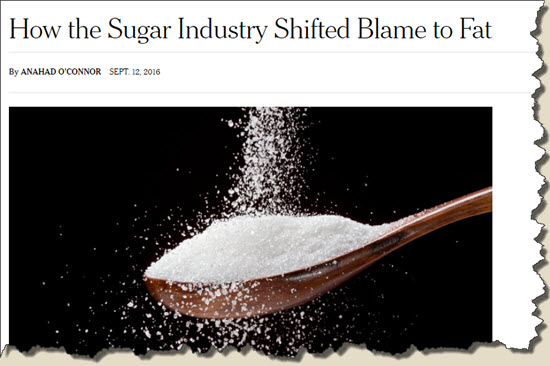
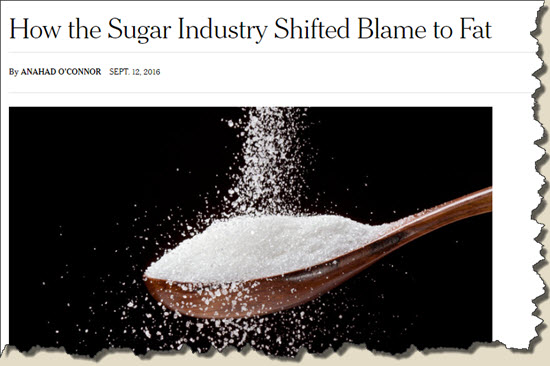
So am I allowed to brag that I scooped the NY Times?! Perhaps you’ve seen the recent article on how the sugar industry shifted blame to fat by paying scientists to move health research in that direction.
Over a year ago (June 2015), I wrote an article called “Why Sugar Hacked Science (And Your Health).” It described the sugar industry’s underhanded finagling to shift research to the so-called dangers of fats. I didn’t investigate or uncover payouts, just facts I had observed directly and in reading for my doctoral dissertation.
My article traced sugar’s link to the obesity trend, along with the impact on the fitness industry and more. And now we can bolster it with knowledge of the money trail.
Bottom line: The sugar industry was responsible for the U.S. obesity epidemic (and all the attendant health issues) because they didn’t care about anything but their own profits.
When we add to the picture its payouts to Harvard scientists, the sugar industry clearly emerges as nefarious, greedy, a bottom-feeder. As bad as Monsanto? Worse? You decide.
So What Happened? And Keep It Brief!
Science journals in the 1970s featured many articles on the negative health effects of sugar. Films were available. William Dufty wrote Sugar Blues in 1974.
I knew the sugar industry was a powerful lobby in Washington, D.C. By 1984, it had managed to spin fats as the new dietary enemy. We now know it was done with payoffs to scientists and prominent science journals like the New England Journal of Medicine.
From that point until the end of the 1990s (and beyond), we suffered through the low-fat craze. Remember? It was “the right way to eat.”
Scientists began researching health problems caused by high-fat diets, saturated fats, red meats, cheeses, and so on.
Food companies created low-fat and non-fat versions of their products. To replace lost flavor, the new products used sugar.
Dietary fats fell far below original recommendations of 30%, traditionally endorsed by the American Heart Association and the American Cancer Society.
My clients’ protein intake fell, too, especially in women looking to lose weight. Protein contains fat, so they started eating carbs instead. Lots of them.
Pasta, Anyone? Nonfat Frozen Yogurt? New Trends!
Recommendations for increased carbohydrates came from everywhere, but it would have happened anyway. Once you eliminate fat and avoid protein because of its fat, carbs are the only thing left.
The Pritikin Center recommended diets of 7% protein and below 10% fat, leaving 83% or more in carbs.
My clients’ food logs showed which carbs they were eating. Not vegetables, legumes or roots, but sugar and white flour.
During this low-fat craze, U.S. sugar consumption rose 25 pounds per person per year. That was just the increase, not the total consumption. It kept rising. By 1996, sugar consumption was up again for the tenth consecutive year.
That sugar/fat seesaw (one goes up, the other down) is acknowledged in science journals but not explained. In my doctoral dissertation, I explained the hormonal and neurochemical links.
Consumption of high-fructose corn syrup rose, too, based on 1991 USDA figures.
During that period, obesity in the U.S. became epidemic. After 20 years at 25% of the U.S. population, overweight shot up to 33% in the 1980s. The Minnesota Heart Health Program tried — and failed — to explain the increase with data on dietary fat.
In 1995, the American Journal of Clinical Nutrition devoted an entire supplement to the papers presented at a conference on dietary sugar. Presenters were hand-selected; I recognized their names instantly. They ALWAYS found that sugar had no negative consequences — on health, weight, cavities, or anything else. (Do you wonder who funded them?)
The result: Every food company attending — all big sugar-users — could claim that a scientific conference presented evidence that sugar is not bad for any reason.
The Fitness Industry Must Take Some Heat
By the late 1980s, the fitness industry had jumped on the low-fat train. (I got trapped on it, too.) Weight-loss guidelines reflected low-fat dogma.
Fitness conference goody bags were filled with low-fat, high-sugar bars. Fitness instructors (and others) ate them “for energy.”
In the early 1990s, I spoke to a group of fitness pros on health problems linked with sugar. An angry woman shouted, “I have the same degree you do” — we both had mater’s degrees in exercise physiology — “and you don’t know what you’re talking about!”
I have many other examples, but let’s not make this about me.
Controversy raged. Fitness industry publications railed against fats in one issue, against carbs in the next.
In 1998, just 3 years after its “sugar’s just fine” issue, the American Journal of Clinical Nutrition devoted an entire issue to the benefits of fats in fighting obesity and metabolic disorders. Several articles in it addressed the failure of low-fat diets to effect long-term weight loss.
We’ve Now Come Full Circle
People now recognize the danger of high-sugar foods. You may think the sugar industry will be unable to bamboozle us again.
But everywhere I go, I see a push for “sneaky sugars.” And consumers want to believe that agave isn’t sugar, or that products sweetened with fruit juice or coconut sugar are different.
A man walked out of my presentation when I answered that, yes, fruit is sugar.
What we’re told about nutrition in the U.S. is not what we should know or do. It’s what will benefit the food industries — they’re the real constituents of the USDA.
Sugar can cause inflammation, increase appetite, and trigger cravings, binge eating and mood swings. It can cause (yes) diabetes, insulin resistance, hypertension, and other metabolic disorders. It affects autistic kids.
Fructose, the sugar in fruit, is arguably the worst sugar. It’s the half of sucrose that makes it junk. Yet people are more reluctant than ever to give up fruit juice, syrups, or many servings of fruit. I’ve written book chapters on fruit as the “final frontier” in nutrition health. It probably is.
It’s fun to say that I scooped the NY Times, but much work remains to be done. I’m passionate about helping you conquer sugar so you can transform your health, stop binge eating, eliminate cravings, stop moods swings, and feel fantastic. Get started now. Grab your free copy of “3 Biggest Mistakes People Make When Trying To Quit Sugar” right here.
I love finding and sharing the latest music with you each week, but this week I'm going back a few years to share a song I've been loving lately. We'll be riding on a flat road at about 95 RPM with this song from 2001:
Premium Members can download this mix for free by following the links below:
[wlm_private ‘PRO-Platinum|PRO-Monthly|PRO-Gratis|PRO-Seasonal|Platinum-trial|Monthly-trial|PRO-Military|30-Days-of-PRO|90 Day PRO|Stages-Instructor|Schwinn-Instructor|Instructor-Bonus|28 Day Challenge']
Right Click on the blue underlined link
Select “Download Linked File As”
Select a download location
Once file is completely downloaded, find it in the location you selected
Drag the file into your iTunes or Spotify library OR
Right Click on the file and Select “Open With”
From the drop down menu select “iTunes” or “Spotify”
File should begin playing and is now part of your iTunes or Spotify library
To download the above media on a PC:
Right Click on the blue underlined link
Select “Save Link As”
Select a download location
Once file is completely downloaded, find it in the location you selected
Drag the file into your iTunes or Spotify library OR
Right Click on the file and Select “Open With”
From the drop down menu select “iTunes” or “Spotify”
File should begin playing and is now part of your iTunes or Spotify library
Click here to watch a video on how to download media files from ICI/Pro.
With summer coming to a close, I thought I would share my favorite songs of the summer of 2016. These are the songs you'll hear over the next few years that will take you back to those hot summer days of 2016. This is more of a compilation than a cycling playlist, so pick and choose your favorites for your own playlists and be sure to share your favorite song of summer from 2016 in the comment section!
1. Which foods are carbs?
The definition of carbohydrates is complicated, boring, and probably not something you’d want to learn. But your prospective nutritionist should know that carbs include vegetables and fruits, as well as the foods most people call carbs, good and bad. (Those include breads, pasta, cereals, potatoes, sweet potatoes, lentils, beans, quinoa, squash, rice, turnips, parsnips and other root vegetables.) For clarity, I call them starches.
2. Do you recommend low-carb diets? Why or why not?
This depends on how low you mean. Paleo diets are popular, but not always a good idea.
Low-carb eating may make a poor training diet. Hard workouts virtually demand healthful starches. Refueling with starch plus protein after a tough training helps replace glycogen, critical after a workout. Extremely low-carb diets can even trigger cardiac arrhythmias in some people.
Appetite control is easier with a food plan that includes healthful starches. This has to do with serotonin production. And if you’re not eating starches, you may crave sugar and/or alcohol.
3. Is weight loss just a matter of calories in/calories out?
The ideal answer is calories do make a difference but are absolutely not the whole story. Hormones — insulin is one key hormone in this — influence weight gain, the 24-hour fat oxidation rate, and more. What you eat influences weight, not just how much.
4. Will you work with my lifestyle / frequent business travel / doctor’s recommendations?
The ideal answer is “yes.” No food plan should be so unyielding that you can’t modify it for these factors. You may need to be willing to prepare — say, in advance of your travel dates. But the plan should allow for your individual needs, and the nutritionist should have suggestions.
5. What should I eat after a workout?
The best answer is starch and protein in a 3:1 ratio. The 3:1 can be easily calculated using calories or grams, since carbs and protein yield 4 calories per gram.
You need to eat no later than 30 minutes following your training. That may mean eating in the locker room and bringing appropriate foods with you. Avoid fats in that 30-minute window because they’ll slow the absorption of carbs.
Your nutritionist should know all of this, as well as why eating within the 30-minute window is critical.
6. I sometimes have mood swings (or feel depressed). Can foods change my moods?
Let’s assume you’ve talked to your doctor about your moods and received a qualified medical opinion about what you do or don’t need.
The answer to this question is definitely yes: foods can change your moods. A vague answer about eating well and feeling better as you become healthier is neither responsive nor helpful.
Foods affect moods because they modify brain chemistry. If your prospective nutritionist can’t explain the exact changes you can effect with diet — and if moods are a critical issue for you — you may need to find one who understands that.
7. Will I ever get rid of my sugar cravings?
The answer to this should be yes. Say you have frequent or strong sugar cravings. A nutritionist who talks about “curbing” cravings or tells you everyone has them might not be ideal for you. If he/she suggests eating a little of what you crave or substituting fruit, that’s also a red flag.
8. Should I eliminate any foods or food groups? Why or why not?
If the nutritionist suggests eliminating carbs, or fats, those diets may not work for a variety of reasons. But if she/he recommends eliminating specific types of junk — such as white flour or sugar — that’s good.
9. I hate vegetables and always have. Do I really need them, or can I just eat more fruit?
Vegetables and fruits are not equal. They’re certainly not interchangeable. Fruits have nutritional value but are no substitute for veggies.
The nutritionist should know that hating vegetables often indicates a high-sugar diet. The ideal step is to check that, then check your family history for factors that may make you carb-sensitive, sugar-sensitive, or both. Next would be a plan that modifies brain chemistry and changes your food preferences so vegetables no longer seem unpalatable.
10. I’ve heard of stomach hunger and mouth hunger. What’s the difference?
These terms are typically used to distinguish real hunger from appetite. But they confuse people. If you ask someone if she ate because of stomach hunger or mouth hunger, she may say, “I’m not sure.”
I describe hunger to be sure a client can recognize and feel it. I save “hunger” for real physical hunger — signals the body sends that it needs food. If someone eats for any other reason, that’s an urge or desire to eat. It’s less confusing.
Many nutritionists are available. These questions vary enough that they can help you screen your nutritionist from the wide field and find one who’ll help you do what you need.
Are you seeking nutrition support for mood issues, sugar cravings, fueling for workouts without the junk that’s out there? Perfect, that’s what I do. My field is Psychoactive Nutrition, how foods affect brain chemistry and hormones, and I’d love to help you.
Please visit www.FoodAddictionSolutions.com/Coaching and request a free Food Freedom Consult. Find out how a few tweaks can improve your moods, your energy, and your workouts — so you can feel fantastic every day.
Today's track is one of my favorite tunes of the summer, HandClap by Fitz and The Tantrums. The original is great, but also make sure to check out the remixes below. Part 1 came out at the end of July and Part 2 just dropped today, so if you're interested in a longer version or using a different BPM, you can probably find that with these remixes. I've used the original as a flat road with accelerations on the ‘hand claps'.