
by Ben Greenfield | Sep 4, 2019 | Engage Your Students
As an indoor cycling instructor, you’re going to find a large percentage of your students dabble in triathlon, or engage in it as a serious sport. Either way, you don’t want to be embarrassed by using the wrong triathlon-related words or terms in your class when talking to them about triathlon (including the ever-popular pronunciation of triathlon as “triath-a-lon”).
So to help you look better and converse intelligently and confidently with your indoor cycling students who are triathletes, this is Part 1 of a five part series called “Tri-Lingo 101” that will teach you how to use the correct triathlon terms. In this article, you’ll learn common triathlon swim terms. Without further ado, let’s dive in!
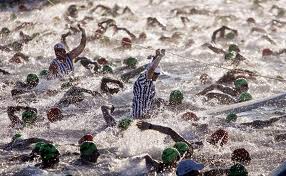
Beach start: Starting from the beach and running into the water to begin a triathlon.
Buoy: The floating markers used on a triathlon course to indicated course layout, distance and turns.
Deck: The hard surface around the pool.
Draft: To swim directly behind or beside the swimmer in front of you, which makes it easier to swim.
Floating start: Starting from the water without the feet touching to begin a triathlon.
Freestyle: The common front stroke style swimming usually used in triathlon.
Kickboard : A floating piece of styrofoam used to for kicking drills.
Lane : A sectioned area of the pool for lap swimming. Typically, a pool is divided into 3 or more lanes.
Lane Lines : The floating markers which that separate the lanes.
Lap: From one end of the pool to the other and back.
Length: From one end of the pool to the other. A “half” lap.
Flags : Small triangular pennants hung over the pool to indicate that the end of the lane is near.
Master’s: A swim class, group or club for adult swimmers.
Open Water: Outdoors swimming in a lake, river or ocean.
Pull Buoy : A floating piece of Styrofoam that goes between the legs so that a swimmer doesn’t need to kick.
Transition: Transitioning from the water to the bike portion of a triathlon.
Wall : Vertical part of the pool that is typically touched between lengths.
Wetsuit legal: A triathlon in which the water is cold enough to allow a wetsuit.
Bio:
Ben is a fitness business coach, triathlon author, and sports nutritionist. If you want more videos, aricles and audios about swimming and other triathlon related topics, visit Ben’s free blog and podcast at http://www.bengreenfieldfitness.com . Also be sure to check out Ben’s endurance sports website Endurance Planet, at http://www.enduranceplanet.com and his Rock Star Triathlete Academy, at http://www.rockstartriathlete.com . Finally, if you want to learn how to grow your fitness business and make more money, visit Ben’s fitness business advice website at http://www.trainfortopdollar.com .

Originally posted 2011-02-06 09:08:50.
by Ben Greenfield | Mar 16, 2011 | Ben Greenfield, Instructor Training
As an indoor cycling instructor, you’re going to find a large percentage of your students dabble in triathlon, or engage in it as a serious sport. Either way, you don’t want to be embarrassed by using the wrong triathlon-related words or terms in your class when talking to them about triathlon (including the ever-popular pronunciation of triathlon as “triath-a-lon”).
So to help you look better and converse intelligently and confidently with your indoor cycling students who are triathletes, this is Part 5 of a five part series called “Tri-Lingo 101” that will teach you how to use the correct triathlon terms. In this article, you’ll learn common triathlon race terms. Without further ado, let’s dive in!
Aid Station: Typically every 1 mile to 1K on the run and every 10-20 miles on the bike, there will be an aid station with gels and water. Plan for these when packing your race fuel and hydration.
Marshall: Typically one or several individuals are on the course, ensuring that the rules are followed, and flashing penalty cards at individuals who do not follow the rules. On the bike course, they are usually on scooters or motorcycles. These vehicles are legally permitted to be on the race course and are there for your safety.
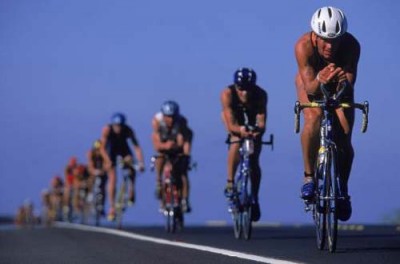
Pack: A group of cyclists that forms during the race. It is possible, if each cyclist is separated by 10 meters, for this to be a legal form of racing in a non-draft legal race, but in many cases “illegal” packs form.
Penalty: During a race, if you are caught illegally drafting, littering, cutting the course, passing on the wrong side of the road, or committing any other activity that has been banned by the race director or officiating body, you will serve a penalty, which is typically A) stopping your bike, waiting, and then starting again; B) stopping for 2-5 minutes in a penalty tent; or C) having time added to your finishing time.
Penalty Tent: Also known as the “Sin Bin”, these are commonly seen in Half-Ironman and Ironman events, and are where you must stop to complete several minutes of penalty time if you are caught drafting or littering.
Podium: Typically the first 3-5 competitors in each age group qualify for a podium finish, which typically receives some type of trophy, medal or certificate in addition to a finisher’s certificate.
Slot: In any races that are “qualifiers” for any type of championship, such as Hawaii Ironman World Championships, there are a limited number of allocated slots that are given to the fastest triathletes. Many times, people will wait for the “roll-down” if they did not get a “slot”, which means they may be able to take slots that qualifying athletes turned down.
Special Needs: During an Ironman distance triathlon, there is a point about halfway through the bike and halfway through the run where you can collect a special bag that you have pre-packed with any needs you may have. The bag is given to you by volunteers.
Volunteer: These individuals are not paid and volunteer to do things like building transition area, handing out aid, timing the race, giving out medals, and even working in the medical tent. Smile at them and thank them!
Bio:
Ben is a fitness business coach, triathlon author, and sports nutritionist. If you want more videos, aricles and audios about swimming and other triathlon related topics, visit Ben’s free blog and podcast at http://www.bengreenfieldfitness.com . Also be sure to check out Ben’s endurance sports website Endurance Planet, at http://www.enduranceplanet.com and his Rock Star Triathlete Academy, at http://www.rockstartriathlete.com . Finally, if you want to learn how to grow your fitness business and make more money, visit Ben’s fitness business advice website at http://www.trainfortopdollar.com .
by Ben Greenfield | Feb 13, 2011 | Ben Greenfield
As an indoor cycling instructor, you’re going to find a large percentage of your students dabble in triathlon, or engage in it as a serious sport. Either way, you don’t want to be embarrassed by using the wrong triathlon-related words or terms in your class when talking to them about triathlon (including the ever-popular pronunciation of triathlon as “triath-a-lon”).
So to help you look better and converse intelligently and confidently with your indoor cycling students who are triathletes, this is Part 2 of a five part series called “Tri-Lingo 101” that will teach you how to use the correct triathlon terms. In this article, you’ll learn common triathlon bike terms. Without further ado, let’s dive in!
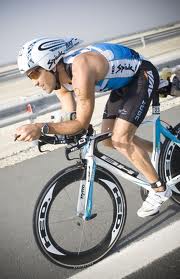
Aerobars – Because it is more comfortable and more aerodynamic for triathlon racing, most triathlon bikes are equipped with these type of bars, which attach to the handlebars or stem of a bicycle and allow you to ride in the aero position. These can also be placed on a road bike.
Aero Bottle – Many triathletes attach a water bottle to the aerobars rather than to the down tube or seat tube, which makes drinking in the aero position an easier task.
Aero Position – Also known as the time trial position, the aero position involves riding in a “hunched over” position with the elbows resting on the aerobar pads. This saves your running muscles and helps keep you aerodynamic, especially on the relatively flat bike courses that most triathlons have.
Bonk – Because you cover long distances while cycling, it's easy to get stuck during a ride or race without food or fuel. When this happens, your blood sugar can drop so low that your brain goes into a fog and your muscles quit firing. This is called a bonk. The fix? Eat fast and eat lots. I hate it when that happens… John
Brick – A “Bike-Run” workout, in which you run immediately after finishing the bike leg of a triathlon or a bike workout.
Cadence – The speed of pedaling while bicycling, also known as RPM, or Revolutions per Minute.
Disc – A solid wheel that is very aerodynamic and often used as a rear wheel in triathlons.
Down Tube – The tube of the bike that runs from the handlebars and diagonally slopes down towards your back wheel.
Drafting – Riding close enough behind the cyclist(s) in front of you that you pedaling becomes less difficult due to that rider stopping some of the wind resistance. This is illegal in most triathlons, and you must typical maintain 3-4 bike lengths behind the person in front of you.
Dropped – When you're riding with a group of cyclists who are drafting, and you eventually get too far behind to be in the draft, you'll find that the gap increases between you and the group, pedaling becomes harder, and you can't catch up. You've been dropped.
Hammer – To pedal very hard, typically for an extended period of time (i.e. “That ride was a Hammer-fest!”).
Seat Post – The tube on the bike that attaches to your saddle, and is typically adjustable up and down. On some triathlon bikes, it can be cut.
Spin – To ride easy, in recovery mode, or pedal with very low resistance. The opposite of hammer.
Time Trial – Typically a 20-180K ride at the maximum sustainable pace, usually performed in the aero position. The bike leg of most triathlons is defined as a time trial.
Top Tube – The tube that extends from the handlebars, between your legs, and horizontally back towards the back wheel.
Ben Greenfield is a fitness business coach, triathlon author, and sports nutritionist. If you want more videos, aricles and audios about swimming and other triathlon related topics, visit Ben’s free blog and podcast at http://www.bengreenfieldfitness.com . Also be sure to check out Ben’s endurance sports website Endurance Planet, at http://www.enduranceplanet.com and his Rock Star Triathlete Academy, at http://www.rockstartriathlete.com . Finally, if you want to learn how to grow your fitness business and make more money, visit Ben’s fitness business advice website at http://www.trainfortopdollar.com .
by Ben Greenfield | May 7, 2010 | Ben Greenfield
 It doesn't matter how much you exercise, how well you eat, or how strictly you control your caloric intake — your body is constantly stressed or your sleep is inadequate, you will constantly fail in pursuing your health, wellness, or performance goals. But if these barriers are removed, you will vastly improve your ability to gain maximum benefits from a good nutrition plan.
As you explain the importance of stress and sleep to your class, here is what to tell them:
The body has several neurotransmitters that are actively involved in control of appetite and mental motivation. Dopamine, one neurotransmitter, is your body's pleasure molecule, acting to significantly affect desire for activity, eating satisfaction and food cravings. Inadequate dopamine increases the chances that you will have a decreased drive to exercise and be less effective at regulating your nutritional intake.
(more…)
by Ben Greenfield | Apr 26, 2010 | Ben Greenfield

It starts with a good breakfast!
For your class to truly reap the full benefits of any workout, they must fuel and re-fuel properly — and a full understanding of pre and post-workout nutrition is one of the best gifts you can give your indoor cycling students!
It is important to understand that if the body’s carbohydrate stores are depleted, then fewer overall calories are burnt during the workout, more stress hormones are released during and after the workout, and the overall fitness response is hampered. Furthermore, if carbohydrate and protein levels are not replaced within 20-60 minutes following the workout (shorter periods of time applicable to individuals with higher metabolisms), then recovery is diminished, and a crucial window of time for the muscles to uptake sugar and proteins into muscle is missed.
Despite this fact, many students feel that in order to lose weight or burn fat, they must starve themselves both before and after their indoor cycling session. These individuals must be reminded that they are slowing their progress and wasting much of their workout benefit.
The best place to begin teaching your class about pre and post-workout nutrition is to give them several simple rules to follow:
(more…)
