by Gino | Dec 7, 2017 | Instructor Training, Master Instructor Blog, Training With Power
Data Collection for the Power Accuracy Research project
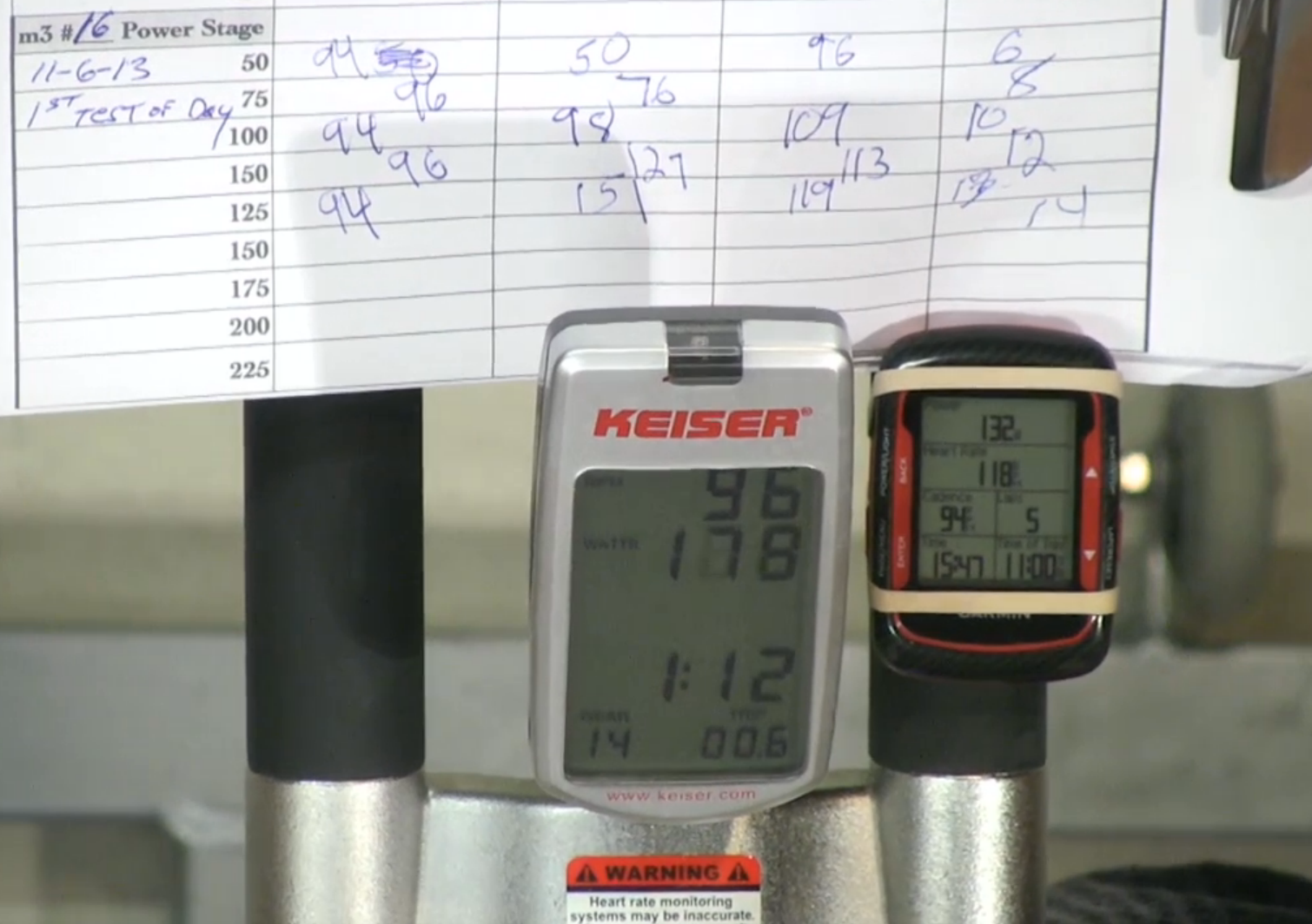
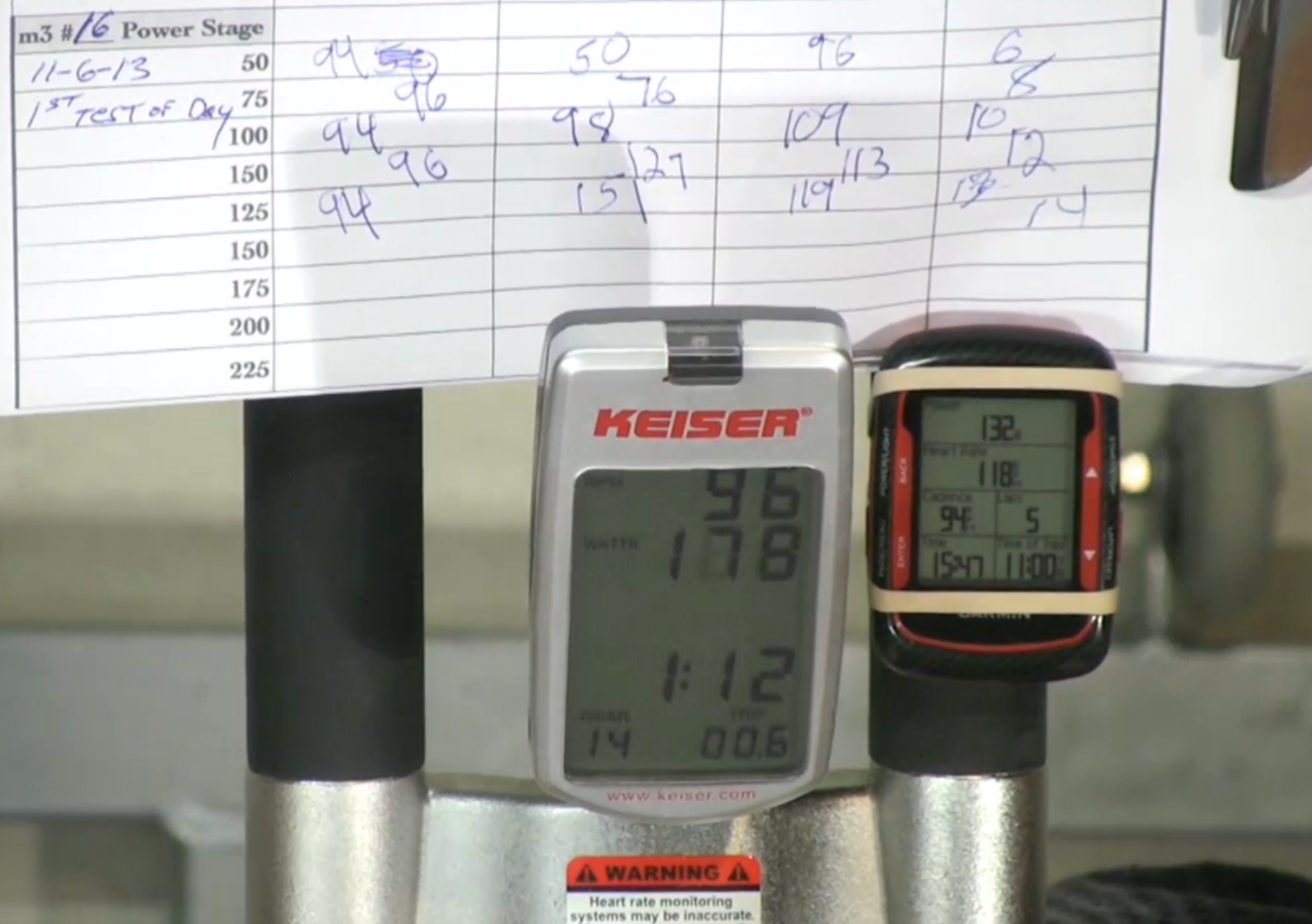
On the last blog post (8/11/17) v we spent a considerable amount of time showing how we set up the test, the equipment, calibrating the power pedals for each trial, positioning all of our data collection tools, and just preparing each test in a methodical manner. This post picks up where we left off and is the only video blog showing the entire test performed on the Keiser m3 with the Vector Power Pedals. This was done so that the reader can see the precise protocol used for all of the trials for all of the different bikes and the repeats with the same bikes.
I only recorded one full session (out of the 25 to 30 total that I performed) as a “reference” session so that the full and complete protocol can be understood and seen. You can even follow along with your own bike if you want to ride while you watch this video.
The most interesting thing to note is that you can see the power clearly as the test progresses between the Keiser and the read out on the Garmin. The variance is significant.
Watch the 2nd video blog.
http://vimeo.com/78919570
Indoor Cycling Power Accuracy Research from Cycling Fusion on Vimeo.

by Gino | Nov 30, 2017 | Training With Power
 No, MSP doesn’t stand for “My Secret Pal”, nor does it stand for “Mom’s Special Potion”, and I’ll stop right there before this gets really silly. MSP stands for Maximum Sustainable Power. It is the level of power once can sustain for a specific time interval. When you are referencing an hour interval (measured and estimated with 20 minute tests), most elite cyclists who train with power refer to this as FTP or Functional Threshold Power.
I prefer to reserve the term “Threshold” for that unique metabolic event that takes place with respect to the production of energy; the “cross-over” process between the aerobic and non-aerobic energy production systems. In my opinion, this term should be reserved for cardiovascular training (it has been used and researched with this term as the agreed upon nomenclature for years before power meters even existed). Therefore, to avoid confusing heart rate and power training terms, I do not refer to threshold with respect to power, but instead reserve its use solely to reference ones heart rate when this metabolic event occurs.
(more…)
by Gino | Jul 17, 2017 | Master Instructor Blog
[plulz_social_like width=”350″ send=”false” font=”arial” action=”like” layout=”standard” faces=”false” ]
 Not sure how you’d construct an experiment on this one
If you’ll recall from Blog post #5, we are doing our best to stick to “The Scientific Method” as we conduct our research. To that end, we have just accomplished three of the initial steps:
The Process So Far
- Select a topic of study
- Simplify the topic
- Conduct a review of the literature
Now it’s time to form a simple and direct hypothesis to act upon. The word “hypothesis” is the fancy science term for basically “my best guess”. That’s really OK since without an idea being a mere guess, we have no reason to do the research. We want to find out if our guess is true or not, and if it is true, the next phase of development would be to use that knowledge to make us (or our students) better riders.

Testability — Can It Be Measured
While it goes without saying, if one can prove something, one should be able to disprove it as well. Either outcome is acceptable if one can measure what is being studied. To do that, we must identify the Variables that are going to be specifically studied an used to prove or disprove our Hypothesis.
A Variable is a factor or element that can be changed and manipulated in ways that are observable and measurable. However, the researcher must also define exactly what each variable is using what are known as operational definitions. These definitions explain how the variable will be manipulated and measured in the study.
“These precise descriptions of each variable are important because many things can be measured in a number of different ways. One of the basic principles of any type of scientific research is that the results must be replicable. By clearly detailing the specifics of how the variables were measured and manipulated, other researchers can better understand the results and repeat the study if needed. (1).”
Our Variables for Muscular Endurance
Fortunately for us, the two variables that are being manipulated are also easily measured in our exploration of Muscular Endurance. These are Cadence and Heart Rate. Since we have used these to define the range at which one should expect the training effect to be activated or produced is defined by those very parameters. These would also be referred to as the “Independent Variables” since an independent variable is a variable that is manipulated in an experiment. We are going to have our subjects change their cadence and heart rate (through resistance or gearing).
The dependent variable is measured to determine if the manipulation of the independent variable(s) had any effect. In some ways, this is the more important variable to identify in that it represents the actual training result we are looking for. In this case, it is the Muscular Endurance of the legs. The problem is how to measure that. Unlike a proper research lab at a university, we do not have a near-infrared spectroscopy (NIRS) which estimates the relative changes in muscle oxygenation and blood volume during exercise.
That being said, it is true that researchers only began using this equipment in recent history, and so the practice of measuring one’s physical ability (or that of one’s legs) has been commonplace in this type of research and can be done with specific controlled riding drills.
The Hypothesis Formula
To “formalize” our hypothesis, we only need to construct it as an “If-then statement”. Specifically, it would be in the format:
IF Independent Variable = X and/or Independent variable = Y, THEN Dependent Variable should change (improve, increase, etc).
Specifically, our hypothesis would be formalized to look something like this:
IF a cyclist maintains a cadence within the range of 65 and 85 RPM while keeping their heart rate within a designated range of BPM (the middle of their Heart Zone 3 and 4) THEN improvements in Muscular Endurance will ensue after some period of repeated training sessions.
The next post will discuss the specific drills we will use to measure the level of Muscular Endurance in each of our study participants.
(1).Form a Hypothesis
By Kendra Cherry, About.com Guide
Originally posted 2012-05-31 12:23:44.
by Gino | Jul 5, 2017 | Training With Power

I’m going to go out on a limb here (wow, that’s new for me right? NOT!) and say that we will see a resurgence of interest in Power this year. It’s not rocket science nor spooky soothsaying, it’s just logical from my point of view. When the Keiser & Schwinn made their initial power introduction to the market about 5 years ago, there was considerable interest and attention. Well, one or two Schwinn recalls later, and a Keiser journey that kept their data locked inside their smallest of on-board computers, we found interest slowly wane. About that time Flywheel and Soul Cycle started to become the talk of the town, and I do mean that in the most New York sense of the word.
The interesting thing about Flywheel is that their initial element of distinction was their custom “power” (or as they refer to it – torque) as represented on their group display called the “Torque Board”. It was neither power nor torque, and I wrote about my first hand experience in an earlier blog, but nevertheless it began to get some excessive PR as is often the case with things that are new or different in New York City.
As I watched from the sidelines, I think this actually helped Soul Cycle since the founder of Flywheel was originally part of the partnership that created Soul Cycle and the mere discussion of this fact helped both get more media exposure. These two female powerhouse entrepreneurs have been a veritable case study in seizing the market with savvy PR, branding and professional connections to the point that they have stayed the center of attention in the Indoor Cycling world for probably the last 3 years.
In the meantime, those that have focused more on the technology rather than on the experience have been quietly seeing more and more options for displaying power and all of its related metrics on not only the slew of new bikes, but also in the way of group displays.
Suunto may have started the group heart rate experience, but Polar, MyZone, and Performance IQ were quickly on their heels with similar offerings as well as adding power to the mix. With the bigger studios beginning to consider how they can compete with the Soul Cycle and Flywheel expansion, they are beginning to look at technology and other ways to differentiate the experience or even introduce real training in the mix.
As my dad used to say when he had an inside scoop, “A little birdie told me” that this March, at IHRSA we will see Keiser finally unlock their data with a couple options for getting the data out of the computer. Given that they sold more power bikes than any other manufacturer since power was introduced to the market, this should be the final element needed to pull the new technology players into the limelight and begin to turn soul cycle mania into a more power player movement.
Only time will tell if my “Spidey sense” is on target or if I’m just doing more wishful thinking. Nevertheless, I have begun to re-double my efforts to study how power is being represented in this Indoor Cycling industry, and how we can exploit it. To that end, this blog represents the first in a series that will be exploring power and how we can make it more accessible, more understandable, more reliable, and more straight forward to teach with.
Originally posted 2014-01-07 05:55:36.
by Gino | Jun 16, 2017 | Training With Power

Time is the great equalizer. We all have different abilities, different income, different experiences, but one thing we all have the same of, is TIME. I don’t know about you, but I am a time miser; greedy, protective and otherwise fanatical about not wasting that precious resource. That’s how I’m going to make up for not having other advantages — I’m going to make every minute count. I’m such a fanatic, I even consider sleep highly over-rated, and have averaged less than six hours per night most of my life — even when I was just a whipper. Yeah, I was that annoying kid who would sit outside your door on Saturday morning waiting for you to wake up. I had kids to see, things to do, worlds to conquer… so it seemed back then.
Now that I’m older, well, it’s still that way, just on an adult scale. So, it should not surprise you that I really dislike wasting time. This is why just plain old “exercising” doesn’t make sense to me. It is so vague and wishy washy. What’s the point? If it’s to loose weight, then I want to make sure that is what I accomplish, lost pounds, or I will be wasting my time. If I want to “stay in shape”, I need to know what that is — is it toned muscles, faster running, winning cycling events, lowering blood pressure, what!?! If I don’t know what that means, I can’t determine if I’ve accomplished my objectives. If I accomplish nothing, then I am simply wasting my time. Argh! I just can’t have that.
(more…)
Originally posted 2009-09-08 05:53:55.