
by Jim Karanas | Dec 17, 2012 | Engage Your Students, Master Instructor Blog
Does hosting an Indoor Century appeal to you?
By Team ICG® Master Trainer Jim Karanas
Using power/watts conventionally in indoor cycling improves students’ fitness. But it’s the tip of the iceberg, a small projection of the immense power below the surface. Consider, instead, introducing the concept of effortless power in your classes.
Without the inner aspect, indoor cycling can limit students’ imagination, causing confusion and disappointment when progress wanes. The inner factors — center and intrinsic energy — provide controlled determination, calm, clarity, and an extraordinary source of power.
To get students to look at power abstractly takes patience. Pursuit of an ideal may not lead to measurable results, but enhances understanding and engages you for life.
Experiencing effortless power is possible, albeit challenging, in daily classes. Students won’t prepare adequately because outside preparation is necessary. An in-house event enables you to coach outside aspects of their lives. I like to use a 5-hour indoor century, during which the students must maintain a certain power output to cover 100 miles in 5 hours. If they don’t complete it in 5 hours, they keep riding until the odometer displays 100 miles.
During the event, minimize time off the bike. No breaks are scheduled; the goal is continuous effort. The event can be a fundraiser, but focus on preparing the riders to maintain a specified power output the entire time.
Some students will consider 5 hours impossible. Others will gear up and train for competition. Both perspectives miss the point. It needs to be viewed as a training session that reveals potential that’s difficult to realize in daily classes riddled with schedules, distractions and unconsciousness. Five hours allows students to detach from what they think is (im)possible.
A key to experiencing effortless power is being centered. Finding center requires Life Balance, which is coached pre-event. It has little to do with training.
Life Balance
Many of us experience life as hectic and frenzied. The experience of effortless power isn’t possible unless chaos becomes order, and motion comes from stillness. When coaching this, one-to-one conversations may be necessary, as individual circumstances vary. Balance needs to start with Lifestyle, then move to Nutrition, and finally to Training.
Your Lifestyle must be in order as you approach the event. Does your spouse support the time you need to train properly? Does your job allow for adequate recovery? Does your schedule permit adequate sleep? Do you have time to sit quietly and contemplate?
Nutrition follows Lifestyle. Do you have time to prepare healthful meals? Are you able and willing to remove alcohol, caffeine and sugar from your diet?
Last is Training. Is your training schedule regimented? Have you made time for ancillary training off the bike, including necessary recovery therapies?
Effortless power comes from balancing and coordinating intrinsic energy, not from endless training. On average, students won’t make all the necessary concessions, but a coach needs to move them toward simplicity and order. My experience has been: the greater the sacrifice to bring balance, the greater the experience of effortlessness.
Coordinating Intrinsic Energy
Daily workouts prepare the body for the rigors of the event. They’re also what the students are used to doing. Below are six effective trainings to help students achieve effortless power while riding. Introduce them sparingly and practice them yourself, so you can teach from experience. Some may resemble exercises you currently use. The shift lies in the intent behind the exercise and what you want the students to accomplish. Build in more of these concepts as you approach the event.
1. Ride position. Grace always accompanies effortless power. Whichever ride and hand positions you use, emphasize the discipline of maintaining proper position and transitioning fluidly. Coach conscious awareness of riding technique: Straight back. Soft elbows. No sitting up or standing unless coached. One hand on the handlebars when drinking water. Fluid transitions from one position to the next. Seated Flat Road at 90 rpm for 32 counts (use Beatmatch: match cadence to the music); 32 counts of Seated Climb at ~75 rpm (use Freestyle); 32 counts of Standing Climb at ~60 rpm (use Freestyle); 32 counts of Standing Jog at 90 rpm (use Beatmatch). Find a 90-rpm song that’s about 10 minutes long. M’Bali Jo by Pili Pili works well.
2. Pedaling technique. To promote awareness, start each class with 10 minutes of soft-pedaling at <50 rpm, with light resistance. Use ambient music to avoid emphasizing the downbeat, such as The Flow of Let Go by Anugama. Independent crank arms work wonders on technique but aren’t available on indoor cycles. The KRANKcycle by Matrix is an effective substitute. Through kinesthetic awareness, you’ll develop leg control by training your arms with independent crank arms. Master and perfect smooth rotations by using the Split, hands exactly 180 degrees apart. Rotations (arms or legs) must be slow (<50 rpm), with little to no resistance. Most students will become frustrated with this exercise.
3. Cadence and power ladder. 20-minute ladders (80, 90, 100, 110 rpm), 5 minutes at each cadence. Power output ladders up, as well. Identify the specific power output (or HR) for each cadence and keep it constant. Intensity is easy to moderate. Use four songs, and Beatmatch each cadence. The following playlist works well: Salt Water Sound by Zero 7 (80 rpm), Whole Lotta Love by Vitamin Dub (90 rpm), When You’re Falling by Afro Celt Sound System (100 rpm), and Reckoner by Radiohead (110 rpm). Cadences don’t need to be exact but should show a definite progression in speed.
4. Breath/cadence integration. After warm-up, perform 20 minutes of one ride movement and hand position (Seated Flat Road is best) at easy-to-moderate intensity. Don’t change position for 20 minutes. Keep power output (or HR) constant. Keep the diaphragmatic breathing pattern (number of pedal revolutions between exhalations) constant. Keep one hand on the handlebars when drinking water. Kanga by Professor Trance (80 rpm) is perfect for this exercise. Use fast, forceful exhalations, pulling the navel to the spine, and relax the abdominals while inhaling every 4 beats. You’ll breathe 20 times per minute for 20 minutes. 400 conscious breaths is a powerful meditation. Students who stay engaged could well experience effortless power during this exercise.
5. All-terrain cruise. After warm-up, vary ride and hand positions for 20 minutes. Change cadences while maintaining a consistent power output (or HR). Select easy-to-moderate wattage or HR and keep it constant, regardless of the terrain changes. Any combination of songs is appropriate for this exercise. Don’t allow students to fall into a rhythm. Use Freestyle more than Beatmatch.
6. Limited recovery with breath/cadence integration. 30 minutes in the saddle at a constant cadence (80, 90 or 100 rpm), using two distinct power outputs or HRs (upper threshold and slightly below). Alternate 5 minutes at each power output. This is a high-intensity effort. The limited recovery should enable students to repeat the high threshold effort. Specify a breathing pattern (number of revolutions per exhale) for each effort level. You’ll need six 5-minute songs at the selected cadence (Beatmatch works best). The cadence need not be exact, but keep it the same throughout. The breath integration described above is necessary, although the rhythm might be different at this higher intensity.
Special trainings help to move students toward effortless power during the 5-hour event. One example is “90 at 90”: 90 minutes at 90 rpm at one specific, moderate power output, using integrated breathing. The discipline is not to change ride or hand positions. Drink water with one hand on the handlebars. The students’ breathing pattern, coordinated with their pedaling, will get them through this exercise with minimal adjustments. Although not mandatory, it will help students to realize effortless power on the day of the event.
The Event
Divide the 5 hours into ten 30-minute segments. Have only one instructor. Each segment should have a beginning, a close, and a defined playlist. Don’t actually break between segments, but allow students to sit up and relax, without disengaging. Quickly bring them into the next 30-minute sequence.
Video
The benefit of Forward Motion Video in this event can’t be overstated. The sensation of forward movement will better enable students to channel their intrinsic energy. That, accompanied by a change of location every 30 minutes (e.g., World-Tour Challenge videos on Myride®+), will dramatically impact students’ sense of effortless power.
This 3-part article challenges conventional thought on power in indoor cycling. Its current use solely for measurable fitness results is not sustainable long-term. Power measurement can instead develop inner balance and the awareness, and coordinated extension, of intrinsic energy, resulting in effortless power.
To learn more, read Flow: The Psychology of Optimal Experience and Zendurance: A Spiritual Fitness Guide for Endurance Athletes
 – both cited in earlier posts.
by Jim Karanas | Dec 3, 2012 | Master Instructor Blog, Training With Power

Image from http://en.wikipedia.org/wiki/Newton_metre
By Team ICG® Master Trainer Jim Karanas –
The Watt. Ten Newton Meters. Ten times the force necessary to raise 1 kg 1 meter vertical in 1 second.
Clean. Absolute. The cyclist’s preferred training statistic. Whether it’s power-to-heart rate ratio, sustainable watts per unit time, or maximum watt output, there’s no better measurement of improved cardiovascular fitness than a watt.
The watt has inspired recent interest in the indoor cycling community and generated millions of investment dollars by product manufacturers to bring it to the average fitness consumer. How good an idea is it?
A driving occupation of the fitness industry is to produce Results for our customers. Customers use our services and products to achieve results that justify the time and money spent working out: weight loss or weight gain, improved fitness, and improved health. They’re all measurable.
Other, unquantifiable, results are often attributed to fitness training — an improved sense of wellbeing, better life balance, greater happiness.
Results are more marketable when they can be measured. “Lose 10 ten pounds in 7 days!” Sustainable or not, the consumer is drawn to the promise of a measurable result.
What about the watt? It’s measurable, but does it tell most consumers what they want to hear? “Improve sustainable watts for your next FTP test in just 3 months!” That might attract some cyclists, but will it attract the general fitness consumer? The poor watt just isn’t as widely accepted as calories.
Some studios put up leader boards that display everyone’s power during class. They provide testimony that comparing participants’ watts to those of other riders in the room makes them try harder. But the comparison doesn’t make sense. It’s your power-to-weight ratio that determines if you get dropped on the next climb, not average watts. Why don’t they factor in body weight? The answer is obvious: It’s more difficult to manage, and people won’t likely weigh themselves before class. So the watt display means nothing. Why not let the watt do its job correctly?
The correct use of watts, particularly in conjunction with heart rate, will increase cardiovascular fitness exponentially in a short time. There’s no doubt. If you want to show a customer quick results, watts help — particularly if the customer has never done structured training before. But that person goes through the rapid-improvement phase only once. After their exponential stage (which could go on for months to years), the average fitness consumer will see a plateau, then a decline in performance measurements using watts. The watt loses favor.
Watts are brutally honest, and most people don’t like looking at them after a while. Ask anyone who has trained with power for 10 years and is no longer “getting stronger” how he/she feels about doing a 20-minute FTP test.
So why is the industry buzzing about whose bike measures watts, how accurately they’re measured, how consistently they’re measured from bike to bike, and whose education provides the best training for instructors to deliver to the members?
Can watts help us with our indoor cycling classes? Maybe. Teaching people to put out more effort is a good use of watts. “As we begin to climb, I want you to drop your cadence below 80 rpm. Remember, climbing requires more effort and a greater power output. Make sure your watts increase as you drop your rpm.”
The above cue uses watts to develop the experience, a good use of the measurement. But when someone feels that improvement of the metric is the motivation to train, there’s potential for dissatisfaction over time. People love watts when they’re going up; not so much when they’re going down. The poor watt can’t catch a break.
Soon all indoor cycles will measure watts. Still, I’m not convinced that watts alone will help indoor cycling.
Maybe you think this is hypocritical. Whether or not it makes sense, watts are here because the market demands it. Who created the demand? We did. By saying we can prove that your training is working. You’re making measurable progress. You want results; we can show them to you.
Up to now, the poor watt has been seen only as a measurement of performance and progress, which is great for the short term. Its use in indoor cycling will eventually lose impact. Cyclists will like the idea until it gets old. Manufacturers will continue to provide options, but how many club owners will accept the added cost over time?
Using watts to create a better experience will work long-term and open the door of understanding to what indoor cycling really brings.
Consider this: Instead of asking how many watts, ask how effortless they are. The first draws attention to measurement and performance. The second inspires deeper contemplation of the experience. The former takes a short-term view and eventually loses appeal. The latter can remain intriguing in every ride for the rest of your life, and will be understood more thoroughly as time goes on (see my recent post on Flow).
If we look at watts differently, they can help people and become a staple of indoor cycling. I like the watt because of the mystery of effortless power. Have you ever seen someone generate formidable watts without looking as if they’re working hard? Where does the power come from?
The watt has more to offer than most people think. I hope we give it a fair chance and don’t relegate it just to measuring performance.
by Jim Karanas | Nov 12, 2012 | Giving Back To Your Community, Master Instructor Blog

Click to learn more about Butterfly Childern
By Team ICG® Master Trainer Jim Karanas
ICG® believes the brand Be Your Own Hero® represents a way of liberating ourselves and raising our quality of life through service. It’s possible for everyone to be heroic. To live life as a hero — and view yourself as doing so — is not ego. It’s a personal commitment to helping others with your unique talents, day in and day out, while making an occasional statement that commands attention on their behalf.
Anna Mei is an Italian schoolteacher in her 40s, married and helping to raise two children with her husband Stefano. She lives her life heroically. Her talent is ultra-distance cycling. On top of family and job, Anna chooses to ride her bike incredibly long distances, day in and day out, to support, and raise money for, the Butterfly Children — children who suffer with Epidermolysis Bullosa.
This is how she shares and helps others, using what she was given at birth. That’s being a hero, and it’s not always easy. Anna gets tired, hurt and injured like everyone else. Her life has ups and downs. Being Her Own Hero simply means she reminds herself every day that living life as a hero obliges her to get on her bike and call attention to the Butterfly Children.
Early this year, Anna set a new world record for miles ridden on a track by a woman — 441.55 miles in 24 hours. Riding in circles. When you speak with Anna, she rarely mentions the record. Instead, she talks about the Butterfly Children.
This past weekend, ICG® sponsored Anna in the 24-Hour World Road Championships in Coachella Valley, CA. I was her crew chief and honored to be part of her team. It was a tremendous display of heroism on Anna’s part.
The event began at 6:00 p.m. The cyclists would race through the night and then the next day in the blistering desert heat near Palm Springs. Starting at night means you’ve already been up for 12 hours prior to the race start, making the final 12 hours during the day even more challenging.
The race started with great promise. Anna was racing alongside legendary ultra-cyclist Seana Hogan, who had surpassed Anna’s 24-hour world record in June by riding 445 miles. Six hours into the race, Anna suffered a crash during a handoff. For a handoff, the rider must ride dangerously close to the support vehicle to take fluids and food while riding. The lacerations on Anna’s legs were extreme, but she had no broken bones, and the bike was not damaged.
Any cyclist who has crashed and gotten back on the bike understands the pain of riding with road rash. Only an ultra-cyclist can understand what it means to have to do it for 18 more hours.
After dawn the route changed, and support vehicles were no longer allowed to follow the riders. We had to remain at the Start/Finish line as Anna repeated a 30-km loop. We saw her every 55 minutes or so. During her third lap, Anna called me. She had been driven off the road by a car and crashed into a ditch of sharp stones and broken glass. We raced to the scene and saw that the lacerations on her arm were more extreme than those from her earlier crash. These would require stitches. Again, no broken bones, and the bike was still ride-able.
Stefano, an ER nurse, cleaned the wound and applied temporary bandages. Without hesitation, Anna got back on her bike. She had 6 more hours to ride in near 100-degree heat.
Anna finished the race, totaling 349.2 miles, enough for 3rd place. She’d put in an incredibly brave 24 hours. What was most heroic about Anna was that, after the finish, there was no thought of how well she might have done if she’d had a better day and hadn’t suffered two crashes. This race was a cry for people to pay attention to the Butterfly Children. That’s all.
Living life heroically is a quiet, personal experience. There’s no want. It’s a simple choice to use attributes you were born with, or developed in life, to help others and occasionally to make a statement that draws some attention.
If you tell Anna she’s an inspiration, she’ll thank you. But that’s not what she’s after. She’d prefer that you support the cause to which she has dedicated herself. That’s why she heroically rides her bike every day.
Living life as a hero has a personal cost. Stefano’s anguish and fear as his wife got back on the bike after her second crash made that clear. He understands, though, that this raises his wife’s quality of life — and, through her efforts, that of others.
Anna is truly a hero from within. She wouldn’t be happy living life any other way.
###
To learn more about Epidermolysis Bullosa, “the worst disease you've never heard of”, and help the Butterfly Children, please click here.
by Jim Karanas | Nov 5, 2012 | Master Instructor Blog, Mental Toughness

By Team ICG® Master Trainer Jim Karanas
Simplicity is the ultimate sophistication. — Leonardo Da Vinci
The tendency of the western mind is to expand and be progressive. The desire to “take it to the next level” is part of that, the goal of it. Progression is inherent in physical training. Until periodization became popular, all cardio-based training was based on progression. With periodization, cardio training still progresses, but in circular modules.
One of the things indoor cycling has been said to do is help someone “take it to the next level”. I used to use the phrase all the time. It suggests linear progress, which I’ve come to realize is not optimal, or even possible, in all training situations.
People like progress. Cyclists, club members, our class participants like to see themselves getting stronger. We like it ourselves. There's value in achievement. Achievement is invigorating.
Progress toward most goals is accompanied by measurement. In cycling, the attitude is, “If you can measure it, you can improve it.” Progress toward goals is also accompanied by learning. Learning to use heart rate effectively. Learning better technique. Learning to train with power. If we keep learning and adding more, the premise is, we’ll progress ever faster. In some cases, that’s true.
For a while, and up to a certain point.
A lifetime of training and riding a bike undergoes an ebb and flow (see my post “The Four Levels of Motivation”). As we continue to train over a lifetime, we of course get older, and desire often ebbs. The excitement behind achievement diminishes, largely because our performance does, along with our energy. We need, and search for, ways to bring back the energy.
The thing is we often look for energy in the wrong place. What can actually provide the greatest return of energy is not increased achievement, analysis or learning, but a return to simplicity.
Over centuries, the wisest philosophers have advised us to keep things simple.
Cycling, particularly indoor cycling, is simple. It’s a basic relationship among cadence, gear/resistance, and intensity. More accurate ways to dissect and measure a workout, or complex structure and patterns, will at times increase performance. After a while, though, they will just induce fatigue. That’s because our greatest source of energy will never be metrics. Or thinking. Over-analyzing will actually make things worse.
This is when a return to simplicity is best for a rider.
When you rollout, or start a class, the shift in consciousness is profound. The repetitive, circular action of the pedals creates a state of mental relaxation. This isn’t the time to over-cue, give detailed instruction and make things “mental.” The sensation of internal energy can’t be sensed when the mind is busy. If the mind is allowed to clear so the body experiences the simple act of turning a pedal stroke, then we (and the students) can feel the energy, the alertness, the aliveness, whatever you want to call it.
Turn off the computer. Forget performance. Feel the energy that comes from the sheer pleasure of riding a bike.
Measuring things, making things complex can sometimes be good for training. Over time, though, it can create fatigue and kill desire. Riding a fixed-gear bike with the computer off is one of the simplest and best ways to reinvigorate someone — and reconnect someone with the joy of riding a bicycle.
If you want to be successful, it's just this simple: Know what you're doing. Love what you're doing. And believe in what you're doing. — Will Rogers
by Jim Karanas | Oct 29, 2012 | Correcting Form, Master Instructor Blog
By Team ICG® Master Trainer Jim Karanas
Bicycling is a repetitive-motion exercise that can lead to tightness in several major muscle groups.
Static (traditional) stretching gradually lengthens a muscle to an elongated position and holds that position for 20 seconds. When done properly, static stretching slightly lessens the sensitivity of stretch receptors in our muscles. That allows the muscle to relax and stretch to a greater length.
In the last few years, however, several studies have found that doing static stretching before playing a sport actually makes you slower and weaker. This is because the lower sensitivity of the stretch receptors makes us less able to move fast or freely.
Static stretching is recommended after cycling and has a variety of benefits when done properly. Still, many elite athletes in all sports are ditching post-training static stretching altogether, and using “dynamic” stretching as a viable warm-up technique prior to exercise.
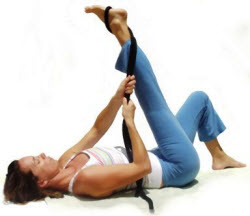
In 1995, I witnessed a stretching demonstration by a trainer named Jim Wharton. Using a rope, he taught me a method of flexibility training known as AIS, or Active-Isolated Stretching. Aaron Mattes, a kinesiologist and world-renowned expert on flexibility, developed this technique. I had the good fortune to study with both Jim Wharton and Aaron Mattes. I’ve used AIS every day for the past 17 years and have trained thousands of students to perform a 20-minute dynamic-stretching routine before riding. Most of them — seriously — continue to do it daily.
Cycling contracts skeletal muscles that attach to bones by tendons. Each muscle has sensory structures called stretch receptors that monitor the state of the muscle and feed the information back to the central nervous system. Stretch receptors are sensitive to the velocity of the movement of the muscle and the degree that it’s lengthened.
The Golgi Tendon Organ is a stretch receptor located at the insertion of skeletal muscle fibers into the tendon. It provides the sensory component of the Golgi tendon reflex, also known as the stretch reflex. The stretch reflex is a protective mechanism that attempts to prevent over-stretching and tearing of the muscle fibers.
AIS uses the body’s natural stretch reflex to enhance flexibility. Because it’s movement-based, it also dynamically stimulates blood flow and muscle extension through movement. These factors make it optimal for warm-up.
After a couple of seconds of stretching, a muscle begins to contract as a result of the protective stretch reflex. This is to prevent excessive elongation and a potential muscle tear. The key to AIS is not to continue stretching beyond this point. Static stretching continues, and that’s why it diminishes performance.
The Active-Isolated Stretching technique involves holding each stretch for only two seconds, rather than 20. The stretch is repeated 8 to 12 times for a progressive muscle release. This degree of repetition dramatically increases blood flow to the muscles to enhance warm up.
This method of stretching is also known to work with the body's natural physiological makeup to improve circulation and increase the elasticity of muscle joints and fascia.
The shorter stretch, however, needs to be coupled with reciprocal inhibition. This is another natural response of the muscle. Contracting the muscles on one side of a joint relaxes the muscle on the other side of that joint. When performing AIS, you actively contract the antagonist of the muscle you are trying to stretch (the agonist). This promotes an enhanced release in the target muscle. The antagonist contraction also stimulates blood flow and generates body heat.
Active-Isolated Stretching does many things that static stretching cannot:
– AIS provides a transition between inactivity and physical exertion.
– AIS assists the pre-exercise warm-up process by increasing blood flow and soft-tissue temperature. This makes is both a stretch sequence and a warm-up technique, and settles the long-running debate in the fitness industry about whether or not it’s necessary to warm-up prior to stretching. With AIS, both occur together.
– AIS produces supple, relaxed muscles, which have a higher capacity for activity.
– AIS reduces the likelihood of muscle cramping, tightness and pain.
– AIS increases and maintains the range of motion in a joint.
Personally, I’ve performed upper- and lower-body AIS daily, both pre- and post-riding, for 17 years. I attribute much of my athletic longevity and my body’s ability to perform at a high level to Active-Isolated Stretching.
AIS is one of the stretching methods most used by today's athletes, massage therapists, personal/athletic trainers, and fitness professionals. AIS allows the body both to repair itself and to prepare for daily activity.
To learn more, simply google Active-Isolated Stretching. An extensive YouTube library depicts the stretching techniques, and numerous websites have images of how the stretches should be done.
