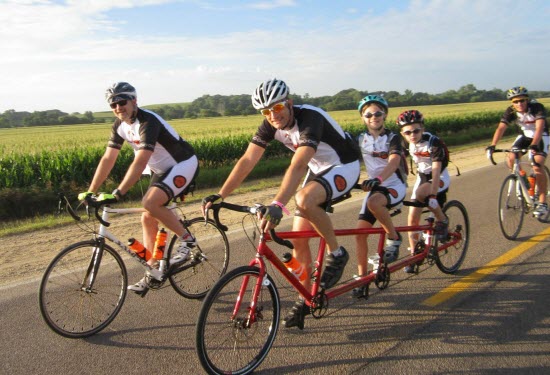
Dr Jay Alberts discovered the value of cycling as a relief of symptoms for people who suffer with Parkinson’s disease, while riding a tandem bicycle in Iowa during the RAGBRAI – the ride across the state of Iowa. Based on his observations of the reduction in symptoms he saw in his tandem partner Cathy Frazier, he began clinical trials to study the affects of what he describes as “forced exercise” on someone suffering from a neurological diseases like Parkinson’s.
UPDATE September 2014:
We are now offering an ACE approved Parkinson’s Cycling Coach training program. To learn if you qualify click here.
Jay Alberts is a native of Sanborn, Iowa and earned a Bachelor of Science Degree in Exercise Science from Iowa State University in 1994. He completed his neuroscience doctoral training in 2000 at Arizona State University where he worked under Drs. George E. Stelmach and James R. Bloedel in his studies investigating the effects of Parkinson’s disease on motor performance and learning.
Dr. Alberts is currently an Assistant Staff in the Department of Biomedical Engineering, within the Lerner Research Institute and the Center for Neurological Restoration , Cleveland Clinic , in Cleveland, OH. For more information on his research visit: http://www.lerner.ccf.org/bme/alberts/ . He has more than 25 peer-reviewed scientific publications in journals such as Brain, Experimental Brain Research and other prominent medical journals. Dr. Alberts serves as a reviewer for a number of scientific journals and funding agencies and his professional affiliations include, American Academy of Neurology, Society of Neuroscience and International Graphonomics Society. Dr. Alberts has had continual extramural funding for his research since 1997 in the form of grants from the National Institutes of Health, American Parkinson’s disease Association and Achievement Rewards for College Scientists Foundation.
Dr. Alberts is married to Janelle and they have two children. Dr. Alberts and his wife are tandem enthusiasts.
Listen to our discussion below to get a more complete understanding of this fascinating topic – or subscribe to our free Podcast in iTunes.
Interested in offering Parkinson’s Cycling Classes at your location?
Click here for more information about our ACE approved training for Coaches.
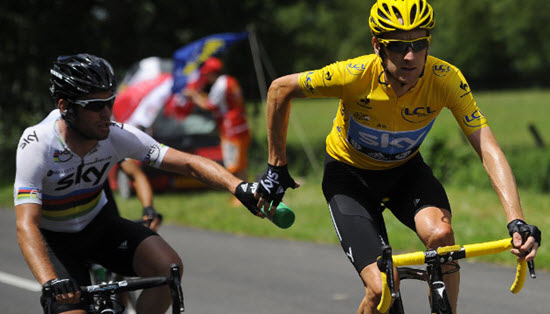
Not practicing the hand-off – but what comes next…
One of the many benefits of riding and training indoors, is not worrying about crashing and ending up on your head. So we practice our; pedaling technique, or Sprint form or whatever, without thinking about balancing or where we’re going.
Now if we were riding our road bikes on trainers we could also practice reaching down, grabbing a bottle, taking a drink and then returning it safely into the cage. Not an easy task for many new (and a few old) outdoor cyclists.
Bicycle Safety Tip
2012 Tour de France winner Bradley Wiggins pictured above/right may be an awesome cyclist with phenomenal bike handling skills. But he’s not demonstrating proper hand position with one hand off the bars. The correct (safe) position for his left hand is on the cross bar, very close to the center / stem. Why not out at the end where he has it in the picture?
It’s a matter of leverage. The further you hand is, away from the center/pivot, the easier it is to turn the bars. Without your other hand to counteract the force, riders with just one hand, on the outer end of the bars, tend to ride erratically = not in a straight line = dangerous.
Speaking of proper hand positions > I discovered this video while researching this article. Nothing to do with cycling, but it will get your heart rate up when you watch it 🙂
In celebration of today being the Super Bowl (the biggest sporting event in North America) we played drinking games. Not the typical; take a shot whenever an announcer uses some predictable cliche – that comes later today.
In class we played a different type of drinking game.
Although we’re not on real bicycles, there’s still a valuable technique we can safely practice during class; drinking at a high level of effort > @ or over FTP/Threshold/AT/Lt whatever you call it. More specifically; learning to regulate your breathing so you don’t choke, launch into a coughing fit, swerve over and ultimately take down your riding buddy – or end up in the ditch.
NOT drinking enough during a long ride is the sure path to early fatigue. During a hard group ride there may not be a lot of breaks where you can recover and hydrate easily. So today we only drank during hard efforts, not during the recoveries when you would normally towel off and take a sip.
The first Sunday of each month is an FTP Assessment. Here’s my class.
Class length 75 minutes + Cool Down
Warm Up — 10 minutes. 5 minutes of gradual increases in wattage. During the second 5 mins. we’re finding the wattage where everyone is first noticing a change in breathing; VT1 / Aerobic Threshold = the top of the Recover Zone. This establishes a rough understanding of a base wattage that we use throughout the rest of class.
3 x 30 sec. Hard / 30 sec. Easy – Openers to AT/LT. I cue these by first having everyone find the amount of load @ 70 RPM that has them feeling they should (not just could) come out of the saddle. The 30 sec. Hard is then simply accelerating to 90+ RPM which results in some pretty impressive power numbers. The 30 sec. Easy is back to 70 RPM — many will stand during the Easy portion.
1 minute rest – I encourage riders to focus on their recovery. Once they feel calm in their breathing, bring back the Base level work wattage.
3 min. Hard Effort — Here’s a “Best Effort” to establish a benchmark PTP Personal Threshold Power (top of the Perform Zone) or ride at 110% of FTP if known. It’s very helpful to riders to have that understanding of their personal upper wattage number. The “Best Effort” Threshold # + the Base Threshold # we found earlier form the three Power working zones I use in class.
2 min. Rest
3 x 1 min. Hard Effort x 1 min. Rest. These should be above the 3 minute average wattage.
3 min. Rest
20 min. TT / FTP Assessment effort – Quickly establish the average wattage at or near the 3 min. Interval. > Stage Button and then maintain. You may want to offer slight changes in cadence & load, while keeping wattage = to the initially established watts #. I was off the bike at the 10 min. to go, coaching, encouraging and then just watching them with a big smile on my face. This is a great group and they looked incredible — I’m so in my element with these classes
5 min. Rest
Base Wattage (aerobic) flat road to finish — use these time to congratulate everyone and give tell them a bit about what you have planned for them next week.
UPDATE: 1/29 8:49 CST – I’ve got my fingers crossed. Hopefully the preventative measures we’ve undertaken has this current attack thwarted and future attacks prevented!
Log-in access to ICI/PRO was locked down today, in response to a “Brute Force” attack 🙁
The unsuccessful attack had attempted to guess user names and passwords of members here. It looks like they tried over 6,000 times!
Please be assured that the attack was unsuccessful and was limited to just this website and NOT the secure shopping cart service to process financial transactions.
ICI/PRO is run on a very secure (and expensive) hosting platform, that features numerous security measures to protect everyone’s accounts.
We’ll continue to monitor the situation and respond as needed.
I stumbled into this article and wanted to share it with you. This group meets regularly in a garage to ride together on trainers…
It is almost quiet. No loud music, no instructor shouting motivational slogans. A pair of box fans hum, nearly drowning out whirring bicycle drivetrains. Conversations are brief, limited by the exertion.
The workout leader calmly, periodically, issues instructions to the half-dozen or so cyclists laboring in a two-car garage in a west Yakima home.
This is back-to-basics wintertime indoor bicycle training – simple, personal and sweaty.
It began nine years ago, the idea of Yakima’s Donna Smith, as a way for riders to stay in shape through the winter.
“It was fun to get people together during the wintertime when you can’t ride outside very much and actually do a workout and talk about the rides you’ve done in past years – and what you’re going to do this next year,” said Smith, a national- and world-champion cyclist between 2005-07. “It helps the winter pass more quickly for us nonskiers.”
The article included this video.
I’m struck by how simple and unpretentious this all is. Just a bunch of like minded cyclists showing up and pounding out some intervals with friends. Awesome 🙂
Where in America should you go if you want to be “healthy, wealthy and wise”? TODAY’s special series looks at top places in the US in each category – and you may be surprised at the winners.
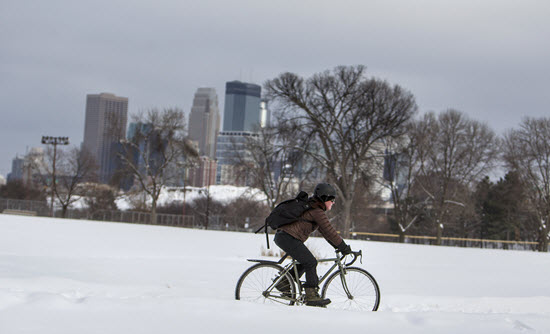
Which city is considered the healthiest, fittest in America? It’s not a sunny, bikini-weather spot like Miami Beach or Malibu. It’s a city famous for its frequent sub-zero temperatures, where residents need snow coats and ear muffs for months of the year: Minneapolis, St. Paul, Minn., according to the American College of Sports Medicine’s most recent American Fitness Index.
Minneapolis, St. Paul has more parks per square mile than any major city in the U.S. and is second only to Portland, Ore. for the number of bicyclists per capita. The Twin Cities also get high marks for access to fresh food.
“There are twice as many farmer’s markets in that area than in the top 10 percent of [U.S.] cities,” says ACSM’s Walter Thompson, Ph.D.
I don’t agree with their judging criteria – access to or number of Farmer’s Markets? Most are only open during our 4 or 5 weeks of summer and only on Sunday’s.
Residents here are fit because we don’t have a choice… it’s all about survival during our Godforsaken winters. We’re thin due to the amount of calories we expend keeping warm. Shoveling snow was the original full-body workout. Move fast enough between passes down & back up the driveway and you add a cardio component + you get the added bonus of staying warm and not freezing to death.