If you run high-intensity trainings in your classes — and I’m guessing most of us do — you may have had a participant experience extreme difficulty during or just after a hard bout of work. In such cases, I’ve seen the skin turn absolutely white or ashen — or, alternatively, bright red and tinged with blue around the cheeks. Either way, the student doesn’t feel well and may be lightheaded, nauseated, shaky, and extremely fatigued.
It’s likely you’ve seen these signs, along with a variety of treatments offered: walking slowly around the room, sitting with the head between the knees, or just lying flat on the floor. These methods often don’t seem to help and may even make things worse.
Keeping in mind something I learned from my major professor in grad school, I developed a “trick” that has proven helpful in such circumstances. It can bring someone back to feeling better quickly and can frequently eliminate the need for stronger emergency measures.
As soon as possible, get the person off the bike and onto the floor. For the sake of comfort, an exercise mat is ideal. If no mat is available, fold a towel to cushion the head. DO NOT elevate the head — we all know from CPR classes that will close off the airway. Speed is more important than comfort, though, so if a towel or a mat isn’t available, just get your student on the floor.
Start the student on his back, with knees bent and feet on the floor. Instruct the student to keep the legs relaxed as she gently lifts one knee toward the chest for a moment and returns the leg to the starting position. Do the same on the other side. If the student is too confused to understand and follow your instructions, just ask him to relax and tell him that you’ll be lifting his legs.
This process typically needs to continue for several minutes. Keep watching the student and giving instructions. Most of them will stop after only one or two repetitions. Be prepared to move the legs manually if the student stops due to fatigue.
A few things not to let the student do:
– Don’t let her grab the knee and hold the leg up. What makes this procedure work is the rhythmic up-and-down action.
– Don’t let him do this quickly and turn it into a forceful exercise. Again, the gentle, rhythmic action of the leg moving up and down is the key.
– Don’t let her lift the second leg while the first one is still in the air. At least one foot should be flat on the floor during the entire procedure.
Like the rest of you, I’ve taken many CPR re-certs. They don’t cover anything like this, but it’s highly effective. The color of the face returns to normal fairly quickly, and the nausea tends to go away quickly, as well.
For better or worse, I’ve had many occasions to use this. When Jim Karanas was teaching his Performance Max program, more than a few participants experienced severe symptoms after max efforts (especially when rowing). Fortunately, the procedure was quite effective, as mentioned above.
Yet long before PMax existed, the “seal of approval” came from Dr. Campbell, my major professor, himself. In our exercise physiology lab one day, a student experienced exactly the symptoms described above — she was sick to her stomach, shaky and white as a sheet. I immediately asked if she’d be willing to do something that I thought would help her. From the floor, her color came back after several knee “pumps” and she was fine.
Tough as he was to impress, Dr. Campbell said nothing, watched closely, and finally made eye contact with me and nodded his approval. This expert in cardiovascular dynamics apparently saw it as an appropriate treatment method.
You might want to practice the technique so you’ll remember it. Then let’s hope we never have to use it.
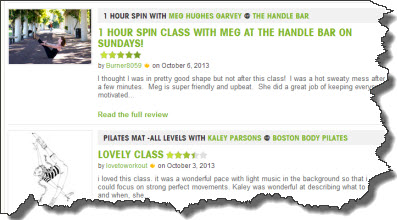
RateYourBurn.com is a review site for fitness instructors who teach in select US cities. RateYourBurn founder Gillian Casten joins me to discuss her vision for this popular Instructor review site + shares a few of her observations and potential strategies you can use to improve as an Instructor.
In a previous interview, Studio owner Jessica Bashelor @ the Handle Bar explains how she recruited her Instructor team based on the the reviews she found on rateyourburn.com
I'd suggest maximizing your rateyourburn.com Instructor profile and start asking your participants to post reviews.Clearly a recommended Best Practice for you as a fitness professional.
Listen to my interview with Gillian below – and please run over to iTunes to either leave us a review or subscribe to our free Podcast.
If you haven't yet, I would encourage you to listen to our latest Podcast that features 26 year old Cycling Studio owner Jessica Bashelor. If you're short on time, you really only need to hear the lead in where she describes her vision for her studio.
I knew that I wanted to have a really strong brand, that was based on; work and fun and music. And those are things that I sort of live by myself as a 26 year old.
Something about this interview has been bugging me until this morning. While riding in Amy's class it hit me. Jessica's brand doesn't include anything about education – zero. Just work/fun/music. Oh, and she throws in; taking life a little less seriously 🙂
Aren't studios supposed to be all about; coaching and purpose and threshold heart rate training and power training and weight loss and healthful living and fitness knowledge and, and, and?
Obviously not for Jessica or the rider's (I'd guess she'd never consider calling them “Students”) who pack her studio.
My generation wasn't any different.
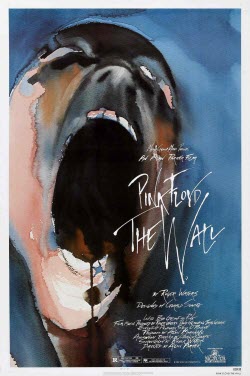
I was 18 years old in 1979 when Pink Floyd — The Wall dominated the the charts and captivated me and many of my friends. The album's most popular track Another Brick In The Wall, Pt. 2 spoke to me as a teenager; we don't need no education… we don't want no thought control…
http://youtu.be/zcevYuG3j7M
I didn't want anyone, telling me anything… I wanted to be heard and understood at 18, and this hasn't changed much now that I'm 52.
The Wall is a story about how we build metaphorical/emotional walls around ourselves. As a young person, or old for that matter, one way we build walls is we learn to tune-out people like our parents/spouses/bosses or teachers, when they talk at us, instead of communicate with us. As the father of two daughters, I know all about how ineffective it can be to try and “educate” them about what I wanted them to know and accept. It almost never worked. Often it had the opposite reaction and it wasn't hard to see them constructing their own wall to shut me out.
Sometimes the walls we create are small.
Have you ever had someone tell you; “I just answered that ten minutes ago” ? Chances are you created your own “wall” and it prevented you from hearing what could be plainly heard by others.
I was in a class last week where the Instructor talked nearly nonstop. While he rattled on about mitochondria and slow twitch muscle fibers, I found myself in my own little world – missing many of his cues. I'd come back to reality and find myself down when everyone was up or surprised when he announced the end of an interval, that I hadn't even realized we were doing. As I watched the rest of the class in the mirror it was obvious I wasn't the only one with a wall around me and my bike 🙁
John it just disappeared. It showed up fine on my computer and I'll swear it was on my Droid before I left to teach. But as I was ready to launch into a long threshold effort, Spotify skipped past a track, completely messing up my class.
Amy is the official Android user here in our home, me and the girls all have iPhones. Which is helpful when people rely on you to help them understand the little idiosyncrasies of a particular music software app like Spotify.
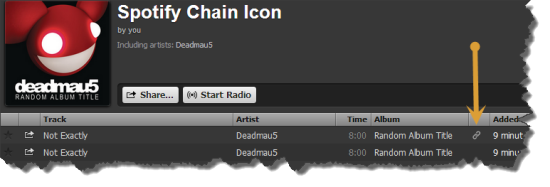
I'll admit that, although I had seen that chain icon before… I had no idea what it meant or represented. I do now 🙂
That chain icon indicates; the specific song you dragged into your playlist isn't available in that exact place, so Spotify has conveniently linked to to the actual location of the track in their database. Perfect if everything works as planned. Which, unfortunately wasn't the case with Ms. Amy today, at her noon class at CycleQuest Studio. I've never had an issue with this on my iphone, but you can never be too careful when it comes to your class music. I'd recommend checking for any any “linked” tracks and see if you can replace them.
Click the “chain” icon and Spotify will take you to the linked location. Select and drag that track into your playlist. Open the playlist and position the track next to the linked track, and then delete it.
So while we're on the topic, what do those other, funny little icons represent?
The square box with the music note symbol indicates a local track, probably from iTunes, that Spotify can't connect to its database. If you see this in your playlist be sure that you set “offline mode” while both your computer and portable devise are on the same WiFi network.
I'm still trying to understand the pinkish square with the lighting bolt. Supposedly they're tracks that Spotify had found once, but can no longer find. Funny – songs with that icon still sync to my iPhone and play both on my computer and iPhone.
Seeing this icon next to a local file means that the link (or path) to your local file is broken or not found. Perhaps iTunes moved the local file to a different folder. You can try to import the file again by browsing to the actual file and dragging it into Spotify’s Local Files pane. The broken rectangle link also shows up if a song is protected by digital rights management (DRM), so it can’t be played outside of iTunes. A notification bar appears if this is the case, and you’re prompted to remove all DRM-protected tracks from the Local Files pane.
Which doesn't make sense to me – all three tracks from the image above play and sync without any trouble.
Ever wondered why some people have their picture displayed next to a comment… and yours doesn't? It's because they created a Globally Recognized Avatar – Gravatar for short.
Gravatars are images connected to a specific email address. You can quickly and easily get your own at https://en.gravatar.com/ which is run by the same group who provide the free blogging platform WordPress.com.
Start by choosing a square image of at least 250 pixels. The image in this post is 250 x 250 pixels for comparison.
Next you'll need to create a free account at gravatar.com/ and then approve the conformation email you will be sent.
Upload your image and you'll start seeing your awesome image everywhere you post a comment 🙂
I used a new metaphor this morning that seemed to resonate with my class.
Watch this video and see if you can see the similarity between an eagle catching a fish and proper pedaling technique.
Through the magic of slow-motion photography it's obvious that the act of plucking a large salmon out of the water is a very fluid, near circular, motion by these powerful birds.
This morning was a cycling strength day. I really enjoy teaching these classes and I describe the format to the class as; BIG PEDALS turning slowly. But slow = STOMP for many in my class.
To help everyone move beyond stomp, I've been introducing the concept of ankling through each pedal stroke to my class. If you missed it here are two videos that demonstrate what local bike fit Guru Chris Balser categorized as USA vs. EU pedaling techniques. To help communicate the concept I've been talking about how there shouldn't be any specific action; stomp, scrape, pull up, ect.. Rather just one fluid motion of your feet rotating around the pedals, with flexible ankles. Tough to describe until I happened to see this video and then it clicked – the focus is on your toes! Or in the case of the eagle, its claws & talons.
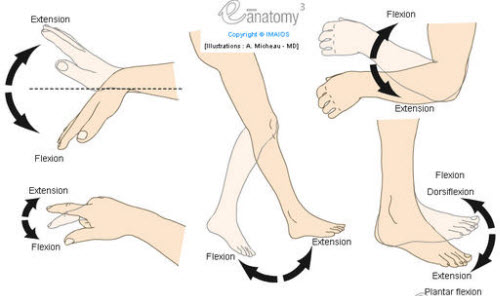
Watch the video again and see how the eagle's talons and *ankles are at full extension as it reaches forward and down in preparation to grab the fish. The eagle's claws then flex forward, essentially rotating around its catch, as it lifts it from the water. This is the same movement Chris was helping me learn to improve my pedaling mechanics and power output.
The difference between extension and flexion in joint movements.
How would you describe this movement to your class?
I had everyone try to visualize what it would feel like to be an eagle, swooping down on a fat, tasty salmon. Talons extended as your pedal crosses the top of the circle, then, flexing forward while you sink your talons into the flesh. Your claws rotate around the fish as you drag your catch from the water… only to drop it… so you try again.
*I'm not sure what that joint is called on a bird, but you get the point.