
by Joan Kent | Dec 1, 2014 | Engage Your Students, Health and Wellness
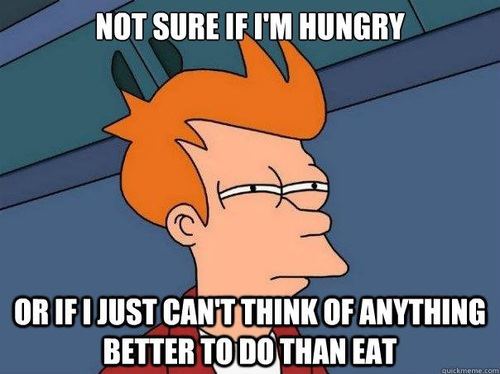
Have you heard about stomach hunger versus mouth hunger? Many nutritionists and dietitians talk about this. A client mentions eating Something Bad, and the practitioner asks, “Was it stomach hunger or mouth hunger?”
A variation on the question is, “Was it physical hunger or emotional hunger?”
Peak-performance motivator Anthony Robbins says, “If you ask bad questions, you get bad answers.” Asking a client whether she ate because of stomach or mouth hunger — or because of physical versus emotional hunger — is the classic Bad Question.
And it gets bad answers. Answers like “I don’t know” or “I’m not sure.” Sometimes the answer is another bad question: “How can I tell?” The client is trying to figure out if she was hungry for physical reasons or emotional ones.
Despite these rampant failures, the question persists. One book even uses the term “intestinal hunger.” Does anyone out there have any idea what that is? If I can’t understand it, what chance do my clients have?
Of course, if you’re not comfortable handling your participants’ food and eating issues, by all means refer to a nutritionist. This post is about awareness of what some of your participants may go through daily.
A Better Question
Here’s an idea that might be good for practitioners to adopt. I never use the term “hunger” for anything but physical hunger. Instead I ask, “Were you physically hungry, or did you just have an urge to eat?”
That question gets real answers and can uncover some important issues. People can tell the difference.
The urge to eat could have much behind it — emotions, stress, shifts in brain chemistry, shifts in hormones. Some clients might need coaching to explore the emotional component and retrain their responses not to involve food. Some may need to change their diets to change brain chem and/or hormones.
Real Hunger
Hunger is a specific, physical signal that the body needs food. I’ve explained in detail what hunger feels like to clients who don’t experience it.
Why don’t those clients experience hunger?
Some may not because, for years, they’ve been eating for reasons that have nothing to do with hunger:
– the clock says it’s mealtime
– everyone else is eating
– appetizing food is here now
– they ate too much at the last meal
– they’re stressed, depressed, anxious, or even happy.
Readers may conclude that the items in the last bullet show “emotional hunger,” but I’m suggesting that the word “hunger” causes the confusion. It’s more appropriate to use it only when physical hunger signals are present.
How Do I Know If I’m Hungry?
Clients who never feel hungry may be confused about how to determine hunger. If someone says, “I ate breakfast at 7 am, and now it’s 12:30, so I must be hungry,” that’s a thought process, not hunger. The best tactic is to help clients retrain their recognition of hunger through increased awareness of body signals.
It’s helpful to stay aware of misinterpreted signals. An obese client told me his hunger was “here” and placed his hand on his throat. Further questioning revealed that he actually had GERD (gastro-esophageal reflux disorder), which we alleviated in two ways. One was monitoring his work position after eating (he sometimes worked from home in bed). The other was taking an OTC remedy before the meal. (Don’t worry; I checked with his doctor.)
Clients who eat lots of sugar may not experience hunger. Despite research, I haven’t yet found a satisfactory explanation for that. Client symptoms, however, can typically be traced back to drops in glucose. If someone says, “I don’t get hungry, I get a headache,” that could be one sign of reactive hypoglycemia. Other examples exist.
So the absence of hunger could reflect lack of awareness, chronic overeating, or chronically high sugar consumption. When I uncover a solid explanation for the last, I’ll definitely let you know.
In the meantime, if you refer your participants to a nutritionist, please screen them and find one who doesn’t ask about mouth hunger.
by Joan Kent | Nov 24, 2014 | Engage Your Students, Health and Wellness

(Indoor cycling instructors probably have their holiday eating under control, so this post is for your participants. I hope the information helps them.)
Quite a few years ago, I was on staff at a 10-day seminar on nutrition and eating behaviors. We lived at the ranch where it was held. Staff and participants alike followed the same mealtime rules.
Frankly, the seminar wasn’t particularly good. But we did one great exercise that helps me to this day.
The Standing Ovation
In the dining hall, we had to stand and announce that we were going back to the buffet to take seconds. At that point, everyone in the room gave us a standing ovation.
The reason behind this is simple. Some people tend to pile food on their plates when they go through the buffet line. It prevents the embarrassment of returning for more. The problem is, once the food is on the plate, it’s easy to keep eating, even when we don’t want it.
Giving yourself permission to get seconds eliminates the need to pile extra on the plate. Start with a small portion, and get more only if you really need and want it.
A Better Standing Ovation
The other part of the exercise was this: We had to stand and announce whenever we were throwing away food. Again, everyone in the room gave us a standing ovation.
I’m convinced this is one of the most valuable exercises anyone with food issues can try.
Most of us grew up learning that it’s a sin to throw away food. Didn’t you? Because of the starving children, right? Where were they starving when you learned it? We all heard different countries, different locations, but the sin was the same.
Kids immediately see through this nonsense and say, “So send it to them.” No one can convince kids that shoveling food that they don’t want or need into their mouths will help starving children anywhere. And yet this “teaching” persists and its negative lesson lingers into adulthood.
U.S. Food Production
Meanwhile, the U.S. produces 3950 calories worth of food for every man, woman and child (even infants) in the U.S., each and every day. 3950 calories is far more than most adult men need, and certainly more than women and children need.
So much of the food the U.S. produces is excess. There’s almost no way to prevent wasting of food.
Under circumstances like those, throwing away food isn’t a sin. It’s survival. And learning to be 100% okay with doing it is the smartest strategy.
Convincing My Clients To Get Rid Of Trouble Food
It isn’t easy to convince my clients of that. One client bought a giant tub of dates at Costco. Even though the date sugar kept triggering binges and her weight was creeping up, she kept eating them daily. When we talked about it, she said, “They’re almost gone.”
Perfect. Don’t put the dates in the garbage. Treat your body like a garbage can and put the dates in there. Yikes.
Another client had dinner with her parents at their home twice a week and couldn’t refuse the giant portions her mother served her. She had a problem with the sin of throwing away food. I wish she’d learn to use plastic containers for the purpose for which they’re intended.
Seminar Benefits You Can Use
After the seminar at the ranch — and all those standing ovations! — I can throw away any food. Now, I’m definitely NOT telling you to buy good food and throw it away for no reason.
But if a food — especially sugar — is making it difficult or impossible to stick with your eating plan, it needs to go. Not when it runs out, but now.
The impact of the sugar you can’t stay away from is huge. It goes beyond the “empty calories” most people talk about when discussing sugar. (Does that phrase bore you as much as it bores me?)
Toss That Sugar
Sugar increases appetite by inhibiting your satiety center. It changes your food preferences and makes you want more junk and fewer vegetables. It can make your eating feel out of control. As all of that happens, it affects your self-esteem, and not in a positive way.
And sugar will — as always — be everywhere this holiday season, along with holiday buffets.
Stop treating your body like a garbage can. Throw junk in the real garbage can, where it belongs. If you need to ruin the food first, do it. (Dishwashing liquid is handy for that!) Dump it and move on.
Your body deserves better. So does your brain, and your self-esteem. Can you hear the standing ovation?
by Joan Kent | Nov 17, 2014 | Health and Wellness, Instructor Training, Master Instructor Blog

John rode the #1 NYC subway train last week and it doesn't look like this today 🙂
Giving nutrition talks in many locations lets me meet interesting people. After a recent presentation, a man came up afterward to tell me about his doctoral research.
Dull, you think? Hardly. The man is working on a program for juvenile offenders that teaches them about good nutrition. His premise is that getting them to make good decisions about food helps them make better choices in life.
How Little Things Can Make a Big Difference
I was instantly reminded of Malcolm Gladwell’s book The Tipping Point. Gladwell describes the turnaround of the high crime rate in New York.
In the mid-1980s, violent crime in NYC was at a peak. Two criminologists, Wilson & Keller, theorized that crime is the inevitable result of disorder, and seemingly small displays of disorder invite serious crime by signaling neglect.
The NY Transit Authority hired Keller as a consultant. He convinced the key players to start the crime cleanup by cleaning graffiti from the subway trains. Some thought it was a foolish start because violence on the subway trains was so high.
But the repainting of trains was relentless. Even partially graffiti’d subway cars were taken out of service until they’d been cleaned. The message that someone was watching was clear, and it worked.
The theory was then applied to other small crimes, such as fare-skipping and minor property damage. By 1990, violent crime in NYC had dropped considerably.
So What Does This Have To Do With Sugar?
What if, instead of avoiding just the big stuff — like dessert — and letting little “tastes” slide by, you convinced your participants to start by eliminating the little tastes? Refusing that piece of a broken cookie, those two tiny M&Ms, that agave on their oatmeal? Small tastes that seem trivial, calorie-wise.
What good would that do? Well, sugar does affect brain chemistry and hormones, so small amounts can increase appetite and change food preferences — and not in a good way. A little can bring on cravings for sugar later that day or the next.
But What About Juvenile Offenders, Gladwell, and The Subway Trains?
I’m also suggesting that strictly refusing small bits of sugar could help your participants develop a different mindset: “That’s not food.”
What I know from decades of counseling dieting clients is they tend to think All-Or-Nothing. (“I ate cookies earlier, so I blew it. I’ll have this chocolate cake tonight and start my “diet” tomorrow.”)
What if — this season — they get out in front of it?
If they relentlessly reject small samplings of sugar throughout the day (and the week), it could be easier to turn down dessert.
Yes, because of the brain chem thing. But also this: Why undo all that careful, healthy picky-ness by blowing it on a bowl of Rocky Road?
Dare To Start Small
We know holiday sugar will be around in both large and small portions.
Why not shun the tiny tastes of sugar that will be everywhere? See if that doesn’t inspire better food choices throughout the day — and throughout the season. See if it doesn’t re-frame sugar as the junk it is, rather than as food.
If this deceptively silly idea keeps your students from overdoing it on pumpkin pie, chocolate truffles, fudge, cheesecake, and everything else that will be temptingly available as the holidays go on, it could even be seen as their practice.
Imagine the inner glow of having a no-sugar practice.
Besides, if you convince your participants to try this, you will definitely be a Hero, like my friend who’s working with juvenile offenders. What he’s doing is brilliant. You could be, too.
I’d love to hear how this Tipping Point approach works for your classes!
by Joan Kent | Nov 10, 2014 | Health and Wellness, Master Instructor Blog

Recently, someone with a self-proclaimed Sweet Tooth asked me the difference between that and sugar addiction. The question brought out the geek in me, so I decided to share the information with you.
Why We Like Sweet
We’re hardwired to like sweet. In fact, a fetus will increase its swallowing of amniotic fluid if the fluid is artificially sweetened.
One author attributed our liking for sweet tastes to evolution. Many plants that seem edible contain substances that can poison and even kill us quickly. Because that didn’t happen with sweet foods, they became “safe.”
Brain chemicals have a lot to do with liking sweet. Endorphins (beta-endorphin), dopamine and serotonin are natural feel-goods that make us enjoy and want the sugary foods that trigger them.
So we like sweet stuff. But some people — and I’ve shared before that I was definitely one of them — go beyond liking sweet foods into a compulsion to eat them.
Sugar Addiction Defined
Addiction criteria apply very well to sugar addiction. Let’s look at the section on Substance Abuse Disorder from the Diagnostic and Statistical Manual of Mental Disorders, Fifth Edition (DSM-5).
DSM-5 criteria for addiction are clustered in 4 groups, but are essentially the same as DSM-IV criteria. I’ve simply listed the criteria below. The examples given are just a few of many.
Some criteria may seem to apply only to illegal drugs, such as spending a great deal of time obtaining them. Sugar is available virtually everywhere, in unlimited quantities, and inexpensively, but stay with me on this.
Criteria for Substance Abuse Disorder
1. Taking more of the substance or for longer than intended
Lack of control over what or how much one is eating characterizes binge-eating disorder. Chocoholics describe an inability to resist, moderate, or stop eating chocolate. Clients keep eating cake, one slice after another, despite planning to stop after one piece.
2. Unsuccessful efforts to stop or limit use
Dieting and weight cycling are found in binge eating and other eating disorders. Secret-eater chocoholics try unsuccessfully to reduce intake of chocolate, then relapse and overeat it.
3. A great deal of time spent obtaining, using, or recovering from use
80% of chocoholics state that chocolate interferes with their lives in some way. Purging behaviors might take increasing time. Excessive exercise, one example, could interfere with important activities or occur despite injury.
4. Craving the substance
Craving, an intense desire for a substance, is a common response to withdrawal or abstinence. Cravings are stronger after high levels of intake but can occur in other conditions. Cravings identify the substance that will relieve them — what you crave will take away the craving. (That’s a poor way to deal with cravings, and I’ve covered the topic in previous posts.)
5. Failure to fulfill major obligations due to use
6. Continued used despite social problems caused or exacerbated by use
7. Giving up or reducing important activities because of substance use
These issues could show up as self-isolation; eating alone due to embarrassment over the eating; refusing to wear bright colors, form-fitting outfits or swimsuits; refusing to attend social events, eat in public, be nude in front of others, make love with lights on, look in the mirror, go to a gym with mirrors, or even go to a gym.
8. Recurrent use in hazardous situations
A client almost had a car accident because she ran into a store to buy candy and “couldn’t get the chocolate into (her) mouth fast enough.” Hypoglycemia can cause hazards.
9. Continued use despite physical or psychological problems that are caused or exacerbated by substance use
Problems may include obesity, diabetes, hypertension, cardiovascular disease, and other illnesses. Chocoholics eat chocolate despite migraines or feeling sick.
10. Tolerance to effects of the substance (needing more to get the same effect)
11. Withdrawal symptoms when not using or when using less
These last two criteria are quite complex and merit their own article. The DSM-IV and other research say both may be linked with addiction, but addiction can occur without them. So let’s leave it here for now.
To that guy who loves to tell me that drug info doesn’t apply to food: Sugar isn’t food; it’s a drug.
Several journal articles, often by the same small group of researchers, “prove” sugar does nothing bad. In most cases, the sugar industry paid for the research. Don’t get me started.
by Joan Kent | Oct 27, 2014 | Health and Wellness, Master Instructor Blog

In the years (okay, decades) that I’ve been helping people conquer sugar addiction, some clients have balked at the idea of giving up sugar all at once: cold turkey, as it’s known. They wanted to wean themselves off sugar a bit at a time.
Experience has taught me that the tapering approach doesn’t work for a number of reasons. Yes, some sugar-users get results by tapering, but everything works for some people. Serious addicts may never get themselves off sugar completely if they feel they can get away with a little bit. That little bit can cause problems.
Relapse
It’s easy for sugar addicts to rebound and relapse when they still have sugars — even sneaky ones — in their diets. This can be attributed to a priming-type effect, where a little makes us want more. Some “experts” claim that priming doesn’t happen with sugar (the term came from drug addiction literature), but decades of experience have shown me that it absolutely does.
Clients have told me that starting the day with orange juice, for example, sets them up to crave sweet foods all day long. Frankly, I don’t care if the clients can cite a reference in a science journal; I just listen to them and help them conquer their sugar addiction.
Loophole Thinking
As a result of continuing to eat sugar in small amounts, addicts may start looking for Loopholes — substitutes for sugary foods or ways to sneak sugar into their diets. They begin eating extra dairy or using agave or artificial sweeteners while telling themselves they’re “off” sugar. Some substitutes can be addictive in themselves. I had a client who was even more hooked on aspartame than she was on “real” sugar. Some addicts use diet colas for their fix. And let’s not even get started on fruit sugar, fructose. It’s the worst of all — and makes sucrose the junk it is.
Tastes Won’t Change
Sugar addicts who taper may never acquire a taste for healthful foods. Their tastes are still oriented toward sweet, maybe in smaller amounts than they used to eat. This is especially true where vegetables are concerned. I’m forever pushing vegetables on my clients (just ask them), but the ones who are most severely addicted to sugar typically say they hate vegetables. It’s fairly obvious that the reason is vegetables aren’t sweet.
(That’s why I’m against that 5-a-Day rule. It’s supposed to refer to fruits and vegetables, but sugar addicts will turn it into all fruits, given the chance.)
Excess Insulin
Advocates of tapering don’t seem to know that sugar addiction is often grounded in carbohydrate sensitivity. Carb-sensitive people release high insulin when they eat sugar, including fruit and syrups. Artificial sweeteners can trigger insulin in carb sensitives, as well.
Carb sensitivity is not the only factor in sugar addiction, but it can be directly related to health issues. For optimal health, we want to release just enough insulin to do the job and no more. Excess insulin has been associated with a large number of diseases — most of the ones we tend to die from in the US.
The Bottom Line
As you see, a plan that encourages semi-recovery from sugar addiction can result in priming, a diet that’s still oriented toward sweet foods, long-term preference for fruits over vegetables, continued cravings, excess insulin if substitute foods are big insulin triggers, and possible relapse.
I want better for my clients with sugar addiction. I want them to gain optimal health AND the self-confidence that comes from knowing they didn’t just stop using sugar halfway (and maybe relapse), but quit it completely.
by Joan Kent | Oct 20, 2014 | Health and Wellness, Master Instructor Blog, Mental Toughness
True observation: I’ve had quite a few class participants who were unable to focus for more than 30 seconds at a time. No exaggeration. It was particularly noticeable in rowing (it’s easier to hide on a bike), and usually coincided with the fact that they were vegetarians.
Another rowing instructor told me that someone in his class “can’t focus longer than 30 seconds.” When I asked, it turned out the man in question was a vegetarian.
Yes, I realize not every vegetarian lacks focus. However, the rowers who couldn’t stick with the training for more than 30 seconds were invariably vegetarians.
The advice I gave to my students and to the other instructor was to increase protein. This has to mean “real” protein, so the tricky part is finding an acceptable form of protein that a vegetarian is willing to eat. When I explained to one participant the brain chemistry of protein and how it affects focus, he was willing to add fish and shrimp to his diet. Within a few days, things had turned around, and he had no difficulty focusing on the rowing workout.
Which brings me to that vegetarian beans-and-rice thing.
You’ve probably heard it. Beans and rice make up an often-touted vegetarian meal that is said to provide Complete Proteins. For those who are unfamiliar with the idea of complete proteins, it has to do with the fact that proteins are made of amino acids, the Building Blocks of Protein, as they told us in 7th grade biology.
When we eat animal proteins — fish, poultry, grass-fed beef, eggs, yogurt with 18 or more grams of protein per serving, for example — we get all the amino acids necessary for human metabolic function. When we eat vegetable sources of protein, some amino acids are missing from the foods. Other foods can provide the missing aminos and complete the spectrum.
But neither rice nor beans contain much protein; both foods are primarily carbohydrate (starch). So beans and rice together provide the complete list of amino acids but still give us only a small amount of protein overall. Lots of starch, though. The effect of starch on brain chemistry is completely different from that of protein.
As mentioned in a previous post, protein increases production of dopamine and norepinephrine by providing tyrosine and phenylalanine, the amino acid precursors. Dopamine and norepinephrine are alertness and focus chemicals. Carbs tend to raise serotonin levels, which make us relaxed, drowsy, and even “spacey”.
Vegetarians no longer suggest combining proteins at a given meal; that concept is long outdated. But ignoring it can make things even worse for someone who tends to space out without animal protein.
It’s not my place to tell vegetarians to stop being vegetarians. But I wish vegetarians would stop calling rice and beans protein foods.
If you have students who have trouble focusing — and I wonder if people who have the problem even know it — a good recommendation might be to add some form of animal protein to the diet.
If that’s out of the question (obviously, people are vegetarians for different reasons), at least add a serving of high-quality vegetable protein powder to every meal to provide the complete amino acid spectrum.
Incidentally, vegans often have screaming cravings for sugar, and again the answer starts with protein. Cravings are a brain chemical thing. For vegans with cravings, vegetable protein powder might be the only road to a solution.
