
by Joan Kent | Dec 30, 2013 | Health and Wellness, Master Instructor Blog
By Joan Kent, Ph.D.
I’ve posted recently about dietary influences on PMS, and thought it might also be appropriate to discuss menopause and how your older students can use food to help alleviate symptoms.
Brain chemical changes of menopause resemble those of PMS: reduced serotonin and beta-endorphin. So in a sense, menopause is almost permanent PMS. (No comment.)
The most common menopause sign is the occurrence of hot flashes. Hot flashes are best eliminated by limiting or avoiding dairy foods, animal fats, red meat, caffeine, white flour, alcohol, and fried foods. The most significant change you can make, however, is to eliminate sugar. That may need to include fruits. Sure, you’ve heard me rail against sugar before. But anecdotally, I can tell you that I had hot flashes only 3 times — always after I had indulged in fruit (beyond my usual apple or two per day).
Getting enough calcium is important for bone health. Nondairy sources of calcium include broccoli, kale, kelp, mustard greens, dandelion greens, turnip greens, collard greens, and sesame seeds.
Keeping insulin secretion low can help with calcium retention. Minimize insulin by limiting the foods in the “hot flash” list above. Eat only when you’re hungry. Eat smaller, more frequent meals. Avoid high-carb meals (or a high-carb diet generally). Make carbs COMPLEX (sweet potatoes, brown rice, quinoa, etc.), and eat lean protein and unsaturated fats with every meal or snack.
Phytoestrogens are another good way to alleviate menopause discomfort. Celery, parsley, nuts, seeds are foods that contain phytoestrogens. Soy contains phytoestrogens, although soy is a somewhat controversial food. Let’s table that debate for now and include fermented soy (miso, tempeh, natto) in the phytoestrogen-containing group.
Eat an all-starch snack, such as brown rice or a potato, about an hour or so before bed. This is designed to shift brain chemistry and help the brain make serotonin, which has a relaxing effect and is also the precursor of melatonin, the sleep hormone.
Eat ½ to 1 teaspoon of acidophilus yogurt daily. Note the small amount. Even if you’re avoiding dairy, this won’t be enough to cause hot flashes, and the probiotic benefits are worth it. Other probiotic foods include real sauerkraut and kimchee.
Eat “good” fats to control cravings for sugar and other carbs. Examples are nuts, nut butters (unprocessed, without sugar), seeds, and avocados; also olive, canola, and walnut oils. More below.
Essential fatty acids are great to add to your diet. (Essential means we can’t make it in the body and have to get it from food.) Cold-water fish, ground flaxseed or flaxseed oil, and walnuts supply a good array of EFA. Another, somewhat surprising, way is to eat lots of leafy green vegetables, such as spinach and other greens in the nondairy calcium list above. We don’t think of leafy vegetables as containing fats — and they don’t contain much — but every bit of the fat in them is an essential fat, alpha-linolenic acid.
Stress management techniques can help. Chronic stress worsens symptoms, increases insulin secretion, decreases serotonin and beta-endorphin even more, induces depression, and increases appetite and food cravings. Stress management techniques can include meditation, acupuncture, and heat to raise body temperature (sauna, steam, whirlpool, hot bath or shower).
The #1 stress management technique is exercise! Exercise raises beta-endorphin and serotonin, minimizes insulin secretion by making muscle more sensitive to insulin (so we produce less), improves mood, and reduces insomnia, fatigue, and food cravings. Encourage students who have symptoms to use your classes to help manage them.
Here’s to eating right and regular indoor cycling classes as part of a lifelong health strategy, not just to combat menopause discomfort.
by John | Dec 18, 2013 | Best Practices, Health and Wellness
This won't hurt a bit
My Colonoscopy is scheduled for February 27th > if you're over 50, have you had yours?
After some not-so-gentle prodding from the Senior Group Fitness Instructor in our family, I agreed to have a physical before we left for Jamaica. I'm in excellent health by the way. A note from the doctor expressed; “Your lipid panel shows a fabulous HDL!” I'll attribute that to all of the oatmeal I eat, nearly every day.
One of my “directives” was to schedule a (to use the euphemism) “procedure” – which I did. My “procedure” is scheduled for Thursday 2/27 @ 8:00 AM and I couldn't be more excited 🙂
Ok, I'm lying to you. I'm secretly dreading this. Not the actual “procedure” as much as the preparation that leads up to the “procedure”, which I've come to learn is a rather unpleasant experience. Kind of like making a major change to your website.
And no, I won't be recording a Podcast, Tweeting, or live blogging while experiencing my “procedure”.
That would be silly. Besides they told me that I get some of those “Happy Drugs”. There would be no telling what I would say or type.
Which ends my PSA for Men's health… speaking of which I also had one of those (very low #) so carry on unless you've been putting this off. In that case it's time to make the call.
by John | Dec 17, 2013 | Health and Wellness, Zone based Heart Rate Training

ICI/PRO contributor Dr. Melissa Marotta Houser is one of those people who ask; “Why?” and “What if?” a lot… and then sets off to answer her own questions. Back on Podcast #157 we discussed the research Melissa had done, trying to understand; Are There Psychological Effects of Heart Rate Monitor Use During Exercise? If you haven't heard this interview it's fascinating and it will give you additional benefits to training with HR that you can offer to your participants.
Building on her research, Melissa has found a population of people who could potentially benefit from monitoring heart rate, beyond exercise. She's published her findings the Journal of Family Medicine – a publications of the Society of Teachers of Family Medicine.
Exercise Heart Rate Monitors for Anxiety Treatment in a Rural Primary Care Setting. Download the full article here.
BACKGROUND AND OBJECTIVES: Rural patients with anxiety often lack access to traditional biofeedback modalities. Exercise heart rate monitors (HRMs) are tools used in the fitness industry to provide athletes with feedback on heart rate and regulatory breathing strategies. HRMs are inexpensive, discrete, and publicly accessible.
This randomized controlled pilot study explored whether use of HRMs for biofeedback during guided mindfulness, diaphragmatic breathing, and progressive muscle relaxation techniques could facilitate anxiety reduction as compared to these techniques alone.
METHODS: Fifty-three rural anxiety patients were randomized to HRM or control groups for four weekly 20-minute, scripted sessions with a non-behaviorist wherein they practiced these techniques; the HRM group received feedback on their heart rate response.
RESULTS: The HRM group had significantly greater improvement in state anxiety (State-Trait Anxiety Inventory) and self-efficacy (General Self Efficacy Scale), and a greater percentage of the group indicated that they “felt in control of their anxiety.”
CONCLUSIONS: This pilot study demonstrates that this novel, inexpensive, and accessible tool may be a useful clinical intervention for anxiety and can be easily incorporated by both behaviorists and non-behaviorist primary care clinicians into individual or group biofeedback treatment for patients with anxiety. This tool has additional potential for patients to use for anxiety self-management.
Further study with a larger sample and blinded design is warranted.
Well done Doctor Melissa – I'm looking forward to what you come up with next!
You can read Melissa's articles here.
by Joan Kent | Dec 16, 2013 | Big Box Instructor, Health and Wellness, Master Instructor Blog

By Joan Kent.
Several months ago, John interviewed Micah Zuhl, doctoral candidate at UNM, for an ICI/PRO Podcast. Among the questions John asked was which Zuhl considered better — high-intensity interval training (HIIT) or endurance training.
Zuhl’s answer wasn’t entirely clear to me; he sounded somewhat back-and-forth. But he did emphasize the need to give cycling students some intensity, along with some variety. He used the well-known phrase “change it up.”
Let me make it clear that I have absolutely nothing against HIIT. I use it frequently in my own training and have used it when teaching, as well.
Virtually any vigorous exercise, including indoor cycling, will trigger the release of beta-endorphin. That’s neither good nor bad, just what is. The more intense the exercise, the greater the beta-endorphin release will be. No doubt that’s one reason cycling students enjoy — or even prefer — harder workouts.
When it comes to comparing HIIT to endurance training, though, I’ve noticed something interesting, and I’m definitely not including Micah Zuhl in this statement, because he was asked the question by John and didn’t bring it up himself.
Diehard HIIT advocates always seem to measure the benefits of HIIT against the lamest cardio they can find, then proudly proclaim that HIIT provides superior results. Have you noticed?
In reality, we don’t have to choose between long, slow nothing and HIIT. If you train right, and train hard, you can go hard AND long. HIIT alone won’t necessarily provide that training adaptation.
My background has taught me that progressive, periodized training can develop a power/endurance dyad, along with a mental discipline that short-duration bursts typically don’t. Jim Karanas posted much on this website on the mental, emotional, even spiritual, benefits of endurance training. I frequently use HIIT as part of a long, structured, “authentic” training.
Having said all of that, I’d like to switch directions. I also use HIIT when my day is slammed and I need to resort to my BTN Workout. (BTN means “better than nothing.”)
One of the convenient features of HIIT is how little time it takes. At this time of year, being able to fit in a short workout is very helpful.
Here’s an 11-minute format that I devised for the Stairmaster (I’m lucky enough to have one at home), but it can be done on any piece of cardio equipment. Set the timer, if you have one, for 11 minutes. On the Stairmaster, every workout is divided into 30 vertical rows of a duration that depends on the programmed time. An 11-minute workout yields 30 rows of 22 seconds each.
I warm up for 9 rows. That takes 3 minutes, 18 seconds. Every 3 rows, I increase the intensity by 1 MET. (Each vertical dot is another MET.) Then I begin my intervals.
The remaining time allows for 7 intervals total. The work segment is 2 rows (44 seconds), followed by a recovery of 1 row (22 seconds). The first work interval is moderately hard, a transition between the warm-up and the hard work to come. The other 6 intervals are done as high as the Stairmaster can go. I drop down in the recovery period to the level-3 warm-up intensity, but no lower.
If I find myself leaning on the Stairmaster during the work segment, I back off one vertical dot (1 MET) until I get back to good, disciplined form. It’s rare that I need to back off more than one, but I’ve dropped 2 METS once or twice. The goal is not to take extra recovery, just to regain good form and make it harder.
If you’re at all like me, you prefer a serious cycling training to something like this. Still, the BTN approach can be used so easily, and on anything. It’s gotten me through insane scheduling more than once. I’ve done it on my indoor cycle, too, and it works. This approach could help students who are over-scheduled and missing classes this season.
Sure, it’s just BTN for enthusiastic indoor cycling fans, but it’s HIIT, which we know is authentic training. Better than nothing when there’s no time for more, yes?
by Joan Kent | Dec 10, 2013 | Health and Wellness

By Joan Kent
B vitamins play an important role in several brain functions. Below are descriptions of some of those functions and lists of foods that contain the specific vitamin. A deficiency in one B vitamin is possible, but, as a rule, the deficiencies tend to occur in clusters.
Thiamin
You may know that thiamin deficiency leads to beriberi. Thiamin deficiency can change serotonin function. For example, it can increase serotonin in specific brain areas, changing sleep patterns for the worse. Thiamin deficiency may also cause behaviors associated with depression, and has been linked with dysfunction of two other important brain chemicals — dopamine and norepinephrine.
Good sources of thiamin include organ meats, pork, peas, beans, and unrefined grains. Deficiency can be caused by carb-heavy diets of refined foods (sugar, white flour, white rice).
Niacin
Niacin deficiency results in pellagra, associated with dermatitis, diarrhea and dementia. Niacin can be made from dietary tryptophan, an amino acid. Since protein-containing foods (eggs, meat, poultry, fish) are significant sources of both niacin and tryptophan, a low-protein diet could be a cause of niacin deficiency. Nuts and legumes are other sources of niacin.
Vitamin B6
B6 plays a significant role in protein, carb, and lipid metabolism and the formation of red blood cells. It’s also critical in brain chemical function.
The conversion of tryptophan to serotonin depends on B6. Low B6 may be involved in low serotonin levels, particularly in women, who have higher turnover rates of brain serotonin than men do.
PMS is associated with lowered serotonin. The most common type of PMS, involves anxiety, irritability and nervous tension. It’s found in women who consume excessive amounts of refined sugar and dairy products, both poor sources of B6. This type of PMS responds well to B6.
B6 deficiency is associated with psychological distress, depression, fatigue and confusion. Since B6 is necessary for the synthesis of serotonin, lower serotonin due to B6 deficiency is considered a primary factor. Administration of B6 has been shown to decrease psychological distress.
B6 deficiency may also reduce melatonin production because melatonin is synthesized from serotonin. Reduced melatonin, the “sleep hormone”, may disturb sleep patterns.
B6 is also important in the production of dopamine, norepinephrine, GABA and other neurotransmitters. Low levels of dopamine and norepinephrine are associated, respectively, with lack of pleasure (anhedonia) and depression.
B6 deficiency may cause neurological abnormalities in human infants and impaired immune function.
The richest sources of B6 tend to be chicken, fish, kidney, liver, pork, and eggs. Other good sources include lima beans, brown rice, whole grains, soy, peanuts, walnuts, avocados, and vegetables. Processed grains lose considerable B6. Alcohol destroys B6, reducing serotonin.
Folate
Folate deficiency occurs often in depression, and folate administration often reverses depressive symptoms. Low folate has been linked with poor response to certain antidepressants (SSRIs).
Good sources of folate are beef, lamb, pork, chicken liver, eggs, salmon, and green leafy vegetables. Alcohol consumption causes folate malabsorption. All folate is lost from refined foods, such as sugars.
As you can see, B vitamins are often found in protein foods, so keeping the protein content of your diet high can help maintain levels of several B vitamins.
Final point: B vitamins are the key players in the only Nutrition Magic I know. If you have a craving — for sugar, white flour, alcohol, nicotine, or almost anything — a teaspoon of liquid B-complex can take it away within minutes. It can truly feel like magic.
by Joan Kent | Dec 2, 2013 | Health and Wellness, Master Instructor Blog
Here we are again, in the midst of holiday season. Tempting treats are everywhere, of course. As indoor cycling instructors, you’re all probably excellent at maintaining self-control.
But have your students ever asked you what you eat when you’re indulging? Maybe they’re looking for ideas — for “better” ways to indulge. I take that last part to mean less harmful to their health, diets, and weight.
One way is to tell them to avoid sugar and indulge in healthful fats.
Okay, stop yawning. Good fats can taste great and be just as indulgent and satisfying as sugar — without most of the side effects — so hang with me for a moment. Don’t worry; I won’t take this occasion to repeat all of the terrible things I’ve recounted in previous posts about sugar’s negative health effects 🙂 Healthful fats are a smart way to indulge without incurring those effects. AND they won’t trigger the addictive reaction that sugar infamously does.
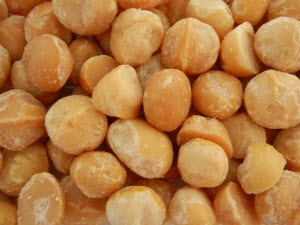
An excellent suggestion would be raw nuts. A couple of months ago, I read a book called It Starts with Food. It turns out, according to authors D. and M. Hartwig, that the two most healthful nuts are cashews and macadamias. Many years before I read that, I used to make a cashew/macadamia nut butter that everyone described as “to die for.” It does have a rather festive taste and mouth-feel, and you can use it as a spread on some wholegrain crackers, to stuff celery or Medjool dates, or as a dip for carrots and more.
Here’s the recipe — if you can call anything this easy a recipe. You’ll need 1 pound of raw cashews, 6 ounces of raw macadamia nuts, 1 food processor, and about 6 to 8 minutes.
Place all of the nuts in the food processor, start it, and let it keep running until the butter has a smooth texture. It will go through a variety of stages in the 6 minutes, but don’t be deterred. Stop and scrape the sides of the container, if absolutely necessary, but it usually works through the stages itself. The butter is perfect if you can hear a slight sloshing sound as the blades turn.
Don’t add anything — no salt, no oil, no water. Everything will blend perfectly. If you’re adamant about keeping the nuts raw, you’ll need to stay close by and turn off the food processor whenever it gets warm. Let things cool, then resume. If not, just let it run.
And there it is: quick, easy, delicious, and sugar-free. If you stick to a once-a-year strategy, it could become a tasty, new (and not too indulgent) holiday tradition.
If you try it, let me know what you think.
