
by Joan Kent | Jan 27, 2014 | Best Practices, Engage Your Students, Master Instructor Blog

By Joan Kent
The difference between something good and something great is attention to detail. — Charles Swindoll
Do you do any writing in your work — blogs, website copy, ads, emails, posts, salesletters? Do you have lots to say, but no confidence in your ability to write it?
Writing intimidates many people. As a result, they avoid it or feel a sense of dread whenever they’re stuck writing something. The result could be missed deadlines, or a stilted, awkward article, post, letter, whatever the occasion requires. It doesn’t have to be that way.
Investing in a good developmental editor and/or copywriter is as important for your business as any other expense you see fit to justify as essential.
Writing style, grammar, sentence structure, parallel structure. The very words sound quaint as I write them. Some people couldn’t even define that last phrase. But their absence simply reeks of slovenliness.
As we know, professionalism is a matter of details. Just think of how many details go into the teaching of a single indoor cycling class: room management, music selection and recording, video selection and use, your workout plan, your training concept, any exercise science you plan to teach, any philosophy of training that matches the day’s workout, personal anecdotes that illustrate the point behind the day’s class, creating the right atmosphere, motivational messages, and more.
If you took a class taught by an instructor who neglected these important details, what would you conclude? ‘Professionalism’ wouldn’t be in your description.
So why would written work be any less important? The written word lasts. If only for that reason, the details of written messaging should be given the time and attention they require. William Feather said, “Beware of the person who can’t be bothered by details.”
There are many reasons to pay attention to our writing. Making sure our meaning is clear comes first. That’s made possible by using the appropriate tone, whether it’s formal, academic, or casual and conversational. The first two are not the only ones that matter.
The power of any message also hinges on both clarity and brevity. Avoid rambling. Unless you’re writing your own blog and hunting daily for material, don’t waste time in your posts describing the clouds in the sky as you sip your coffee while thinking about the topic you’re about to cover for Cyclotronic Cecil’s Cyclo-sation website. Get to the content and make it clear.
Another important element is grammar. Sure, I’m dating myself, but I insist that good grammar matters. Don’t kid yourself. Your readers — and not just the old ones like me — are, in fact, cringing as they read those embarrassing mistakes.
My tip on this is to avoid language trends. They always go in the direction of worsening illiteracy. Just because everyone around you says, “I could care less,” doesn’t make it right. If you don’t care, it’s correct to say you “couldn’t care less.” Think about it for a moment.
But I digress.
The point of this post is that a good editor/copywriter is a wise investment. He or she can polish stale prose, make you sound even smarter than you feel(!) when putting your ideas in writing, and leave you with the confidence that you’ve done the job well.
The attention to detail will show in your growing reputation for professionalism. You deserve that. You spend that kind of time on your teaching. Don’t neglect your writing when help is easy to find.
Give attention to the details and excellence will come. — Perry Paxton
by John | Jan 19, 2014 | Class Work-Sets, Master Instructor Blog, Music, Training With Power
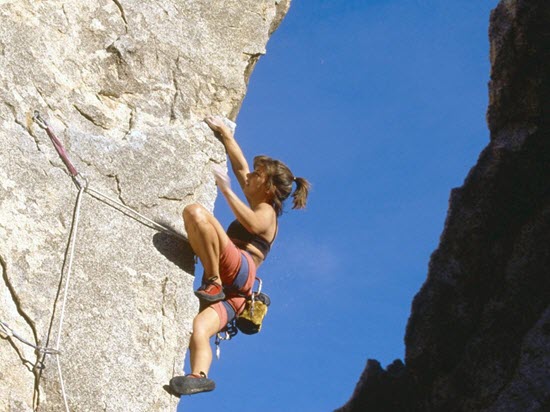
In keeping with the Nonlinear Periodization training prescribed by Coach Troy, today was a combination day of strength (climbing) and building endurance @ Threshold HR/Watts.
Experienced cyclists know what a real climb feels like. While Indoor Cycling may get close, nothing can truly replicate climbing outdoors, on a road bike, over a long, steep climb. This morning's profile includes 4 long climbing efforts; 2 x 8 min., 1 x 10 min. and the final 11.5 min. to the summit. The final 2:48 features “The Wall” – an all out effort paced to my favorite Black Sabbath track Paranoid. Only available from iTunes.
Long duration efforts, at reduced pedal cadences, offer time to work on other components of efficient cycling; pedaling technique, body position and breathing control. Today we focused on what I call disruptive breathing, i.e. consciously breaking each rider's innate breathing rhythm, for the purpose of bringing focus to each breath and making each as complete as possible.[wlm_private ‘PRO-Platinum|PRO-Monthly|PRO-Gratis|PRO-Seasonal|Platinum-trial|Monthly-trial|PRO-Military|30-Days-of-PRO|90 Day PRO|Stages-Instructor|Schwinn-Instructor|Instructor-Bonus|28 Day Challenge']
There's some interesting literature about this. Here's an excerpt from one article.
WHAT CAN YOU DO?
First, practice deep breathing. With a normal breath we generally use only 10 to 15% of our lungs capacity. And during exercise, we tend to increase the rate, not the depth of our breathing. Although deep breathing is more work, and uses a bit more energy, the pay off can be that 1 – 2% edge in a competitive situation. Here are 4 changes you might consider:
-
Exhale more completely. After a more complete expiration, it is easier to take a deep breath. The usual rhythm is exhale to a count of 3 followed by inhaling to a count of 2.
-
Belly breathe. As you concentrate on deep breathing, you will push your diaphragm down and thus the abdominal contents out. If you are doing it correctly, your abs will expand more than your chest.
-
Widen your hand position. A 2 cm wider hand position will open up your chest and decrease the difficulty of drawing in a deep breath.
-
Synchronize your breathing. Try to synchronize your respiratory rhythm to that of your pedal cadence. Remember the 3:2 ratio of exhale to inhale.
I cued variations on all four of these concepts throughout class.
Quick Tip: years ago I learned first hand how widening your hand position can improve your O2 uptake / power while cycling. My first road bike (Schwinn Paramount) came with somewhat narrow handlebars. Not knowing anything different, I rode with them for about a year. Until during one group ride one of the “Old Dogs” riding next to me asked; “why do ride with such narrow bars?” Not having a good answer, I just shrugged my shoulders and said they came with the bike. Taking the hint, that week I bought new bars in the width recommended by my team's sponsor/bike store. They made an amazing difference in my ability to breath and with wider width bars, I felt better in control of the bicycle.
Here's today's profile which follows Spinervals Competition 24.0 HILLacious and my Spotify playlist 1-19 Performance Class. You'll be missing my local tracks #1 Planet Caravan (yesterday's free track) and track #15 (follows Time Will Crawl) Black Sabbath's Paranoid from iTunes.
Class length 75 minutes + Cool Down
Warm Up — 10 minutes. 5 minutes of gradual increases in wattage. During the second 5 mins. we’re finding the wattage where everyone is first noticing a change in breathing; VT1 / Aerobic Threshold = the top of the Recover Zone. This establishes a rough understanding of a base wattage that we use throughout the rest of class.
3 x 30 sec. Hard / 30 sec. Easy – Times Like These Openers to AT/LT. I cue these by first having everyone find the amount of load @ 70 RPM that has them feeling they should (not just could) come out of the saddle. The 30 sec. Hard is then simply accelerating to 90+ RPM which results in some pretty impressive power numbers. The 30 sec. Easy is back to 70 RPM — many will stand and walk during the Easy portion.
2:35 rest – The Best Is Yet To Come ~ Tony Bennett. I encourage riders to focus on their recovery. Once they feel calm in their breathing, bring back the Base level work wattage. I'm talking/motivating everyone about how important it will be for their “Best Effort” to be a BEST EFFORT!
3 min. Hard Effort — 4:03 Race Against Time ~ U2. Here’s the “Best Effort” to establish a benchmark PTP Personal Threshold Power (top of the Perform Zone) or ride at 110% of FTP if known. Song is @ 70 RPM – which is perfect to establish PTP at a climbing cadence. Have everyone find the tempo and add gears > STAGE Button about one minute in and I coach them off the bike during this hard effort.
1:16 Rest – Quick drink before we start Climb #1
7:58 Climb – Bermuda ~ Fluke. Right back to 70 RPM and have riders quickly establish their wattage to 10%-15% below the 3 min. “Best Effort” power. > STAGE Button and then maintain this average until the end. You may want to offer slight changes in cadence & load, while keeping wattage = to the initially established watts #.
4 min. Rest – Delirious ~ Prince
8:02 Climb – Tribal Force ~ Higher cadence @ 84RPM with the same wattage. This moves more of the work to the aerobic system and is a little less stressful on everyone's legs.
4 min. Rest – White Flag ~ Dido
10:03 Climb – Final Frontier ~ Juno Reactor. Back to 70 RPM and encourage riders quickly get as close to their 3 min. “Best Effort” as possible and sustain it to the summit. Many of your athletes are strongest now – help them take advantage of their full strength here!
2 Min. Rest – Last Impression
Final 11:33 Climb – Starts with Come together ~ Joe Cocker at 83RPM. This is more of a tempo effort in the middle of the Performance Zone / between the two power thresholds. Continues with Time Will Crawl ~ Bowie as the road steepens and pedal speeds slow to 63RPM > keeping the same watts, with a bigger gear, as we approach the the final challenge of the day…
The Wall – 2:48 Paranoid ~ Black Sabbath. The beauty of riding magnetic cycles is how simply accelerating a big gear = a huge increase in work. Those big pedals accelerating from 63RPM to over 80RPM should produce the biggest #s of the ride and at less than 3 minutes this should be achievable by everyone 🙂
Base Wattage (aerobic) flat road to finish — use these time to congratulate everyone and give tell them a bit about what you have planned for them next week.
Cool Down[/wlm_private]
by John | Jan 16, 2014 | Best Practices, Instructor Training, Master Instructor Blog, Training With Power

It's a fact of life for all of us teaching power based classes; inconsistency in the watts readings between cycles. Some brands seem to be better than others. Certain bikes seem to be always right, while others are never even close. Calibration is done more frequently by some clubs… or not at all – or the cycles you ride don't offer that option.
This isn't just about us either. Our riders want to feel confident in what they are seeing on their monitors. If they don't believe what they're seeing, they'll soon come to ignore it or worse – ignore you and your coaching.
Here's a screen shot from the Indoor Cycle With Power Instructor Survey – click here to add your experiences.
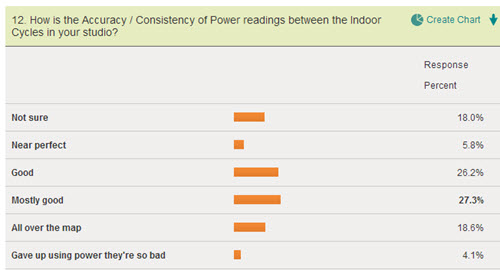
As you can see, only 32% of Instructors rate their cycles as having Near Perfect or Good Accuracy/Consistency. Those of you in the other 68% have a real challenge, making effective use of the tools we're provided and teaching an awesome class!
So here's what to do about it, three simple steps:
Step # 1 – Acceptance of the problem
I actually found myself getting defensive whenever someone made a negative comment to the effect of; “the power meters on these bike aren't accurate.” I'd start making excuses, or questioning the person with; “inconsistent compared to what”? This question, it turns out, does have some value. It's often important for Step #2 to understand; are they are comparing the cycles in your studio to their road bike power meter, or is their complaint focused on inconsistencies between the individual cycles in the room?
If you don't catch yourself, excuses may slip into complaining about management's lack of over-site (not doing regular calibration) or lament that no one asked you which Indoor Cycles to purchase. It you only had XYZ brand this wouldn't be a problem 🙁
This is all out of your control – so just accept “what is”, smile and deal with it.
Step #2 – Communicate your acceptance
To your cyclist you may say; “Yes I know that the power you're seeing doesn't compare with the $2,000.00 Quraq power meter on your road bike.” “There are a multitude of reasons why you're seeing different watts readings… your fit is different, the crank arms are longer/shorter, etc…” Or you might add; “has it been a while since you were riding consistently?” “Could your fitness have changed”? In any event I feel you just need to communicate your understanding that there is a difference.
More importantly, to your class; these power meters are an awesome tool to help you improve your fitness. We are seeing some variation between cycles, making it difficult to compare wattage numbers between workouts and/or other individual bikes in the room. What's important is today's numbers. After all, yesterday's or last Tuesday's ride is in the past… let's focus on today's effort!
Step #3 – Coach the solution
In the survey we're running, I ask the question; Do you conduct any type of assessment during class, to help your students understand or identify a benchmark watts PTP (Personal Threshold Power)? If so please briefly describe what you do and how you teach it.
Yes I know it was a bit of a “leading question”. But identifying a benchmark watts/power # is the solution to inconsistencies between the Indoor Cycle's power meters in your class.
The question was open-ended and drew a number of great responses:
Because the power measurements are so different (inaccurate) among the bikes in the studio I do a 7 minute PPT at the beginning of every class to give each member a usable number for the specific bike they are using.
I need to do a “mini” threshold test at the beginning of every class to get participants “dialed in” because the power readings are so inconsistent from bike to bike.
Yes.. A 5min MAP test
I'm not aware of any “approved” protocol for a benchmark / PTP effort (I call them “Best Efforts”). Depending on your demographic you want these to be 3-7 minutes long – mine are typically four minutes long. I do feel that you and your athletes will benefit from consistency. I do these in every class. If you're a Life Time Fitness Instructor these fit very nicely into the new EDGE Cycling format.
Warm Up — 10 minutes. 5 minutes of gradual increases in wattage. During the second 5 mins. we’re finding the wattage where everyone is first noticing a change in breathing; VT1 / Aerobic Threshold = the top of the Recover Zone shown above. This establishes a rough understanding of a base wattage that we use throughout the rest of class.
3 x 30 sec. Hard / 30 sec. Easy – Openers to AT/LT. I cue these by first having everyone find the amount of load @ 70 RPM that has them feeling they should (not just could) come out of the saddle. The 30 sec. Hard is then simply accelerating to 90+ RPM which results in some pretty impressive power numbers. The 30 sec. Easy is back to 70 RPM — many will stand during the Easy portion.
2 minutes rest – I encourage riders to focus on their recovery. Once they feel calm in their breathing, bring back the Base level work wattage.
4 min Best Effort – to establish a benchmark PTP Personal Threshold Power (top of the Perform Zone) or ride at 110% of FTP if known. It’s very helpful to riders to have that understanding of their personal upper wattage number. The “Best Effort” Threshold # + the Base Threshold # we found earlier form the three Power working zones I use in class.
– 1 min. build at preferred cadence (suggested as 85-95 rpm) — press the Stage Button to reset the averages.
– 4 min. “Best Effort” This should hurt, but be do-able. I ask everyone to observe their average at the end
What are your ideas?
by Joan Kent | Jan 13, 2014 | Big Box Instructor, Master Instructor Blog
By Joan Kent
Johnny G, legendary creator of Spinning and all indoor cycling, as well as Kranking, teaches three elements of training — rhythm, timing and breathing. From him, I borrowed the idea of opening each quarter of training with these concepts, one each day.
Day 1 is about rhythm. This is not following a beat; that’s actually a matter of timing. It’s about feeling our own rhythm within, our sense of aliveness. That sense is always there but can be obscured by internal noise — thinking, unfocused attention, and so on. If you can quiet your mind enough to feel it, you’ll always train with peace and a sense of joy.
Day 2 is about timing. You can explain cadence and work on drills involving cadence changes. I added my own “spin” on it by teaching the close connection between timing and technique. Most mistakes in technique are mistakes in timing.
Technique is important for safety, efficiency (we waste less energy), and the optimal application of power. The mechanics of the pedal or Krank stroke stay essentially the same at any cadence, despite the change in timing. That’s where cadence work becomes essential. Beatmatch is a terrific tool in cadence drills.
Another timing element is more apparent in movement sequences than in continuous circles — summation of forces. Force summation requires correct timing and sequencing of body segments and muscles throughout the motion. As you may know, combining correct timing and sequencing from large muscles to smaller ones results in maximum force. Before energy is lost from the first — and largest — muscle group, force from the next largest is added to it, continuing through the sequence and creating max force.
Some of you may have analyzed the pedal stroke in such a way that you can give a perfect breakdown of each segment of the pedal stroke in terms of force summation. I’d love to hear from you on that.
Day 3 is about breathing. Sustained power depends, of course, on oxygen delivery to muscle, and hard training is made possible by efficient breathing. A basic drill is to inhale and exhale with a consistent rhythm, so that the number of breaths matches up with a specific number of pedal strokes in any given time (say, 1 minute). Focus on basic abdominal breathing. Participants have called it “yoga breathing” because inhaling and exhaling both start in the abdomen.
Then run a cadence ladder and note how the match-up of breathing and pedal stroke changes with the increase in power and heart rate.
Another “spin” on breathing comes from my martial arts background. Power is created when we exhale. In karate, the kiai is performed not to shout and make noise, but to generate a moment of great focus of power. In tennis matches, we hear the forceful sound of the players exhaling. Pedaling is continuous, so there’s no specific moment where we focus power. Instead, we can create one. It can be any part of the pedal stroke that feels like an application of power, but it should be at that same point on each exhalation.
The final breathing drill was another Johnny G technique: uneven breathing. The even rhythm the rider has established between pedal stroke and breathing now changes to make the exhale one pedal stroke shorter (and sharper) than the inhale. (Inhale for, say, 4 down-strokes. Exhale for 3.) This takes practice but is a fantastic way to focus. (I did it for 40 minutes one morning, and my very experienced core knew it had done some serious work.)
At any rate, it’s a new year. It seems that one great way to start January — even in a class that’s been running continuously since last year — could be to go back to the beginning of indoor cycling, back to the basics, back to the underlying factors behind the basics, and back to our IC roots.
Then take off from a solid foundation for a great year of training. Happy New Year.
by John | Jan 5, 2014 | Big Box Instructor, Class Work-Sets, Master Instructor Blog, Training With Power

Today was the official launch of the Life Time Fitness Performance Cycle Winter training series. These classes are hosted at many of the LTF clubs around the country and the plan is for all of us to deliver similar formats, following the same nonlinear (or is it non-linear) periodization training program.
If the concept of nonlinear periodization is new to you, join the club. I first saw the term used in some of the educational material from Coach Troy Jacobson that was provided to us. It essentially means you don't follow the rigid training periodization calendar we're all familiar with; Endurance > Strength > Speed > Anaerobic > Race.
Here's a good description of nonlinear periodization from trainingpeaks.com
Lydiard-style periodization is known as linear periodization because the various major training stimuli (aerobic, anaerobic, strength, speed, etc.) are largely segregated from each other in the training process and arranged in a line in which each gives way to the next. This approach is distinct from nonlinear periodization, in which the various major training stimuli are mixed together throughout the entire cycle and only the emphasis changes from period to period.
Most of the newer periodization systems–those introduced since 1980–are nonlinear. One example is the so-called multi-pace training method developed by David Martin and Peter Coe. In their book, Better Training for Distance Runners, Martin and Coe wrote, “One sensible method for injury-free performance progress over the course of a macrocycle involves harmonious interdevelopment of strength, speed, stamina, and endurance all during the year, never eliminating any of these from the overall training plan… We tend to disagree with coaches who prescribe large volumes of solely longer-distance running over an initial period of weeks, followed by a similarly concentrated bolus of solely higher-intensity speed sessions over succeeding weeks.”
When I hear Nonlinear Periodization I think NOT BORING! Perfect for our Indoor Cycling classes where we really don't know exactly what our Athletes in class need, so let's give them a combination of; Endurance > Strength > Speed > Anaerobic.
I discussed this with Coach Troy during an Instructor call last week. His said he felt confident that our riders will see good progress, working in multiple energy zones in the same class = no mind numbing Long & Slow classes… or at least Long & Slow combined with some Strength > Speed > Anaerobic efforts to break up the monotony of a long class.
Why haven't I heard about this before?
Good question…
As this was the official Kick Off – we started with Spinervals 27.0 Threshold FTP Test .
Here's my Spotify FTP Class Playlist which tracks well with Epic RaceDay Indoor Cycling DVD — which includes a very intense 30 minute criterium race that is the perfect motivation for a 20 minute FTP assessment classes.
Instructor Tip
You can time the criterium to end right on cue with the completion of your 20 minute effort for an awesome finish – complete with the cheering crowd and ringing cow bells! At the initial start/options screen, select 60 min SFX – (no music > just the sound effects). I run the video from the beginning, not really following it until the start of the Crit. When you have 15 minutes left in the FTP assessment use the Skip >> on the DVD player remote to move forward to the next section = the final 15 minutes of the Crit. I keep the DVD sound down until the last 5 minutes. It's bicycle racing magic when they ring the Cow Bell signalling last lap / one minute to go!
Class length 75 minutes + Cool Down
Warm Up — 10 minutes. 5 minutes of gradual increases in wattage. During the second 5 mins. we’re finding the wattage where everyone is first noticing a change in breathing; VT1 / Aerobic Threshold = the top of the Recover Zone. This establishes a rough understanding of a base wattage that we use throughout the rest of class.
3 x 30 sec. Hard / 30 sec. Easy – Openers to AT/LT. I cue these by first having everyone find the amount of load @ 70 RPM that has them feeling they should (not just could) come out of the saddle. The 30 sec. Hard is then simply accelerating to 90+ RPM which results in some pretty impressive power numbers. The 30 sec. Easy is back to 70 RPM — many will stand during the Easy portion.
1 minute rest – I encourage riders to focus on their recovery. Once they feel calm in their breathing, bring back the Base level work wattage.
3 min. Hard Effort — Here's a “Best Effort” to establish a benchmark PTP Personal Threshold Power (top of the Perform Zone) or ride at 110% of FTP if known. It’s very helpful to riders to have that understanding of their personal upper wattage number. The “Best Effort” Threshold # + the Base Threshold # we found earlier form the three Power working zones I use in class.
2 min. Rest
3 x 1 min. Hard Effort x 1 min. Rest. These should be above the 3 minute average wattage.
3 min. Rest
20 min. TT / FTP Assessment effort – Quickly establish the average wattage at or near the 3 min. Interval. > Stage Button and then maintain. You may want to offer slight changes in cadence & load, while keeping wattage = to the initially established watts #. I was off the bike at the 10 min. to go, coaching, encouraging and then just watching them with a big smile on my face. This is a great group and they looked incredible – I'm so in my element with these classes 🙂
5 min. Rest
Base Wattage (aerobic) flat road to finish – use these time to congratulate everyone and give tell them a bit about what you have planned for them next week.
Cool Down
by Joan Kent | Dec 30, 2013 | Health and Wellness, Master Instructor Blog
By Joan Kent, Ph.D.
I’ve posted recently about dietary influences on PMS, and thought it might also be appropriate to discuss menopause and how your older students can use food to help alleviate symptoms.
Brain chemical changes of menopause resemble those of PMS: reduced serotonin and beta-endorphin. So in a sense, menopause is almost permanent PMS. (No comment.)
The most common menopause sign is the occurrence of hot flashes. Hot flashes are best eliminated by limiting or avoiding dairy foods, animal fats, red meat, caffeine, white flour, alcohol, and fried foods. The most significant change you can make, however, is to eliminate sugar. That may need to include fruits. Sure, you’ve heard me rail against sugar before. But anecdotally, I can tell you that I had hot flashes only 3 times — always after I had indulged in fruit (beyond my usual apple or two per day).
Getting enough calcium is important for bone health. Nondairy sources of calcium include broccoli, kale, kelp, mustard greens, dandelion greens, turnip greens, collard greens, and sesame seeds.
Keeping insulin secretion low can help with calcium retention. Minimize insulin by limiting the foods in the “hot flash” list above. Eat only when you’re hungry. Eat smaller, more frequent meals. Avoid high-carb meals (or a high-carb diet generally). Make carbs COMPLEX (sweet potatoes, brown rice, quinoa, etc.), and eat lean protein and unsaturated fats with every meal or snack.
Phytoestrogens are another good way to alleviate menopause discomfort. Celery, parsley, nuts, seeds are foods that contain phytoestrogens. Soy contains phytoestrogens, although soy is a somewhat controversial food. Let’s table that debate for now and include fermented soy (miso, tempeh, natto) in the phytoestrogen-containing group.
Eat an all-starch snack, such as brown rice or a potato, about an hour or so before bed. This is designed to shift brain chemistry and help the brain make serotonin, which has a relaxing effect and is also the precursor of melatonin, the sleep hormone.
Eat ½ to 1 teaspoon of acidophilus yogurt daily. Note the small amount. Even if you’re avoiding dairy, this won’t be enough to cause hot flashes, and the probiotic benefits are worth it. Other probiotic foods include real sauerkraut and kimchee.
Eat “good” fats to control cravings for sugar and other carbs. Examples are nuts, nut butters (unprocessed, without sugar), seeds, and avocados; also olive, canola, and walnut oils. More below.
Essential fatty acids are great to add to your diet. (Essential means we can’t make it in the body and have to get it from food.) Cold-water fish, ground flaxseed or flaxseed oil, and walnuts supply a good array of EFA. Another, somewhat surprising, way is to eat lots of leafy green vegetables, such as spinach and other greens in the nondairy calcium list above. We don’t think of leafy vegetables as containing fats — and they don’t contain much — but every bit of the fat in them is an essential fat, alpha-linolenic acid.
Stress management techniques can help. Chronic stress worsens symptoms, increases insulin secretion, decreases serotonin and beta-endorphin even more, induces depression, and increases appetite and food cravings. Stress management techniques can include meditation, acupuncture, and heat to raise body temperature (sauna, steam, whirlpool, hot bath or shower).
The #1 stress management technique is exercise! Exercise raises beta-endorphin and serotonin, minimizes insulin secretion by making muscle more sensitive to insulin (so we produce less), improves mood, and reduces insomnia, fatigue, and food cravings. Encourage students who have symptoms to use your classes to help manage them.
Here’s to eating right and regular indoor cycling classes as part of a lifelong health strategy, not just to combat menopause discomfort.
