
by John | Jun 8, 2011 | Master Instructor Blog

If your were curious what Threshold looks like...
The look on Tom Scotto's face says everything! That's real mountain climbing, at Threshold, in Spain.
Tom was in Spain last week with Gene Nacey to film another in the series of Global Ride Indoor Cycling DVDs
If you have a few minutes I encourage you to watch the short video below where Tom and Gene relax with some Gelato at the end of a hard week of riding/climbing in Spain.
Gino & Tom Film in Spain from Cycling Fusion on Vimeo.
by Tom Scotto | May 26, 2011 | Master Instructor Blog
 Being a sprinter by nature, explosive efforts are one of my favorite topics. It is not too surprising however that this was one of the elements of indoor cycling that made me sit up and think “huh?”. Besides the bad form, lack of any recovery and unrealistic lengths (i.e. 2 minutes), people seemed to fall to one cadence extreme or the other when the instructor yelled “sprint”. Some riders overloaded their bikes with so much resistance that it look as if they were wrestling an alligator to the ground trying to turn the pedals. Others had their legs spinning so fast that their bodies morphed into crazed jackhammers.
Putting the technical and tactical aspects of sprinting aside, sprints are a combination of fast leg speeds and maximal force. To get an idea of leg speed, let’s look at some of my favorite professional sprinters and see how fast they are turning their legs as they charge for the finish line:
Mark Cavendish: 110 — 125 RPM
Tom Boonen: 115 — 118 RPM
Thor Hushovd: 98 — 110 RPM
Erik Zabel: 108 — 118 RPM
Mario Cipollini: 105 — 118 RPM
Now keep in mind that these guys are generating upwards of 1200watts (Cavendish has been said to average ~1600watts). Needless to say, they would have a good amount of resistance on their indoor bikes if they were sprinting in one of our classes. So how do we teach our riders to use a realistic amount of resistance and legs speed? Before I give you a game you can play, remember that sprints (in the cycling world) are maximum efforts. We have a saying “if you’re not going to sprint at 110%, don’t bother”. So that being said, we need to: (1) make sure everyone is using good form so they don’t get injured, (2) have ample time to recover so then can give 110% again and (3) are not asked to sprint longer than 30 seconds (which is a LONG time at “all you’ve got”). Make sure you urge riders to work at their own pace and simply only work on sprinting form if they are not able to push the higher intensities.
How much power can you generate at ______ RPM?
Here is a little game that can be made into a class (providing you have power and cadence displayed on your bike). Have riders hold an 80 RPM cadence and then add as much resistance as they can and sprint without slowing down their legs. This can be done seated or standing. Perform 3 to 4 sprints at 80 RPM (with 2 minutes of recover between efforts) and see if riders can start to figure out which resistance (or gear) combination works best for the most power. Then do another set at 90 RPM and then 100 RPM. What is the most power that can be generated at 90 RPM and 100 RPM? If you are teaching an advanced class or one populated with experienced cyclists, you can attempt 110 RPM and 120 RPM. Just keep in mind that sprints are MAXIMUM efforts and may fatigue your class very quickly.
Not only does a game like this demonstrate the immense effort a true sprint requires, it can help your class become more acquainted with proper resistance and leg speed in general.
by Tom Scotto | May 19, 2011 | Master Instructor Blog
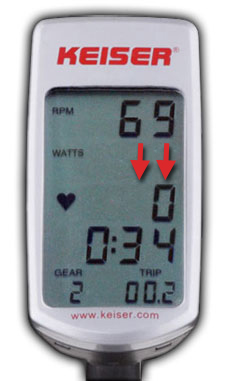 I coached one of the last weeks of Cycling Fusion’s winter training program with a focus on developing muscular strength. The indoor ride consisted of a 15-minute warm-up, 2 openers (short, high intensity efforts) and then 4 climbing strength intervals. The goal of the intervals was to sustain the maximum load (resistance) while maintaining a slower cadence for 3 minutes. Although I told the riders that the climbing cadences for all of the efforts were between 60 and 70 RPM, I failed to stress the importance of this leg speed for achieving the desired result — strength. I also failed to alert the class that their power output would be less than what they were accustomed (they were riding on Keiser M3 bikes).
As we started to tick off the intervals, I observed the cadences of many of the riders increasing noticeably above what was indicated. As usual, I had the music tempo set to the desired leg speed for each climb. As riders were cooling down after the last interval, I walked around the room to chat and see how different people did. It was interesting to note that many of the riders increased their power (watts) during each climb. Although in almost all circumstances this would have been a good thing, in this case it was not.
Now keep in mind that this group of riders was used to training with power and was also used to seeing a certain (higher) power number when climbing. In addition, they were used to climbing at tempos closer to 70-80 RPM. So when I asked them to climb at a leg speed of 60 RPM, they immediately noticed a lower power number. They associated this lower power output as “not good” and thus FIXED it by backing off some resistance and increasing their cadence. Were they wrong in doing this? Well, in a general sense, no. It actually shows they understand the impact of cadence (velocity) on power output. However, in this case, the focus was on developing muscular strength which demands an emphasis on workload and not power output. The goal was to apply maximum force (stress) to the muscles of the legs for the entire 3 minutes. So during this workout, it was more important to target a slower (60 RPM) leg speed in order to maximize strength development.
SIDE NOTE: Having power meters during drills like this are still very important. Even though we are not going to expect the highest watts, we do want to make sure we are maintaining a consistent power output for each interval. This is one of the ways power is such a valuable tool. If we only have a heart rate monitor, we may observe the same or higher heart rates for each of the 4 climbing efforts. This only shows what the effort is costing our body and not how much is being produced. The addition of power allows us to see if we are maintaining a constant power output for each effort or if our power is dropping even though our heart rate remains the same or increases.
So if you are designing a class that focuses on developing leg strength, avoid the error I made and emphasis the importance of a sustainable 60-70 RPM cadence. I would also encourage the use of music that matches the desired leg speed so riders can feel the pulse. Music at 60 RPM (or 120 RPM/BPM) is usually the easiest to find since dance music is often at this tempo. And, as always, make sure your riders maintain good form and are instructed to work at their own pace particularly if they are nursing leg, back or neck injuries.
Ride Strong!
by Tom Scotto | May 12, 2011 | Master Instructor Blog
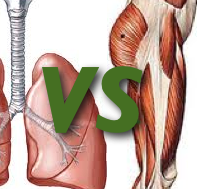 Once we understand and move past the limitations of cadence on the indoor bike, we can begin to realize how much of the focus of our class can be affected by leg speed. I’m not just talking about cadence drills and biomechanics, but actually controlling how much stress we place on the cardiovascular system and how much stress we place on the muscular system (legs). Although little scientific study has been done on the effects of cadence, there is substantial practical evidence from years of cycling, training and competition to grasp the overall impact of cadence on the body.
Keeping in mind that there are always exceptions, it has been generally accepted that 80 RPM is the imaginary line between cardiovascular and muscular emphasis. More specifically, a cadence of 80 RPM or higher will demand more from the cardiovascular system where a cadence less than 80 RPM will place greater focus on the musculature of the legs. Similar to how our energy systems and fuel systems work, there is not a specific “cut-over” from cardiovascular to muscular, but rather an emphasis or greater percentage of one over the other.
A more technical way to think about it is to consider the concept of force (or torque) and velocity. The more velocity (faster cadence) for the same amount of output (such as power) the less torque or stress on the leg muscles. Similarly, the same power with a slower leg speed will require more force (torque) and place a greater emphasis on muscle engagement. If you have a power meter that measures torque (in newton metres – Nm), you can see the impact of cadence as you try to hold the same power output with different leg speeds.
So what does this mean for Indoor Cycling?
Well it means a lot. An instructor can guide riders toward a certain focus by encouraging a leg speed that provokes the right physiological response. For example pushing a rider to a perceived effort of 80-85% with a 90 RPM cadence will place a great amount of stress on their cardio system. The rider will most-likely feel as if their ability to breath is being severely challenged. Pushing a rider to the same 80-85% perceived effort using a 60 RPM cadence will place a tremendous load (and emphasis) on the leg muscles. The rider will most-likely feel as if they can sustain their breathing but their legs will soon give out. The same target intensity but a totally different response.
So think about the type of training effect you are trying to promote and what you want your riders to feel during different parts of your class and make sure the suggested cadence is appropriate. This may also help guide those who are pedaling too fast during an effort focused on muscular endurance. Explain both the target cadence and how their legs should feel to entice them to decrease their leg speed and increase the resistance. Conversely, lure the pedal masher to a faster leg speed (with less resistance) to transfer the emphasis from the legs to the lungs.
Suggested Cadences:
- Warm-up: 80-90 RPM
- Aerobic Endurance: 80-100 RPM
- Muscular Endurance: 70-80 RPM
- Muscular Strength: 60-70 RPM
- Threshold Training: 90-100 RPM
- Climbing: 60-80 RPM
- Sprinting: (See Part 4)
- Cool-down: 80-90 RPM
Give Em a challenge: CLIMB LIKE A PRO CYCLIST
It is not uncommon for riders in an indoor cycling class to slow their cadence to 60 RPM with tons of resistance when simulating a climb. Instead, encourage them to climb like a pro (or maybe Tour de France) rider by maintaining an 80 RPM cadence while climbing. Many pro cyclists will climb at faster leg speeds because it produces more power (remember the force-velocity relationship). However, the reason they can maintain this is due to their aerobic ability (or capacity). When we climb at an 80 RPM cadence, in or out of the saddle, we feel our lungs beginning to burn and our natural response is to slow down the legs to ease the pain in our chests. So, bring your riders to a 80 RPM cadence either through a cadence check or music that indicates the tempo. Then have them continue to add resistance until they are barely able to maintain the leg speed. That is the baseline for the climb. You can give them the option to stand while climbing, but they must maintain their 80 RPM cadence even out of the saddle. Keep the climbs short (2-5 minutes). Ask riders if they were successful in being able to visualize the climb at the faster cadence AND if they felt the stress in their lungs even through they were climbing. This is a great way to demonstrate the power of cadence and how we can manipulate the way our body responds to intensity.
by Tom Scotto | May 5, 2011 | Master Instructor Blog
 The cadence or speed at which we pedal has a large impact on the type of workout we will receive. Maybe larger than we think. Often times, the only thing that separates one workout from another is leg speed. This 4 part series will explore different ways cadence affects the type of workout and our body’s response.
Part 1: Extremes and Limitations
Part 2: Cardiovascular or Muscular Emphasis
Part 3: Power Output or Strength Development
Part 4: Sprinting for Maximum Power
PART 1: Extremes and Limitations
There are two things to understand as we begin to explore the full range of leg speeds in cycling, (1) what is capable on a real bike, and (2) what is appropriate on an indoor bike. Although the later may appear more to the point for the indoor cycling instructor, I’ve seen instructors lose respect from outdoor riders because of uninformed, end-all comments. Some of these comments sound like, “there is no value in pedaling faster than 110 RPM” or, “it is unsafe to pedal slower than 60 RPM — EVER!” or, “leg speed doesn’t matter, just ride as hard as you can!” Anyone who has hung around me long enough knows my thought on these comments is, “it depends”.
Why is the impact of cadence when riding indoors different than when riding outdoors? It boils down to the lack of side-to-side and forward and backward movement (limitations) of the indoor bike. This limitation of movement has both mechanical and safety implications.
Natural Movement of the Bike
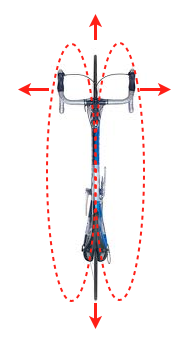
When we stand on a bike outdoors, it moves side-to-side (or should) as we apply pressure to the pedals. The bike may swing as little as 3-4 inches to greater than 10 inches. What we often don’t realizes is that the bike is also surging forward and backwards as well. The overall movement of both the side-to-side and surges results in a “Figure 8.” Keep in mind that this movement is also present when riding seated. We just don’t notice it as much because the bike moves less. So simply, a bike ridden outdoors moves much more than you may think. This “natural” movement provides leverage for power production and aligns joints to apply maximum force. The lack of natural movement of an indoor bike can limit mechanical efficiency and power.
This lack of bike movement also presents safety concerns for indoor cycling. Because the indoor bike does not move naturally, the body often needs to compensate by moving instead. Regardless of how much one moves their body to compensate for the lack of bike movement, an unnatural amount of stress will be placed on the muscles and joints. This is the reason why certain movements and extreme cadences should be avoided. Quick or explosive movements from a seated to standing position should be avoided. These include sprints that start in the saddle and then force a rider to quickly stand with heavy resistance, and jumps (Spinning®) which encourage riders to move rapidly from a seated to standing position. These movements will place unhealthy stress on the lower (lumbar) spine, because the body must compensate (not the bike) for the force.
Similarly, leg speeds faster than 110 RPM are discouraged on an indoor bike. The lack of any movement on an indoor bike will place unnecessary stress on joints at higher speeds. The addition of a fixed, weighted flywheel only adds to the risk. Conversely, pedaling slower than 55 RPM (with heavy resistance) on an indoor bike can also put a rider at risk since the bike is not able to move under the workload placing unnatural stress on joints. Understand that it is not uncommon for riders training outdoors to perform cadence drills above 120 RPM or muscular strength efforts under 50 RPM. Are these beneficial — well, it depends. More importantly, regardless of whether you are riding indoors or outside, appropriate resistance (gearing) and proper form should be maintained at all times.
NOTE: The limitations described above can also apply to “real” bikes ridden using an indoor (stationary) trainer.
by Tom Scotto | Apr 8, 2011 | Master Instructor Blog
 What to do when you are the ONLY one at your club that teaches a “real” cycling class.
I’ve received this question quite a bit. “How do you handle teaching a class that is so different than what other instructors offer at your club?”. One of the reasons we have gravitated to ICI/Pro is because of the sound teaching and training concepts. Although we can be really excited to learn something new (or just get reinvigorated), the excitement can wane when we think of how it will be received by our riders or our club as a whole. Those who love our rides, are also bombarded by other indoor cycling classes that have little resemblance to biking or training.
Try to Avoid Bashing Other Instructors
We can find ourselves in an awkward situation from time to time when we are the only one who teaches a cycling-specific class at our club. Our classes tends to have more structure and purpose with a greater emphasis on proper form and technique. It is not uncommon for someone to approach me after class and ask why my classes are so different. We never want to speak bad about another instructor or even give off the impression that we think we are better than anyone else. This NEVER looks good and is not professional. But it is a tricky questions to maneuver around. My response is that it is more an issue of “style” than right or wrong. Since I’m a coach, my approach is “training”. Other classes that may just be random fun rides for example, are not wrong or inappropriate, but just a different “style” of indoor cycling. Of course we know there are elements (sometimes many) of these other classes that are unquestionably incorrect (from a cycling or group fitness prospective), but it is never a good policy to “point” them out. I’d rather focus on why I approach the class the way I do and relate it to my experience.
Now bike setup issues are another story and harder to talk your way around. I had a person approach me after class who was visibly and verbally frustrated. She was new to the area and club and told me that she had been given 4 very different ways to setup her bike in the last 4 days. Each instructor was adamant (and apparently a bit condescending) telling her, that what she was told previously was all wrong. Now here I was watching her recount everything she was instructed to do and thinking to myself “ah man, none of what she was shown was correct. Now I’m going to be instructor number 5”. I tried to focus her on some changes she should try based on her injuries and fitness instead of focusing on why she was put in various positions in the first place. She would not let it go. “This is so different than what the other instructors told me — none of them knew what they were doing!” I was put in serious back-pedaling mode… “I’m sure they based your settings on what they saw at the time”. Then I tried to focus her on how she felt and made some recommendations for shoes and clothing.
I’ve talked to my various group fitness directors many times asking that we establish a standard so we are not providing members with a mixed message. I hate being put in that position.
Set The Expectation
Be different, but set expectations. Let your class know how you approach your ride and don’t be afraid to leverage your experience or credentials. As part of my introduction, I let riders know that because I’m a USA Cycling Elite Level Coach, my classes more closely resemble a structured training session. I mention what we’ve been working on over the last few weeks, the day’s plan and a peak into the upcoming weeks. For me, these sets up the expectation. It indicates my teaching style (coaching), and that my class is organized (structured), cycling specific (USA Cycling …blah blah blah) and purposeful (planned classes). Yeah Tom, that works for you, you braggart! Wait a minute, don’t dismiss this too quickly. Everyone has a purpose in how they approach and build their classes. What is yours? What motivates you? What are your “convictions” about cycling, fitness and training. Seriously, think about this and craft an opening that sets the stage for your class. When people ask why your class is different, you won’t have to answer – your riders will answer for you. They will simply repeat what you told them, which IS, why they continue to come to your class.
Get a “Special” Class Description
See if your club will post a description of your class. You may not want to call it “special”, but it is good policy to set member expectations when they are making decisions about which classes to take. Many clubs have an area or board (or page on their website) that gives a description of each class. Think about what makes your class different (your above assignment) and ask if they can post a description with an appropriate title. This approach resonates well with most group fitness directors or coordinators, because it is member-focused. It also let’s them “advertise” something about their program that is different than maybe what other clubs in the area are offering. My classes have been called everything from “Stage5 Cycling” to “Performance Cycling” to “Road Cycling” to “Ride with Coach Tom”. One of my directors even came to my defense when a regional director took my class and felt it was too “coach-y”. He apparently had a tough day and just wanted to chill (sorry, not my “style”). My director simply turned his focus to the board where the classes were described and said, “you should have read the description, that is why people take Tom’s class”.
Try not to focus on “right” or “wrong” but rather on what makes your class and experience different. Set your riders expectation with a short and sweet description of your approach and see if your club will post (advertise) it. Being different can be tough, particularly when everyone wants to quickly jump to comparisons and finger pointing. Be professional, humble and confident — even that may appear different.
