
by Tom Scotto | Feb 25, 2011 | Instructor Training, Master Instructor Blog
Here is Tom Scotto's first post in his official capacity as a Master Instructor here at ICI/PRO –

Indoor cycling instruction keeps progressing and improving and so do the bikes we ride. Today, many of our indoor bikes have more than the ability to add and remove resistance. Bikes are now providing us with cadence, heart rate, power, time and a host of other measurements to guide our rides and training. So I thought it would be good to talk about what these numbers actually mean and get some response from our knowledgeable community about experiences you’ve had or ways you’ve incorporated these tools into your classes and teaching.
“KILLER” Calories
OK, they are really not “Killer” calories but that is how is sounds much of the time when I hear people talk about it. We are referring to kcal. This is a scientific abbreviation for kilogram calories or kilocalories. It is generally used to indicate a “small calorie” or gram calorie. When written properly, it is presented with a lowercase “c” as in “cal”. However, like many things we try to understand these days, the inconsistency of how it is display and how it is calculated can create more confusion. So, by its original definition, kcal is 1000 “small” calories or simply a Calorie (note the uppercase “C”).
Without nose-diving into a verbose science lesson (which I’m not qualified to give), kcal or Calories is simply a measurement of energy needed or required. In science terms a kcal represents the approximate “energy” needed to increase the temperature of 1 gram of water by 1 degree Celsius. So on the bike kcal is simply a measurement of how much “energy” we are generating.
So how does the bike know this? Enter the joule.
Since these bikes are also calculating power output (watts — we’ll talk about that in another post), a joule is the measure of energy from the amount of force (mechanical work) required to move an object. Joules can be converted to calories (1 joule equates to 0.2389 calories or 0.0002388459 kilocalorie) – YIKES!!!!! Let’s just say that with my math skills, I’m glad computers can figure this stuff out.
Enough of that Brain Twisting — Is kcal Useful or Accurate?
In a “very” general sense 1 kcal = 1 calorie, but it is better to think of this as the energy that you produced during your ride rather than how many calories your body burned while riding. Here are some factors that affect the true conversion from 1 kcal to 1 Calorie:
(1) Muscle Mass
A person with a higher percentage or body fat will usually burn LESS calories than a person with more muscle mass. Since body fat percentage affects a person’s metabolism, it will affect how much it will cost them (energy) to do a certain amount of work.
(2) Fitness Level
A person who has a greater fitness level will more likely burn LESS calories than someone who is not as fit for the same amount of work or activity. Hence the benefit of training and adaptation.
(3) Body Weight
A person that has more body weight may require LESS energy to push (move) a certain workload (force) than an smaller, lighter person.
(4) Mechanical Efficiency
A rider with good form, posture and technique will fight the mechanics of the bike LESS and may achieve the same output with LESS effort of energy expended.
Because of all the possible variations and factors, it is best to use kcal as a “personal” benchmark. If you generated 500 kcals during a certain ride or training focus, you can try to replicate this on a future ride or try to exceed it. Use it to measure your progress or gauge how hard you may be working during a given class. Just remember, that different pieces of fitness equipment may not calculate kcal the same. This may be due to the mechanics of the equipment (treadmill vs. bike) or because they may include additional measurements (like body weight) into the calculation. Consider each piece of equipment its own animal and use kcal an estimation of how much energy one workout required compared to another.
by Gino | Jan 21, 2010 | Master Instructor Blog, Training With Power
If you live in a state that is relatively flat (3% grade or less on most roads), then generating power will be more for generating speed, overcoming wind resistance, toning leg muscles, and in general getting fitter. However, if you live in one of our hilly states, you know well that it’s all about the climbing.
In fact, unless you are a time trial specialist, the main determining factor for whether you can be competitive in racing, or successful at that century ride you’ve always dreamed of doing, will be how you ride in the hills. As a spectator of professional cycling, you may have also noticed that it is the mountain stages that typically determine who will make the podium, and who waits till the next race to make their mark. At the end of the day, climbing is just about the most important discipline to conquer in outdoor riding. To that end, the Cycling Fusion Speed & Power Climbing chart can help you train in the hills.
Across the top of the chart are the grades of a given climb. The left side represents the speed you will travel up the hill if you can generate the Watts/Lb that is reflected in the intersection of the two. For example, if you want to climb a 7% hill at 10 mph, you will need to generate 1.5 Watts/Lb. How do you know what grade a given hill is? There are numerous mapping programs that can tell you the average grade of a given section of road, you can get a reading from certain bike computers or GPS devices, or finally, you could calculate it if you know the elevation gain, distance and a little algebra.
Notice on the sample chart below, that the cells representing 1.0 or 1 Watt/lb are highlighted in red or pink. This is because the power created at this level permits the rider to climb most hills at a reasonable speed.
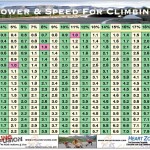
During the development of the Cycling Fusion Power Training System, we did numerous indoor and outdoor comparisons of power numbers, which included different victims (er volunteers) riding specific hills with specific grades and observing their average speed and power that was recorded from top to bottom. These field tests, as well as the general riding principles of the road provide the basis for 1 Watt/lb as the gateway to outdoor climbing. Consider also these facts:
- Below 5 mph, it is extremely difficult to keep a bike on line, rolling straight, safe and steady.
- Below 5% grade it’s not much of a hill. As a point of reference, rail trails are typically 3% grade at their highest, and on occasions 4% because trains could not generally negotiate grades steeper than that.
- In looking at the top end of the applicable grades, research on road construction guidelines has shown us what we as avid cyclists already knew from experience, that double digit grades are rare, and construction crews avoid building roads that steep when possible, but there are times when that is not possible. There are a number of references on the internet that corroborate this fact; a couple appear below. Maine and New Hampshire each show guidelines that range from 5% to 12%:
- Consequently, the facts above permit us to construct a sort of minimum set of hill grades and speeds that should be manageable if one wants to ride outside, unimpeded. That is, the desire is to ride up each hill, not needing to get off and push the bike. This range is a speed starting at 5 mph, and a grade that can be negotiated up to 10% grade. The configuration below represents the minimum output required to keep riding within these guidelines. In general, it is 1 Watt/lb or less:

- Notice that 10% does not quite make the 1.0 Watt/Lb guideline. Since we know that double digit grades are more rare, and often of shorter length, we can assume that the rider can use power in their Climbing or Explosive zones to conquer these sections.
by Tom Scotto | Sep 2, 2009 | Instructor Tips and Tricks, Master Instructor Blog, Stage 5 Cycling

Tom Scotto is the Program Director for Stage5 Cycling Incorporated and a Certified USA Cycling Coach. Tom asked if he could contribute to the discussion and offer his perspective on if you should incorporate jumps into your Spinning / Indoor Cycling Class profiles. Tom was a guest on Podcast #34 where we discussed his Indoor Cycling Certification Program
In summary, jumps (as Spinning and Schwinn) define them, should never be
done on an indoor bike. There are some dangers and misconceptions that can
help instructors understand why this is not an appropriate technique.
Let me start by saying, as a USA Cycling coach, my perspective is very
real-cycling focused. Regardless, I'm not a big fan of distinguishing
between and indoor (non-cyclist) and a outdoor cyclist, both of whom may
take an indoor cycling class. Both are riding a bike which require similar
biomechanics and technique with a few adaptations (I'll explain below). The
determining factor is the workout. A well defined, appropriate and
purposeful workout (with good music) will please any crowd regardless of
age, fitness or skill level.
I am in agreement with Jennifer Sage's definition of “real” cycling jumps.
Dead on. My issue lies with the non-cycling (Spinning, etc.) jumps.
Why NON-Cycling Jumps are potentially Dangerous
———————————————–
(1) Strain to the lower back (lumbar spine). When a rider stands on a real
bike, the bike moves backwards under the rider approximately 3-6 inches.
The better the rider's technique, the least movement. You may have noticed
this when riding close to a someone's back wheel. They stand to climb or
accelerate and now your front wheel is hitting or overlapping their rear
wheel (hopefully the later). THE PROBLEM: Indoor bikes don't move. When an
rider stands too quickly or forcefully on an indoor bike, stress is placed
on the lower back and spine because the force and momentum of the pedals
thrusts them forward. When sprinting or accelerating out of the saddle on
an indoor bike, riders should be instructed to smoothly come up out of the
saddle with the appropriate resistance BEFORE launching their effort to
reduce the force on the lower back.
(2) The Bike Doesn't Move (Part 2).
Because indoor bikes don't move SIDE to SIDE, a
rider can potentially stress hip and knee joints and strain upper body
muscles without proper technique. When a rider stands and pedals on a real
bike, the bike gently (and sometimes, not so gently) sways/rocks side to
side underneath the rider. This is proper technique and done to achieve
better mechanics between the legs and bike. If a rider stands and tries to
keep the bike from moving side to side, this will cause the upper body
muscles (shoulders, back, neck, biceps, chest, forearms, etc.) to contract
against the force. This unnecessary muscle contraction wastes energy
(fuel), uses oxygen, fatigues the muscles and, more importantly can strain
the muscles. Similarly, if a rider tries to stand and keep the bike still,
the mechanics of the legs will be hindered placing stress on the hips, knees
and sometimes the ankles and feet.
With that said (whew…), non-cycling jumps are too fast a movement to
compensate for the NON-MOVEMENT of the indoor bike. In addition, it is more
difficult to monitor a larger indoor cycling class to ensure everyone is fit
correctly to the bike and is using proper form and technique.
It Doesn't Teach Functional Technique
———————————————
I appreciate using non-cycling jumps as a drill to
improve technique. Her examples of a tennis player, soccer player and
volleyball player are correct. However, this does not translate to cycling
for one reason – The Bike Doesn't Move. The tennis, soccer and volleyball
players are using the same equipment and functional movement required of
their sport. The movement on the indoor bike is not “functional” for the
purpose of non-cycling jumps because the static nature of the bike does not
promote proper, movement, reaction and bike handling out of the saddle. If
you are still not convinced, go outside on your real bike and do a few sets
of 2-second jumps (wear a helmet).
MISCONCEPTION: Standing on the Bike.
———————————————
Riders in general (indoors and out) have a misconception about riding out of
the saddle and tend to stay seated as much as possible. I've encouraged my
indoor riders to watch at least one stage of
the Tour de France this year and observe how often riders stand. One will
notice that riders not only stand on climbs and to sprint and accelerate,
but they stand on flat roads and at lower intensities as well. I'm not
going to get into the different standing techniques, but let's just say
riders should be standing way more often than they do. One reason riders
will stand is to stretch the legs (they will often do this on flat sections
of road). It allows the leg (which cannot not fully extend seated) to
elongate and stretch the muscles keeping them from shortening from multiple
contractions. This year I coached a training camp with Tour de France
rider, Fred Morini (Gerolsteiner). He spent a good amount of time getting
riders out of the saddle and teaching them stretching techniques. I was even
challenged to get out of the saddle more (and I thought I stood a lot).
This can be a tough concept to explain, even to outdoor riders (and
instructors) because they are not often spending enough time out of the
saddle themselves. Standing technique needs to be better incorporated in drills and recovery.
MISCONCEPTION: We Need Variety
———————————————
We don't need variety as much as we need real training. We (Stage5) have
over 40 different indoor workouts. Each with its own focus (training
effect), specific drills, music and charts. There is no mystery or magic
here. We are simply adapting outdoor workouts to the indoor cycling studio.
The workouts are designed to target different skill and fitness levels and
are appropriate to the time of year (periodization). Our riders will often
not get the same workout more than once in a 2-month period. Classes can vary
from focused training sessions (aerobic development, speed-biomechanics,
muscular endurance, explosive power, threshold, etc.), rides (rolling
terrain and famous routes), to race day events (Tour de France, local races
and the like). If an instructor does their homework and understands how to
lead their riders through the training session, ride or event, they will
please and motivate any rider, any age, skill or fitness level. That is the
beauty of indoor cycling.
Cheers, Tom.
