
by John | May 10, 2010 | Featured Articles
ICI/PRO contributor Dr. Haley Perlus lives in the town where Jennifer teaches Spinning® Indoor Cycling at a studio. She recently went to two of Jennifer's indoor cycling classes. The first one was a high intensity training interval class, and the next was a threshold field test the following week. Here are her reviews of Jennifer's two Spinning Indoor Cycling classes.
April 19, 2010 (review of class on Friday April 16)
Let me be clear, early morning cycle classes are not my style! Unless I’m teaching (which means I’m getting paid) to get to the club for a 6am class, I’m simply not interested. That said, I did drag my behind out of bed Friday to participate in Jennifer’s cycle class. Not only did I make the three minute drive to the club, I also brought my entourage including my boyfriend, Brad, and my father, Jon. Jennifer’s husband, Jeff, was also there so it turned out to be a cycle party! It took all of one minute for Brad and Jeff to start chatting, but as I instruct fitness professionals to do, Jennifer got off her bike, stood between our men, and explained the class objectives. Brad and Jeff got the hint loud and clear, but not before they jokingly blamed the other for starting the chatter. Jennifer walked back to her bike, smiled and said, “don’t make me have to separate you boys for misbehaving!”
Jennifer’s wit is one of many strengths she has an indoor cycle instructor. She also knows the wants and needs of her participants. Friday was an interval class and Jennifer explained its components so that everyone could understand what was expected of them and modify the intensity to fit their weekend plans. We live in a ski resort town and it was a good possibility that class participants would want to ski on the weekend (it was closing weekend for the resort). Taking this into account, Jennifer suggested that those planning on skiing reduce the intensity and those not skiing challenge themselves to the best of their ability. This instruction was particularly important for my father who arrived in Vail Wednesday with the intention of skiing four days in a row. I’m pretty sure he appreciated Jennifer’s ‘heads up’.
I also want to share with you a few other things about Jennifer’s indoor cycle class. It was a full class. Even though I’m not a fan of early morning training, Jennifer has managed to inspire others to see the value in it. They get excellent training from an excellent trainer. She has a unique way of explaining principles to her participants. For example, instead of talking about the physiology behind high intensity training, she explained, “you shouldn’t be able to drink water immediately after an interval. If you’re pushing hard enough and try to drink right after, it would be like breathing in water.” Jennifer’s teaching experience has taught her that participants need easy explanations and images they can quickly understand and use immediately. Her cycle enthusiasts have developed a tremendous appreciation for her. During the cool down, a lady in the back row yelled out, “can we do one more?” Once again, Jennifer used her wit and responded, “You can stay after school if you’d like.”
So, have I changed my mind about early morning training? I’m not sure. All I know is that I plan on making the three minutes drive again this Friday for Jennifer’s cycle class!
April 23 (review of class on Friday April 23)
Growing up as a competitive Alpine ski racer, I’ve had my fair share of fitness tests. 400-meter sprint, one-mile run, VO2max, the box jump, and numerous other assessments were the least enjoyable components of my sport training. As much as I hate to admit, I developed a fear of fitness testing. That changed today!
Jennifer guided us through a Lactate Threshold field test. It was the first time I enjoyed assessing my fitness level and I have Jennifer to thank. She was honest and direct in her instruction so I knew exactly what was expected of me. When testing for ski racing, my coaches never informed me of how I would feel, when I would experience fatigue, and when I would need to question my commitment and fight a little bit more. Jennifer communicated all of this to her participants at the beginning of the class and consistently reminded us of our commitment throughout the test.
It is evident that Jennifer takes great pride in her cycle class. She always shows up with a pre-selected playlist to compliment her profile. Today, she used energetic, but even tempo songs. They helped us maintain an even cadence, stay energized throughout the test, and focus on our bodies and work output. One song, in particular, provided us the image of a car race. The introduction included the sounds of race cars revving up and taking off. Jennifer effectively placed this song at the beginning of the test to help us ‘rev’ ourselves up for the ride.
When the test was completed, Jennifer used the cool down to discuss how to use the knowledge we had obtained. She tailored her explanations to fit the needs and wants of her participants. This might be one of her greatest strengths as an instructor. She knows her attendees. She provides enough scientific knowledge for them to learn something new, but always uses concrete examples that specifically relate to them. Consequently, Jennifer’s participants connect with her and keep coming back for more fitness and fun.
Thank you Dr. Haley for your reviews!
by Ben Greenfield | May 7, 2010 | Ben Greenfield
 It doesn't matter how much you exercise, how well you eat, or how strictly you control your caloric intake — your body is constantly stressed or your sleep is inadequate, you will constantly fail in pursuing your health, wellness, or performance goals. But if these barriers are removed, you will vastly improve your ability to gain maximum benefits from a good nutrition plan.
As you explain the importance of stress and sleep to your class, here is what to tell them:
The body has several neurotransmitters that are actively involved in control of appetite and mental motivation. Dopamine, one neurotransmitter, is your body's pleasure molecule, acting to significantly affect desire for activity, eating satisfaction and food cravings. Inadequate dopamine increases the chances that you will have a decreased drive to exercise and be less effective at regulating your nutritional intake.
(more…)
by Ben Greenfield | Apr 26, 2010 | Ben Greenfield

It starts with a good breakfast!
For your class to truly reap the full benefits of any workout, they must fuel and re-fuel properly — and a full understanding of pre and post-workout nutrition is one of the best gifts you can give your indoor cycling students!
It is important to understand that if the body’s carbohydrate stores are depleted, then fewer overall calories are burnt during the workout, more stress hormones are released during and after the workout, and the overall fitness response is hampered. Furthermore, if carbohydrate and protein levels are not replaced within 20-60 minutes following the workout (shorter periods of time applicable to individuals with higher metabolisms), then recovery is diminished, and a crucial window of time for the muscles to uptake sugar and proteins into muscle is missed.
Despite this fact, many students feel that in order to lose weight or burn fat, they must starve themselves both before and after their indoor cycling session. These individuals must be reminded that they are slowing their progress and wasting much of their workout benefit.
The best place to begin teaching your class about pre and post-workout nutrition is to give them several simple rules to follow:
(more…)
by | Apr 15, 2010 | Health and Wellness, Melissa Marotta
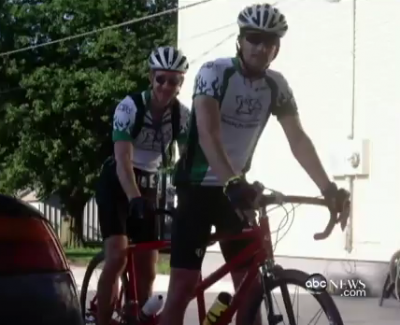
Dr. Jay Alberts and friend on his tandem bicycle
Last week, the new York Times ran a fascinating article describing the case of a man with severe, debilitating Parkinson’s disease — who, while remaining largely able to walk, can ride his bike for several miles every day. Here is a link to a video showing him riding.
Since the article ran, I’ve received several emails from ICI subscribers, students, and classmates alike — all asking the same thing: “What’s the deal with this? How is this possible?” Truth be told, I had no idea. So, I decided to find out.
UPDATE: 2/10/14 There has been considerable research done to quantity the symptom relief experienced by people suffering with Parkinson's disease, by riding a tandem bicycle or on Indoor Cycles. Learn more by listening to this interview with Dr. Jay Alberts with Pedaling for Parkinson's.
UPDATE September 25 2014:
We are now offering an ACE approved Parkinson’s Cycling Coach training program. To learn if you qualify click here.
Background
What is Parkinson’s Disease?
Parkinson’s disease is a neurodegenerative condition (primarily affecting older people, though can occur any time) characterized by progressive destruction of part of the brain called the substantia nigra, which is responsible for the production of a brain chemical signaling molecule (see also: neurotransmitter) called dopamine. Since dopamine is the primary neurotransmitter of movement, Parkinson’s disease is marked by gradually worsening motor function. Its cardinal signs include difficulty initiating movements (“akinesia”) and slowness in maintaining movements (“bradykinesia”), including swallowing and speaking. Problems with balance, gait, and tremor are also very common1.
Current treatment options include Levodopa (essentially, synthetic dopamine) with supplemental use of drugs that boost dopamine or block its breakdown. Deep brain stimulation of the affected portions of the brain has also shown promising results. Still, even with treatment, the disease often causes significant disability and decreased quality of life2.
The Role of Exercise
The focus of treatment for Parkinson’s disease is largely medication-based. While a role for supplemental therapy with non-medication treatments (including exercise) has been thought to be important, most research over the years has focused on its effects on quality of life, not motor symptoms directly. In recent years, this is changing. There have now been recent studies demonstrating improved independent functioning3, balance and gait4, and walking endurance with exercise therapy5. In animal models, exercise has been thought to contribute protection against further brain deterioration6 — and even to potentially induce repair at the level of the brain7.
Can’t Walk but Can Ride a Bike?
Although exercise is recommended for patients with Parkinson’s disease to supplement their treatment with medications, the scenario described in the new York Times article is not the norm. What appears to be at play here is not merely a success story of exercise therapy; rather, it is a specific neurological phenomenon. Bike-riding, in this case, is not functioning merely as exercise. It is actually a mechanism whereby damaged brain pathways are being overridden. Allow me to explain.
You see, movement initiation can be in response to either an external (“exogenous”) or internal (“endogenous”) stimulus. Turns out, “akithesia” (lack of movement initiation) in Parkinson’s disease is largely a failure of ability to respond to endogenous stimuli. The exogenous pathway, however, remains intact8.
A phenomenon called “akinesia paradoxa” (like it sounds: paradoxical akinesia) has been well-described in the neurological literature since the late 1960s. This refers to the ability of people who have difficulty initiating movement somehow being able to move in the presence of visual cues (lines, objects, colors) at their feet8. Remove visual cues? “Frozen” again.
There is no research specifically on cycling-supplied visual cues responsible for akinesia paradoxa. It is reasonable, however, to think that perhaps it is the repetitive linear road markings that might be at work here. Or perhaps the cue isn’t visual at all — like music, which has also been studied in relationship to akinesia paradoxa, any one of the sounds (gliding, scraping, squeaking, etc.) we hear our bikes make as we ride can also be thought of as a repetitive cue. What may go unnoticed to us and our preoccupied senses may indeed be responsible for creating movement in the movement-less.
As amazing as this sounds, we must be careful not to go too far in our interpretations. All we know is that akinesia paradoxa happens — in response to a visual cue that generates a brain signal for movement, movement can happen. Research is still lacking as to whether these successful “cued movement” episodes have any long-term impact on disease severity. Still, this is an active and fascinating area of ongoing research. We’ll see what happens…
The writer is a third-year medical student at the University of Vermont College of Medicine. She is also a STAR 3 Spinning instructor, Certified Personal Trainer (ACE), and author of the popular blog Spintastic (http://spintastic.blogspot.com/), which applies patient-centered medicine to motivational coaching..
References
Crizzle M, newhouse IJ. Is Physical Exercise Beneficial for Persons with Parkinson’s Disease? Clin Jl Sport Med. 2006. 16(5): 422-425.
2 Rao SR, Hofmann LA, Shakil A. Parkinson’s Disease: Diagnosis and Treatment. American Family Physician. 2006. 74:2046-54,2055-6.
3 Yousefi B, Tadibi V, Khoei AF, Montazeri A. Exercise therapy, quality of life, and activities of daily living in patients with Parkinson disease: a small scale quasi-randomized trial. Trials. 2009. 10:67.
4 Gobbi LT,Oliveira-Ferreira MD, Caetano MJ, Lirani-Silva E, Barbieri FA, Stella F, Gobbi S. Exercise programs improve mobility and balance in people with Parkinson's disease. Parkinsonism Relat Disord. 2009: 15(Suppl 3):S49-52.
5 White DK, Wagenaar RC, Ellis TD, Tickle-Degnen L. Changes in Walking Activity and Endurance Following Rehabilitation for People with Parkinson Disease. Arch Phys Med Rehabil. 2009. 90:43-50.
6 Zigmond MJ, Cameron JL, Leak RK, Mimicks K, Russell VA, Smeyne RJ, Smith AD. Triggering endogenous neuroprotective processes through exercise in models of dopamine deficiency. Parkinsonism Relat Disord. 2009. 15(Suppl 3):S42-5.
7 Hirsch MA, Farley BG. Exercise and neuroplasticity in persons living with Parkinson’s disease. European Jl of Phys and Rehab Medicine. 2009. 45(2): 215-29.
8 Kaminsky TA, Dudgeon BJ, Billingsley FF, Mitchell PH, Weghorst SJ. Virtual cues and functional mobility of people with Parkinson's disease: a single-subject pilot study. J Rehabil Res Dev. 2007;44(3):437-48.
9 KM & Valenstein E. Clinical neuropsychology.. 2003. Oxford Univ Press: 4th Ed. p 299.


