You know the type; this is the rider who after EVERY class quietly, almost stealthfully, navigates their way to the instructor bike and starts every class critique by saying “That was a great class!”, then pauses for a few seconds and says “But” or “Have you ever considered” or “You should try…” or “why did you…?”.
The first few times this happens you're happy to engage, but as you realize this is going to be an EVERY class occurrence, you start to despise this person. I'm all for constructive criticism and suggestions, but it becomes exhausting having to defend or explain your training philosophy, music choices and cueing to the same person after EVERY class.
Some would say that I shouldn't be so sensitive, that I should embrace the fact that the critiquer wants to discuss my craft with me. I would most often agree, especially if the critiquer approached me after every 3rd or 4th class but when it happens EVERY class I start to feel like it's more passive-aggressive than constructive criticism. Quite frankly it becomes more like nagging than anything else.
Eventually, you realize the critiquer's critiques are only self-serving rants in an attempt to turn your class into a personal indoor cycling training session for them without any concern for the 40 or 50 other riders who may be loving what you are doing. As you wise up to the critiquer's narcissistic tactics, you should try to keep your “end-of-class evaluations” as short as possible. Sometimes they get the hint and back off, but in my experience, they realize they are losing control over you and turn into the tattle-tale. Now you need to be prepared for that dreaded conversation with your supervisor. 99.9% or your class participants probably think you're awesome, but this self-serving, narcissistic, tattle-tailing critiquer is about to make your life miserable.
I would suggest being honest with your supervisor. Most likely management has had to deal with this person in the past and will back you up in this uncomfortable situation. In the unfortunate situation that management is not supportive, you have a hard decision to make. If you are regularly filling your classes and receiving positive feedback from your class participants, I would not change anything about your class. Indoor Cycling is a group activity, and you need to do what is best for the group NOT THE INDIVIDUAL. If management feels the need to kowtow to the wants and needs of every self-serving facility user it may be time to look for another place to teach.
I apologize for the negative tone of this post. It's not always hugs and kisses when you're on the instructor bike. Once in a while, you need to deal with challenging situations and “crazy” people. It takes years of experience to be confident enough in your product to stand up to unwarranted critiques of riders and possibly management. After nearly 25 years on the instructor bike the criticism still stings, EVERYTIME! But now, I listen and “take in” the feedback. If any negative comments are warranted, I'll make the appropriate changes and move on as a better instructor. But when I identify someone as a self-serving, narcissistic, tattle-tailing, critiquer. And when this life sucking vampire approaches me with their 5th “suggestion” of the week, I just smile and say “thank you” as I make my way out the door to my next appointment.
Then, when I get to my car I cue up, crank up and scream along to Eminem's The Way I Am and get on with life.
At one of my recent Stages trainings I had a participant struggle with my explanation of various intensities. When I would ask them to ride at a lower intensity she would ask “Flat Road?” and if I said moderate intensity she would ask “Seated Climb?” and when I would ask for a high intensity she ask “Standing Climb?”. My response was “easy is easy, moderate is moderate and hard is hard, it doesn't matter if the “terrain” is flat or up hill.”
As anyone who has ever ridden a bike outside knows a flat road can be VERY hard and if your bike has proper gearing an uphill ride can be VERY easy. I have always been confused but the instructors who use cues like “Flat and Fast” or “Seated Climb” or “Standing Climb” and assumed I should know the intensities associated with these cues. I have ridden in time trials that were very flat and very fast and VERY intense so why would I automatically assume “Flat and Fast” is easy.
Now that more and more facilities are introducing bikes with power to their members it is our job, as instructors, to change the way we cue intensities to our riders. First and foremost it's important to understand that, when riding inside, we are riding at ZERO miles per hour, going ZERO distance at ZERO incline. Most bikes with power will estimate MPH and distance by taking the wattage being produced and placing it into a formula that assumes an average size rider, riding at sea level, on a flat road with no wind. With a watt being a watt no matter if it's produced while riding at a fast or slow RPM or while seated or standing the estimated speed or distance will be the same. So 100 watts will translate to the same speed no matter what position or RPM a rider is riding.
In my classes I do a lot of distance challenges. For example I'll ask my riders to perform three 4 minute intervals with 90 seconds recovery between each while attempting to ride “farther” for each interval, using the odometer on the bike console. I'll change the riding position and RPM range for each of the 4 minute intervals and without fail when I have my riders stand for all or for a portion of an interval I'll have someone comment the they ride slower miles per hour when climbing a hill. My response is always; “I never said we were climbing a hill, I said we were standing”. A watt is a watt is a watt and when riding inside, on bikes that go nowhere, more watts translate to faster estimated speed therefore more estimated distance.
So let's stop using those corny and senseless cues “Flat and Fast”, “Seated Climb and “Standing Climb”. We are riding bikes that go nowhere and we certainly don't gain elevation throughout a class. It's very simple, higher wattage means more intensity! It doesn't matter if you produce those watts by riding with a lighter resistance and a faster cadence or with a heavier resistance and a slower cadence or if you are standing, MORE WATTS MEANS MORE INTENSITY!
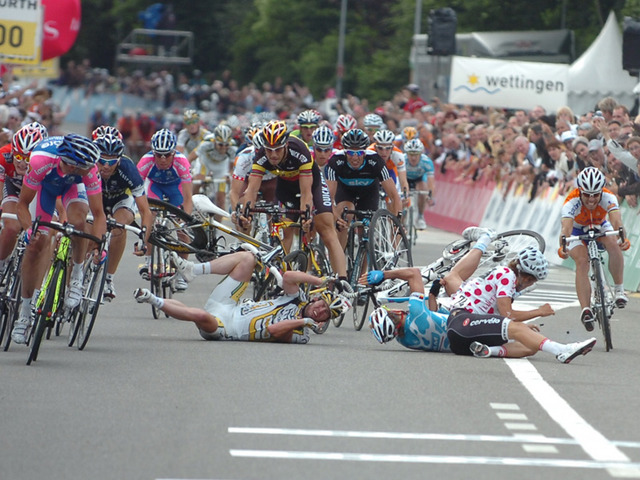
I'm getting so tired of hearing indoor cycling instructors say “If you don't do it on a bike outside you shouldn't do it on a bike inside”. This statement is repeated over and over again on social media. In Facebook groups like Indoor Cycling Instructors battles will rage on for days about topics like weights on the bike, tap backs or appropriate RPM ranges. Often these movements will be labeled “Dangerous”. I often wonder if the instructors who say “If you don't do it on a bike outside you shouldn't do it on a bike inside” have ever ridden a bike outside. I can think of no more dangerous activity than riding outside. Cyclist literally put their lives at risk ever ride.
This video below shows how “safe” riding outside can be.
Something else I find interesting is the same person who screams “If you don't do it on a bike outside you shouldn't do it on a bike inside!!!!!” will in the very next post ask if anyone has a suggestion for a hill climbing song with a BPM of 72. Hmmm, when I ride outside I don't listen to music because that IS dangerous and I certainly wouldn't limit myself to riding at one specific RPM. So, if this instructor really believed “If you don't do it on a bike outside you shouldn't do it on a bike inside” then they shouldn't be using music during indoor cycling class!


 You know the type; this is the rider who after EVERY class quietly, almost stealthfully, navigates their way to the instructor bike and starts every class critique by saying “That was a great class!”, then pauses for a few seconds and says “But” or “Have you ever considered” or “You should try…” or “why did you…?”.