“In the field” bike fits can lead to uncomfortable situations like this!
Coming Home
Recently, during a visit to my parents, I had the urge to visit my old High School. Upon arriving, Track was in session, so I took a walk down glory lane as memories of my High and Long Jumping career came rushing back. Surprisingly, all 3 of my track coaches were still there, 20 years post graduation. Before long, I was mentoring up and coming high jumpers from 7th to 12th grade.
Coach Caroll, my head coach, was off at the discus cage working with a special student athlete. Tim recently had a bout with cancer, and though now cancer free, was blind as a result of the cancer medication. It was quite something special to see Coach Caroll verbally instruct to this athlete the technique of throwing the discus. Tim was well humored considering his misfortune, but was also clearly frustrated. After a failed throw he said “I just want to throw like a did before.” Coach didn’t miss a beat and said, “with out form, you got nothing…no speed, no distance, no power.”
Discussing form in cycling, we are usually referring to how we pedal, with force and cadence. But form can also refer to how we are positioned on the bike. In the discus event we can have great power, force and speed with the throw, but if our footprint is off, it won’t matter. In cycling our starting position or “footprint,” determines how we interact with the bike and in-turn (pun intended), improve our ability to have success.
How Class Begins
It is Monday night 5:29, 1 minute before go time. Your pre-class music is playing, there is excitement in the air with student banter, and the room is almost filled to capacity. The regulars are way set up, and have been turning the pedals for 10 minutes, eager to start the best part of their day. You strap on your mic, mount your stead, and one more person sheepishly walks in. They find an open bike and look at it like a foreign object. Then, they find the courage to look up and ask, “can you set me up?
That first 5 minutes is so important as it lays down the groundwork. Yet, this person is a fragile egg. It took everything they had to enter the room for the first time. You have an obligation to keep everyone safe with proper bike fit, and create a positive open environment, not a clique of local fitness heros. If they don’t have a good first experience, they will never come back. Remember regulars were first timers once too.
Though there is no audible sound, you sense the rooms displeasure as you step down. The Hammers are giving you and newbie the evil eye. You pinch yourself between bikes and rush nervously through the fit. Getting knee over pedal is almost impossible without shoving your spandex into some else’s personal space.
As you finish, the dominos start to fall. “Can you set me up too? Yeah me too!” 5 minutes late now and into your second song(which you spent 20 minutes picking out as the perfect progression from intro/warmup), you frantically try to get back on track. Your bike fits were sub par, attitudes are everywhere, and the mojo is gone. We have all been here, pulled in every direction. What can you do to end this tug of war between punctuality, safety, and success?
Empower Your Students!
What we need is a way to empower our students to fit themselves. We need to be just like Coach Caroll and verbally give a set of descriptive, yet simple instructions, so that any one can achieve a solid bike fit without an instructor manually turning knobs, raising and lowering saddles. At Stagesâ„¢ indoor cycling we have this simple, clever, package of verbal instructions called FastFitâ„¢.
Here is one example of our instructions that you can adapt for your own use. “Raise your saddle to the top of your iliac crest. Run your finger across from your navel to your side. Then go straight down until you reach the crest of your hip bone. Bring your saddle to this land mark.”
Will it provide the ideal fit? I can see all of you bike fit gurus scoffing and shaking your heads. I know what you are thinking. Bike fit is sacred ground, there is 3D imaging, plumb bobs, goniometers, and scientists performing this critical component. However, they are not doing this at 5:32PM, in a packed house, with minimal space. Our goal is to get people in a safe range while “in the field.”
Hannah, more than likely needs a more precise “hands on” approach for ideal bike fit.
If you walk into any cycle room it is almost guaranteed that someone will be riding with a saddle too low. However I can also almost guarantee that no one is riding with the saddle too high. Why? First, the rider will feel their foot disconnecting from the pedal at the bottom of the downstroke which is unsettling. Second, without getting too explicit, lets just say the pressure and movement on the saddle in THAT region will rub you the wrong way. Third, the rider will give a look of, “I don’t think so” based on the first two sensations. The iliac crest method, if it is to fail, will set the saddle too high. This is quickly and eagerly remedied by the student and a quick cue of:
“The saddle should be as high as comfortably possible while still allowing a flat foot at the bottom of the pedal stroke, a slight bend in the knee, and minimal hip rocking.”
Will this work for everyone? Our system achieves success with 90% of the population, and I will fully admit the seat height landmark did not work for myself (my iliac crest is mad high). But, I have seen our FastFitâ„¢ 5 step system, designed by Stagesâ„¢ Indoor Cycling and specifically for Freemotionâ„¢ S-series bikes, achieve a safe set up 9 out of 10 times through many trainings.
I encourage instructors to develop their communication skills and design a set of instructions that works for their particular bikes. Can it replace a hands on approach with fitting tools and working space for observation? Of course not. It will however, quickly create an indoor cycle experience, where comfort is king, the fit will allow for safe and effective mechanics, and the room mojo will remain high.
Functional Threshold Power, better known as FTP, is the basis for establishing individual training zones using power/watts. Now that I'm teaching power based classes I've developed some questions about FTP and asked STAGES Indoor Cycling's Cameron Chinatti to answer them and give all of us a better understanding of Why is FTP Important? What exactly is FTP? and How can I help my students discover their individual FTP?
We are planning to have Doug Rusho (another Power expert) in the show soon to give all us Big Box Instructors an abbreviated version of an FTP assessment -OK not FTP exactly, but some benchmark that we can use during a typical class – giving our students some understanding of of where they should be working. Stay tuned 🙂
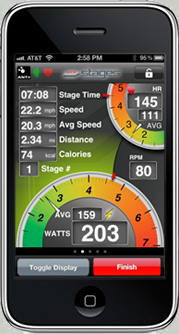
Master Instructor Cameron Chinatti joins me on this episode of the Podcast to discuss their new iPhone App. Looks very cool as it uses Ant+ to connect to the FreeMotion Power console, displaying your ride info on your iPhone. More on this once I have the chance to use it myself 🙂
You'll need this Ant+ dongle from Wahoo Fitness to connect to your iPhone.
The It's not easy staying green -Video PROfile from Cameron we discuss in this interview will post later today.
I'm like a kid in a candy store now that I have power in my Sunday 90 minute endurance class 🙂
Much of it, I'm sure has to do with the purity of the participants – which is to be expected from participants in a 90 minute anything… but there is more to it than just transitioning a 90 minute class without Power, to one with Power.
They get “it”
The people in my class are really smart! Once I explained everything they quickly understood how valuable the combination of magnetic resistance and power indication would be to reaching their fitness goals. Now when I talk about maximizing their time in class; get in and setup early, don't wait for me or waste 10 minutes talking to your neighbor – start your warm-up as soon as possible, as soon as your breathing calms get back to a flat road wattage, etc… they nod in agreement. Don't get me wrong, Heart Rate training is still important, but the instantaneous and member specific, information that comes with Power, makes Heart Rate training so 2000's.
They get “me”
“John, now it's all starting to gel together…” And gel it has! Being able to discuss Power and it's correlation with Heart Rate training zones has been very freeing and immensely satisfying, to me as an Instructor.
Today for example, I did my Nice Pull! ride. This is a simulation of working through a pace line of a group riding into a heavy headwind. Tucked in nicely, shielded from the wind, everything is manageable. Until BAM! The last rider in front pulls left and now you're hit hard with the force of the wind. Cuing / describing that feeling, to someone who's never ridden in a group, is very difficult. The challenge for the indoor rider is to immediately add load, at a level they can sustain for 2-5 minutes, without losing cadence. Tough to do on a conventional IC bike, working off of RPE or Heart Rate, but very easy and understandable when you have taking your class through some 5-8 minute intervals where you establish an estimate FTP – Functional Threshold Power. In an outdoor ride your pull at the front needs to be at a consistent pace. As soon as you can no longer maintain the pace you need to pull off… those who can sustain the pace, for an extended period of time, get a simple Nice Pull! as they slip toward the back. Having an average wattage number to maintain, for the whole 5 minute interval, replicated the feeling of pulling into a headwind more realistically than ever before. And the multiple, positive comments I received after class were just awesome. This could make a fun Audio PROfile 🙂
I don't have to feel like I need to compete with anyone, anymore!
And neither does Amy – and neither will you [wlm_firstname]. Lorrinda takes both of our classes and she told us both this weekend; You guys need to train all the other instructors! We are so far out ahead of all the “entertainment on bikes” crowd it's not even funny. Not everyone will want to make the transition, there will still be still be goofy housewife classes at 9:30 on Tuesdays, but the tide (at least where we teach) is a changing.
Both the FreeMotion S 11 series and Schwinn AC Indoor Cycles have the ability to record your ride data using a USB Thumb Drive.
This past Sunday I asked Alan ******, one of my regular students, if he would be willing to have his class performance data recorded so I could share it with you. Al is a long time cyclist and we first met back in 1998 while I was leading group rides for a local bike shop. He agreed and the process for collecting his information was a simple as plugging a Thumb Drive into the USB port before turning on the FreeMotion computer.
The data that's collected is:
Time – it takes a snapshot every second.
Miles traveled*
MPH*
Watts
Heart Rate BPM
Cadence RPM
My understanding is that Miles traveled and MPH are estimates based on research done by FreeMotion's engineers that measured the amount of power needed to sustain a given speed. As I type this I realize that I need a more comprehensive understanding so I can explain this better. You can download the .xlsx spreadsheet here.
Here's why both FreeMotion and Schwinn use a “Stage” button during class.
There is an enormous amount of data collected during a 90 minute class… Four Thousand, Eight Hundred and Thirty Nine lines of data to be exact.
The reason for only 116 minutes of total time is that we had a 14 minute warm-up, where no data is collected. More on this as I learn and experiment in the future.




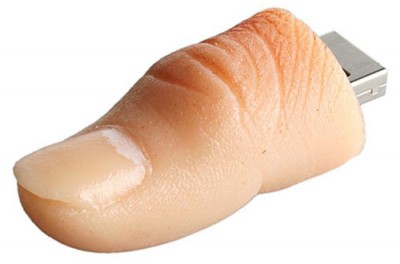 Both the FreeMotion S 11 series and Schwinn AC Indoor Cycles have the ability to record your ride data using a USB Thumb Drive.