
by Jennifer Lintz | Aug 26, 2021 | Featured Studios, Instructor Tips and Tricks, Instructor Training
 When I take off my instructor hat and walk into a class as a participant, I have two expectations beyond the obvious (getting a good workout):
1. The class will start on time.
2. The class will end on time.
I understand there are exceptions to every rule and occasionally instructors get started a little late or run a bit long, but in general, I think it is important that we make a concerted effort to stick to the official schedule.
Why? For me, it comes down to being respectful of people's time and making sure members' expectations match up with reality. If the schedule says class will run from 5:30 to 6:15 p.m., folks probably anticipate a 45-minute class that starts at 5:30 p.m. and ends at 6:15 p.m., and they should! There may be participants like the one in Krista's recent post who take extreme measures to be at class early. There may also be people who feel bad about leaving “early” in the event that class ends late. Straying from what is expected increases the likelihood that participants will leave feeling disappointed, frustrated or annoyed.
Whether you are a hyper-prepared instructor or a professional improviser, there are several things you can do to ensure you start on time and end on time. Below are my thoughts regarding time management in the cycle studio.
Arrive 15 minutes early. I don't just mean walking into the building 15 minutes before class starts; I mean walking into the studio dressed and ready to teach 15 minutes before class starts. This will give you time to get your music ready, test the microphone, adjust your bike settings, greet members, answer questions, and assist new participants with bike setup.
Read announcements before class starts. I typically turn on my microphone to make announcements 1 to 2 minutes before class begins. That way, when 5:15 a.m. or 5:30 p.m. hits, I am ready to push play and teach immediately. Every minute counts.
Have a plan. I don't like to feel unprepared and I also don't like looking at the clock, so my profiles are planned out down to the minute to avoid both of those situations. Preparing a thorough class plan allows me to focus on my participants instead of the time.
Be consistent with cool down. If you teach every Thursday from 5:30-6:30 p.m., pick a time when you will start cool down and stick with it. That way, even if you improvise in your classes, you know that when 6:25 p.m. (or whatever time you choose) rolls around, you better start slowing things down.
Stay focused. Talking too much can throw a wrench in class plans; I know, because it has happened to me. I can recall multiple occasions when I had to shorten hills or alter drills because I was long-winded with a story or something that was on my mind. Being conversational has its positives, but it is also important not to get too carried away.
What are your strategies for time management?
Originally posted 2013-04-11 12:34:24.
by Jennifer Lintz | May 10, 2021 | Instructor Training
 By Jennifer Lintz, Registered Dietitian and ICI PRO Contributor
A few days ago, I attended one of my colleagues' classes. The ride was top notch from start to finish, but one drill in particular got me thinking.
Towards the middle of class, Lori (the instructor) told us we would be doing a climb. I can't remember exactly how long we were to be in hill mode – it was either 3 or 4 1/2 minutes – but I do remember her instructions for the drill. She told us to lift out of the saddle for 15 seconds three separate times during the climb. The catch? We could decide when. This was an interactive drill. As a participant, it forced me to be present, keep my eye on the clock, and take ownership of the task I had been given.
As an instructor, I immediately felt like I gained a new tool to enhance participant engagement. If one of our goals is to help our students stay present on the bike, why not give them some time in the driver's seat?
Certainly, it might be a bit much to do a class full of drills like the one I just described, but sprinkling in one or two could be a great way to keep students focused. Being in Lori's class got me thinking about other drills that might have a similar impact. Here are two I came up with:
– Flat: 5 minutes. The bulk of the flat should feel moderate in intensity. Work at a hard intensity at least twice for 30 seconds. If, in the last minute of the flat, there is time for one more push, challenge them to fit it in.
-Intervals: 3 minutes. Alternate between high and low intensities for the duration on the drill. The “work” period must be longer than the recovery. Time frames are left up to the students.
-Hill: 3 minutes. Each minute should be more challenging than the previous. The increased intensity can be created by a change in speed or resistance.
Do you have other drill ideas that give participants guidance, but ultimately put them in charge?
My experience as a student reinforced just how beneficial it can be to spend time on the other side of the cycle studio. I would love to hear your thoughts on this topic as well.
Originally posted 2014-07-13 14:14:27.
by Jennifer Lintz | Mar 26, 2021 | Instructor Training
By Jennifer Lintz, Registered Dietitian and ICI/PRO Member Soigneur
Recently, I had the opportunity to attend a Schwinn training led by the very talented, energetic, and inspiring Julz Arney.
The training was called “All the Right CUES” and boy, oh boy did I walk away with a ton of great information. Julz gave us awesome examples of effective coaching strategies to use on the instructor bike. Interestingly, one of the points that stuck with me the most from this session had nothing to do with talking and everything to do with keeping my mouth shut.
To start the conversation, Julz asked “How many of you would consider yourselves extroverts?” and “How many of you would say you are introverts? For the most part, the group was mixed, with slightly fewer extroverts.
She then told us about a time she attended a cycle class where the instructor narrated every single minute. Participants were told what to think virtually non-stop, from warm up through cool down. For some students – extroverts, in particular – she explained, this type of teaching technique might be ideal, but it wasn't for her. For introverts, she said, some of the most interesting moments happen during the quiet, when there is time to process, reflect, and think.
Even though we all want riders to have a positive experience, I doubt any of us plans to poll the room before class to ask: “How many of you are extroverts?” or “Where are my introverts?” No way! A better approach would be to assume there is a mixture in the room. In other words, expect to have some extroverts who love it when you spend time talking, and also plan to have introverts who appreciate it when you give them a chance to hear their own thoughts.
The take away from Julz Arney's message, at least for me, was that I do not have to fill every single second of class with my voice.
She suggested having a “minute of silence” at least six times in an hour-long class.
In other words: I (and you) have the right to remain silent!
Coincidentally, after the Schwinn workshop, I viewed a recording of one of my classes from earlier this year (we are required to do this annually where I teach). As I watched, I waited and waited and WAITED for a “minute of silence,” hoping that I might already be on the right track, but it never came. As I told my supervisor afterward, I would have been so annoyed if I were a participant in my own class that day. I talked the ENTIRE time!
Since listening to Julz and watching that video of myself teaching, I have learned that great coaches need not talk non-stop, and that a blend of talking and being quiet can be a beautiful thing. Am I meeting the goal of having a minute of silence six times in every class? Not quite. But, I am definitely working on it.
Originally posted 2018-02-07 09:00:34.
by Jennifer Lintz | Nov 18, 2020 | Instructor Training
I love learning about our members, their backgrounds, and where they teach. Recently, we received notes from two women who have both served as indoor cycle instructors while on active military duty. Note: Active duty instructors receive a complimentary ICI/PRO Membership.
Tammie just recently retired after a little more than 20 years of service to the United States. She started teaching indoor cycling  classes in Afghanistan in 2010 and enjoyed every minute. She said “it was an exhilarating experience teaching the soldiers. When I was in Afghanistan, soldiers would line up to get a chance to spin and leave their unspoken fears and frustrations behind for just 45 minutes to an hour.” Lacking road bike experience, Tammie found her ICI/PRO membership valuable because it helped her learn the fundamentals of indoor cycling.
Oxana, pictured on the instructor bike, is also an active duty instructor currently stationed on a military installment with her husband in Korea. Oxana reached out to us at ICI/PRO because she was looking for ways to instruct that would benefit her students, who are all at very different fitness levels. She appreciates her ICI/PRO membership because she is eager to help her students “learn and enjoy cycling.” Oxana is curious — and, so are we! — if there are other instructors who teach on military bases within the ICI/PRO community.
Originally posted 2013-02-27 05:03:19.
by Jennifer Lintz | Sep 22, 2020 | Engage Your Students, ICI/PRO Team Member Articles, Mental Toughness
By Jennifer Lintz, Registered Dietitian Nutritionist and ICI/PRO Contributor
Have you ever not done something because you weren’t sure you could?
As instructors, I have a feeling many of us talk quite a bit about comfort zones (specifically, getting out of them) in our classes, but I often wonder … do we take our own advice?
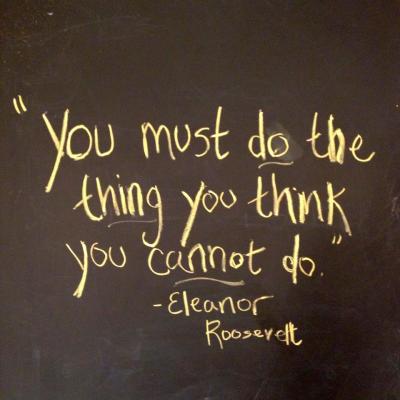
I have seen Eleanor Roosevelt’s quotes on this topic numerous times, but I will admit, I never fully appreciated her words until I actually took them out for a test drive.
Two years ago, a dietetic intern of mine, Amanda, who is now a very close friend, asked me to do something with her called RAGNAR®. Ever heard of it? She told me a little bit about it, but all I processed was:
“You have to run a lot over two days. You will be in a van with 11 other people when you aren’t running. You probably will not sleep.”
I immediately thought “Why would anyone choose to do this?”
I told her I would pass, and thought “Whew. I’m off the hook.”
That was, of course, until she asked me to join her team again the next year.
She assured me it would be “life changing” and “the most fun I’ll ever have.” While I was not convinced it would be either of those things, I begrudgingly agreed to do it.
Our team of 12 – all women – was formed by the early part of 2014, and because many of us live in southeast Minnesota, we chose to do RAGNAR® Great River which starts in Winona, MN, and ends in Minneapolis, MN. Over August 13th and 14th, we would run just over 200 miles as a team. Each runner was assigned 3 legs of the route that ranged anywhere from 3 to 10 miles. Some of us ran during the day, others overnight. I was runner #2, which meant my first leg was 6.2 miles, the second 5.1, and the third 5.6.
Knowing we would be running in the dog days of August, I made sure to get plenty of training under my belt in the months leading up to RAGNAR®, sometimes running a few miles in the morning and later a few more at night. I did everything from steady state runs, to hill-repeats, speed work, tempo runs, cross training, and weight lifting to prepare.
As the event neared, I was feeling fairly confident about my ability to do the running part. My apprehension, I realized, stemmed mainly from knowing I would get virtually no sleep and have very little time to myself. I have long considered myself an introvert who requires plenty of rest, so both of these aspects of RAGNAR® made me nervous. I fully expected to be tired and grumpy when it was over.
Without sharing all of the details, I will tell you that I couldn't have been more wrong. Doing RAGNAR® was an incredible experience and just plain fun … and it wasn't because of the running. Sure, it was exciting to get a couple PRs, but the real value of RAGNAR®, for me, came down to the people and the camaraderie. Needless to say, we are already preparing for next year.
So, how does this tie into teaching indoor cycling? For starters, my self-talk during the training process and the weekend itself gave me fresh ideas for coaching in cycling classes. But, perhaps most importantly, it helped me truly understand what it means to get uncomfortable and why stretching our personal limits can be a beautiful thing. As someone who regularly encourages students to challenge themselves, I found it very valuable to practice what I preach off the bike.
For me, RAGNAR® was just the tip of the iceberg. I now have the beginnings of what I'm calling a “To Try” list; first up is Zumba (let's just say dancing is not one of my strengths). In all seriousness, it reminded me how important it is to be the student and get a taste of what it feels like to be a little nervous.
What would you do if you weren't apprehensive about it? Please feel free to share your experience.
A big THANK YOU to John and ICI/PRO who sponsored our team. Below are a few pictures from the weekend.

The start line at 6:00 a.m. Friday morning.

Community nap time at one of the big exchanges on Saturday afternoon.

I was just finishing my last leg of the race. Felt good!

The full “Ragdolls” team!
Originally posted 2014-11-22 04:33:43.
