
by Joan Kent | Nov 21, 2020 | Master Instructor Blog

By Team ICG® Master Trainers Joan Kent and Jim Karanas
The training adaptations that derive from indoor cycling are well documented and ubiquitous. Still, when we speak with new instructors, they seem to appreciate hearing the information. Also, everyone describes the benefits slightly differently, and a change can help students understand.
So even though this is review for most of you, we thought a list of aerobic training adaptations, as we describe them at ICG®, would be worth covering. Some are cardiopulmonary, some vascular, some muscle-specific, or other.
Increased Tidal Volume Improved aerobic conditioning moves more oxygen to the working muscles. The first adaptation is breathing capacity, called tidal volume. The volume of air the lungs can move with each breath increases with aerobic training due to improved diaphragm strength and breathing technique. Higher tidal volume has also been associated with longevity.
Increased Blood Volume Blood is actually an organ that responds to training by increasing in volume. With increased cardiovascular training, the body produces more red blood cells and blood to increase its oxygen-carrying capacity and oxygenate body tissues. Increased blood volume also increases the capacity to remove metabolic waste, improve recovery and sustain a greater muscle mass.
Increased Stroke Volume Stroke volume, the amount of blood ejected by the heart per beat, increases. This adaptation tends to occur at “slower” heart rates, or at least at rates less than 160 bpm. Increased stroke volume indicates improved heart function. When people talk about “strengthening” the heart, this comes the closest to being the underlying mechanism. In pumping more blood per beat, the heart moves a greater workload. The strength-training equivalent would be using a heavier weight and slow repetitions, versus pumping a lighter weight quickly.
Enhanced Capillary Network* Capillaries are blood vessels with walls only one cell thick. They surround the muscle cells and deliver oxygen and nutrients. The capillary network becomes denser with aerobic conditioning. This results in a greater available surface area for the transfer of oxygen to the mitochondria within the muscle cell.
Increased Mitochondrial Size and Density* Aerobic training results in an increase in both the size and density of mitochondria. Mitochondria are subcellular structures that convert fuel to energy aerobically. They are the receptor sites in muscle cells for the molecular oxygen needed to power the Krebs, or citric acid, cycle and produce ATP. Mitochondria are the only sites in the body that burn fat — with the exception of the heart, which can and will use whatever it gets, including lactate.
Increase in Type 1 Muscle Fibers* Aerobic conditioning also increases the sensitivity of working muscle to the effects of insulin, in part by promoting the development of Type 1 muscle fibers. Type 1 fibers are high-endurance fibers that respond well to insulin. (Type 2b are better for explosive power but less sensitive to insulin.) Everyone knows that cardio training can reduce the incidence of heart disease, hypertension, stroke, diabetes, cholesterol problems, and more. Improved insulin sensitivity is a significant mechanism in that, because insulin resistance underlies these conditions. (More about insulin resistance in a future post.)
Increase in Fat-Burning Enzymes This applies specifically to hormone-sensitive lipase (HSL), which moves fat from storage to bloodstream for utilization. HSL is activated when the body needs to mobilize energy stores, and responds positively to catecholamines and ACTH. It’s inhibited by insulin and activated by the removal of insulin's inhibitory effects.
Items with an * are peripheral adaptations, specific to the working muscle. Thus, upper-body cardio training, such as arm cranking, will increase mitochondria, capillarization and development of type-1 fibers in the upper body in the same way that lower-body training affects the lower-body muscles involved.
Adaptations without an * are central adaptations that impact the entire body. Central adaptations permit a “transfer” effect, i.e., aerobic training with the upper body can improve aerobic performance using alternate muscles (in this case, the lower body). This was covered in Jim’s post on “The Best Cross-Training for the Indoor Cyclist.”
It’s important to address the impact of aerobic training adaptations on weight loss, because it’s a primary goal of many who attend our classes. A distinction should be made between aerobic training and cardiovascular training generally.
In cardiovascular exercise, the heart, lungs and vessels of the body work at an accelerated rate to sustain exercise. It includes aerobic training. Aerobic training adaptations improve the body’s ability to move oxygen to burn fuel for energy. Aerobic exercise has limited impact on weight loss because its built-in intensity ceiling becomes a limiting factor in several ways, the low calorie expenditure being only one. That’s why anaerobic training is also necessary.
A major benefit of aerobic conditioning with respect to weight loss is that it supports the body’s recovery from intense training. Trainers advocating only anaerobic work for weight loss often miss this point. Furthermore, as covered in many previous ICG® posts, training is about much more than weight loss.
Regardless, when it comes to the sheer pleasure of riding your bike, indoors or out, a well-developed aerobic system makes you feel fantastic.
Originally posted 2013-01-07 09:28:53.
by Joan Kent | Oct 25, 2020 | Engage Your Students, Master Instructor Blog

USA Women's Rowing Team – image credit boothbayregister.com/
If you’re about to start teaching a class that includes both cycling and rowing, here are a few tips.
Stay off the bike. To handle all the variables in a cycling/rowing class, you’ll need to be on your feet, moving around the room.
Will you warm up? On-bike stretches won’t work in a split class. Decide whether you’ll begin with a full-class stretch and warm-up, or have the participants take care of that on their own. Active Isolation Stretching is the most efficient in class — it warms the body as you stretch — but they all take up training time.
Pre-plan your trainings. You’ll need a specific and detailed rowing workout, along with your planned cycling workout. They don’t have to run parallel. That is, a 6:00 flat on the bike doesn’t have to run in sync with a 6:00 interval on the rowing ergometer (erg). They can if you prefer.
Feel the differences between the two workouts. Rowing workouts are often rigidly timed. That makes them effective and easy to cue. But some of the most unpleasant cycling workouts I’ve ever done were created by an instructor who was primarily a rower. His classes seemed to be created with a calculator and a slide rule (a what?). Instead, use cycling workouts that are similar to the ones you run now. Then you can mold your rowing workouts without alienating your riders.
Gear your music for the bikes. It’s less important to match music to a rowing drill, so keep handling your music the way you have been. There are exceptions — mostly performance-related — but generally this holds true.
Memorize the steps for setting the erg monitor. Concept 2 Models D and E use a complex procedure for setting time or distance. You’ll have to cue it every time. If you switch mid-workout from time to distance, be prepared to re-cue. Example: “Press Select Workout. Press New Workout. Press Intervals Time. DO NOT set the time yet! Use the Back Arrow to go back to the “tens” column. Set that for 1. Now use the Forward Arrow to get to the “ones” column. Change that to 0.” [At this point you have to cue setting the rest interval.] “Now press the check mark at the bottom of the screen.”
That lengthy description sets the timer for a 10-minute interval. If they set the “ones” column first to 0, it will default to an automatic “:20” (20 seconds). That messes up everything, and you’ll have to spend time changing it.
Note: The above cues are an illustration. You’re not done till you’ve set the rest interval (assuming you want repeating intervals). If you press the check mark midway through the process, you have to begin again. It will happen.
Don’t kill the Concept 2 people. All of the above is why the simple Model C was wonderful, but you’ll get used to the D/E. And you WILL remember the cues. I wrote the procedure from memory.
Always cue the rowers first. Let’s say you’ve decided to run the workouts in parallel format, which is easier for you. Separate the groups on their equipment. Cue the rowers while the riders roll their legs. Tell the rowers what to do during their warm-up (say it’s 10 minutes). Easy warm-up shortcut: Have them press “Just Row”. They row as instructed and stop when the computer clock reaches 10:00. While they row, you run a 10-minute bike warm-up. Once the warm-up is done, the riders roll and recover while you cue the rowing training — and setting the monitor.
This approach syncs the major changes for the two groups. The intervals will be of the same duration, but what the groups do during the intervals can be as similar or as different as you like.
Create a timeline. If you like multitasking, feel free to create workouts that don’t resemble each other at all. You may need some sort of timeline to track what’s happening. If you’re a spreadsheet geek, that approach will be fun for you. If you’re able to keep track of two different workouts mentally with no cheat-sheet, just go for it.
A timeline could be just a basic log with 3 to 4 columns. Minutes (0:00 to 30:00) go in the left column, rowing drills in the next, the cycling workout in the third column, and perhaps notes and prompts for you in the fourth column. Use a stopwatch. You’ll check your watch and know exactly what everyone should be doing at any given minute.
All of this planning makes improvising and modifying a lot easier. You have your plan, yet still feel ready to change whenever time or circumstances call for it.
At the 30-minute mark, switch equipment. The change will take a few minutes, so shorten the warm-up, but give everyone a chance to accustom the target muscles to the new activity for the second half of the class. Re-start your watch and repeat the body of the training.
If you can manage to do all of this AND deliver content — exercise physiology, technique, and training philosophy — your classes will be engaging and informative, and appeal to a broad base.
I hope these instructions are clear. I’d be happy to answer questions.
Originally posted 2014-07-14 10:24:52.
by Joan Kent | Oct 7, 2020 | Instructor Training

New Year’s Resolutions are upon us, but that doesn’t mean clear sailing. Things that can waylay resolutions are everywhere. Christmas candy will be on sale till early January, when the Valentine candy goes out and will be on display till February 14. February 15 it goes on sale. That brings us to March, when the Easter candy appears — even in years that Easter is late in April. And so on through the year.
Everyone offers tips for sticking to your resolutions. Ideas for quitting sugar, for example, may include (Don’t take notes here!) having fresh fruit instead of juice or dried fruit; flavoring plain yogurt with fruit or honey; using artificial sweeteners; switching to dark chocolate from milk chocolate; limiting sugar to desserts only; weaning yourself off desserts by reducing the weekly number; substituting wine or spirits for high-sugar mixed drinks.
Those tactics don’t — and can’t — work for those of us who have a sugar addiction. Here are a few suggestions — and some of them are just common sense.
1. Keep sugar and other junk food out of the house. Totally. Don’t buy it and tell yourself you won’t eat it. Don’t buy it and tell yourself you’ll have just a small portion. Don’t make your kitchen a binge blowout waiting to happen. Just don’t.
2. Stop putting your willpower to the test. I keep reading that we have only limited conscious self-control, limited willpower — and it certainly appears to be true. Instead, look for ways to change the situation. Ask the waiter to remove the breadbasket from the table. Don’t even ask for the dessert menu. Reread Suggestion 1. The fewer willpower tests you have each day, the fewer lapses you’ll experience later that day.
3. Train yourself to end a meal without dessert, no matter what time of day it is, no matter what everyone else is doing, no matter what others think, no matter what other say, no matter what habits you learned as a child. It takes practice, but it’s worth it.
4. Lie. (That’s fun to say because it grabs attention.) Don’t worry — I’m definitely not telling you to become untrustworthy and lie for no reason or about important matters.
But, seriously, sugar is a need-to-know issue. Does everyone at the dinner table need to know that you’re turning down dessert because you’re addicted to sugar? Or trying to lose weight? Both reasons will bring out every form of sabotage your “friends” can serve up:
“You’ll eat less tomorrow.”
“You’ll work out harder tomorrow.”
“Just a little can’t hurt.”
“But I made it myself.”
Harsh as it may seem, anyone who sabotages you is not a friend. If you have to pretend to want the food, claim to be full from the terrific dinner and ask for a doggie bag. On the way home, stop at the nearest trashcan and dump it. Don’t take it home and tell yourself you’ll make it last several days. Reread Suggestion 1.
5. That brings up another important point, covered in a previous post: Learn to throw away food, especially stuff that’s not really food, but junk. No compunctions here. The U.S. overproduces food significantly, and on a daily basis. Tossing the junk is survival, NOT a sin, as you may have been taught.
6. Little things add up. Focus on short-term actions — what you can do right now to avoid sugar. A recent study showed this approach — versus thinking about the long-term goal — was better for weight loss. It works for quitting sugar, too. Plan your next meal: how can you make it healthy? Buy nutritious foods when you shop. Develop an end-of-day ritual for the first 20 minutes after you arrive home to keep you out of the kitchen.
There won’t be any sugar in there, anyway, right?
As I’ve written in previous posts, motivation is not necessarily enthusiasm. It also tends to fade when daily life presents its daily challenges. But using these suggestions consistently can be transformational.
Enthusiasm is entirely optional. In fact, it’s often the result of consistent action.
Please feel free to share this article with riders and friends!
Originally posted 2014-12-29 09:20:32.
by Joan Kent | Oct 1, 2020 | Master Instructor Blog, Zone based Heart Rate Training
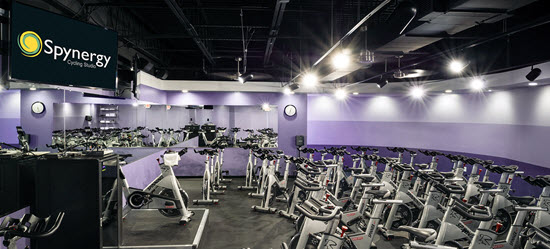
Bill Pryor's Spynergy Studio
By Joan Kent
Indoor cycling classes have become inextricably linked with dim lighting, and I’ve never understood why. Personally, I’m not crazy about training in the dark and will tell you why in a moment.
Studio lighting is one of the factors involved in creating the best class environment, along with music, video, voice, tone, cueing and more. Here are two scenarios from my teaching experience, in which the lighting differences span the spectrum.
In Studio A, the lights are always on and always bright. There’s no on/off switch in the studio because the lights go on when the club is opened. The master switch controls all.
In Studio B, the lights can be brought all the way up to a bright level, but the previous instructor, who had a huge following (okay, it was Jim Karanas), liked to keep the lights dim by flipping only the middle switch on the 3-switch panel. Needless to say, whenever I subbed for him, I made sure the lighting matched what everyone was accustomed to in his class.
The dimmer lighting was okay, but periodically one bank of lights, often on the far side of the room, would burn out, leaving everything on that side of the room just plain dark. It wouldn’t affect the participants close to the door because light outside the studio shines in on the near side of the studio.
We’d notify the front desk staff about the burned-out bulbs, and a short time later, we’d have lights — until they burned out once more.
By my last observation, though, that infamous bank of lights was out again and had/has been for a long time. It made me think about this topic. Apparently, no instructors have reported it to the desk. Apparently, no one has complained.
That last fact amazes me. Because of Jim’s teachings, everyone in the class uses a heart rate monitor (see How to Get Your Students to Wear Heart Rate Monitors). I always train with a HR monitor, mainly because of what I learned from both Johnny G and Jim.
So here’s the thing. In this studio, the bikes don’t have computers that light up and display HR. It’s virtually impossible to see a HR monitor on the far side of the partially lit studio. I’ve seen riders hold up their HR monitors, twist them around to catch available light, and keep track of their heart rates that way. What’s wrong with this picture?
Now I happen to find it difficult to train extremely hard in the dark. For a club anniversary one year, the theme involved decorating the studio like a spooky forest and turning out almost all the lights. Several people did complain that they felt nauseated. Guess I tend to feel that whenever I’m training really hard in the dark.
I had hoped the current instructors might take notice (read ‘take the hint’) when I started bringing a small flashlight to class with me to light my HR monitor on days that I ride on the far side. No such luck.
I have a feeling I’m in the vast minority on this — indoor cycling is almost always taught in dark rooms. Of course, in studios with bike computers that light up, much of this is solved. Still, if I had to choose between the glaring lights of Studio A and the darkness of Studio B, I’d go for the glare. I can monitor my HR easily and definitely feel better physically.
How do the rest of you feel about lighting? Which is most important to you — the atmosphere that goes with dimmer lighting, tracking heart rates, other factors? Please let us know, and thanks.
Originally posted 2014-02-13 10:09:37.
by Joan Kent | Sep 22, 2020 | Instructor Training

Whenever I work with a new client who needs to get off the sugar roller coaster, I see some familiar patterns as the client struggles with her or his sugar addiction.
The pattern may include lapses, relapses, frustration, embarrassment, giving up, moving between compliant and noncompliant behaviors, getting past all of these, and finally moving forward decisively.
As the process goes on, mistakes may occur that could be labeled “predictable” because they’re things many clients have done before and conquered. Best of all, they can be modified so the end result is getting off sugar for good.
In this post is a list of mistakes that are common in trying to quit sugar. I made all of them and probably a bunch more. I discovered what I had been doing wrong mentally and emotionally that had kept me from becoming a successful quitter.
My Addiction Created This Sugar Quitting Mindset
I’m a good person to talk to about sugar addiction. I have a PhD in psychoactive nutrition (how foods affect brain chemistry), with a specialty in sugar addiction. Before that, I got a master’s degree in exercise physiology. I’m also certified by ACE (American Council on Exercise) as a Health Consultant.
I wrote a dissertation on using psychoactive nutrition in the treatment of women with binge-eating disorder. In it, to the very best of my knowledge, I was the first person to outline the neurochemical pathways of sugar addiction, and a neurochemical and hormonal explanation for the sugar/fat seesaw.
But there may be a more compelling reason to listen to me about sugar addiction. I’m arguably the world’s foremost recovered sugar addict.
I quit sugar more times than I can count. I tell this to all my clients because it’s helpful for sugar addicts when they know I’m not just preaching from an academic perspective.
In the process of making every mistake in the book — and inventing a few of my own — I discovered a formula that works.
Mindset Mistakes That Mess Up Quitting Sugar
Let’s look at the mistakes that kept me stuck for quite some time — and might be keeping some of your students stuck, as well.
Mistake 1: Expecting quitting to be easy
You’ll probably have good days and bad, easy moments and difficult ones. If you expect quitting to be easy, you might be unprepared for the bad times.
If you expect instead that it will take effort to quit, you’ll be ready to deal with whatever happens.
It’s not that quitting sugar won’t bother you at all, but you’ll be less reactive. Not only to external factors — like tempting foods around you — but also to internal factors, like sugar cravings.
Eventually, you’ll be non-reactive to sugary foods in general, whether you see them, smell them, or even taste a little. It’s definitely worth getting to that point!
As for cravings, liquid B-complex is the most effective short-term solution, as explained in a previous post.
Mistake 2: Not having a solid system
It’s easy to find questionable “wisdom” on websites, in magazines, in books, on podcasts. But it’s not a good idea to cobble your plan from a mishmash of unrelated bits of advice.
Instead, find one plan and stick with it.
Because I quit sugar before it was recognized as harmful, I had to piece my plan together from my research. Not every step was a clear one forward, and there was backsliding. My continued research eventually led to a solid system.
Part of that system is to focus on your sugar addiction first until you succeed in quitting and feel ready to move on to the next issue. This isn’t the time to focus on weight loss, become a vegan, go raw, or schedule your life makeover. Conquering sugar addiction gets top billing now.
Mistake 3: Looking for support … in all the wrong places
It’s only natural to want support. But telling the wrong people about your decision to quit sugar could lead to sabotage that undoes your efforts!
As detailed in a previous post, telling everyone at the dinner table that you’re turning down dessert because you’re addicted to sugar might trigger this:
“Have it; you can eat less tomorrow.”
“Just work out a little harder tomorrow.”
“A little bit can’t hurt.”
“But I made it myself.”
Not one of those comments shows an awareness of the issues a sugar addict faces. If they succeed in getting you to go against your plan, you’re the one who suffers and has to start over again.
Part 2 will cover the changes that are key in making quitting sugar possible — the Mindset Shifts I needed to stop resisting — and finally implement — so I could quit sugar successfully. Some of your students may need to know them, too.
Originally posted 2015-06-29 14:49:24.
