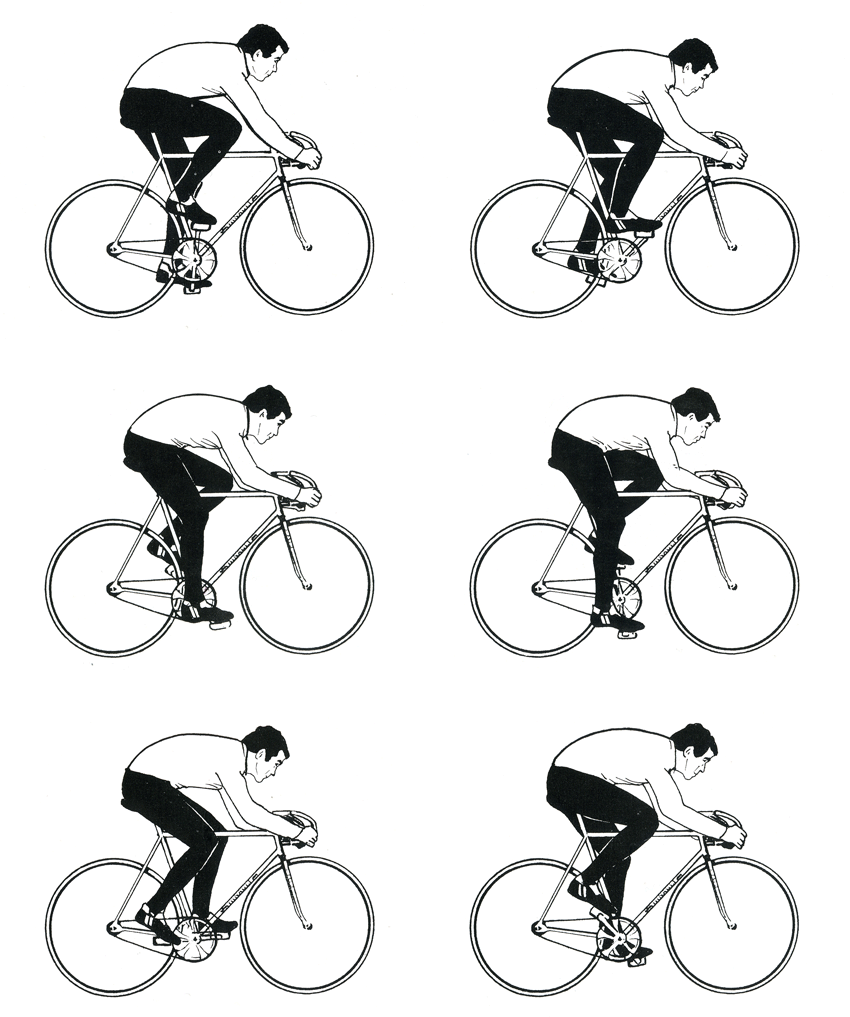
Beyond the obvious fitness benefits Indoor Cycling provides to our outdoor riders, there’s an overlooked skill that will make your participants smoother and safer riders in a pace-line… riding fixed-gear Indoor Cycles teaches us to pedal constantly – i.e. not starting and stopping while riding.
It’s rare that you’ll ever have your class stop pedaling. We start turning the cranks and don’t stop until the end 45 minutes later. Not surprisingly this steady/consistent pedal stroke is the mark of an experienced cyclist. Pedaling without stopping will also prevent you from hearing me calling out from behind you, in a somewhat irritated voice; Pedal, Pedal, Pedal!
At this speed you only get one chance.
Riding in a paceline at speed is a magical experience. Sailing along at 20 mph with your wheel 12″ or less from the person ahead. You feel their draft dragging you along, as the group members take turns sharing the work of pushing through the friction of the air. As long as everyone rides smoothly and consistently, it’s all good. But “things” happen over a 40 mile ride; dropped water bottles, lost or distracted concentration, garbage on the shoulder – lots of “things” that will cause one of the riders in front of you to slow suddenly. Exactly how you react can make the difference between just another “thing” that happened on today’s ride or you painfully ending up on your head 🙁
I’ve seen a lot of rear-end collisions and nearly always it’s the rider behind who gets the worst of it.
@ 20 mph you are travelling ~ 29 feet per second. That 12″ gap between you and the rider in front represents 1/29th or 0.034482 of a second. So let’s say you’re JRA (Just Riding Along) and everyone in front slows very quickly. There’s very little time (just a fraction of a second) to; perceive the change in speed and then react, before you hit someone. A fraction of a second may sound like a short period of time, but your brain can do a lot – especially if you’ve conditioned/trained it to respond correctly.
Brakes are for slowing… Pedaling is for going
Spend as much time leading and riding with cyclists in a paceline as I do and you start noticing the small differences that identify experience levels. Observing how closely a rider is willing to follow, consistently maintaining the distance to the rider ahead, is what tells me if you’ve done this before. When I see someone who’s not comfortable following closely, it’s almost always because they are attempting to control their speed by first stopping their pedals. Trouble is that bicycles coast…
MICROADJUST It’s nearly impossible for everyone to put forth equal amounts of effort, especially on undulating terrain. You need to make adjustments along the way to prevent what Ignosh calls the Slinky effect, where the line alternately bunches together and becomes strung out, with big gaps. “It’s better to make two small undercorrections than one big overcorrection,” he says.
“Think of it like driving: You don’t slam on the brakes, then hit the gas; you moderate your speed.” To do that in a paceline, try one of these techniques:
Soft pedal: If you feel like you’re getting sucked into the rider in front of you, take a light pedal stroke or two to adjust your speed accordingly.
Air brake: An easy (and safe) way to trim speed is to sit up and catch some wind. It’ll slow you down a notch without disrupting the rhythm of the line.
Feather brake: Gently squeeze the brakes while continuing to pedal. You can scrub speed while shifting up or down as needed to alter your pace.
Note that none of these 5 techniques involves stopping your pedals.
New/inexperienced/poorly trained riders typically do the following in a panic situation:
Sense the change in speed > {stop pedaling} > realise that wasn’t enough > grab a handful of brake > overlap the wheel ahead or hit the rider’s wheel. The time spent between the {stop pedaling} was their allotted 1/29th of a second to react and prevent the collision. Having survived this mistake a few times, the rookie rider will increase the gap {adding additional time} until they learn what’s causing the problem.
Experienced riders have learned to skip the {stop pedaling } and instead quickly apply (feather) the brakes lightly, while soft pedaling. In a panic, their hands are already doing what their supposed to be doing and can continue to add pressure to the levers as needed. Collision prevented 🙂
I’ve discussed this in my classes and have used it to break up the monotony of a long long tempo flat at Threshold. I’ll ask everyone to close their eyes and visualize the scenario I described above…
You’re tucked into a fast group this morning. Your hands are lightly resting on the hoods, fingers at the ready on both brake levers. Sensing the lead rider slowing you feather the brakes just enough to maintain your 12″ gap between wheels, while softening the pressure in your feet just a fraction. Keep this level of effort until the group accelerates again – your response to this surge is perfect.
With any luck you’ll have taught them a valuable skill that could keep them safer in a group ride. Or at least save me from have to call out; Pedal, Pedal,Pedal!
Riding a fixed gear bicycle is a common training technique among outdoor cyclists, for the exact reason.
When you fit new riders to Indoor Cycles you tell them their numbers, right? You say; your seat is hole 6, seat slider is X, handle bar height is Y, etc… You may write these settings down on a note card and your riders depend on these setting marks/numbers being accurate, regardless of which bike they ride.
Their expectation is that they’ll be able to pull out the 3×5 index card, with the position numbers listed and set themselves up properly – regardless of which bike they choose. Doesn’t always work that way…
This past Thursday morning I set up my Instructor bike, jumped on and knew immediately that something was wrong. I felt like I was sitting way forward of my normal position. Jumped off and checked the slider position – It was exactly where I always have it. Jumped back on and still felt like I sitting too far forward… and I just lived with it while I taught my class.
I checked afterward to see what was causing my concern and it was as I suspected – someone must have switched out this bike and this saddle was installed in a different position, all the way to the front of the seat post = although I had adjusted the slider correctly the saddle was still to far forward.
You’ll need a wrench to fix this.
Saddle Fore/Aft position of the saddle can be change in two ways:
How you’re familiar, using the adjuster knob or pin and sliding position –
Or by loosening the nut that holds the two seat rails to the seat post – slider assembly. Here’s where you need a 9/16 or 15mm wrench. Each saddle should have been installed in the same position – operative word here being should, they almost never are. You’ll only need to make this adjustment once, preferably when you take each of the box.
Here’s a video I made showing Spinner NXT’s and how you can check that each saddle is installed correctly. NOTE: every Indoor Cycle and bicycle saddle adjusts on the rails the same way – how you measure the position, in relation to the slider, will be different between the various brands.
While you’re at it, I suggest checking that each seat is level. Dead level is typically best for men and women. You’re measuring from the high-points (not the center depression) on either side, to the nose of the saddle.
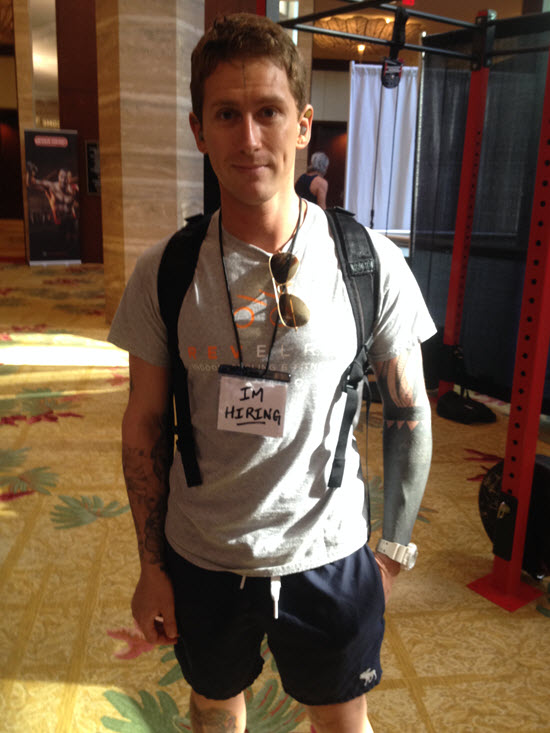
Christian Noni wants to hire you as an Instructor at Revelry Indoor Cycling and Fitness. But there’s a catch to his interview process… he’s looking for Instructors / coaches who’ve experienced inspiration from fitness, who have seen the light.. the proof.. (whether it be weight loss, winning a triathlon, or even had a wild twist and that’s how they met their wife or husband) and who lives to share and pass that torch in their classes.
I’ve been asked multiple times; “John can you help me with a problem I have hiring Instructors?” “I’ve never hired anyone before, what’s the trick to bringing on only great Instructors who will fill the room?”
Great question. One that I really didn’t have an answer for, before this interview with Christian Noni. Christian is the Fitness Director at Revelry Indoor Cycling and Fitness. One of his responsibilities to recruit, hire and train the Instructors who will make their studio successful. He has a wonderful way of interviewing potential Instructors… Listen to the interview to learn exactly what he’s looking for from and then how they plan to train each new Instructor to bring consistency to all of their classes, regardless of who’s teaching.
Christian’s mentor is the excellent educator Lawrence Biscontini. If you haven’t yet, I would highly suggest that you listen to both episodes of the interview we had with Lawrence:
Good stuff and these two interviews probably rank in the top ten of all the interviews we’ve ever recorded 🙂
Here’s my interview with Christian.[wlm_private ‘PRO-Platinum|PRO-Monthly|PRO-Gratis|PRO-Seasonal|Platinum-trial|Monthly-trial|PRO-Military|30-Days-of-PRO|90 Day PRO|Stages-Instructor|Schwinn-Instructor|Instructor-Bonus|28 Day Challenge’]
I’d love to hear if this helps you to select better Instructors. [/wlm_private]
It’s “Equalizer” or “Equaliser” depending on what side of the pond your classes are held.
In a comparison of Deezer’s and Spotify’s iPhone Apps, I would always choose Spotify – their App includes adjustable crossfade playback. Once you have crossfade you won’t want to go without it. Beyond that the IOS Apps are very similar.
A little bird notified me today that Deezer is going to release a new version of their music player App for both iPhone and Android soon… whatever that means? Based on the above graphic, the new Apps will allow higher quality 320kbps playback, crossfade and an Equalizer. I let you know when I hear more.
I know how to use crossfade effectively – OK, I just have it set at about 8 seconds and have left it there for at least a year.
But I’m going to be really curious to play with the Equalizer 🙂
Have you delivered your class music with your laptop and used the Equalizer that’s in iTunes?