
by John | Feb 21, 2013 | Best Practices, Instructor Training, Master Instructor Blog

This maybe a great bike, but completely inappropriate for a brand-new outdoor rider.
I'm listening to a recording of you, talking to member after a class last week. Would how you speak, and the words you choose, leave me feeling that your intent was to:
A: Educate them?
B: Impress them?
Last Sunday morning a participant approached me after a class I subbed at the Life Time Fitness HQ club. I call it the HQ club because it shares the parking lot of Lifetime's corporate offices in Chanhassen, MN.
I've forgotten her name, but she asked if I had a minute to advise her about purchasing a new bike. She explained how she had been riding indoors for about a year and was excited to test her new fitness outdoors this Spring.
“It sure looks and sounds like you have a lot of experience riding outdoors John, what brand of bike would you recommend for someone just getting started?”
THIS A TRAP!
Do I have a lot of knowledge about outdoor bicycles? Of course I do. If I chose to, I could have launched into an hour long dissertation about the virtues of carbon frames vs. aluminum frames, the specific differences between gruppos from Shimano, SRAM or Campagnolo, wheel choices and on and on – all with the intent of impressing her. But I didn't.
I could print my standard answer to this question on a business card; “I always recommend new riders start with the bicycle they will ride regularly.” This straightforward response often illicites a confused look from whomever I'm talking with. So I explain further, telling her…
“I love riding outdoors and I enjoy encouraging others as well. But riding outdoors, especially on the road, isn't for everyone. Because you don't know if cycling outdoors is really for you, my suggestion is to find a simple bike, start riding it and see if you enjoy it. You may have one hanging in your garage or one of your neighbors may have one you can borrow. Barring that, you could go to a local bike shop and find a reasonably priced cross-bike. Forget the special shoes and clips, the standard pedals are all that you need. Then I suggest finding a friend to ride with – it's safer and more fun riding with someone else. Then set yourself a goal for this summer of say 500 miles. If you reach it, promise yourself a new bicycle. Between now and then you'll have learned a lot that will help you make a good decision… but if you don't it's no big deal. You've just learned that outdoor riding just isn't for you, or you may find you only enjoy riding on the LRT trails.”
When I finished she looked like she wanted to hug me. Thank you, she said with a big smile. You have no idea how freeing it was to hear that. I have been getting dizzy with all the choices of bikes and really stressed about learning how to get in and out of my shoe clips. I'm having enough trouble here at the club. I have a friend who fell in a busy intersection when she couldn't un-clip. She called her husband to pick her up and I don't think she's ridden her bike since.
I'm not sure if you know him, but Tim Ferriss is a master communicator. He's the author of a number of best seller books including; The Four Hour Work Week and The Four Hour Chef. Both books are about learning the process of learning and then leveraging that skill to quickly become proficient in just about anything. A recent interview discussing the The Four Hour Chef included this:
Tim Ferriss: Yeah. And it's so easy. I mean, when you get to the highest levels, when you're talking to the best chefs in the world, they don't try to complicate it for you. That's what I realized. When you're talking to a lot of people who are kind of good, or really want to prevent you from being part of their world because they want to be some like, weird high priest of the blogosphere or whatever? They don't, they complicate things. But when you talk to, like, the Michael Jordans of cooking, like Grant Achatz, at Alinea in Chicago, where I spent two or three days, which is the #1 ranked restaurant in the US, while I was writing the book, or Marco Canora of Hearth in New York City, or you name it. I mean, Joshua Skenes of Saison in San Francisco. They are happy to give you simple techniques that will make you one of the best home cooks in the city. I mean, it does not have to be complicated at all.
Many of our students look to us as authorities or experts. We all have a unique opportunity to help others make positive lifestyle changes if we remember to avoid the trap of trying to impress and instead, concentrate on communicating effectively using simple techniques. Our Best Practices category of articles is an example of how we try to apply this here at ICI/PRO.
Can you think of a few areas where this could possibly apply to you?
by John | Feb 20, 2013 | Best Practices, Correcting Form
Myth # 10 – There's only one place your knee should be “over pedal” and that's when the forward pedal is horizontal.
Actually there's a second place where your knee should line up vertically with the center-line of pedal – when the pedals are at BDC (bottom dead center) like this picture shows.
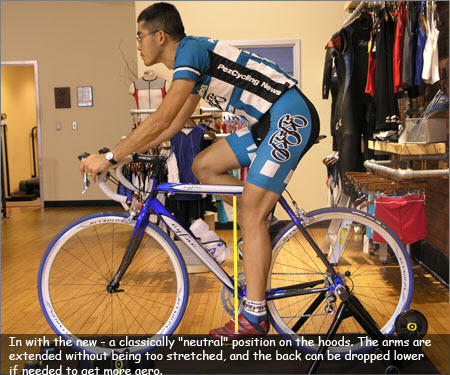
From http://www.pezcyclingnews.com/?pg=fullstory&id=3617 – I added the yellow line.
But wait John, for the knee to be over pedal, doesn't that mean that the lower leg would be perfectly vertical?
Isn't there supposed to be an angle in there some where? Of course there is and it's there right in front of you. It's created by rearward offset of the saddle which is a function of the Seat Tube angle, typically around 73°.
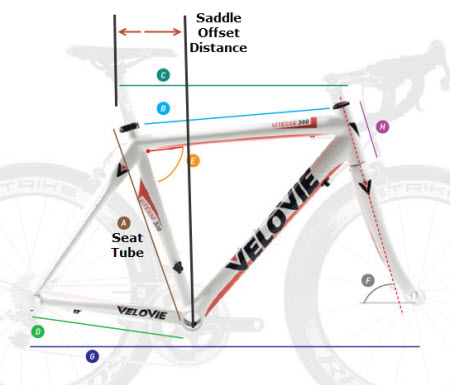
Why I see this as a myth is because we all live in a world filled with right angles, created by perfectly horizontal and vertical lines. Floors are level, walls are plumb and bicycle riders need a soft bend in their knee – an angle of around 30°. Because we are looking for this angle, the tendency is to reject the premise and assume it can't be perfectly vertical/plumb, except it can and often is* 🙂
The easiest way to check this is to simply step back away from the rider. Observe them with still pedals at BDC and a relaxed ankle/horizontal foot.
*You'll find this applies when the saddle fore-aft is set properly. Where it is not applicable is in those situations where the rider has moved the saddle all the way forward. Can you see how this will decrease the amount of offset = reduce the amount of the angle at proper extension?
by John | Feb 19, 2013 | Engage Your Students, Latest News

Word travels fast – I was contacted by a listener in London who heard our latest Podcast about the upcoming Ride of Hope. She offers these suggestions for anyone traveling to London this summer 🙂
Whether you're still sporting rookie marks or consider yourself an experienced roadie, it's time to enter London's dazzling cycle event to be held the first weekend of August: The 2013 Prudential RideLondon. These spectacular cycling trials are expected to draw spectators and participants numbering in the tens of thousands from all over the world. London has so much to offer these cyclists and those who cheer them on. RideLondon provides the perfect opportunity to enjoy London's culture, history, arts, and entertainment. Visitors should consider looking into the abundance of shows, special offers, and meal deals available through theatretickets.co.uk.
Cyclists and spectators alike won't want to miss these four dramatic cycling events:
* RideLondon GrandPrix: Held in the heart of London on a 1.3-mile loop circling St. James's Park, this trial is designed to inspire women cyclists, young people, and hand-cyclists. In addition to supporting professional women's cycling and Paralympic racing, RideLondon will provide special activities for young cyclists to encourage cycling as a healthy life choice.
* RideLondon Freecycle: Envision 50,000 cyclists over an eight-mile route in central London from Tower Bridge to Buckingham Palace and Parliament. People of all ages are invited to participate in the Freecycle in order to prove that cycling is fun, healthy, and tremendous for the environment. Participants, solo or as a group, may register online for free at the Prudential RideLondon website and will receive a special participation tabard.
* RideLondon Surrey-100: A 100-mile fundraiser for charity, this ride offers a challenge to amateurs as it winds its way from the new Queen Elizabeth Olympic Park, through the Surrey countryside, and back to the London Mall. Last chance to sign up, as 55,000 participants have already been accepted via ballot. Additional cyclists may enter through charity sponsorships. Amateurs need not fear bonking or getting cashed, as cyclists will be seeded along the route according to their abilities. A Business Relay is also scheduled for teams to compete over a 25-mile course. Charities are encouraging cyclists to commit to riding for their cause, including the British Red Cross, Hope for Children, Help the Hospices, World Wildlife Federation, and the Make-A-Wish Foundation.
* RideLondon Surrey Classic: Watch 150 international men's elite cyclists wind up through 12 London boroughs, into the County of Surrey, and back to the London Mall. This trial will commence at Queen Elizabeth Olympic Park in East London, scene of the London 2012 Games, and be broadcast on TV. The Classic is expected to establish a new annual event for Union Cycliste Internationale (UCI).
Designed to encourage more people to take up cycling, RideLondon wishes to promote the development of an environmentally-friendly cycle-hire program throughout the London area, in addition to raising money for charity.
by John | Feb 18, 2013 | Master Instructor Blog, Music

By Team ICG® Master Trainer Jim Karanas
Indoor-cycling instructors tend to plan their classes in one of two ways. Some start with music. They compile an audio profile of songs they enjoy and select the ride movement, cadence and intensity based on the song.
Others start with a fitness concept, let’s say endurance, and construct a ride profile of movements, cadence and intensity that supports the endurance workout. They then choose music to support their profile.
I also consider the length of a song and am a big fan of 10-minute songs. Song length is important with regard to conveying the fitness concept and giving students the necessary time to get the day’s message. My file of songs that last 10 minutes is huge, and I’m always on the lookout, sometimes purchasing entire collections just to get a good 10-minute song.
“Best” is subjective, of course, but here are my 10 favorite 10-minute songs and how I use them. I hope you find it useful.
Hallogallo by Neu! (10:07)
This is the optimal feel-the-rhythm-of-the-road song. It’s a dead-on beat-match of 80 rpm. After warm-up, throw the bike in a monster gear and haul ass down the road at 20 mph. Commit to the saddle, to one hand position, and to steady state just below threshold heart rate. I never get tired of this song.
Bigmouth by Underworld (10:08)
This is my favorite hill-acceleration song. Fall into a base-riding cadence of 65 rpm by riding to the beat. You can add accelerations in a variety of interval formats. I love the harmonica.
Mojave by Afro Celt Sound System (10:34)
This is the BEST descending-interval song ever. 4 minutes easy, 3 minutes moderate, 2 minutes hard, 1 minute very hard. Add the extra 34 seconds wherever you want. The first four minutes are mellow, and then the music moves into a kick-ass hill-climbing rhythm. Start seated and move to the standing position for the 2-minute interval, followed by a full acceleration, still standing, with 1 minute to go. Achieving a max heart rate was never easier.
Palladio (Symphony Mix) by Silent Nick (9:44)
The absolute best ascending resistance ladder (not a pyramid!) with fixed cadence on a hill climb. Maintain a rocking beat-match cadence of 75 rpm and add resistance every 2 minutes. Stand for the last 2 minutes, holding 75 rpm, and blow your legs to smithereens.
The Flow of Let Go by Anugama (10:31)
My favorite ambient 10 minutes dedicated to recovery. The music inspires you to follow your breath and turn the pedals in a smooth circle.
Adios Ayer (Paul Daley Remix) by Jose Padilla (9:37)
I love this song for the lightness it can help you bring to your pedaling technique at a high cadence. Ten minutes at 100 rpm in an easy gear, keeping your feet as light against the pedals as you can. Sit forward on the saddle and let your legs turn a soft, smooth rhythm. Surreal.
M’Bali Jo by Pili Pili (10:36)
This is a not-well-known jazz piece with a beat-match of 88 rpm. I love this song for intermittent jogs, maintaining the same cadence in both the standing and the seated position. The song has a wonderful natural build that encourages you to make the jogs longer and longer.
Things Can Change by Klangstrahler Projekt (10:06)
I’m happy that a KP song makes this list. With beat-match at 90 rpm, this song is good for many things. My favorite is a big-gear, ascending resistance ladder. Maintain 90 rpm in the saddle and add resistance every 2 minutes. You’ll find yourself trying to break the pedal axles by the end of the song.
Homage to Patagonia by Lemon Jelly (9:34)
Some of you may not like Lemon Jelly. They’re said to appeal to a listener demographic that I fit perfectly. I love their unusual themes and interesting rhythms. This song provides a wonderful beat-match of about 95 rpm. I use it mostly for fartlek training. Set your base cadence at 95 rpm. Mix in random, unstructured attacks with added resistance in the standing position. The song provides a rhythm that’s very catching when you drop back to the saddle.
Alone by Moby (10:47)
I saved the best for last — early Moby at his finest. This is my favorite dream piece and provides the perfect climbing rhythm. Stay supple with strong determination. Steady state. Timeless.
Here's a Spotify playlist 5 of the 10 Best 10-Minute Songs
by John | Feb 15, 2013 | Music
 Have you ever shared a track or playlist from Spotify with a friend? PRO member sandyballardini shared this awesome playlist spin for glory with me and while I was listening to it play this morning, this track from the band Santigold really jumped out at me.
It's endurance season here in the frozen north and I love to string together multiple, interesting tracks in the mid 70's for long sub threshold climbs. Santigold — Disparate Youth taps out at 76 RPM with just the right amount of intensity to communicate where I needed everyone to be.
Maybe I should define what I mean by an interesting track = one that causes or requires the riders to stay mentally engaged; i.e. music that sounds just a little bit “off”, confusing or slightly hard to follow.
It's no secret that teaching endurance classes (while keeping the group focused) can be challenging. In the past I've used very long tracks, that are almost hypnotic, for the purpose of helping everyone disassociate from the effort. Jim Karanas' ZENDURANCE PRO/Playlist has a bunch of great examples and 15 minute Pili Pili — Pili Pili is my favorite.
But there are times when I want to bring students back mentally, so I'll throw in an interesting track like Santigold — Disparate Youth to snap them back to reality.
Do you have a favorite you'd like to see as the Friday Favorite? Yes? Then send it to me user johnmac11
Here's a fun cover you can download 🙂
