Spinning® Instructor Kristen Dillon was another of the winners in our Ultimate Instructor Class Profile Contest with her; Push Your Threshold Audio PROfile!
Kristen trains cyclists at the Beach City Health and Fitness. The club is located in/on Hilton Head Island, SC where she says the only hills you’ll find are those created by the red knob… rotated clockwise, during one of her four weekly classes 🙂
Kristen’s success was even recognized by her local paper – how cool is that?
In its second ultimate instructor class profile contest, local Hilton Head Island Resident and Beach City Health and Fitness Spinning certified instructor Kristen Dillon was voted first runner-up by a panel of professionals. Dillon won a $300 cash prize and $250 in other prizes for her “Push Your Threshold” profile – an indoor training class designed to improve performance for indoor cyclists as well as road cyclists and triathletes.
Endurance Coach and Author Grant Molyneux joins us to discuss his book Effortless Exercise
and its importance in actually enjoying exercise, while building aerobic fitness & endurance, vs. dreading the thought that it is time to thrash yourself on the bike yet again.
Wouldn’t it be fantastic if you felt great every time you exercised — every step of the way? What if you could consistently experience the bliss of the runner’s high or the flow of a perfect swim stoke and benefit from all the positive health benefits of exercise without any of the downside of pain and injury. Imagine what your life would look like if it became effortless to maintain your ideal weight, play with your kids, climb a mountain or participate in a triathlon on any given day, at any given age.
If you answered a resounding “Yes!” then effortless exercise is for you. Whether you’re a beginner or wanting to win an Ironman triathlon, the principles in this book apply to anyone seeking a deeper experience of exercise. Come on a journey into the Zen state of exercise that will transform your training and help you to achieve more with less. The ideas in this book will help you to go within for a deeper, richer experience that creates sustainable fitness and peak athletic performances through meditative flow states. Fundamentally you’ll discover the pleasure of exercise and be drawn to move every day because it feels so good to exercise this way.
I’m curious to hear your responses to this. Grant makes a great point how the pendulum of “conventional thinking” tends to swing back and forth… Long and Slow works best – no, wait. HIT is what will make you fitter, faster & thinner.
Cuing the Console — Change is GOOD!! was designed towards the instructor that may be new to teaching with a console in front of them, and/or to the instructor who may be new to teaching indoor cycling in general. The goal is to construct a simple, easy to CUE class, but not necessarily just an “easy” ride!
Sometimes when we attend a conference or weekend workshop we come home really jazzed with all the new information and want to spend it all on Monday morning’s class! Or we try to emulate and teach EXACTLY like the presenter we listened to in the training but perhaps still question- “how do I make it MINE??” This profile is designed to help you speak in your language and convey your message in a fun, easy way!
This maybe a great bike, but completely inappropriate for a brand-new outdoor rider.
I’m listening to a recording of you, talking to member after a class last week. Would how you speak, and the words you choose, leave me feeling that your intent was to:
A: Educate them?
B: Impress them?
Last Sunday morning a participant approached me after a class I subbed at the Life Time Fitness HQ club. I call it the HQ club because it shares the parking lot of Lifetime’s corporate offices in Chanhassen, MN.
I’ve forgotten her name, but she asked if I had a minute to advise her about purchasing a new bike. She explained how she had been riding indoors for about a year and was excited to test her new fitness outdoors this Spring.
“It sure looks and sounds like you have a lot of experience riding outdoors John, what brand of bike would you recommend for someone just getting started?”
THIS A TRAP!
Do I have a lot of knowledge about outdoor bicycles? Of course I do. If I chose to, I could have launched into an hour long dissertation about the virtues of carbon frames vs. aluminum frames, the specific differences between gruppos from Shimano, SRAM or Campagnolo, wheel choices and on and on – all with the intent of impressing her. But I didn’t.
I could print my standard answer to this question on a business card; “I always recommend new riders start with the bicycle they will ride regularly.”This straightforward responseoften illicites a confused look from whomever I’m talking with. So I explain further, telling her…
“I love riding outdoors and I enjoy encouraging others as well. But riding outdoors, especially on the road, isn’t for everyone. Because you don’t know if cycling outdoors is really for you, my suggestion is to find a simple bike, start riding it and see if you enjoy it. You may have one hanging in your garage or one of your neighbors may have one you can borrow. Barring that, you could go to a local bike shop and find a reasonably priced cross-bike. Forget the special shoes and clips, the standard pedals are all that you need. Then I suggest finding a friend to ride with – it’s safer and more fun riding with someone else. Then set yourself a goal for this summer of say 500 miles. If you reach it, promise yourself a new bicycle. Between now and then you’ll have learned a lot that will help you make a good decision… but if you don’t it’s no big deal. You’ve just learned that outdoor riding just isn’t for you, or you may find you only enjoy riding on the LRT trails.”
When I finished she looked like she wanted to hug me. Thank you, she said with a big smile. You have no idea how freeing it was to hear that. I have been getting dizzy with all the choices of bikes and really stressed about learning how to get in and out of my shoe clips. I’m having enough trouble here at the club. I have a friend who fell in a busy intersection when she couldn’t un-clip. She called her husband to pick her up and I don’t think she’s ridden her bike since.
I’m not sure if you know him, but Tim Ferriss is a master communicator. He’s the author of a number of best seller books including; The Four Hour Work Week and The Four Hour Chef. Both books are about learning the process of learning and then leveraging that skill to quickly become proficient in just about anything. A recent interview discussing the The Four Hour Chef included this:
Tim Ferriss: Yeah. And it’s so easy. I mean, when you get to the highest levels, when you’re talking to the best chefs in the world, they don’t try to complicate it for you. That’s what I realized. When you’re talking to a lot of people who are kind of good, or really want to prevent you from being part of their world because they want to be some like, weird high priest of the blogosphere or whatever? They don’t, they complicate things. But when you talk to, like, the Michael Jordans of cooking, like Grant Achatz, at Alinea in Chicago, where I spent two or three days, which is the #1 ranked restaurant in the US, while I was writing the book, or Marco Canora of Hearth in New York City, or you name it. I mean, Joshua Skenes of Saison in San Francisco. They are happy to give you simple techniques that will make you one of the best home cooks in the city. I mean, it does not have to be complicated at all.
Many of our students look to us as authorities or experts. We all have a unique opportunity to help others make positive lifestyle changes if we remember to avoid the trap of trying to impress and instead, concentrate on communicating effectively using simple techniques. Our Best Practices category of articles is an example of how we try to apply this here at ICI/PRO.
Can you think of a few areas where this could possibly apply to you?
Myth # 10 – There’s only one place your knee should be “over pedal” and that’s when the forward pedal is horizontal.
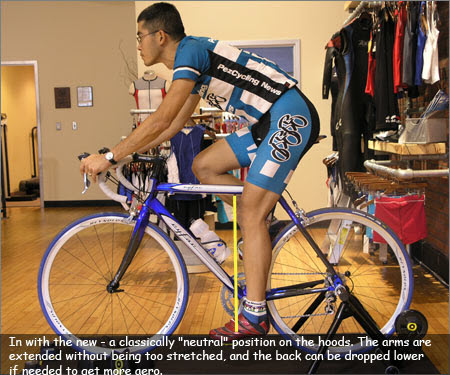
Actually there’s a second place where your knee should line up vertically with the center-line of pedal – when the pedals are at BDC (bottom dead center) like this picture shows.
From http://www.pezcyclingnews.com/?pg=fullstory&id=3617 – I added the yellow line.
But wait John, for the knee to be over pedal, doesn’t that mean that the lower leg would be perfectly vertical?
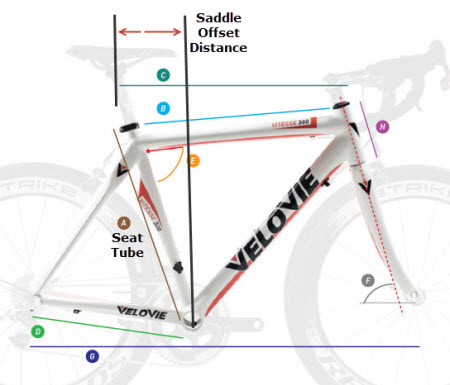
Isn’t there supposed to be an angle in there some where? Of course there is and it’s there right in front of you. It’s created by rearward offset of the saddle which is a function of the Seat Tube angle, typically around 73°.
Why I see this as a myth is because we all live in a world filled with right angles, created by perfectly horizontal and vertical lines. Floors are level, walls are plumb and bicycle riders need a soft bend in their knee – an angle of around 30°. Because we are looking for this angle, the tendency is to reject the premise and assume it can’t be perfectly vertical/plumb, except it can and often is* 🙂
The easiest way to check this is to simply step back away from the rider. Observe them with still pedals at BDC and a relaxed ankle/horizontal foot.
*You’ll find this applies when the saddle fore-aft is set properly. Where it is not applicable is in those situations where the rider has moved the saddle all the way forward. Can you see how this will decrease the amount of offset = reduce the amount of the angle at proper extension?