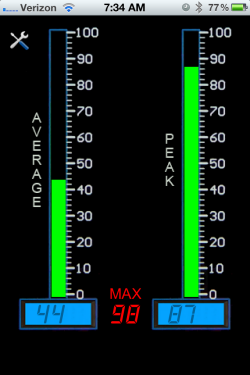
Click to download this App – I'm sure a search on your Droid phone will find something similar.
ICI/PRO member Kristin Krantzman makes an excellent point here in her comment, to my earlier post about sound levels.
I have one student that really complains about the loudness of the music. She has tried wearing special noise protectors. She tells me that I am damaging my own hearing as well as that of my students if I do not reduce the volume.
BUT, when she is in my class and I reduce the volume to the level she wants, the rest of the class can barely hear the music. Students start cross-talking in class and they lose interest. What can I do? I agree that increasing the volume so high that the walls are shaking is not healthy. But, when the members cannot hear the music and they start talking to each other in class, that is not good either. Anyone have ideas about how to handle this sensitive problem???
Kristin you're making a great point about “subjective” vs. “objective” measurements. We all have different levels of hearing. I want to call it a “sensitivity” to sound that may have reader's nodding in agreement, if they've ever had an argument with their spouse about the sound level coming from the TV.
You and your student are having the time honored, back-and-forth of; “it's too loud”… “no it's not”… “yes it is”… “I like it this loud”… “it will damage your hearing”… “no it won't”… which goes on without resolution because there's no “objective” sound level you can point to as an authority. I know from 24 years of marriage that a subjective argument like this will never end in “Win – Win”. Amy get's mad and leaves the room or I begrudgingly turn down the volume. Either way only one of us “wins” and, more often than not, neither of us feels good about the outcome.
The same is true for you and your noise sensitive student. If you had a sound meter in your studio (or living room) you could point to it and say something like; “our sound levels don't exceed 85 dB, which is the maximum level recommended by The National Institute for Occupational Safety and Health (NIOSH).
Can you see how having this “objective” measurement could change everything [wlm_firstname]? Instead of your student arguing with you, her complaint is totally with some third party authority. She may still believe that the music is too loud, but her issue isn't with you or your club. You're following the recommendations of a highly authoritative government body.
She maybe frustrated by all of this, but none of it will be directed at you. Smile and say; “I'd really like it if you stayed for my class, but I will completely understand if you don't.” And then it's critical that you make a very direct disengagement from him or her. Physically turn your body, break eye contact or say hello to another student. If you give her the chance, she'll re-load and come at you with another complaint or a different spin on her original complaint.
Handled correctly, my guess is that she'll stay for your class because…
People frequently use non-specific complaints to advance their own self interests!
It's said, but true. Every day people are trying to manipulate you into doing… what they want you to do!
Kristin's comment included this:
She tells me that I am damaging my own hearing as well as that of my students if I do not reduce the volume.
Please tell me if I'm wrong here – This student's expressions of concern, for Kristin and the other students, maybe completely well-intentioned. But I've been around far too long not to think that at some level she's simply taking advantage of Kristin's concerns for the wellness of everyone in her class, with the intent to manipulate Kristin into doing what she wants.
If you've had sales or customer service training, you'll recognize customer comments such as “your music is too loud” as a classic objection or complaint without specificity. Sales people learn that when presented with a non-specific objection; “your price is too high” the only effective response is to make the objection specific; “compared to what?”
The same is true in a customer service situation; “your music is too loud” needs to be qualified and made specific “our classes don't exceed the recommended safe maximum of 85 dB” effectively neutralizing the complaint. “Next?” you say, as you smile and greet the next person in line.
Like it or not, as the Instructor you are also a front line Customer Service person for your club or studio. Be aware that complaints from students aren't always what they appear. Bringing clarity to a complaint, by identifying specifics, can go a long way toward peace and harmony in your class and a lot less frustration for you, the Instructor.
P.S – I've downloaded the free sound meter App for my iPhone shown in the screen shot above. I played around with it last night and plan to use it to establish an agreed sound level for the TV in our home. So the next time I hear; “it's too loud!” I can check and see who's right 🙂
P.S.S. You may want to forward this to your owner or Dept Head, so you're both on the same page if/when this student tries to escalate her complaint to management.
My Monday morning (5:45 am) classes are always a JRA Endurance ride. My class looks forward to them as a foundational part of their weekly training. The combination of plenty of caffeine + a steady Aerobic effort gets the old brain cells working and the creative juices flowing. This past Monday was no exception and I found myself considering the state of Indoor Cycling and it's potential for the future. What started as an appreciation of the room and all my loyal students slowly morphed into a mental list of reasons Indoor Cycling is here to stay – and probably destined to continue to grow 🙂
I tried to come up with a top ten, but fell a few short. Perhaps you can suggest a few more?
Winters (here in Minnesota and in many other parts of the world) are getting colder and longer, driving everyone inside and keeping them there.
We've got the demographics on our side. My participants seem to be are getting older. Many tell me that Cycling is the only thing they can continue to do with the joint problems they deal with daily.
These older participants are looking for two things from a class; help maintaining their body weight and hopefully stave off the aging effects of each new year. Vanity, in my opinion, is the number one motivator for many in your class. Are you speaking to it?
You can't turn on the TV without seeing some Fitness Program like P90x being advertised. Our general population is obese, and getting more so. They don't like it (see #3) and many are looking for a fun way to get thinner, err… healthier 🙂
Small Indoor Cycling Studios are popping up everywhere offering high quality, low financial commitment alternatives to traditional health clubs. I see these new studios following a parallel path that boutique Yoga/Pilates studios use. They appear to numerous and profitable.
I see society contracting inward, with the Internet allowing for the creation of very specific communities of like minded people – like ours here at ICI/PRO 🙂 I'm watching Life Time Fitness attempt to adapt to this by offering “Clubs within a Club” like their Cycle Club, Run Club, Triathlon Club,etc…
Indoor Cycling 2.0 is becoming a reality as more clubs invest in the new Indoor Cycles with Power from Keiser, Schwinn, Cycle Ops, FreeMotion and the new Spinner NXT with power.
The introduction of Power measurement will dispel the “I burned 700 calories today” lie that so many in our industry continue to tell. I predict that many in your club will hate knowing the truth; that you can't sit in class and talk to your neighbor for an hour, while barely getting warm and burn a substantial amount of energy. But many will learn the truth and accept it. Sure at first they maybe angry, but that anger will subside … and possibly change to a renewed source of focused intensity that will have them achieving their goals (see #3) … maybe for the very first time. When that happens they will be back, and they will bring their friends.
Cameron Chinatti from Stages Indoor Cycling alerted me to this Indiegogo project: BreathAcoustics All-in-One Headset. She was excited by it and I can see why.
I've spoken with the inventor Nirinjan Yee who's the CEO and Founder of BreathResearch and we will be recording an interview this coming Thursday morning – I'll try to have it posted by Friday so there's still time for you to help fund this project.
Nirinjan has some big hitters on her team including Sally Edwards and Dr. Carl Foster. Dr. Foster is conducting clinical research at UW Lacrosse to validate if this headset can accurately identify VT1 (first ventilatory/aerobic threshold) and VT2 (second ventilatory/anaerobic threshold) by measuring the distinct changes in breathing that occur with changes in intensity.
Here's why I feel this project is worthy of your support.
Perhaps the hardest part of teaching/Coaching Indoor Cycling / Group Fitness classes is effectively communicating your intended intensity.
Effective communication requires a common language between you and your participants.
How hard is HARD? What exactly does MODERATE feel like? Is my perception of an “8”… the same as yours? All of those descriptions are subjective = they only mean what I (me/you) think or feel they mean.
Walk into a Home Depot and ask for a gallon of Red paint – or – visit Amy at the makeup counter and ask for Red lipstick. Both Amy and the paint salesperson will ask; “we have quite a few different Red's… which shade are you looking for?” Then they'll show you a chart with all the different shades of Red for you to choose from.
With out realizing it, you're probably doing the same thing in your classes. In our attempts at getting our classes to work where we want them, we introduce more object descriptors = we'll probably be cuing to breath & breathing patterns; you've first noticed your breathing, need to open your mouth, jaw dropped, lost interest in speaking, sound like a freight train, gasping for air! etc… to help our riders understand the intensity we're looking for in class.
Next, we try to correlate those breathing patterns to a Heart Rate number or HR Zone; when you feel that early change in your breathing you're crossing your Aerobic Threshold T1… That strong, rhythmic breathing (without feelings of distress) has you in the middle of Zone 3; etc…
So why do we try to tie breathing (direct indication of intensity) to a Heart Rate number? Because it's really (beyond watts) the only objective measurement we can easily (and repeatably) make and we do so by using a heart rate monitor. We then assign a range of HR BPMs to a “Zone”. These HR Zones* become the common language between you and your students. If everyone knows their HR at VT2 (AT/LT) I can simply cue; “I need everyone at threshold” and the class understands.
Is there something magical about a specific Heart Rate BPM? Not at all… your heart is just responding to requests for more or less O2 and energy from the muscles it serves. Those requests are based on intensity and IMO anything that could improve the connection between intensity and Heart Rate BPM will help us to more effectively communicate with all those smiling faces riding in front of us.
Improving that connection (without needing to wear one of those awful New Leaf masks) sounds like something we should be supporting. That's exactly what BreathAcoustics is trying to accomplish with their Indiegogo project.
*I'm continuing my crusade advocacy toward the fitness industry adopting a common HR Zone system and have a number of expert interviews planned for later the Fall.
Allen Jones from EpicPlanet.tv always sends me an advance copies of new Indoor Cycling DVDs he produces. Allen does this because – A) he knows I frequently use video in my class, B) there is no better place on the internet to promote videos for your next Spinning class and C) because yours truly did the ride profile for his latest video – Epic Wine Country.
Actually I had received an advanced, advance copy that he burned by hand, so I could use it in my class before writing the profile.
I have a brand new copy of Epic Wine Country indoor cycling dvd that I want to give it to an ICI/PRO member along with an official ICI/PRO long sleeve t-shirt.
So I devised a little contest 🙂
What is my favorite David Bowie Song?
Now I realize that there are a lot of Bowie songs, so I will give you a few hints:
It was produced before 1980
I would sing a song to my two girls when they were very young, but not if Amy was around – you don't want to hear me sing 🙁
It had a little Doo-Wop in it.
On the the album it transitioned to a song with a title (actually a statement) that I would prefer my two girls say NO to.
It wouldn't work in any Indoor Cycling class – way to slow.
Now I realize that the majority of ICI/PRO members were born after 1980, but just the same I'm guessing there are a few Bowie fans in our community.
How would Tom Scotto lead a virtual Indoor Cycling class? You're about to find out. In our latest Audio PROfile, Tom walks your through teaching to Club Ride In France – DVD #1 of the three part France Series of videos from Global Ride.
Past Audio PROfiles, that are the companion to Indoor Cycling DVDs, have been very popular and we plan to offer more of these in the future.
The music used in the Global Ride DVDs is actually quite good and I suggest you follow Tom's advice and used it – just be sure to choose the “No Coaching” option. Or you might try using the coaching track and ride along with everyone else.
Info about Club Ride In France DVD
Coaching Tracks
Since the first DVD made in Hawaii, Global Ride has been providing coaches from all over the world to help you get the most out of these virtual rides. Each coach having their own style and objectives. With the France series you can ride to the DVD's Featured Coach, Fiona Ford, a British Triathlon coach, National Championship and International Gold medallist for World & European Triathlon, Aquathlon & Duathlons.
This DVD also explores a bit of role-playing to help transport the rider into the scene both mentally and visually. For a different coaching track, Gene Nacey & Tom Scotto play two coaches out for a ride with their students, each vying for open spots with Triathlon Europe.