So you made it through your audition and your name is listed as “Instructor” on the schedule. Congratulations!
It's very common for the initial excitement, “I can't believe it…I'm an Indoor Cycling Instructor!!” to quickly fade away, replaced by fear and anxiety. The realization that in __ days you'll be mounting the bike and leading your class for the very first time, typically solicits “HELP! I'm teaching my first class on Thursday!!”
That “HELP” is based on FEAR > the perfectly natural fear of presenting or speaking to a group. Fear that you won't do a good job. Fear that you'll look foolish. Fear that you won't be liked, etc…
So to help you manage the fear that's going to come when you teach your first few class, I thought you'd appreciate three suggestions for mitigating that fear. Then you can get on to the task at hand > which is delivering a FUN and entertaining class for everyone who shows up.
Step #1 Prepare… But Not Too Much
If you were to ask me, “John – which do you feel would be better for my first class?
A. I walk in super prepared, with lots of detailed notes and cues on multiple 3×5 cards…
or
B. I have a simple/basic framework/profile for the class, leaving some room for spontaneity and my personality to shine through?[wlm_private ‘PRO-Platinum|PRO-Monthly|PRO-Gratis|PRO-Seasonal|Platinum-trial|Monthly-trial|PRO-Military|30-Days-of-PRO|90 Day PRO|Stages-Instructor|Schwinn-Instructor|Instructor-Bonus|28 Day Challenge']
I'd always suggest “B” and here's why.
Yes it's important to be prepared, but IMO having too much detail; your minute by minute profile reduced to writing, on a bunch of note cards, is a recipe for disaster > or possibly a very boring class presentation.
First you need to give your class what they want; a FUN and entertaining workout. It's only after you've accomplished this can you begin to add in what they need; structured, effective cardiovascular training.
When you climb up on that stage for the first time, there's a huge amount of stress and sensory/emotional overload. You're now faced with; using an unfamiliar sound system, getting your music going, all those faces watching you, you watching them, “am I showing good form?, “what is her frown communicating?”, do they like me? Are the enjoying the class?
So there you are, with a handful of note cards, that you proceed to read to your class while you manage everything else required to teach the class. Have you ever watched a speaker who gets up and just reads his/her speech? Head down, drowning on and on, with no audience engagement and certainly no personality? Not what you want to do in your first class – is it?
If you commit your early classes to a complicated series of notes, there's a good chance you'll do the same thing = despite all of your preparation something will happen (a late arriver/Spotify will skip a song or to your horror it will be on shuffle) something will happen that will throw you offand your well planned class could quickly become your worst nightmare.
Trust me on this. It's better to have a very simple structure to follow. There's nothing wrong with doing one activity/movement/intensity for each song in your early classes. Without the need to follow a script, you'll probably lift your head up and smile at a few participants in your class. I know it may sound crazy, but that's all many of them really want from you!
Step#2 Salt the Room
Back in the gold rush days, unscrupulous mine owners would sprinkle gold dust (Salting the Mine) to fool people into thinking the mine was valuable, in the hopes of selling a worthless hole in the ground to an an unsuspecting investor.
This strategy also works very well during an audition.
You can do something similar to make the room or studio more valuable for YOU, but it doesn't involve gold – something much better. Invite a number of your friends or family members to your first few classes – effectively Salting the room with friendly faces. I'd have them all sitting right there in the front row.
Now you'll have a bunch of familiar participants you can feel comfortable engaging with / get energy from! I had my wife Amy front and center during my audition with LifeTime Fitness. When ever I was feeling anxious I would look at her. She'd smile back and then turn and look to one side > my cue to not focus on her and make eye contact with others in the class. It worked like a charm and look at me now 🙂
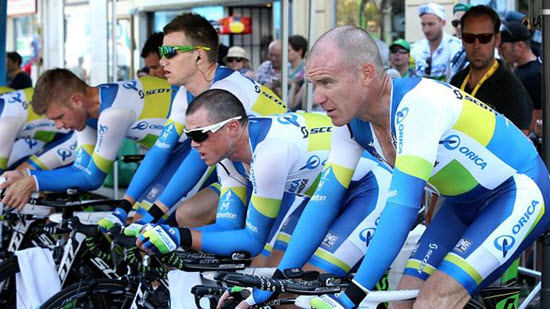
Cycling Team getting warm before a big event. Image credit http://velonews.competitor.com/
Step#3 Pre-Class Warmup
It's a learned art to be able to ride with intensity and still be able to communicate effectively as an Instructor. I chose the words ride with intensity specifically because participants want to see you working > nothing reduces your authority in the room more than being labeled as an Instructor who fakes it – I've never seen anyone who can effectively pull off pretending to add resistance, so don't bother trying.
So until you develop the skills (and specific fitness – I don't care how fit you are, this is different) needed to comfortably breath and talk in full sentences, while in Zone 3 – I suggest you take the time to warm up before your class. No cyclist would think of starting a time trial without a complete warm up. They have to be able to perform right from the start and you need to be able to perform as soon as you press play.
Let's say your class starts at 9:00. You want to make sure you're standing at the door to greet everyone starting at 8:45. Twenty minutes should be long enough for a nice gradual warm up that include 3-4 short hard efforts to get you up to threshold and a few minutes to cool down. Leave 5 minutes for the bathroom break you know you'll need = you need to be riding at 8:20.
This would be the perfect time to practice your first few tracks. Listen for obvious changes that will cue you to make a change. If possible, try speaking out loud to loosen up your voice. Or maybe pick out a quiet segment where you flash that big smile and thank everyone for attending your first class… doesn't Madonna have a song, something about the first time?[/wlm_private]
The big news at this years IDEA World Fitness Convention was the launch of Fitness Connect, which is the world’s largest fitness professional directory, connecting more than 16 million consumers to more than 100,000 fitness professionals with credentials verified by the top 14 fitness certification bodies.
While I was at the convention I met Jason Davis -IDEA’s Internet Revenue Director.
Jason walked me through a demonstration of Fitness Connect and while I watched I was struck by how intuitively it was designed and it became very easy to see the potential value it could bring to both individual fitness professionals and fitness clubs and studios.
During my interview with IDEA's COO -Mike Bannan we discuss additional details about why I feel strongly that you, as a Fitness Professional, need a profile on Fitness Connect.
Listen to the Podcast below or subscribe for free using
Are you annoying some of your current (or potential) participants? You know, rubbing those folks who are of a different/opposite personality type than yours the wrong way?
I recently came to the conclusions that there's a good chance that I do at times – please let me know if any of this makes sense to you…
Yesterday I gave a presentation to our sold-out group of studio owners and Instructors at the Full Psycle/PRO PIQ workshop entitled:
Selling Power – The success of your studio depends on it!
We've got all of this fancy technology in our studios; bikes with consoles, display training systems, results emails and online user profiles that record all of your previous class data. So (to me) it should follow that persuading (Selling) participants that Training with Power is worthwhile becomes supercritical to building a loyal following = a profitable fitness business.
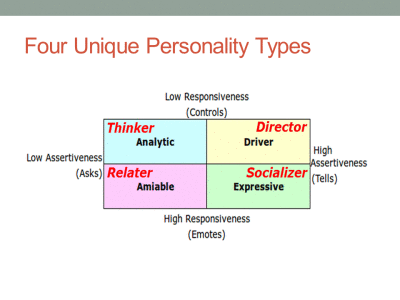
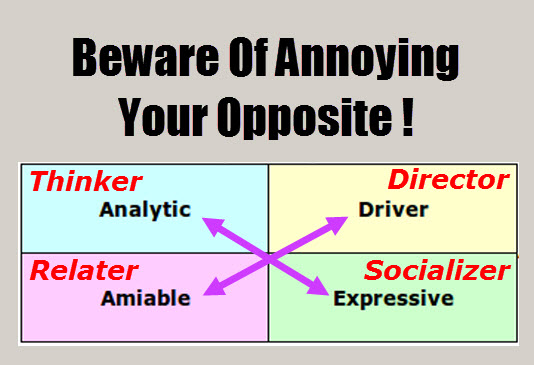
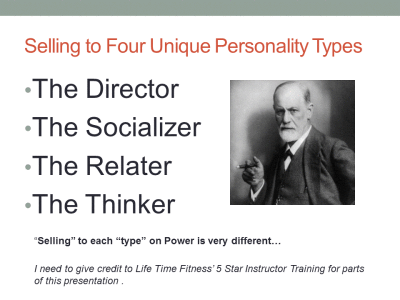
The core concept of my talk was how you need to understand how the four different personality types; Director, Socializer, Relater and Thinker need to be “Sold” to differently.
The personality matrix is constructed like this:[wlm_private ‘PRO-Platinum|PRO-Monthly|PRO-Gratis|PRO-Seasonal|Platinum-trial|Monthly-trial|PRO-Military|30-Days-of-PRO|90 Day PRO|Stages-Instructor|Schwinn-Instructor|Instructor-Bonus|28 Day Challenge']
Then I went on to describe the common personality traits of each type.
Teach an early AM class? I'll bet it's filled with “A” type Directors.
I am a Director > my kids will attest to me sometimes being a bit harsh 🙁
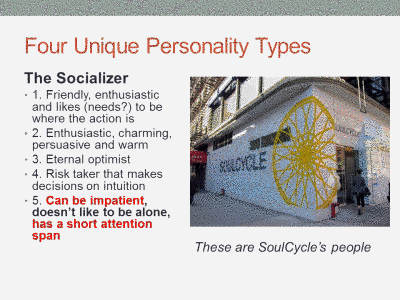
These social folks will pay your overhead if you can attract and retain them.
I explained how it was my belief that attracting Socializers is the key to a successful/profitable Indoor Cycling Studio. Everything I observed at SoulCycle appeared to be designed to attract this type of people and who can argue with their success?
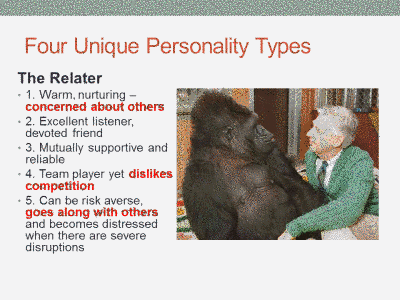
You're a Relater if you include the word “safe” in your class description.
When we first began promoting Performance IQ there was some initial pushback from Instructors; “we need to keep competition out of our classes!” > which I realize now came from Relaters who were concerned about weaker riders not being able to keep up. NOTE: that's been fix… now you can run PIQ competitions between riders that are handicapped for weight/gender or Team based challenges are awesome for including everyone.
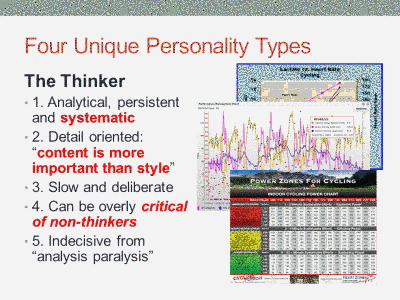
Thinkers spend a lot of time discussing the “Science” of training with anyone who will listen.
At the risk of sounding harsh (I'm a Director… we do stuff like that!)…
I feel we are wasting our time, when we focus our attention on Thinkers.
Many (maybe most) dedicated endurance athletes/cyclists fall into the Thinker group. Don't get me wrong – I know hundreds of them and they're a bunch of nice people. If I had a technical product or service to sell I would devote nearly all of my attention on these data junkies. But Thinkers are very individualistic* (loners) ≠the type of people who add value to a group fitness class. Not to mention they disappear from your class on the first nice spring day.
While typing this I remembered an article from Stages Indoor Cycling's Cameron Chinatti about not focusing on the Squeaky Wheels in your classes. Cameron doesn't call out Thinkers directly, but I see it all the time where Instructors get sucked into esoteric debates about the science of training on Facebook or with the guy in a full kit, who sat in the front row, doing his own thing.
Little, if any, of the “science” of training is of interest to Socializers. So while you're caught up with the wannabe pro cyclist/Thinker, debating the pro's and con's of Training Zone 5B > the Socializer (who has many hundreds of friends) who wanted to thank you for recognizing them during class, leaves feeling like you don't really care… and never comes back.
So Who annoys Who?
I got a lot of heads nodding “YES” when we discussed who annoys who during my presentation.
All of this is strictly anecdotal > just my 53 years of observation and my own personal feelings.
Thinkers and Socialisers can get under each other's skin.
As a Director, Relaters can bug the crap out of me and they see me a uncaring 🙁
We discussed a number of examples of how we need first need to identify our “type” and then be careful not to annoy our opposites, during the presentation of our classes.
Directors need to recognise a Relater's concerns for the safety of others – even if we think it's unfounded.
Relaters need to understand that not everyone shares their concerns and encourage the Directors in class to take a risk.
Thinkers need to minimize the “science lessons” or they'll quickly lose Socializers.
Socializers – it can't be all passion and cheerleading. Throw your Thinkers a few technical “bones” to satiate their need for concrete data.
[/wlm_private]I'm kicking myself for not recording this complete session. There was a lot of excellent comments and feedback. We're planning more of these Full Psycle/PRO workshops and I won't make the same mistake twice.
*Yes, cyclists go on group rides, with other cyclists. But these rides are rarely social events – especially for men. More like a group of individuals riding near each other, all going in the same direction and using each other's draft.
I invited Cameron Chinatti and Doug Rusho from Stages Indoor Cycling back to the Podcast to learn how they communicate the concepts of Power in ways that reach the different learning styles and personalities in your classes.




 professional directory, connecting more than 16 million consumers to more than 100,000 fitness professionals with credentials verified by the top 14 fitness certification bodies.
 The personality matrix is constructed like this:[wlm_private ‘PRO-Platinum|PRO-Monthly|PRO-Gratis|PRO-Seasonal|Platinum-trial|Monthly-trial|PRO-Military|30-Days-of-PRO|90 Day PRO|Stages-Instructor|Schwinn-Instructor|Instructor-Bonus|28 Day Challenge']