What message do you send from the bike, while conducting your class?
If that's that's of interest to you, here are two short videos to help you.
First is communication expert Alexa Fischer. She sets up her video on body language this way…
I was at a networking event recently (actually enjoying it, as I am wont to do), shaking hands, making small talk, when I saw her — arms crossed, head down, avoiding eye contact while she alternated between sipping her drink and scrolling through her phone.
And this made me think two things:
1. My friend, we’ve all been there. Who among us hasn’t felt nervous at an event filled with new people?
2. I want so much to come over and say hello! And ask you where you got that great haircut! But your body language is telling me you’d rather … not.
In today’s video, we talk about how body language affects how others view us, how our own body language affects how we feel, and how we can read someone’s body language and use that information to choose our words.
If you missed hearing our past interview with Alexa you can find it here.
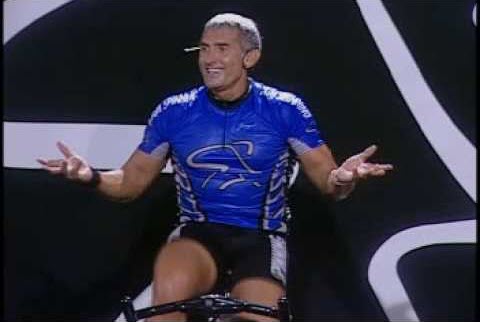
To build on the concept of projecting confidence, take a few minutes to watch Johnny G and see how he presents that “outward energy” on the bike.
Watching Johnny has me considering how often I sit up and project openness – rarely now that I think about it.
Do you spend the majority of your class down? Or are you sitting up frequently to reinforce an important point or simply to extend that outward energy to your class?
John Baudhuin with Colby the office dog -photography by Michael Darter
The brand that we all know now as Spinning grew out of a partnership between endurance athlete Johnny G and cyclist / CPA John Baudhuin in the early 90's. Together they formed Mad Dogg Athletics and the rest is history!
John R. Baudhuin is the founder, President and Chief Executive Officer of Mad Dogg Athletics. Prior to founding Mad Dogg Athletics in 1994, Baudhuin worked as a certified public accountant for Los Angeles-based Duitch, Franklin & Company, where he provided a variety of consulting and strategic planning services. An active member of the Young Presidents Organization, Baudhuin received his Bachelor of Arts degree in Economics from the University of California, Santa Barbara and his MBA from Loyola Marymount University.
Listen to the interview below – or .
Are you receiving our weekly email newsletter? Click here to subscribe and receive our Top 404 Indoor Cycling Songs list
Click Image to learn more about training for ICI/PRO Members.
Hi John,
Since you are a Spotify guru, I thought you might know the answer to this question: Spotify says their music is for non-commercial use and that you can't use it to play at even a school. I haven't found anything from Spotify mentioning that it isn't allowed in fitness classes, and I know a LOT of people (including myself) who love to use it. Any thoughts?
This is from Spotify's page:
Can I use Spotify to play music in my bar, restaurant, store, school etc?<https://support.spotify.com/us/learn-more/faq/#!/article/public-usage>
ANSWER: No, the Terms & Conditions<http://www.spotify.com/se/legal/end-user-agreement/> that you agree to when registering for Spotify state that Spotify is for personal, non-commercial use.
We discussed this exact concern two years ago when we were just getting our feet wet with Spotify.
Before I got too excited, I decided to check what other Terms and Conditions I have agreed to — who reads those things anyway? It turns out that every music service or music software I use is restricted to Personal Use Only. Let’s go down the list:
iTunes has a similar restriction — (i) You shall be authorized to use iTunes Products only for personal, noncommercial use.
Windows Media Player from Microsoft — Unless otherwise specified, the Services are for your personal and non-commercial use.
My copy of MixMeister Express (no link) says: You may only use the MixMeister Software for Your private, non-commercial use.
You can add Deezer to that list:
The Developer agrees that the use of the Services is strictly limited for a non-commercial purpose and in a non-commercial environment.
It means that the Developer shall not perceive, receive, generate, benefit or create directly or indirectly, any moneys, incomes, revenues, data or any other consideration in connection with the use of neither the Services themselves, nor any and all Content accessed through the Services.
So am I screwed? Do I need to learn how to perform as a one-man-band?
No
Are you prevented from using Spotify, iTunes, Windows Media Player or MixMeister to produce and deliver music for your class tomorrow?
I’m not an Attorney, so that’s going to be your choice. I certainly don’t want to be advocating you do something that’s potentially in conflict with something you have agreed not to do… but I personally don’t see this as comparable with using music that’s been illegally downloaded in some fashion. Actually just the opposite.
You’ve heard me state on this recent Podcast about music licensing that; as a content creator, I’m very much against the distribution of copyrighted materials without due compensation given to the creators.
My feeling is that as long as the studio is properly licensed for playing music, this won’t be seen as much of an issue. Music labels are already dealing with the enormous amount of illegal file sharing that happens every day. iTunes changed how many people acquired music by creating a service that’s so convenient (and secure) that millions of people would rather pay a $0.99 than waste their time going elsewhere.
Like iTunes, I believe that Spotify can actually reduce the amount of sharing that ends in no revenue for the record labels by offering a convenient method of finding and accessing music.
That said, I want to offer this disclaimer: Links to Spotify playlists you find here are intended for your personal use only.
What do you think about this?
Do you have a question or problem we can help with? If so, please let us know and we'll do our best to answer it for you.
We've got zones for everything else; fat burning zone*, aerobic zone, anaerobic zone, recovery zone, strength zone,interval zone, race day zone and my personal favorite, the puke zone.
Zone Systems numbered every which way; 3 Zones, 4 zones, 5 zones, 7 zones and we can't forget O³ (the ozone).
Zones based on; Max Heart Rate, resting heart rate, VT1 (aerobic threshold), VT2 (anaerobic threshold), metabolic tests, complicated math, the guy riding next to you's heart rate and others.
All in all an utterly confusing mess. So where's the harm in adding another zone… the Performance Zoneâ„¢?
Of course there are the naysayers who will respond; I don't recall hearing Joe Friel speak of this, or this isn't in any of Chris Carmichael's books… so it must not exist 🙁
The Performance Zone… is where you perform.
I do appreciate zones described by their feeling or specific training purpose. I've actually come up with a few myself, with the expressed medical purpose of helping me to communicate a range of heart rates and how they feel, to my classes. I love simplicity. So even though a five zone system is the standard at Lifetime Fitness, my preference is to always discuss heart rates based on the 2 Thresholds / 3 Zones system. Actually it's it's not conflict. VT1 ( aerobic/low threshold) tends to be the base of zone three. VT2 (anaerobic threshold) is the top is the top of Zone 3 / bottom of Zone 4.
The Chatty Zoneâ„¢
Below VT1, that first threshold, is what I describe as the Chatty Zoneâ„¢. You'll recognize it as the place where your class starts talking after recovering from a more strenuous effort. We know it's below VT1 because, by definition, it is the place where you have comfort speaking. For many of us aerobic activities tend to stimulate our creativity. Once our breathing has reduced to the point where we feel comfortable speaking, many of us can't help but express ourselves to our neighbors.
JRA – Just Riding Along
JRA is something I've borrowed from the mountain bike crowd. Many descriptions of particularly entertaining crashes begin with; “I have no idea what happened. I was JRA and the next thing I knew, I was flying through the air.” JRA is the Zone where you literally zone out. Your body is on autopilot as you ride down the road. Heart Rate is hovering right at the VT1 and it's hypnotic.
The Performance Zoneâ„¢
I like to describe this zone as focused effort. Midway between JRA and Threshold… the place where we perform and what we are trying to improve by training above and below it.
What has me off on this tangent is the MS 150 ride Amy and I are participating in this weekend. We'll be spending about eight hours in total in our Performance Zone, sitting up front, pulling our team over the 150 miles riding the “Bus”. I've written some past posts where I describe where Amy and I become a sort of machine; guided by my blink heart rate monitor, together we find that maximum, sustainable effort, where we can ride for hours. Post ride update: Make that close to 10 hours. The second day was spend piercing a hole in the 20mph headwind we faced all day, barely managing a 15mph average.
Does this sound like something you could introduce in one of your classes?
â„¢ Notice: When ever I add the â„¢ to any word or phrase I feel is clever or unique, it's only to identify that as far as I can tell, I was the originator of the concept. Indoor Cycling 2.0â„¢ is a good example. Anyone is free to use it. All I ask is that you credit where you got it from.
*Which by many accounts doesn't exist – It's on the list only as an example.
As a followup to Jennifer Lintz's article, here is our interview where we discuss her day getting certified as a Spinning Instructor. Jennifer teaches at Cycle Quest Studio run by ICI/PRO member Joe Ducosin!
During the interview Jennifer explains how she sees the value of additional education, beyond her initial cycling certification.
While I was there I shot this short video of Jennifer.