by John | Oct 23, 2017 | Best Practices, Class Work-Sets, Instructor Training, KEEPING IT FUN, Master Instructor Blog, Training With Power

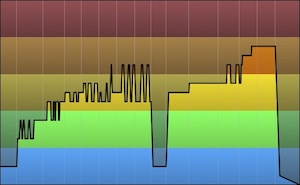
Here's the profile I used a while ago in our Performance Cycle FTP assessment.
[wlm_private ‘PRO-Platinum|PRO-Monthly|PRO-Gratis|PRO-Seasonal|Platinum-trial|Monthly-trial|PRO-Military|30-Days-of-PRO|90 Day PRO|Stages-Instructor|Schwinn-Instructor|Instructor-Bonus|28 Day Challenge']
1/25 75 min FTP Class
Klangstrahler Projekt — Extremely Well
At 10:47 Extremely Well is a perfect warm up song. Plenty of quiet early to give you time to announce the class format – followed by a number unique changes that you can use as a personal cues to initiate a change in intensity.
The Cars — Just What I Needed
Time for some openers – everyone knows this song, so load up the resistance @ 62 RPM and have them surge along to different segments. The objective is to have everyone up to threshold once of twice before the last 30 secs that is use as a short recovery.
ZZ Top — La Grange
Let's find your Best Effort! Have everyone find the 80RPM cadence and then add gears during the 30 sec intro. I start the timed three minute Best Effort at the intensity change in the song at 0:34. Stage button and then encourage everyone by asking; “is this really you… at your best? [This is also a great time to be off the bike, working the room.]
The Kooks — Junk of the Heart (Happy)
This happy go lucky track is a fun reset/recovery. No purpose here, just fun 🙂
Moby — Extreme Ways (Bourne's Ultimatum)
We're getting serious now! I use this 100RPMish track to have riders dial in and observe JRAP/Base Watts. Find the cadence and then gradually add load until you feel your HR begin to creep above VT1 (just above chatty) and then recover slightly. I have them repeat this a number of times, always observing the connection between RPE/HR & the watts they're maintaining.
20 Minute Assessment
I remind everyone how they've found two numbers already, now well find the third that will really validate the others. This 20 minute assessment should flow smoothly from the earlier base watts we were in during Extreme Ways.
Black Sabbath – Planet Caravan Remix download this remix to have for this playlist. Right Click > Save As
Planet Caravan is slightly slower @ 94RPM. Establish this cadence and find the watts that you feel will be your Best Effort over twenty minutes. This # will of course be somewhere between the Base watts and the three minute Best Effort.
Ted Nugent — Stranglehold
Slower at 75RPM – request the necessary changes, while staying locked into your average. We've moved more of the work to our legs = breathing will become slightly easier.
Golden Earring — Radar Love
Back to 100RPM to give our legs a break.
The Kooks — Ooh La – another fun reset & recovery
Klangstrahler Projekt — Take A Breath and Safri Duo — Snakefood – 13 minutes of steady JRAP/Base watts (they should all know exactly where to go by now) and I just let them ride – cuing occasional out of the saddle time.
America — Sandman – 5 Minute Best Effort – or – additional JRAP/Base work if they already appear cooked 🙁
This 80 RPM live track has an awesome lead in you can use for a one minute recovery. Have everyone dial in the wattage of their choice and cue your start at the 1:10 [you'll hear it] for this last 5 minutes of hell!
[/wlm_private]
Recover and Cool Down
Selah Sue — This World
Passenger — Let Her Go
Lana Del Rey — West Coast – Rob Orton Mix
Save
Podcast: Play in new window | Download
by Joey Stabile | Oct 20, 2017 | Best Practices, Creativity Indoor Classes, Instructor Training, Music
Welcome to the The Weekly Ride by Cycling Fusion:
No more hunting for new music or counting out cues. Here is your ready to ride document, that can be displayed from your phone, or printed out onto cue cards. This ride is timed out, down to the second, to make your life as easy as possible!
(more…)

by Joey Stabile | Oct 19, 2017 | Best Practices, Instructor Training, Music
Welcome to week six of Music to Mention. This week's music to mention is one of my favorite songs for muscular endurance work: Pump It by The Black Eyed Peas. Muscular endurance is always a challenge for the instructor as there are 3-4 minute sections of the ride, some back to back, where the rider is in the saddle and maintaining a specific cadence and exertion level to achieve the development of muscular endurance. While this is understood by the cyclists in your group, the average fitness person that is looking for as much entertainment as workout they may find this work boring. That is where we step forward as instructors and use this time to educate our riders, work on form and allow them to listen to and enjoy the music. Have fun with this and use the longer sections to connect with your class and educate them on training.
There is no real timing for this song as the entire piece falls into a 75-80 (actual is 78) cadence. This is great work that pushes to cells to make adaptations such as increasing mitochondria and increasing enzime availability to burn fat for fuel, so have your riders go hard. I usually cue this as the highest gear they can maintain at 78 rpm or “Hard, but sustainable.” In order for them to get the fitness gains from muscular endurance work, they need to be in HeartZones of High Zone Three to High Zone Four.
Pump It by The Black Eyed Peas:

Apple Music

Spotify
Have fun with this song and enjoy your ride.
Ride Hard, Ride Well and Ride Often……Joey
Save
Save
Save
Save
Save
Save
Save
Save
Save
Save
Save
Save
Save
Save
Save
Save
Save
Save
Save
by Joey Stabile | Oct 11, 2017 | Best Practices, Creativity Indoor Classes, Instructor Training, Music
Welcome to the The Weekly Ride by Cycling Fusion:
No more hunting for new music or counting out cues. Here is your ready to ride document, that can be displayed from your phone, or printed out onto cue cards. This ride is timed out, down to the second, to make your life as easy as possible!
(more…)
by Joey Stabile | Oct 5, 2017 | Best Practices, Creativity Indoor Classes, Instructor Training, Music
Welcome to the The Weekly Ride by Cycling Fusion:
No more hunting for new music or counting out cues. Here is your ready to ride document, that can be displayed from your phone, or printed out onto cue cards. This ride is timed out, down to the second, to make your life as easy as possible!
(more…)
by Joan Kent | Oct 4, 2017 | Best Practices, Health and Wellness, Master Instructor Blog

Early cycling classes. Late nights. Approaching holidays. Fall quarter can be a busy time, and it might be difficult to get enough sleep each night. But it's important to do so because sleep deprivation affects several factors related to health and weight management.
For one thing, sleep deprivation, even short-term, can lower leptin levels. Leptin is a powerful satiety hormone that tells the brain/body it’s had enough food and doesn’t need more. (Leptin’s functions are far more complex and diverse than these, but for the purposes of a short post on sleep, health and weight, this will serve.) The name leptin means “thin”, so if it’s not working properly or is in short supply, it can create the opposite effect.
Another thing inadequate sleep can do is raise levels of ghrelin. The hormone ghrelin works in opposition to leptin and stimulates the part of the brain that promotes eating. This “monster” hormone increases appetite, decreases metabolic rate, and even promotes a preference for fats.
Because ghrelin has such a negative influence on appetite and weight, it pays to know what else triggers it. A high-fat diet (even a high-fat meal) can do that, so keep your fat intake moderate. The type of fat — saturated or unsaturated — doesn’t seem to affect ghrelin levels but, for health reasons, unsaturated fats — omega-3s and omega-9s — are recommended. One obvious exception is raw, organic coconut oil: it’s saturated but extremely healthful. Still, use it moderately.
Sleep deprivation can also reduce melatonin. When we sleep, the brain releases melatonin, an anti-inflammatory hormone that can help heal any number of things in the body. Since inflammation is the source of most (some sources say ALL) disease, getting enough sleep is a key to staying healthy.
Getting too little sleep can trigger pro-inflammatory chemicals that make us less responsive to insulin, and that's never a good thing – either for health or for weight. Insulin resistance underlies many metabolic disorders. Those disorders include diabetes, hypertension, high triglycerides, high cholesterol, heart disease, breast cancer, colorectal cancer, polycystic ovary syndrome and polycystic kidney disease. Because these disorders tend to occur in clusters, someone with one is likely to have several.
Insulin resistance can contribute to weight gain, as well. If you have students who struggle with their weight, this is worth passing along to them. We typically hear that insulin resistance is the result of obesity/overweight. That’s true, but insulin resistance can actually cause overweight, too. I’ve mentioned this in previous posts, but here’s a brief summary. Body tissues differ in their sensitivity to insulin. The primary site of insulin resistance is skeletal muscle. Insulin resistant muscle doesn’t respond to insulin, so glucose isn’t transported to muscle tissue and is instead transported to fat deposits. In short, anything that decreases insulin sensitivity is bad news for health and for weight. (Diet can be a significant cause of insulin resistance, but we’ll limit this article to the effects of sleep deprivation.)
So the bottom line is pretty straightforward. Be sure to make sleep a priority, even when — or especially when — you're busy.
Save