
by John | Nov 28, 2012 | Correcting Form, Instructor Training, Master Instructor Blog

All the confidence in the world and totally clueless.
I actually got myself in a little trouble exposing Myth #2
You (the Instructor) can set yourself up correctly.
It was at the end of an Instructor evaluation, where I was a pretend participant. The Dept Head asked us if we had any comments or suggestions for the Instructor being evaluated. Now I'm not normally comfortable critiquing others publicly, so I sat and pedaled quietly off to one side. A few of the other Instructor/participants offer a few simple suggestions and I felt pressured to say something… and being a guy, finally offered up something I thought would be safe:
“Have you ever had someone evaluate your bike setup?” “Your saddle appears to be too far back.”
Not a good choice.
I couldn't tell if her flushed look was communicating embarrassment or anger. Either way it was the wrong thing to say publicly in a room full of her peers.
“I'm right where I'm supposed to be”, she said rather indignantly as she sighted down across her knee at the left pedal.
But she clearly wasn't. Any experienced cyclist looking at her from the side could see how stretched out her position was and how she looked on the bike would benefit from a few minutes my (or anyone's) observation.
When was the last time (if ever) you've had someone look at your bike setup on the instructor bike at your club? During your initial certification doesn't count.
Instructors are proud people.
We expect others to look to us for stuff like bike fit, direction and guidance. Unfortunately this has us walled off as a sort of island, operating all by ourselves, without the benefit of any constructive criticism.
Our participants are nice = they won't typically say anything, even though they see something not quite right – or even grossly wrong.
I'll never forget a lunch meeting I had with a prospective customer a few years back. He had a spinach salad, I've forgotten what I ate that day. I remember his spinach because at some point during the meal my lunch guest suddenly had one green tooth. Completely green like it was something he paid for from one of those places at the mall where they sell jeweled “grills”. A piece of the spinach had attached itself and neatly covered one of his front teeth. I foolishly said nothing while we sat and talked. The whole time trying not to stare at his new organic dental appliance. We parted and I had forgotten all about it until checking my email later that day; I CAN”T BELIEVE YOU JUST SAT THERE LOOKING AT MY GREEN TOOTH AND NOT SAY ANYTHING! I'm pretty sure that was the last time I communicated with him.
But participants (read cyclists) will judge you based on everything they see
Believe me when I say cyclists will judge you. What do you think we are doing to keep our minds occupied during a 5 hour ride? We notice every detail. Now I'm sure that the Instructor being evaluated really did believe she was properly positioned. She found a bike setting and repeat it every time she taught. Her body got comfortable until it became “right”… even if it wasn't. Alone at home in your basement this isn't a problem. Sitting in front of 10s or 100s of cyclists every week is.
What to do?
I'm guessing you already know the answer to this; ask for help! And it doesn't need to come from another Instructor.
Would you like to make someone's day? In your next class pick out one of the experienced cyclists. Ask them to review your setup on your bike. I know I would have been flattered if someone in authority (you) asked for my help. You could even make a big deal about it during your warm-up. Simply explain how you recognized that you needed a second pair of eyes to really check your bike setup, so you asked Linda to help because you saw her as an experienced cyclist. Then you could continue with how Linda was able to suggest a few small changes and how much better you feel now.
This simple act of humility may have a profound effect on your class. Once other's realize that the Great and Powerful Instructor needs help, they to maybe inclined to ask for help as well.
Give it a try and let me know your experience.
by Jim Karanas | Oct 29, 2012 | Correcting Form, Master Instructor Blog
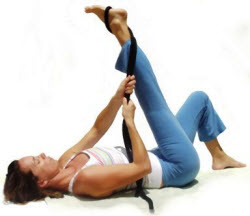
By Team ICG® Master Trainer Jim Karanas
Bicycling is a repetitive-motion exercise that can lead to tightness in several major muscle groups.
Static (traditional) stretching gradually lengthens a muscle to an elongated position and holds that position for 20 seconds. When done properly, static stretching slightly lessens the sensitivity of stretch receptors in our muscles. That allows the muscle to relax and stretch to a greater length.
In the last few years, however, several studies have found that doing static stretching before playing a sport actually makes you slower and weaker. This is because the lower sensitivity of the stretch receptors makes us less able to move fast or freely.
Static stretching is recommended after cycling and has a variety of benefits when done properly. Still, many elite athletes in all sports are ditching post-training static stretching altogether, and using “dynamic” stretching as a viable warm-up technique prior to exercise.
In 1995, I witnessed a stretching demonstration by a trainer named Jim Wharton. Using a rope, he taught me a method of flexibility training known as AIS, or Active-Isolated Stretching. Aaron Mattes, a kinesiologist and world-renowned expert on flexibility, developed this technique. I had the good fortune to study with both Jim Wharton and Aaron Mattes. I’ve used AIS every day for the past 17 years and have trained thousands of students to perform a 20-minute dynamic-stretching routine before riding. Most of them — seriously — continue to do it daily.
Cycling contracts skeletal muscles that attach to bones by tendons. Each muscle has sensory structures called stretch receptors that monitor the state of the muscle and feed the information back to the central nervous system. Stretch receptors are sensitive to the velocity of the movement of the muscle and the degree that it’s lengthened.
The Golgi Tendon Organ is a stretch receptor located at the insertion of skeletal muscle fibers into the tendon. It provides the sensory component of the Golgi tendon reflex, also known as the stretch reflex. The stretch reflex is a protective mechanism that attempts to prevent over-stretching and tearing of the muscle fibers.
AIS uses the body’s natural stretch reflex to enhance flexibility. Because it’s movement-based, it also dynamically stimulates blood flow and muscle extension through movement. These factors make it optimal for warm-up.
After a couple of seconds of stretching, a muscle begins to contract as a result of the protective stretch reflex. This is to prevent excessive elongation and a potential muscle tear. The key to AIS is not to continue stretching beyond this point. Static stretching continues, and that’s why it diminishes performance.
The Active-Isolated Stretching technique involves holding each stretch for only two seconds, rather than 20. The stretch is repeated 8 to 12 times for a progressive muscle release. This degree of repetition dramatically increases blood flow to the muscles to enhance warm up.
This method of stretching is also known to work with the body's natural physiological makeup to improve circulation and increase the elasticity of muscle joints and fascia.
The shorter stretch, however, needs to be coupled with reciprocal inhibition. This is another natural response of the muscle. Contracting the muscles on one side of a joint relaxes the muscle on the other side of that joint. When performing AIS, you actively contract the antagonist of the muscle you are trying to stretch (the agonist). This promotes an enhanced release in the target muscle. The antagonist contraction also stimulates blood flow and generates body heat.
Active-Isolated Stretching does many things that static stretching cannot:
– AIS provides a transition between inactivity and physical exertion.
– AIS assists the pre-exercise warm-up process by increasing blood flow and soft-tissue temperature. This makes is both a stretch sequence and a warm-up technique, and settles the long-running debate in the fitness industry about whether or not it’s necessary to warm-up prior to stretching. With AIS, both occur together.
– AIS produces supple, relaxed muscles, which have a higher capacity for activity.
– AIS reduces the likelihood of muscle cramping, tightness and pain.
– AIS increases and maintains the range of motion in a joint.
Personally, I’ve performed upper- and lower-body AIS daily, both pre- and post-riding, for 17 years. I attribute much of my athletic longevity and my body’s ability to perform at a high level to Active-Isolated Stretching.
AIS is one of the stretching methods most used by today's athletes, massage therapists, personal/athletic trainers, and fitness professionals. AIS allows the body both to repair itself and to prepare for daily activity.
To learn more, simply google Active-Isolated Stretching. An extensive YouTube library depicts the stretching techniques, and numerous websites have images of how the stretches should be done.
