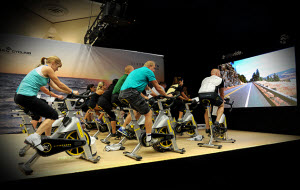
Video is taking over the world. Over 4 billion hours of video are viewed each month, and YouTube is the most-used search engine, after Google. Video is also changing indoor cycling classes everywhere. Like music, video engages our emotions. To reach a cycling audience with imagery and music creates a synergy that lifts indoor cycling to new levels.
Club owners seek something innovative. Cycling with video is enjoyable, entertaining, and a dramatic differentiation from the current indoor-cycling market. The number of emerging businesses that produce video attests to the impact it will have on indoor cycling.
As entertaining as video can be, however, the key reason people join clubs is to achieve their fitness goals and be educated in how to do that, not for entertainment.
Before writing the check, anyone investing in video programming must investigate the quality of education or coaching that accompanies the video product. This applies equally to live-instructor group classes and virtual group classes.
At ICG®, we believe it’s important to remember that video is JUST video. It’s an asset that can add to the indoor-cycling experience but will never dominate it. Even with the world’s best video, without proper coaching for the live instructor or excellent voiceover coaching in the virtual product, you’ll have:
Instructors continuing to teach to music only, or turning on the projector but never integrating video into their classes.
Virtually instructed classes projected to empty classrooms, and/or DVDs sitting unused in a box or drawer in the studio.
Quality instruction has always been the key to any successful indoor-cycling program. That won’t change with the addition of video. As long as facilities offer live-instructor classes, the instructors must first appreciate, and be energized by, what video brings to their classes. Once they support video’s benefits, they will sincerely recommend virtual programming — so long as that virtual class stands up to the quality of live coaching.
Bringing video to your cycling program is not a stand-alone purchase. Whether it’s to enhance live instruction, provide virtual classes, or both, it must be supported by online learning, as well as live education and training offered by your video provider.
Empowering instructors to use video in their classes demands technology that allows them to control the video as easily as they control their music. (DVDs just don’t make the grade in that regard.) It also requires an education platform that teaches them to integrate video readily into what they’re already doing — while producing a significantly enhanced experience for the members.
If a club offers both live classes with video and virtual classes, then the instructors must stand behind the virtual-class program and see it as complimentary to, not competitive with, their positions. Participants will typically follow the instructor’s lead. However, that alone will not motivate the members to participate in virtual classes.
For a workout video to compel people to train in a cycling studio with no instructor, the content can’t be good. It must be great. There’s no motivating instructor who knows your name, maybe no social interaction with other members. What works for a solo participant on a bike in front of a small screen may fail miserably in the group-cycling studio. This is even truer if the facility doesn’t employ instructors.
So the question is: What makes a virtual class compelling?
There are four dimensions to a successful virtual cycling class — Sensation, Flow, Challenge and Convenience.
Does the visual sensation grab attention? A compelling member experience must elicit strong, positive emotions. Is forward-motion video of beautiful destinations around the world more visually engaging than the world’s top master presenters sitting on bikes?
Does the workout flow? To be effective, a virtual class must be better designed than a live class. Members will come in and take an average class from a live instructor, but they won’t come in to take an average virtual class. Sound levels, content, matching voice and tone to the content, pacing — the sense of flow delivered through the interaction of voiceover cues and video must be better than with live instruction to be as effective.
Was the workout successful? The members will want to be physically challenged by the workout and mentally engaged by the information delivered. With no instructor and possibly no other members, what encourages the member to work hard? It comes down to quality recorded instruction, selection and use of music, music/video synergy, and editing.
Were the virtual classes offered at convenient times? Does the technology offer “auto” scheduling, where the virtual class and projector turn on and off at scheduled times? Dynamic club schedules that allow virtual classes to be easily added to, or taken off, the schedule based on participation will have a big impact on virtual programming success.
At ICG, we consider ourselves the leading authority in cycling with video. We believe indoor cycling is driven by instructor communication and motivation, plus social interaction. We believe instructors need education and training to integrate video skillfully and professionally into their classes.
We believe that virtual classes can rock and that instructors must support the classes.
Virtual classes must be visually stimulating. They must flow, provide a challenge, be offered at convenient times, and be better produced than a live class. We’re committed to developing better techniques and technologies to make future indoor cycling experiences more “real” as classes with video and virtual classes go mainstream.
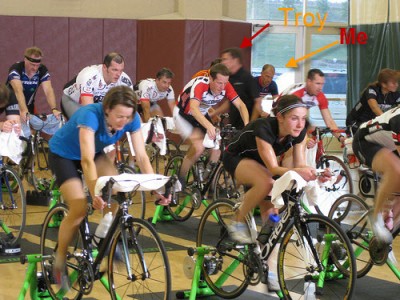
I was there! OK, but because I was talking to so many people I ended up in the back row, at the end of that row, but I did get close to Troy Jacobson, as he walked past, once…
By Team ICG® Master Trainer Jim Karanas and ICG® Marketing & Product Director Gary Warren
Forward Motion Video was first produced for, and used in, Indoor Cycling classes in the form of DVDs. DVDs paved the way for production companies like Virtual Active to bring Hollywood-level filming to the fitness industry.
We would never detract from the contribution these DVDs and their producers made to the indoor-cycling industry. Going forward, however, there’s a point of contention that we consider critical: continuing to use DVD as the medium for providing forward motion video.
In response to Jim’s last post, “Video Done Right”, Gino Nacey, one of the pioneers of Forward Motion Video, offered his “1% disagreement” and commented, “as long as the DVD is played on a big screen, I don’t really see why we should knock it — if all a site can afford is a projector, screen and some DVDs then if the video is well done, they should have a great experience.” We appreciate Gino’s feedback.
DVDs are seen by some in the industry as a good option for clubs, a way to provide a quality visual experience in an indoor cycling class. ICG® believes that, at this time, DVDs will do more to inhibit the development of both indoor-cycling programs that offer video and the instructors who teach with it.
DVD is being superseded as technology progresses. Despite DVD’s low initial purchase cost for club owners, is it really forward-thinking and fit-for-purpose with respect to the skills instructors need to develop to enhance their classes with video, as they do with music? We believe DVD limitations are one reason more instructors don’t teach with forward motion video.
What can an instructor truly do with a DVD? The instructor can’t alter the programming or investigate the synergies that exist between music and video. The profile is unchangeable. DVD length can’t be altered to fit the music. That limits the music that can be used with the DVD. The instructor can’t swap out portions of the DVDs, which makes it impossible to alter the profiles to create endless class variations.
DVDs lack the essential tools the instructor needs, such as selecting and changing footage at any given point in a profile, repeating parts of a video, skipping parts of a video, or switching to panoramic footage for water breaks or to shift the experience. Even more importantly, DVDs don’t permit the instructor to keep the footage running to match the music track length, or vice versa. Any of the above can be done — with one touch — with a system like Myride®+.
DVD offers the same ride time and again, and the ability to use different music is limited.
The use of DVDs for virtual classes may seem to make sense initially, particularly if the voiceover coaching and the music are good. Again, the number of different rides is limited because DVD footage is fixed and can’t be reprogrammed. Also, quality of filming comes into play because Standard Definition on a large screen looks unrealistic.
But it’s more than that. Virtual classes have to be highly advanced in coaching, graphics, filming techniques, post-production techniques, and exhibit extremely compelling locations because they now do what instructors do — lead the class. We also have to push the limits of technology to enable consoles to provide “virtual class” schedules, where console and projector turn on and off at selected times to enable the club owner to offer classes without an instructor present.
It takes a platform of technology that can continue to grow to make the experience (and the buyer’s investment) stronger over the years without fading. Sustainability is key, and DVDs can’t make the cut.
Are DVDs passable? For the retail market, yes. But for sustainable commercial operations where the consumer is savvier and more demanding as competition rises, perhaps not.
Finally, our tree-hugging moment. DVDs are not green and create an enormous amount of waste product that is eliminated with the use of advanced digital technology. CDs and DVDs don’t decompose. Their composition is too complex to make large-scale recycling possible, unlike aluminum, glass or paper. So old CDs and DVDs must be shipped to a special center for recycling.
Then there’s packaging. 85% of under-24s believe that downloading music can help save the planet by reducing the packaging, waste, and carbon emissions involved in producing and transporting CDs and DVDs to shops.
Here’s what video in indoor cycling needs:
1. Improved content-delivery tools for video that offer increased programming features, designed to enable instructors to utilize this new asset fully and owners to embrace the ROI they can get from video done right.
2. Increased availability of high-quality video through network delivery that will enable us to bring new video to our customers as easily as we bring new songs.
3. Improved filming and post-production techniques to enhance immersion and raise the member experience and the demand for video.
4. A shift away from a retail product that’s not green and that experts say won’t be around much longer.
We believe Myride®+ fulfills these needs, except item 2, which it will in the immediate future.
As always with new technology, there’s a higher initial cost — in this case, for the digital media console and the HD projector. But let’s not confuse initial cost with “total cost of ownership” (TCO). The cost of a DVD media system may be low, but it wastes money if it’s not sustainable and/or doesn’t fully meet the market’s needs. As demand increases and more companies play a role in development, digital video costs will decrease. Continuing to advocate DVDs, which give the club owner a cheaper option without a complete understanding of its limitations, will hinder forward progress.
The end result seems inevitable, and DVD may delay the transition but won’t prevent it.
ICG® respects Gino and his organizations for all they’ve done to pave the way. But ICG® can’t recommend adherence to an outdated form of presenting video to the Indoor Cycling industry.
My friend Allen Jones from Epic Planet.tv – the company with the Epic Planet Indoor Cycling DVDs – has just launched a FREE Virtual Cycling Studio Program. It address a major pet-peeve of mine; getting a reduced price replacement DVD when you have one that's scratch, damaged or for what ever reason won't play.
I'll let Allen explain the program…
Virtual Cycling classes are taking the indoor cycling world by storm with instructors and studios all over the U.S., Canada, and Europe using epicRIDES to bring an exciting new dimension to their classes.
From Southern California to Maine… from Florida to Washington state… from Nova Scotia to British Columbia… and in Europe too… epicRIDES are wowing classes and giving both instructors and studios an exciting new way to differentiate themselves from the competition.
Here's what some indoor class students said about their virtual ride to Epic California – Mt. Baldy:
“I was really impressed. I usually close my eyes when I’m spinning, but I kept looking up to see the scenery. I have to admit I took the last climb to my '10' and that damn clock on the screen was way too slow!”
“The Mt. Baldy ride was outstanding, as this is a ride I have actually done, so I could really relate to it. I was able to make this ride feel very real, as the video was very well done and made me feel like I was right there, doing this painful ride again. Two thumbs up to you and the producers.”
If you are an instructor or studio owner using or planning to use epicRIDES for your classes, we want to encourage your efforts! To do that, we are launching the Virtual Cycling Studio Program, which will provide member instructors and studios MANY special incentives and benefits, including:
Discounts on DVDs and downloads
Disk replacement program
Discounts on indoor cycling clothing
More to come…
To become a member, just complete their online signup form. There is no charge or obligation.
I have always been a fan of cycling videos in my Indoor Cycling classes. I tend to do a fair amount of my low zone work inside, even during the summer months, on various indoor bikes or trainers and I totally love the distraction. Bike-O-Vision was a fresh new take for me in that the videos do not have cyclists or any type of dashboard. This is truly just eye candy to get your mind off of the hours of work that you have ahead. The creative inspiration of Jan Hunter is evident in the videos that he produces and they have over 71 titles.
Additionally, Bike-O-Vision has recently release their streaming service on Vimeo which is an amazing way to try their products and always have fresh scenary on hand.
This Podcast is was originally published on November 1, 2008, I have updated it with our new Podcast host information and I am representing it now. I hope you enjoy it, Joey
I have never been a fan of bike racing videos in my Indoor Cycling classes. Too distracting. It's very much like watching a NASCAR race, you feel compelled to watch, waiting for the inevitable crash or some other drama. The creative team of Liz & Jan Hunter, the co-creators of the Bike-O-Vision DVD series, sent me a copy of their latest video to try out in my Spinning class. I liked it and so did the participants. My wife Amy (the senior group fitness instructor in my family) also liked them. Instead of creating a distraction, the pretty scenery you would see while riding these roads on your bike, added a nice atmosphere to the room. Jan and I discuss how they are made and his plans for more videos in the future.