No more hunting for new music or counting out cues to develop your ride profile. Here is your ready to ride profile for a fully choreographed ride, that can be displayed from your phone, or printed out onto cue cards for your class. This ride is timed out, down to the second, to make your life as easy as possible!
No more hunting for new music or counting out cues to develop your ride profile. Here is your ready to ride profile for a fully choreographed ride, that can be displayed from your phone, or printed out onto cue cards for your class. This ride is timed out, down to the second, to make your life as easy as possible!
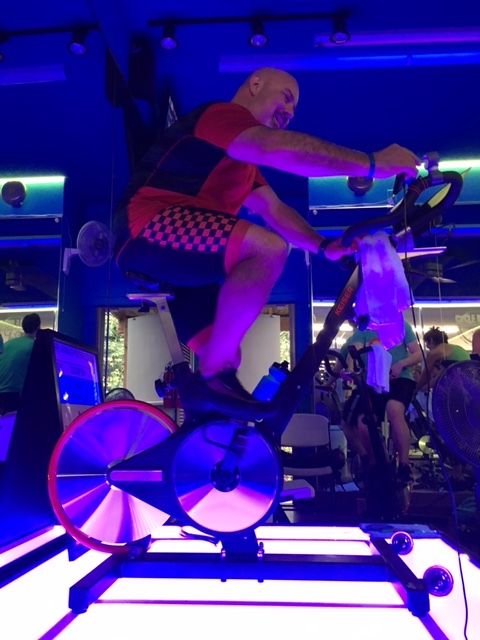
This look may not always be appropriate when you teach.
This was awkward. Have you ever had a dream where you're naked in some public space? Well yesterday I wasn't dreaming, I was dressed, but inappropriately it turned out. The feeling I had was very similar.
That's because yesterday I had the privilege of taking a class at The Firm in Minneapolis. They were the very first official Johnny G Spinning® studio in the Midwest – introducing Indoor Cycling to us here in the frozen north around 1995*. As far as I know, they could be the oldest operating indoor cycling studio. Do you know of another?
I had met the one of the owners, Neil Miyamoto, at IHRSA. I sheepishly told him that I hadn't been to his studio for about 20 years. Turned out he understood us suburban folks don't stray far from home. To remedy that, Neil invited me to come downtown to see his club and meet his wife Kelly. She actually started The Firm back in 1986. Our plan was for me to take a class and schedule a time for me to interview Kelly. I'm guessing there's a lot of new studio owners who would love to know how The Firm as been so successful, for so long.
So yesterday was the day and as I'm driving into the city, I'm thinking; who comes to a 3:00 pm class, on a Saturday?
I got checked in, quickly dressed and ran up the stairs to a nearly full studio. My quick count showed about 50 riders… many of them watched me as I walked in. And a number continued to look at me. Not in an unfriendly way, no. Their expressions seemed friendly enough, some even smiled as they continued their appraisal of me. I started getting that awkward, I'm standing out like a sore thumb, feeling as I set up my bike.
What are they looking at? Could I be the only new guy here… Is that it?
Then it dawned on me. I was the only person in the room wearing a full cycling kit – my Life Time Cycle Team bicycle jersey and matching bib shorts. There were lots of t-shirts, running shirts, ripped sweatshirts, women's workout tops, gym shorts, regular shorts and yoga pants – but nothing remotely like what I typically teach in. 50+ people and I only could see three pair of bike shorts. No wonder people were looking at me funny. I couldn't help but think how silly and out of place I looked. What was I thinking?
They're not cyclists
This experience has me re-considering something I feel I've mistakenly believed; at some level all indoor cycling participants are cyclists and I should look like a proper cyclist (to set a good example) when I teach.
These folks at the Firm seemed to really enjoy riding indoors, wearing whatever they wanted, but by no stretch were they cyclists.
Kelly (the Instructor) was wearing a cute top and yoga pants. Nothing to distinguish her role as the leader. She looked like her tribe and her tribe looked like her… and they fill the place, on a Saturday afternoon, in part because she makes everyone feel comfortable. There was no pretentious; look at how cool I look in my fancy getup.
In fact the entire club is much the same. Simple concrete floors and white walls. Quite a change from the cherry walls and bamboo flooring where I normally conduct class.
So what to wear?
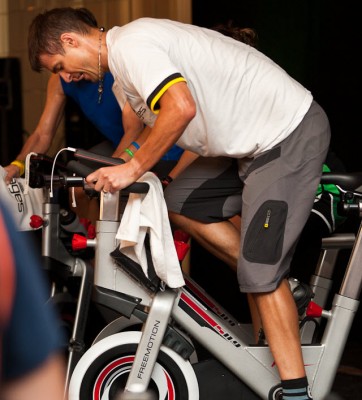
This picture is of Stages Indoor Cycling Master Trainer Doug Rusho, at a past ICI/PRO conference. Notice there's nothing that screams I'M A VERY SMART LOOKING CYCLIST in what Doug is wearing. He looks sharp and professional, but nothing about his shorts or shirt would communicate; I'm a hard-core cyclist. If you aren't a hard-core cyclist like me, well… you might not fit in here. Which I'm now concerned I have been communicating (and not always subtly) to the people who come to my classes.
*1995 is my best guess. Amy was originally certified and her club (The Flagship Athletic – now a Life Time) added Spinning around 1996.
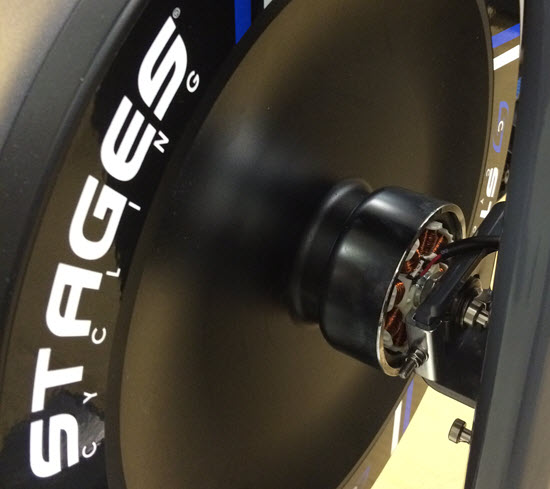
I had the privilege of visiting the Stages Cycling HQ and factory in Boulder Colorado with my buddy Randy Erwin. Director of Indoor Cycling education Cameron Chinatti, along with Stages vice president Pat Warner, were our tour guides. We spent a fascinating couple of hours learning exactly what goes into building the Stages single side crank arm power meter used on the new Stages SC3 Indoor Cycle and available for most road/mountain bicycles.
You know these people are cyclists the moment you walk into the place. Everywhere you look there are bicycles; tucked into every corner, hanging from the ceiling, along every wall – heck, their conference room has probably the coolest table I've ever seen. Instead of legs, the table top is supported by a pair of 70's vintage Schwinn Sting-Ray bicycles.
Cameron explained the hiring process, “you pretty much have to be a passionate cyclist to even be considered… many of these guys have been riding buddies for years.” And I'll add that these “cyclists” are also some of the most brilliant people I've ever met 🙂
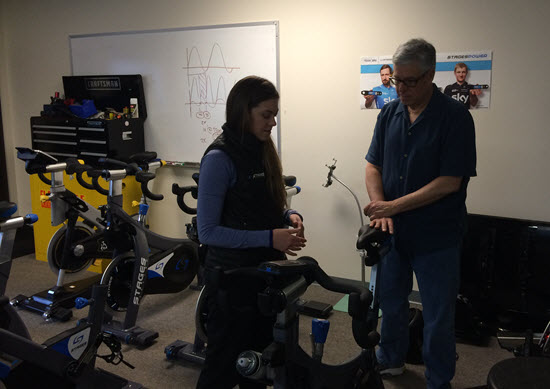
Cameron explaining all the cool features of the Stages SC3 to cyclist Randy Erwin
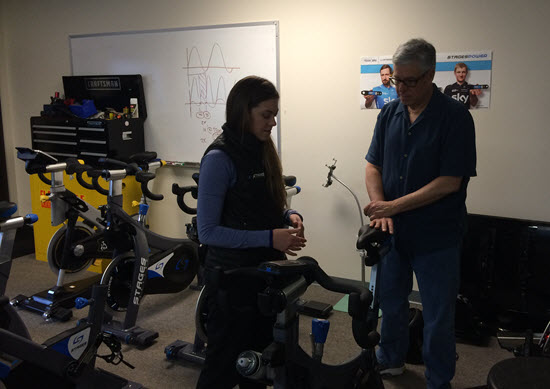
Cameron met Randy and me and our tour started in their official “training room” except it won't be for long. Stages is growing so fast that half of this room has been taken over by manufacturing stations. My friend Randy was very interested in the new SC3 because the Westminster, CO Life Time Fitness (where he's a member) will be the very first location to get these new cycles. Now if we could get Dennis Mellon in there as an instructor…
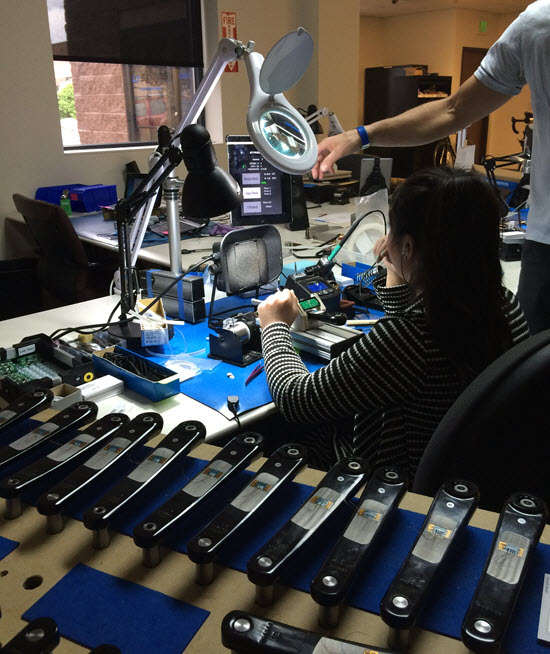
New power meters being installed and tested – this is super technical stuff.
Early in the our factory tour, I asked Pat; “why aren't your power meters built in Asia, like most other technology companies?” His responses made perfect sense to me; “there are multiple reasons actually.” “Stages has become the leading provider of bicycle power meters, after only a few years. We can't afford any preventable issues when it comes to quality or availability. It's critically important that we control the quality of these power meters… we can't if we're dependent on a third party supplier's factory, regardless of where it's located.”
Pat explained how keeping everything in-house provided a solution to a unique challenge they faced. “We manufacture power meters for 16 different model bicycle crank arms, from major suppliers (Shimano, SRAM, Cannondale and FSA) plus the power meter for the SC3 Indoor Cycle. Bicycle cranks aren't made just one size. Multiply each model bicycle crank by the four or more available crank arm lengths and we have to stock over 60 part numbers. Sure, 172.5 is the most common size for a road bike, but how many of each should we be building? The lead time for overseas manufacturers is measured in months – customer's won't accept waiting that long. We have thousands of stock crank arms on hand and we're setup to quickly change production. So if we receive an order for an out of stock power meter, we can normally build one and ship it within a few days!”
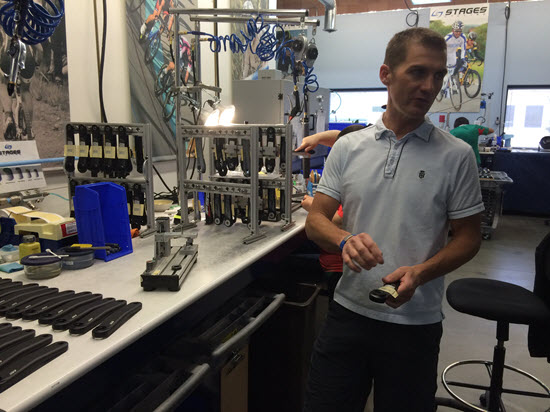
Pat Warner explaining the complicated process that attaches the power meter to the crank arm.
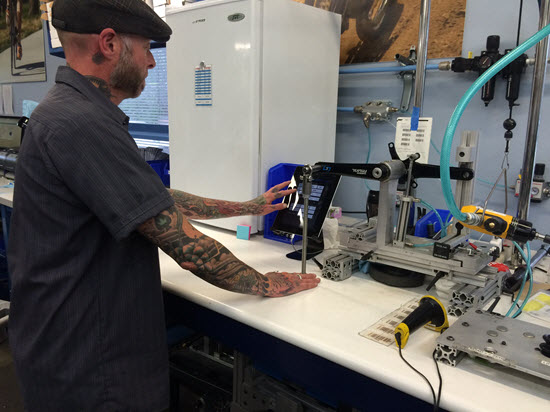
Every power meter is checked for proper calibration and the results captured using a iPad with custom software that's developed in-house too!
The Stages SC3 is build by Giant Bicycles in Taiwan – Pat told me,”those Giant guys are experts at mass producing high quality bicycles and fitness equipment, so we leave that part to the experts. We still produce the SC3's power meter here in Boulder and then ship them out for installation on the cycle.”
Stages has a separate facility, near their main offices, that's use for product endurance and destructive testing. We just missed the completion of a test rig that repeatably pressed down on a handle bar, tens of thousands of times without any failure.
Want to know how long the drive train will last pedaling at a continuous 360 watts? This video shows the test rig that pedals 24/7 for weeks at a time. Not only are they watching to see if something will break, or wear out, but they also record the actual power readings vs what they know their electric motor is pushing.
Quality control – Early production Stages SC3 cycles are unboxed and checked for any defects.
Feel free to leave the lights on! There's the battery charger for the Stages SC3 power meter.
No more hunting for new music or counting out cues to develop your ride profile. Here is your ready to ride profile for a fully choreographed ride, that can be displayed from your phone, or printed out onto cue cards for your class. This ride is timed out, down to the second, to make your life as easy as possible!
Let’s use this post on labeling loopholes to cover three of them. The first is glycerin.
Glycerin (or glycerol) is an alcohol. It’s not like ethanol, so it won’t give you a buzz, but it is an alcohol.
So what? Maybe you haven’t heard of it or haven’t paid much attention to it, but it’s used as a sweetener. It’s in many foods — including about 99.999% of the food bars that are so convenient and far too numerous to name individually. It’s always in the ingredient lists because the FDA insists, but that’s where the disclosure seems to end.
Things may get fuzzy once you check the nutrient counts. If you were ever geeky enough (yes, that would describe me) to do the arithmetic and calculate the calories of fat, carbs and protein in a glycerin-containing food bar, you might notice a discrepancy between the carb numbers you calculated and the label count of carbs per serving. According to Mendosa.com’s Diabetes Update, about half the glycerin-containing bars that were tested were off in their nutrient counts.
Why is that? Glycerin/glycerol doesn’t fall into the reported categories. Strictly speaking, it’s not a carb, not a protein, not a fat, so it doesn’t have to be counted in with any one of them.
What that technicality allows the product developers and packagers to do is make claims on the label, such as “low carb” or “no carbs”. They can say “low sugar” or “sugar-free.” The claims are considered true because glycerin isn’t any of those.
But it’s definitely a sweetener — and often high on the list of predominant ingredients. The product developers know that, of course, but some are willing to keep consumers in the dark because it might limit sales if everyone understood how much sweetener they were getting in the bars. Don’t be fooled.
A second labeling trick is how sugars are placed on ingredient lists. Several bars use a variety of sweeteners and list each of them separately. (I’ll blow the whistle on Cliff Bars because I’ve counted between 9 and 13 different sugars on their labels. At last count, there were no exceptions.)
This practice may encourage the “casual” label reader to skip over many of the sugars (such as “cane juice”) or simply remain unaware of how much sugar is in the bar as a whole. If all the sugar in the bar came from the same source, it would have to be first on the list as the predominant ingredient. Separating the sugars prevents that.
Here’s another labeling trick, although it’s not really about nutrition.
Does anyone besides me remember the “large economy size”? You may already have noticed that unit prices on large sizes are sometime higher than on smaller sizes. Shoppers who are hurried or shopping with young children may not bother to check the unit pricing. They buy the large size because they need that quantity and also — out of cultural habit — expect the larger size to be a better value.
Product developers are paid to know all of these things and help food companies take advantage of it (and us). The only way to prevent it is to remain aware.