
by John | Sep 28, 2014 | Best Practices, Engage Your Students, Instructor Training, KEEPING IT FUN, Master Instructor Blog
Have ever asked your class; what do you want from me?
It's a very different question than; do you like my class? or; do you like my music? or; what could I do better/different?
Challenge #6, of the ICI/PRO 28 Day Instructor Challenge, was pretty simple:
#6 Ask some of your participants to fill out the feedback form after your class.
The PDF download we provided asked just one question:
 Getting honest feedback from people can be maddeningly difficult. Mostly it's because people will often lie to you when they are concerned the truth could hurt your feelings. So we designed this question to get a response that indicates a preference vs. a response that would be a critique. Consider how you would respond to these two questions, asked from your mother when you still lived at home:
#1 – What would you like for dinner?
Vs.
#2 – Would you like my meatloaf for dinner?
Question #1 asks for your preference and you wouldn't feel a bit concerned by responding honestly with; I'd like your lasagna tonight Mom.
But question #2 is very different and most of us (if Mom's meatloaf is better used as a doorstop) might have a difficult time answering honestly 🙁
So if Mom's intent is to cook a meal that pleases you, she'll take your suggestion and do what she can to make you lasagna for dinner tonight. Then you'll be happy (you feel valued as a son or daughter) because Mom delivered based on your preference. And, because pleasing you makes her feel like she's a good Mother, Mom's happy as well!
But consider what happens when Mom asks question #2 (or doesn't ask either question) and just decides what you want/need for dinner… you show up for dinner and your first thought is; doesn't she know how much I dislike her meatloaf? Followed with; I love her lasagna, why doesn't she just ask me what I would like for dinner and I would tell her.
Now I realise that this is a pretty simplistic illustration, but does that sound anything like your role as an Instructor?
So what happened? What were the responses our challenge participants received from their classes? Here's a few:
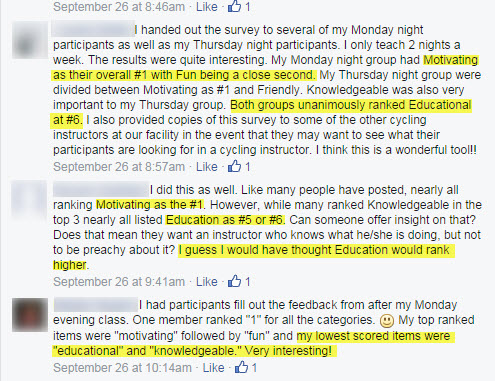
Would your class respond differently? Or similarly? Click to download the survey PDF.
So, how would your class respond?
Click here to download the survey PDF. Print a bunch to get your class responses and then report back here with your findings.
by Joan Kent | Sep 15, 2014 | Health and Wellness, Master Instructor Blog

You probably know how I came up with the title of this article. Several years ago, a popular book advocated chocolate consumption based on various factors, some of them unique to women. Hormone changes during PMS, menopause and stress were given as examples. Trust the body and give in to your cravings, the author told us! Indulging is better than depriving ourselves. Fat and carbs like bread and chocolate are the body’s natural feel-goods. (Yes, it really says that.)
Where are the anti-gluten, anti-processed food champions when we need them?
The good thing about the book was the extensive bibliography. I researched, read and cited a few of the references in my dissertation. Still, the author’s conclusions are flawed. For instance, she says cravings reflect the body’s needs. It’s a common theory, but it’s just not the case with processed, addictive foods.
So I hope you haven’t been recommending chocolate for your students, even if it’s PMS time!
Why talk about this not-so-new book? Because cocoa is news. No doubt you’ve read about, heard about, and talked about the benefits of cocoa, particularly dark, unsweetened, 70% cacao. They’re everywhere lately: the antioxidant benefits due to the specific flavonoids in cocoa, called polyphenols.
A quick summary of the benefits includes decreases in all of these: blood pressure, insulin resistance, excess clotting, diabetes risk factors, and the risk of cancer, stroke, and coronary heart disease.
In addition, cocoa promotes increased HDL (good) cholesterol and improvements in vascular health and gut bacteria, which thrive on the polyphenols. Cocoa can prevent oxidation of LDL, which contributes to arterial disease when unchecked. It even seems to inhibit fluid secretion in the small intestine, so research may soon show it to be effective in treating diarrhea.
Other health benefits are reduced fatigue and improved mood, both due to cocoa’s natural theobromine (similar to caffeine). Another mood-elevating chemical in cocoa is phenylethylamine, sometimes likened to the feeling of being in love.
What I won’t do — send me your hate mail now — is what the book’s author did, namely recommend chocolate. Even 70% dark chocolate.
Why not? The drawbacks of sugar are too great. In fact, sugar can singlehandedly reverse almost every one of the benefits of cocoa listed above.
But there’s not much sugar in 70% chocolate, you say.
I specialize in sugar addiction, so I look at sugar’s consequences differently. Recently, at someone else’s seminar, a participant offered her opinion that “sugar is bad in large quantities.” You’ll never hear me argue with that! Yet sugar can be bad even in small quantities because of its sneaky effects.
One sneaky effect of sugar is to increase appetite. Another sneaky effect is to change food preferences. Both of these are due to endorphins, which are often overlooked when people talk about health or food.
And what then? Your students may eat an “innocent” amount of chocolate and find themselves wanting more food in general AND more endorphin-triggering foods — such as sugar of all types.
This is how the quantity of sugar can go way up when students eat chocolate for its “health” benefits. Health becomes the excuse for eating sugar. And that’s why I won’t recommend it (no matter who does).
But I will — and do — strongly recommend cocoa. Dark, unsweetened, 70% cacao will let you reap the benefits of cocoa without the drawbacks of sugar. Please tell your students.
by John | Sep 11, 2014 | Instructor Training, KEEPING IT FUN, Latest News, Master Instructor Blog, Promote and Build Your Class
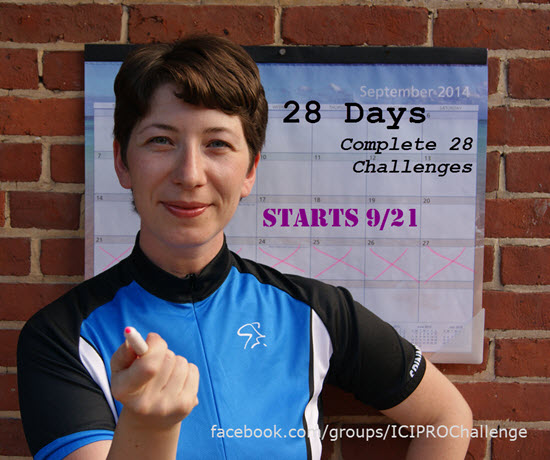
During my interview with Instructor Lena Hershey, she explained to us how she made her personal transformation…
I have started this journey on an ordinary day in February 2013. I was in the car with my husband and two step-kids, driving home from somewhere when I said: “I will go and work out at the YMCA every day for a month starting today”. Just like that — out of the blue. I can’t even remember why I said that or what prompted that decision. I just said that and once I did, I had to do it. So I did.
Lena's first step was saying it out loud – where others would hear her.
Making public commitments can be very powerful – especially when told to people who will hold you accountable. Which got me thinking; “wouldn't it be cool to use social media to give Instructors a place to post their commitments to change/growth/improvement and then other Instructors could hold them accountable?”
So I told Lena about my idea. Not only was she excited about developing the concept, she wanted to see it become real. Not wanting to disappoint her forced me into action – which I did by agreeing to collaborate with her until we had completed this task. Here's the result:
ICI/PRO 28 Day Challenge
28 unique challenges, to be completed over 28 days. Are you willing to do the work required to become a better Indoor Cycling Instructor?
Nothing impossible (teach 10 classes back-to-back & non stop) or dangerous (base jumping). Each challenge is designed to help you grow as a person and as an Indoor Cycling Instructor. Some might be easy for you… others you’ll want to skip when you read them – but you won’t because you made the commitment and you're going to keep it.
Here’s how this challenge works:
- Join our private Facebook Group — facebook.com/groups/ICIPROChallenge
- The group's privacy settings are set so your posts and comments are not visible to non-members of the group and none of your comments should show up in your newsfeed.
- Make a public commitment to complete Challenge #1 before you know what it is (or any of the others are) on the post we’ve provided. Don’t ask for more information before 9/21 – our lips are sealed until…
- On the morning of Sunday September 21st we’ll reveal the first seven challenges for you to complete.
- You'll have one week to complete the challenges.
- The next seven challenges will follow on Sunday 28th, October 5th and 12th.
- Four weeks x seven challenges each week = 28 total.
There will be a post for each of the 28 challenges in the FB group where you'll note your completion and leave a comment about what happened/what you learned/what you experienced during that challenge.
We will tell you this much:
- None of the challenges are particularly time consuming, but some may require planning on your part.
- A number of challenges are focused on Teamwork — assisting and supporting other Instructors you work with and participants in the group.
- Other challenges are about stepping out of your comfortable cocoon and doing those things you know you should do, but for whatever reason (fear, insecurity, procrastination, etc..) you choose not to.
Prizes
First of all, the real reward will hopefully be a better you at the end of this ☺
But I love offering prizes so here they are!
Season pass to ICI/PRO – Complete all 28 challenges to the best of your ability and earn a six month subscription to ICI/PRO, a $60.00 value.
The winners of the ICI/PRO challenge – will be the two Instructors we feel best exemplify the spirit and intent of this personal growth exercise. We realize that this is hard to define, but we feel we’ll know who wins when we see it.
If we can't decide we'll be asking the group who they feel should win.
And what do they win? My friends at Fit Bodies Inc are providing the top 2 instructors with vouchers for a free (agent fee is normally $400- $550) one week fitness vacation for two adults (+ two kids* under 12) at any of 60 Caribbean all-inclusive resorts.
Many of you have heard me talk about my wife Amy and I have taken dozens of these trips — everyone was fabulous. They are the absolute best deal for a fitness Instructor to spend a romantic week at a gorgeous resort in Jamaica, Mexico and other exotic locations.
These are 4/5 star resorts where couples pay $3-5,000 per week + Air. You are treated as a full guest… except that you’re also the 9:30 cycling Instructor.
Travel (air-fare) is not included and some resorts do require a Group Fitness or Mind-Body certification.
More information here http://www.workingfitnessvacation.com/about/
* There are multiple resorts that are kid friendly, but all of them require you to be a Group Fitness instructor.
by Joan Kent | Sep 8, 2014 | Engage Your Students, Health and Wellness, Master Instructor Blog
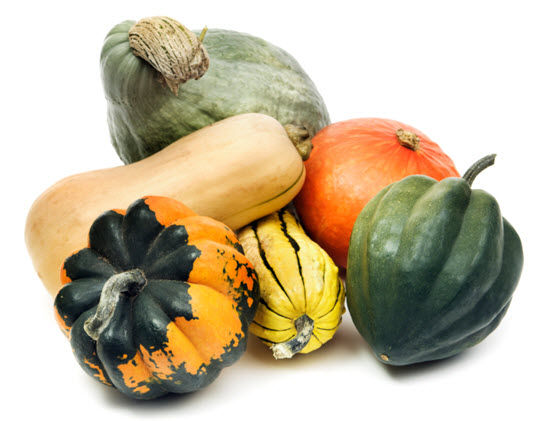
It’s squash season! Winter squash — almost all of them — are among my favorite foods. They’re an excellent source of starchy carbs, which are necessary for training, and don’t add the undesirable elements of sugar or gluten.
People ask how I cook squash, and my answer is shocking but true. I microwave. (As mentioned in previous posts, I’m a lazy cook but determined to eat healthful foods.) One safety note: larger squash, such as butternut, can be difficult to cut when raw. Most roasting/baking instructions require cutting the squash in half before placing it in the oven, so be careful. If you decide to be lazy like me, you can microwave without cutting first.
Acorn squash seems to be everywhere these days. It can be eaten as part of a quick pre-training meal. The meal could include any protein source you choose, from dinner leftovers to vegetable protein powder. Reheat the acorn squash, if desired, and top it with some raw, organic coconut oil. It’s a fast, healthy meal and can get you through a tough workout.
Stuffed acorn squash makes a nice dinner side dish. You can, of course, use virtually anything you like to stuff it. One combination I’ve played with is brown rice, wild rice, chopped vegetables, and pine nuts. If you go easy on seasonings, this could also serve as part of the pre-training meal above.
Another terrific squash is delicata. It can be substituted for acorn squash in either dish above and offers a little variety.
And how about spaghetti squash? It can be eaten just like any other squash, seasoned whichever way you prefer. But it also has that added fun-factor because it can be used exactly like spaghetti and topped with your favorite sauce to make a gluten-free “pasta.”
My favorite squash dish combines two winter standards. Butternut has a fantastic flavor but is often watery. Kabocha (aka Japanese pumpkin) has a drier, firmer texture but tastes bitter. Combining the two is easy. Cook both, let them cool, and discard the seeds. Scoop out the squash from each one, place it in a bowl, and use a potato masher to blend them. It’s really quick. Pour out the water from the butternut squash as necessary.
The taste of this combo is good enough to be eaten plain with no seasoning. But, obviously, you can season it if you want, with any seasonings you choose.
Whether you already like squash or try it for the first time it this season, you might miss it (as I sometimes do) the rest of the year. Here’s one way around that. A few years ago, I discovered canned, organic pumpkin. Look for a brand that contains pumpkin and absolutely nothing else. You can treat it exactly the way you would oatmeal or quinoa in my no sugar, no-bonk breakfast suggestion from a previous post. Season it according to your preference. I tend to use cinnamon at breakfast, but sea salt, freshly ground pepper, allspice, nutmeg, curry, and many other seasonings can work quite well anytime. If you stock up on several cans, you’ll have it year-round.
My plan this year is to try some of the squash varieties I’ve never tried before. If you have a favorite recipe, please feel free to pass it along to us. And please let me know how squash works as part of your pre-workout meal.
by Joan Kent | Sep 2, 2014 | Engage Your Students, Health and Wellness, Master Instructor Blog
Have you ever noticed that some of your students react more strongly to sugar than others? That they seem to want it more often, crave it frequently, and want more even after they’ve eaten some? The reasons are genetic. I love that because it takes all the “blame” off the person and de-personalizes the reaction by making it chemical. We can’t be blamed for something we can’t control, right?
As an indoor cycling instructor, you may hear all about students’ problems with sugar. You’re also in a unique position to help them. Your students know you, trust you, and follow your recommendations.
So what is this genetic, chemical thing that goes on in people who are susceptible to sugar addiction? It’s in two parts — carbohydrate sensitivity and sugar sensitivity.
Carb sensitivity simply means exaggerated insulin secretion to sugar and some other carbs. The extra insulin can cause glucose to drop, causing cravings. The cravings are typically for foods that will raise glucose quickly. Sugar is an obvious culprit in that regard. The glucose drop can also trigger hunger, so it’s likely that the carb-sensitive person will crave sugar, eat it, and eat quite a bit of it.
Who’s likely to be carb sensitive? Typically people with a family history of one or more of these: alcoholism, diabetes (including mature-onset), hypoglycemia, hypertension, or obesity. Another factor is central adiposity (apple-shaped body). That apple shape is the typical characteristic of men, but women with that body type are more likely to be carb-sensitive.
The other aspect — sugar sensitivity — is about neurochemistry. People who are sugar-sensitive seem to have low baseline levels of several brain chemicals — beta-endorphin (or endorphins), dopamine, and serotonin. To simplify (oversimplify!), the fact that those 3 chemicals are lower than normal makes these people feel crummier than normal.
Who is likely to be sugar-sensitive? People with a family history of alcoholism, other addictions, depression or other mood disorders, or a personal history of PTSD (post-traumatic stress disorder).
Let’s return to sugar. When we eat sugar, we get a brain release of beta-endorphin. That triggers a dopamine response because the two tend to go together. But when a sugar-sensitive person eats sugar, the beta-endorphin response is greater than normal — and so is the dopamine release.
Their serotonin will be exaggerated, too — because of carb sensitivity and the high insulin release. The more insulin we secrete, the more tryptophan (the amino acid used to make serotonin) travels to the brain, and the more serotonin we produce. It’s pretty linear. So carb-sensitives — who release extra insulin when they eat sugar — end up making a lot more serotonin.
And what does all of this have to do with addiction?
Dopamine and beta-endorphin are involved in the good-feeling, reward part of addiction (including sugar addiction). That means people who are sugar-sensitive may feel rotten without sugar, but hugely better than normal when they eat it. Obviously, that’s pretty reinforcing. It encourages repeat behavior, both in animals and in humans.
Then there’s serotonin. Serotonin is involved in seeking behavior — how much trouble we’re willing to go through to get the addictive substance we want. Once again, the exaggerated response comes in here. Extra insulin leads to extra serotonin, and that leads to stronger seeking.
To recap, it kinda works like this for a carb-sensitive, sugar-sensitive person: She/he may feel crummy without sugar. The giant-sized reward caused by extra-high dopamine and beta-endorphin makes Ben & Jerry’s seem pretty appealing in the middle of the night. Reinforcement from eating it may provoke that desire on many nights, while the extra serotonin is what makes someone drive to the store in a bathrobe at 2:00 am to get it.
What I love about this hormonal and neurochemical viewpoint is that it takes all judgment off the person, who can’t fight those genetics any more than we can fight our eye color. There’s nothing wrong with feeling compassion, rather than judgment, for someone’s compulsions. Judgment never helps anyone, although compassion certainly can.
What besides compassion can help your students? Changes in nutrition are most important, but if you’re not comfortable tackling addiction, you can still help. Don’t underestimate the organized, structured workouts you offer in your classes.
You may already know that workouts increase brain levels of beta-endorphin, dopamine and serotonin. (More on serotonin and training in a future post.) Encourage consistent participation from your sugar-addicted students, especially any who are in recovery from alcohol or other substances.
Even if they don’t want to work out some days, your class will help them that day AND in the long run — and make you feel great that what you do so well can be so beneficial for them.
by Joan Kent | Aug 11, 2014 | Best Practices, Health and Wellness, Master Instructor Blog

It’s dinnertime, and I’m flying home to San Francisco from a Houston business trip. The flight attendant is bringing around the service cart and I’m about to order … milk. I never drink milk, so why now?
Let’s go back to how the day started. Fortunately, I had ordered eggs and oatmeal from room service. (This was a number of years ago, before we all became gluten-phobic.) Breakfast showed up at 7:00; so far so good.
I was in Houston in January for a meeting called by Sherry. The meeting started at 10:00 a.m. and was scheduled to last till 1:00. My return flight was at 2:30 p.m.
Sherry had promised us food. I should have been suspicious, because Sherry and I once had dinner at an airport, and hers was a plate of white-flour pasta and a plate of white rice. The only foods at the meeting were donuts, Danish pastries, M&Ms, Halloween-size candy bars, soft drinks and coffee. No refreshments for me, thank you.
At 1:00, a few of us got into Sherry’s car so she could drive us to the airport. Six hours without food had left me hungry, and I planned to get food at the airport. Unfortunately, unexpected traffic due to an event in town slowed us to a crawl. It was not going to be possible to get food before my flight. Maybe a pack of raw almonds? Almost every airport newsstand sells those.
Well, time was so short I had to run to the gate. When I finally stepped on the plane, they closed the door literally the instant I was on board. And then.
The flight couldn’t take off for an hour due to some problem or other. (Believe me, I had stopped caring.) Even when we were cleared to go, we couldn’t take off because the plane now had to be de-iced. We sat on the tarmac for 2 more hours.
So our 2:30 flight departed at 5:30. There was no meal service — it was an afternoon flight. A 2½-hour flight. After a 7:00 a.m. breakfast and nothing else, all I could think about was food.
Finally, the beverage cart appeared. I had already decided what to order. You might think I’d grab whatever I could get, but as I watched people consume Pepsi, ginger ale and apple juice, I knew that spelled nothing but trouble for a carb-sensitive like me.
The answer lay in finding food.
Food on a beverage cart. Are you thinking peanuts? So was I. But they had pretzels. White flour would have been worse than nothing. So my plan — at this point, was it Plan B or Plan C? Maybe D; it was a long day — was milk. Milk isn’t a beverage; it’s food. Usually, I don’t drink it, but this wasn’t usual.
Got milk? They had it — 2%, the only kind they serve on airlines. I had done the calculations (plenty of time to do arithmetic on the tarmac), and 2% was actually the perfect answer. It came as close to a 40-30-30 meal as I could get on the fly, although it was light on protein and a bit heavy on fat. Even though I don’t go around pushing 40-30-30 meals (remember The Zone?) on my clients, I do know that the effect of those percentages is stabilizing.
The key word is Stabilizing, and that’s the take-away here. In this case, stability refers to both blood sugar (glucose) and brain chem. In a semi-emergency like this, it’s tempting to use the situation as an excuse to grab anything edible, even things we should avoid.
But milk was a wiser choice, and in 20 minutes I felt a lot better.
Lately, I’ve been finding it necessary to go with Plan B often — so the best idea is always to have one. When it comes to food, a solid Plan B is absolutely vital. Carry envelopes of protein powder or packs of raw nuts with you, rather than fruit. Think stability. After all, we’re talking about your brain first, as well as the rest of you.
