In the years (okay, decades) that I’ve been helping people conquer sugar addiction, some clients have balked at the idea of giving up sugar all at once: cold turkey, as it’s known. They wanted to wean themselves off sugar a bit at a time.
Experience has taught me that the tapering approach doesn’t work for a number of reasons. Yes, some sugar-users get results by tapering, but everything works for some people. Serious addicts may never get themselves off sugar completely if they feel they can get away with a little bit. That little bit can cause problems.
Relapse
It’s easy for sugar addicts to rebound and relapse when they still have sugars — even sneaky ones — in their diets. This can be attributed to a priming-type effect, where a little makes us want more. Some “experts” claim that priming doesn’t happen with sugar (the term came from drug addiction literature), but decades of experience have shown me that it absolutely does.
Clients have told me that starting the day with orange juice, for example, sets them up to crave sweet foods all day long. Frankly, I don’t care if the clients can cite a reference in a science journal; I just listen to them and help them conquer their sugar addiction.
Loophole Thinking
As a result of continuing to eat sugar in small amounts, addicts may start looking for Loopholes — substitutes for sugary foods or ways to sneak sugar into their diets. They begin eating extra dairy or using agave or artificial sweeteners while telling themselves they’re “off” sugar. Some substitutes can be addictive in themselves. I had a client who was even more hooked on aspartame than she was on “real” sugar. Some addicts use diet colas for their fix. And let’s not even get started on fruit sugar, fructose. It’s the worst of all — and makes sucrose the junk it is.
Tastes Won’t Change
Sugar addicts who taper may never acquire a taste for healthful foods. Their tastes are still oriented toward sweet, maybe in smaller amounts than they used to eat. This is especially true where vegetables are concerned. I’m forever pushing vegetables on my clients (just ask them), but the ones who are most severely addicted to sugar typically say they hate vegetables. It’s fairly obvious that the reason is vegetables aren’t sweet.
(That’s why I’m against that 5-a-Day rule. It’s supposed to refer to fruits and vegetables, but sugar addicts will turn it into all fruits, given the chance.)
Excess Insulin
Advocates of tapering don’t seem to know that sugar addiction is often grounded in carbohydrate sensitivity. Carb-sensitive people release high insulin when they eat sugar, including fruit and syrups. Artificial sweeteners can trigger insulin in carb sensitives, as well.
Carb sensitivity is not the only factor in sugar addiction, but it can be directly related to health issues. For optimal health, we want to release just enough insulin to do the job and no more. Excess insulin has been associated with a large number of diseases — most of the ones we tend to die from in the US.
The Bottom Line
As you see, a plan that encourages semi-recovery from sugar addiction can result in priming, a diet that’s still oriented toward sweet foods, long-term preference for fruits over vegetables, continued cravings, excess insulin if substitute foods are big insulin triggers, and possible relapse.
I want better for my clients with sugar addiction. I want them to gain optimal health AND the self-confidence that comes from knowing they didn’t just stop using sugar halfway (and maybe relapse), but quit it completely.
True observation: I’ve had quite a few class participants who were unable to focus for more than 30 seconds at a time. No exaggeration. It was particularly noticeable in rowing (it’s easier to hide on a bike), and usually coincided with the fact that they were vegetarians.
Another rowing instructor told me that someone in his class “can’t focus longer than 30 seconds.” When I asked, it turned out the man in question was a vegetarian.
Yes, I realize not every vegetarian lacks focus. However, the rowers who couldn’t stick with the training for more than 30 seconds were invariably vegetarians.
The advice I gave to my students and to the other instructor was to increase protein. This has to mean “real” protein, so the tricky part is finding an acceptable form of protein that a vegetarian is willing to eat. When I explained to one participant the brain chemistry of protein and how it affects focus, he was willing to add fish and shrimp to his diet. Within a few days, things had turned around, and he had no difficulty focusing on the rowing workout.
Which brings me to that vegetarian beans-and-rice thing.
You’ve probably heard it. Beans and rice make up an often-touted vegetarian meal that is said to provide Complete Proteins. For those who are unfamiliar with the idea of complete proteins, it has to do with the fact that proteins are made of amino acids, the Building Blocks of Protein, as they told us in 7th grade biology.
When we eat animal proteins — fish, poultry, grass-fed beef, eggs, yogurt with 18 or more grams of protein per serving, for example — we get all the amino acids necessary for human metabolic function. When we eat vegetable sources of protein, some amino acids are missing from the foods. Other foods can provide the missing aminos and complete the spectrum.
But neither rice nor beans contain much protein; both foods are primarily carbohydrate (starch). So beans and rice together provide the complete list of amino acids but still give us only a small amount of protein overall. Lots of starch, though. The effect of starch on brain chemistry is completely different from that of protein.
As mentioned in a previous post, protein increases production of dopamine and norepinephrine by providing tyrosine and phenylalanine, the amino acid precursors. Dopamine and norepinephrine are alertness and focus chemicals. Carbs tend to raise serotonin levels, which make us relaxed, drowsy, and even “spacey”.
Vegetarians no longer suggest combining proteins at a given meal; that concept is long outdated. But ignoring it can make things even worse for someone who tends to space out without animal protein.
It’s not my place to tell vegetarians to stop being vegetarians. But I wish vegetarians would stop calling rice and beans protein foods.
If you have students who have trouble focusing — and I wonder if people who have the problem even know it — a good recommendation might be to add some form of animal protein to the diet.
If that’s out of the question (obviously, people are vegetarians for different reasons), at least add a serving of high-quality vegetable protein powder to every meal to provide the complete amino acid spectrum.
Incidentally, vegans often have screaming cravings for sugar, and again the answer starts with protein. Cravings are a brain chemical thing. For vegans with cravings, vegetable protein powder might be the only road to a solution.
Amy and I are in Santa Monica, CA this week for the MINDBODY Bold convention. I knew I would have a bunch of downtime and did a search for classes near our hotel. Imagine my delight at discovering a SoulCycle just a few blocks away 🙂
We attended a sold out class there Sunday morning at 9:00. The Instructor's name was Heather P and it was very easy to see why people (primarily women 20-40 years old) are in love with these classes.
I also attended a second class (about 85% full) on Tuesday 10/14 with a different Instructor. Please keep in mind that what follows is my first hand experiences, based on taking two classes at the Santa Monica location.
It's all about the details.
The whole experience (registration, welcome, pre-class, the class, post class) had me understanding why they are so successful. SoulCycle is a well-oiled machine designed and scripted to deliver their product very efficiently. Their attention to detail is remarkable and IMO a large reason for their success is based on how well they appear to have refined (and execute) even very small details.
I've got a lot to tell you – I may end up breaking this into a few posts – so lets get started.
Registration
First time participants get a discount ($20 vs $34) and free ($3) shoe rental – but you can't sign up online if you want the deal– you need to call the studio directly. A very pleasant young lady answered the phone, asking me my questions (mine was; “who's class should I take?), took my information and smoothly asked for my credit card info to confirm my appointment.
So why do you force me to call? I'm on your website. You could easily provide a “first timers click here” button, but SoulCycle wants me to call them. WHY? I've been thinking about this question since last week. Probably overthinking it. They say the simplest explanation is typically the right one: SoulCycle wants to make a personal connection with their customers right from the beginning – before they ever set foot in their studio.
A nice touch – would that make sense for your studio?
After getting the recommendation to take Heather P's class, I was asked where I wanted to ride. I asked for two bikes near the front – they reserve the front row for regulars I think. This is important as these experienced riders tend to lead the class as Heather was off the bike for at least half the class.
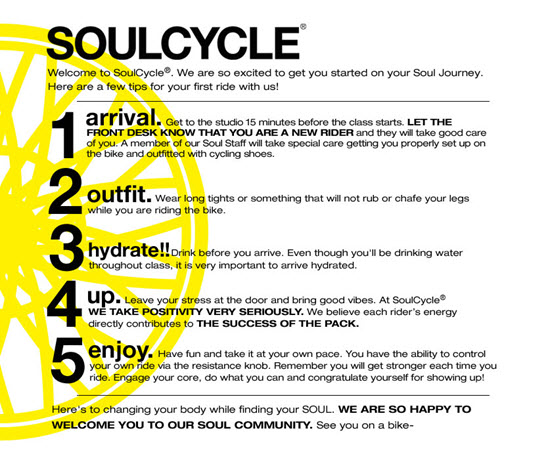
After the call I received a series of emails; a CC receipt and a Welcome to SoulCycle email that included the image above.
Welcome to SoulCycle
Amy and I had a short walk from our hotel and I have to admit I was a little apprehensive about the experience I was about have. There were three, friendly, young people behind the counter. We introduced ourselves and one of the attendants found our names on a printed class attendance list. Next to each of our names was a purple check mark, indicating we were first time riders. Another nice touch – this list was given to the Instructor so she would know who's new and she made a point of greeting us before class started.
What else can we provide for you two? I had purposely left my bike shoes at home, preferring to try out their rental shoes. I gave her my shoe size and she quickly handed me a pair of generic road shoes with LOOK cleats. LOOK cleats? Not SPD's? That didn't make sense to me and I wasn't able to get any information about why LOOK instead of SPD. Amy's idea was that LOOK cleats maybe easier to get in & out of?
Key Studio Room Details
Arrow pointing out Instructor monitor speaker
By all appearances, the studio is exactly the right size for the 60 cycles they have. There isn't room for anything else! Each bike is set very close to the others in the row. The rearward end of the seat slider in front of me sits right below the end of my bike's handlebars. The back 4 rows are raised theater style.
Some people might not like how cramped this studio is. My initial reaction was just that; too many people squeezed into a small space. But by this time I was seeing how SoulCycle doesn't appear to do anything without a purpose. As I watched the others ride, it became obvious that the closeness (we're all part of the same tribe) was another part of the charm that is this brand + with each bike potentially bringing in $2,000 a week, I'd pack them in as well plus have a few hanging from the ceiling if I could find a way for a person to ride it!
Rubber flooring – what a relief to have something other than slippery polished stone or bamboo flooring to walk on wearing cycling shoes 🙂
Instructor monitor speaker – even though this is a small space, having a monitor speaker (so the Instructor hears & can adjust her mic/music ratio) is crucial for keeping your vocal cues intelligible along with loud music.
Those candles are electric – which was a bit disappointing. Here I kept hearing about the candles – maybe they are real at some of the other studios.
Two exits – a small thing but I've been frustrated in other studios trying to get in or out.
Ventilation – minimal and yet it never felt stuffy… nor did the mirrors fog up like I certain LifeTime club I'm aware of.
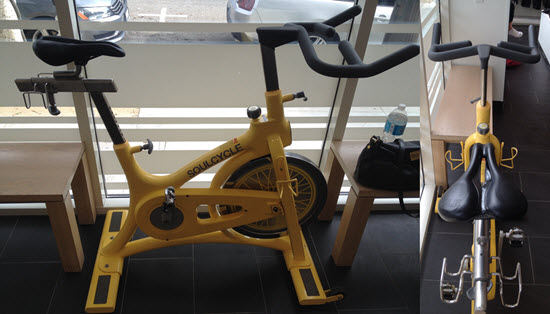
The SoulCycle Indoor Cycle
Amy wasn't crazy about the saddle and I didn't notice either way. About 70% of this class was standing so it really didn't matter.
I don't think you can buy enough for a full studio, but you can purchase the Indoor Cycles used at SoulCycle studios for use at home. These cycles are of their very own design and my understanding is that they're manufactured in the same factories that make other brands.
Conventional weighted flywheel with friction resistance. These things are very heavy bikes = solid and stable. The ride is very smooth and I found the resistance very progressive. There's no computer/console of any type and the only thing out of the ordinary are the cages that hold your weights. Every bike uses reversible LOOK/SPD pedals. There is no shoe basket option for using fitness shoes – an important detail as I'll explain in a moment.
I quickly found a setting that had me comfortable in and out of the saddle. Amy said she got close, but didn't feel completely right and she wasn't a fan of that sculpted saddle. I should note that we didn't identify ourselves as Instructors, but I was wearing Pearl bibs which obviously identifies me as someone with some level of bicycle experience. Although we were told at check-in that someone would be there to help set us up, no one did. There were three assistants in the room, so my assumption is that if we had looked clueless (or asked) someone would have been there to help.
Key Bike Details
As you can guess, you move around on the bike a lot in these classes vs. more cycling specific formats. The rock solid stability of the SoulCycle bike instills a lot of confidence in the rider that it isn't going anywhere. After the class I tried lifting one end and those things must be made out of cast iron they're so heavy. Every bike was spotless and appear to be very well maintained despite 60+ classes offered there each week.
If you're going to move around safely, it's important that your feet stay connected to the pedals. The LOOK cleats on my bike and SPD's on Amy's bike were adjusted quite tightly, requiring more rotational force than typical to release. You don't want your release settings too high on a road bike, but to me, tight = safe indoors.
Before taking this class, I had looked at shoe rentals as a convenience you offer to riders. Now I recognise that having a policy where everyone is securely clipped in would be a real safety enhancement. Shoe baskets (AKA Toe clips) may be more accommodating for new people, but they're truly a pain and could actually have potential safety issues when compared to cleated shoes:
Cleated shoes offer a very secure, positive engagement vs. shoe baskets that may or may not be fastened securely – or stay fastened if the strap isn't routed correctly through the capture mechanism.
Cleated shoes have better foot alignment – how your foot is positioned on the pedals can have a big effect on your knees. Don't believe me? Next time on the bike rotate your heals in and watch where your knees end up. Knee over pedal needs to be in two planes; fore/aft and side to side.
Cleated shoes control the position of the ball of your foot over the pedal spindle – this can vary wildly with different size feet in shoe baskets.
Cleated shoes have solid bottoms = much more comfortable when standing regardless of how much out of the saddle riding you do.
If your studio offers unconventional classes similar to SoulCycle, I see a policy of only allowing cleated shoes as a Best Practice to ensure your riders safety + at $3.00 a rental (your first class rental is free) it could be a nice source of additional revenue.
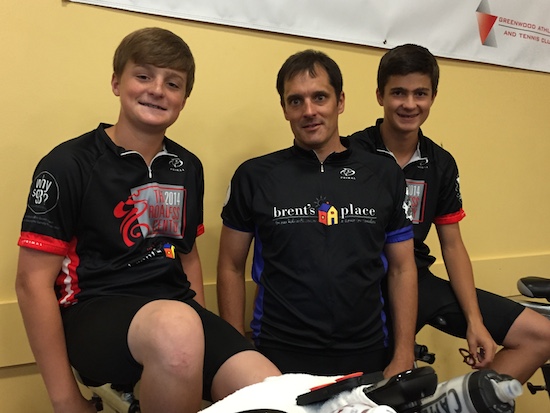
On October 10th my sons, Christian and Seth, and I participated in an indoor cycling charity ride called The Roadless Ride which benefits a local charity named Brent's Place. This event consists of 12 one hour indoor cycling classes where participants donate $45 or more for each class they choose to participate in. There is also a group of “Century Riders” who ride all 12 hours. Christian, Seth and I joined 22 other endurance junkies for this challenge. It was an awesome day! Most of the classes sold out and all the Century Riders completed their 12 hour endurance journey. The event organizers are predicting we raised over $100,000!
I participated in 9 classes and led 3. For the final 2 hours I team taught with fellow instructor, Collin Catel. Colin and alternately taught 3 song sets. We have different teaching and music styles, but when we were organizing our playlist I fell in love with this set that Colin put together, so I thought I would share it with you.
I also included the video we used with this 3 song set. I hope you enjoy it!
3 song harmonically mixed track, to download Right Click > Save As / Save Target As to download. Open in iTunes and then you'll see this in your Spotify Local File folder.
Not only do I think there's something special about 3 song mixes I also think there is something powerful about 3 interval sets. One of my favorite 3 interval sets is to go HARD, HARDER, HARDEST. This teaches pace and control but also forces riders to “dig deep” on the third interval. If you are lucky enough to have bikes with power these sets are easy to teach, simply finish each interval with a higher average wattage. If you do not have wattage you can use more gear\resistance and the same cadence or the same gear\resistance and a faster cadence for each interval.
This 3 song mix is perfect for this type of interval set. All 3 songs are about 4 minutes long so you can simply have the riders go hard for 3 minutes and recover for 1 minute and repeat 3 times. This HARD, HARDER, HARDEST interval can be done in a variety of ways. I sometimes teach it in the same position for all three intervals, other times I teach it: seated with a fast cadence, seated with a slow cadence followed by standing. Other times I let the riders choose their position, but I remind them that each interval has to be harder than the previous one.
These types of intervals are both fun and challenging. Let me know how it goes.
I'm not kidding. On the first day of Registered Dietitian School, I think every RD student must be taught to recommend the Registered Dietitian Breakfast: orange juice, yogurt and granola, often with berries.
I wish I could tell you this is a joke, but over many years, I've heard this recommendation from virtually every RD I've known or heard speak to groups. (And I've known a bunch. It's my business.) I'm suspicious when a group espouses exactly the same thing.
It has always driven me crazy, and still does. For one thing, they consider yogurt protein.
If you're thinking that yogurt IS protein, please understand they've been making this ridiculous recommendation for decades — long before the recent Greek yogurt trend started. That's important to keep in mind.
Before the craze, all yogurt – even the unflavored, unsweetened kind – was mostly carb with only a smidgen of protein. No yogurt had enough protein to compensate for the sugar in the OJ, the berries and the granola, especially when combined with the lactose in the yogurt. Yet RDs were blithely, shamelessly recommending it.
Even since the popularity of Greek yogurt, though, it's a bad recommendation because it's made with no specifications, no qualifiers. Sure, SOME Greek yogurts actually have enough protein to be considered protein food, but many do not. They're called Greek only because they've been created to feature that creamy texture that's considered characteristic of Greek-style yogurts. People really like them, but their protein content is relatively low.
And after all these years, non-Greek varieties of yogurt don't have much protein. They never did.
None of these food facts, however, has stopped RDs from recommending this infamous breakfast. Consistently, too, even though it's basically sugar, sugar, sugar and sugar. I even see it recommended in articles that offer breakfast suggestions for both regular folks and athletes. Some of the articles display pretty color photos of the breakfast.
In my humble opinion, the pretty picture doesn't make the sugar go away. It doesn't increase the protein content of the meal.
Again, the type of yogurt is almost never specified or clarified. But even telling the reader or the listener that it should be “Greek” won't fully help. Not when there are too many Greek-style yogurts available – and when, as previously mentioned, many of them have very little protein.
So which recommendation would make me stop ranting about, and railing against, the Registered Dietitian Breakfast? RDs could tell clients who want to try that meal to look for yogurt brands that contain between 18 and 22 grams of protein per serving. And lose the OJ.
How simple is that?
Okay, I freely admit RDs know some important stuff for sure, and many have their clients' welfare in mind at all times. Nevertheless, I'd give anything to meet even one who doesn't recommend this same breakfast. It absolutely has to be the first lesson they ever learn in RD school. How else could you explain such a bizarre phenomenon?
If it weren't part of the RD curriculum, why would they all say the same thing? Why would they have recommended it years before any yogurt, anywhere, had much protein?
You have to wonder, though: why would any curriculum include granola?
Avoiding unnecessary sugar and getting enough protein are only two keys to a healthy lifestyle. I help people conquer food addictions so they can keep moving forward (no matter what) with their goals to lose weight, improve their heath dramatically, transform their relationship with food, and stay that way. I'm available for coaching, lectures, workshops. Please visit http://www.foodaddictionsolutions.com.