On January 20 John Macgowan posted Would you teach for SoulCycle? If you have not read it, try to find the time. It generated a lively discussion of 17 comments between eight of us. The post highlights excerpts from an article in New York Magazine that ran on January 14, 2013. An interesting read as well pointing out that Soul Cycle instructors are earning $50K and more.
Coincidentally, Soul Cycle is coming to San Francisco, opening a studio inside an Equinox. On Friday February 8th they invited us local instructors to participate in a ‘Soul Cycle Master Class’ to get a sense of what Soul Cycle classes are like. Why? Because on Saturday February 9th Soul Cycle was holding auditions for instructors who would – should they make the grade – be the first to do Soul Cycle (SC) classes in Northern California. I wanted an audition.
I attended the Master Class looking forward to the experience. SC owners Elizabeth Cutler and Julie Rice were there for opening remarks. A very buff/cute and perky twenty something instructor originally from Santa Cruz led our 45 minute class.
I was on the bike warming up next to an acquaintance. We were chatting easily five minutes before class started and I was holding about 95bpm. (I always wear my heart rate monitor) Class starts, in less than two minutes I was above T2 and thats where it stayed for a lot longer than I thought possible. My friend and I never spoke again.
Those of you needing a quick refresher, T2 (Ventilatory Threshold 2) is roughly equivalent to Lactate Threshold which is roughly equivalent to anaerobic threshold. Even for the most fit athletes long periods above T2 are just not possible without slowing down. I was viewing my heart rate on my iPhone app. Finally I had to turn it over so I could not see the numbers. Take away lesson: if you are doing Soul cycling, leave your heart rate monitor at home.
Our instructor spent about half her time on the bike. The other half was spent bouncing around the room ‘pumping us up’. During the first thirty minutes we spent a good percentage of time out of the saddle and at high cadences. I observed a new position; come out of the saddle, rest all your upper body weight on the handle bars, and then spin at extremely high cadences. I didn’t even try. We also did movements that can only be described as pushups and jumps. These I did.
The music was played so loud that it was distorted. Of course this caused the instructor to turn up her mic volume to a place where I couldn’t understand a word she said. I just copied the women around me.
Thirty minutes in she sat us down and we did simulated upper body resistance training. Simulated because – ironically – there were no weights in this cycle studio. After that a couple more high intensity climbs and bam, we’re done. Whew!
I think it is safe to say that I was definitely bringing up the average age in the room. I was one of three men in the full studio. My friend and I being roughly the same age and one hard body guy in his early 20’s. (In San Francisco this guy will easily play successfully to both genders) Not sure why men were so outnumbered but this is a female dominated arena. And, oh my could they scream with the joy of being pushed into a sweating mass. I put the average age of the women in attendance at late 20’s.
I think we all get that there has been a decline in what used to be a pent up demand for cycling. Clearly in the markets where Soul Cycle studio's exist there is pent up demand for this product. Indeed – if one is to believe the New York Magazine article – some riders interviewed were spending in excess of $20K per year on their Soul Cycle habit.
Why is that? I struggled with this question but, if we take a hard look at the Soul Cycle model we find that their distinction is a huge commitment to finding just the right instructors. Let’s face it, at the end of the day quality instruction is still the key to successful programs. Soul Cycle management believes in their program (having perfected it), which is kind of like the American Idol of indoor cycling. They invest a lot of time and money to find a few good instructors. If one has the right stuff, the end game is worth it for SC and instructor.
How many studio owners are willing to go there? Historically, not many. And what is there?
Let’s look at Soul Cycle again. Soul Cycle supports, motivates and promotes the instructor all the way to a Soul Cycle stage, if they make the grade.
Making it through the audition process is only the first step. Then off you go to their training center to learn to do it their way. If one makes it through that, then one teaches six to eight classes per week and not necessarily prime time. Still there is more. One must attend three to five classes per week taught by the studio mentors. And, one cannot teach anywhere but SC.
Having done all this your large paycheck is still not in the bank. Soul Cycle uses a tiered incentive system essentially based on how many butts are in saddles during your class. The more butts, the bigger the pay check.
Lots of work that – from my experience in this industry – few instructors and even fewer studio owners are willing to to do.
Indoor cycling isn’t new any more. Simply rejuvenating existing programs isn’t a trivial task, will take time, money and commitment that is rarely seen in our industry. I doubt many studio owners have so clear a vision of their Unique Selling Proposition that they would pony up the dollars to operate like the very successful Soul Cycle.
If you are wondering if I got hired, I did not go back to audition. A part of me wanted to know for sure if I had the right stuff. I believe I would have passed the audition. I’m a big enough ham and love connecting with my riders so much that – to me – making the first step seemed inevitable.
Truth is, I live one hour from San Francisco. I have other contracts in my ‘portfolio career’. I could not have committed the time or to the commute.
Yet today, I find myself getting off the bike more, bouncing around declaring to my riders that I AM here to pump them up. I guess a little bit of soul cycle goes a long way.
Video impacts Indoor Cycling more than any other form of Group Fitness. With the advent of Forward-Motion Video (FMV), the indoor cycling instructor can integrate the video into the ride profile for the day’s class. It’s an asset that the instructor can use to enhance the experience of the class participant directly. This can’t be done in any other type of class. You can use video of scenery to create a mood during a yoga class and create the impression of doing yoga outdoors, for example, but using video as an integral part of the class to direct class structure and choreography? In that, Indoor Cycling stands alone.
In a recent post (“Video is JUST Video”), we stated our belief that education and training will drive video use in indoor cycling. By providing tools and training methods that empower instructors, FMV will elevate indoor cycling to a new level.
In an earlier post (“Video and Indoor Cycling, Part 2 — Teaching With Video”), we introduced the concept of creating immersion through a cuing system we created, called SIT — Simulation, Interaction, and Telepresence. After a year of testing the teaching process, we can happily say that SIT works: Decide on your level of interaction with the video (None, Partial or Complete), then add Simulation (factual information about the video) and Telepresence cues (referring to aspects of the video) to involve the students in what they’re watching.
This results in immersion. The students’ self-awareness blends into the absorbing footage, and they feel as if they’re riding in the video.
We get many questions about how and when to prepare the video portion of a class. That’s the subject of this post. The answer is it depends on which FMV system you’re using.
Two FMV formats are currently on the market. With a “permanent” format, the video profile is permanently configured and can’t be altered. A DVD featuring FMV is permanent. The ride display is the same every time.
FMV can also be “changeable”. Destinations on Demand by Myride®+ is the only FMV on the market that allows you to rearrange your video for every class. The videos are cataloged in libraries of varying terrain (flat, mixed, climb, and descent) to enable you to select segments and create a ride that conforms to your audio profile.
Currently, most indoor-cycling instructors plan their classes in one of two ways. They may start with a fitness concept (say, endurance) and construct a ride using movements, cadence and intensity that support an endurance workout. They then choose the correct music to support their profile.
Alternately, instructors may start with music, compile an audio profile of songs they enjoy, and — based on the song — select the movement, cadence and intensity.
Both methods of class design are supported only by FMV that’s changeable. The selection of the video typically happens after the ride or audio profile has been created. It’s simple to match a video segment to movements selected for the ride or the song when the video segments conform to standard indoor cycling movements and can be lengthened or shortened to fit your exact needs.
If you use permanent FMV, the video will always come first in class preparation. Songs and ride movements will need to be choreographed to what’s happening in the video. If they aren’t, your choreography and/or song selection will be contrary to what the students see. If you cue a seated climb when the video displays a descent, the mismatched cues and video may seem absurd to the participants. Permanent FMV includes all DVDs, the Challenge and Expedition video libraries on Myride+, and all FMV on other media consoles, such as Fitness on Demand.
Changeable FMV (Destinations on Demand) can actually be the impetus behind the class design. Much the way a song can drive a ride movement or a movement can dictate the song, a spectacular video can drive the selection of either song or ride movement, or both.
Building a profile with changeable video segments differs from the use of permanent FMV. You can control the type of class you teach. You’re simply choosing to feature the visual aspect of the class before everything else.
FMV is changing indoor cycling classes around the world. Instructors must now consider how to work with all FMV and integrate it into their classes. Teaching with video is easy but, as with music, also a skill that develops over time. Eventually it will become a standard part of every instructor’s class preparation.
I started to share this over at pedal-on.com and quickly realized that this is another Best Practice for Indoor Cycling Instructors.
Suggestion to anyone reading this who is planning to use Spotify in class.
A cycling coach / friend of mine taught me that race day is never a good day to try something new.
The mark of a Rookie is someone who changes his seat height the night before a big event, or slams the latest energy drink on the way to the race – only to find the new saddle height feels weird and uncomfortable… and the stimulants have your heart (and mind) racing so fast you're worried about what effect all of these changes will have on the race you've trained months for that you're an emotional wreck as you roll to the line and are off the back before the end of the 1st lap.
Experiment during your training and only bring what's familiar to the starting line. Same is true with using Spotify in your class. I've lost track of how many calls and emails I have gotten that begin with; the first time I tried to use Spotify in my class ____________________ happened. It worked perfectly at home… I have no idea why it didn't __________.
Show your professionalism by doing a dry run at your studio before you attempt to use Spotify to deliver your class music.
Teach a whole class by yourself and experiment with your new toy;
Will it play with Air Plane Mode turned on?
Can you find your playlist if it's buried in a folder?
Is the cross fade working correctly?
Hit a few of the wrong buttons… do you know how to get back?
Accidentally tap the shuffle (no, just tapping it again won't return it to ordered play) … can you quickly turn shuffle off?
Get sweaty and try to scroll through the playlist – can youwithout inadvertently changing tracks?
Have some sweat drip on the screen – will you resist the temptation to wipe it off with your towel = changing songs? or learn that you can dab the screen without messing everything up?
Do your local files play when the should?
I'm sure this is only a partial list of the potential problems (feel free to add your own) you could suddenly be faced with, if you run into class without taking the time to become proficient with Spotify.
My interview with Douglas Brooks continues with a discussion of RealRyder's class planning – it maybe the exact opposite of how you create your profile.
Listen below to find out why.
Show notes:
During our discussion Douglas references their class planning template – you can download a copy here.
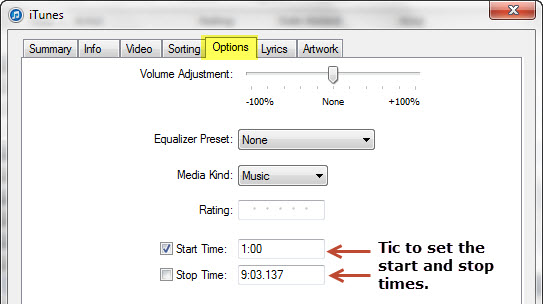
Douglas also described how they teach a method of trimming the length of a song in iTunes (setting the start & stop times) to fit a specific segment. I mentioned that we have specific instructions for trimming the length of a track available here for ICI/PRO members – but it's buried in a video over at the MixMeister Academy.
Here's how to “Trim” the length of a song in iTunes.
Sample the track and record where you would like it to begin and end.
Highlight the track in the list view.
Either go to: File > Get Info, Right Click the Track and select > Get Info or use the shortcut Control i
Tick the box you wish to change and enter your preferred start/stop times.
Finish with OK
Unfortunately this isn't an option in Spotify. Just to be sure I experimented with first trimming a song in iTunes, and then opening it in Spotify – both on my computer and iPhone. It played full length (not trimmed) in both cases.
Here's part two of my interview with Douglas Brooks – enjoy and let me know if this was helpful for you [wlm_firstname].
Myth #8 – Adjusting bicycle shoe SPD cleats correctly is hard/confusing/frustrating/impossible and should be left to professional bike fitters or the guy at the local bike shop.
Amy's Shoes are now perfectly adjusted!
This actually wasn't a myth (as far as I was concerned) up until yesterday. Properly adjusting cleat position can be a maddening process to get right. So I wouldn't have included this in my 10 myths of Indoor Cycle Rider Setup / Bike Fit, but I can now after the UPS guy delivered this amazing $25.00 Ergon TP1 Bicycle Pedal Cleat Tool yesterday.
If you've ever tried to adjust the cleats on your own shoes you're probably nodding your head in agreement to how difficult this is to get right.
First; with your shoes on, find the joint of your big toe it's under the fleshy bump on the inside of your foot – the widest part – and mark it's location.
Then loosely attach the cleat.
Move the cleat to what looks like the right position and then tighten the two screws securely.
Clip the shoe into the pedal to see if you got it right… you didn't?
Note the change(s) needed and un-clip.
Flip the shoe over and prepare for the inevitable confusion; I want the shoe to go forward and in and rotate out a bit more… but everything is backwards so I should move the cleat back, out and rotate it in… but this is the left shoe so it goes; down, over and in?
After a dozen or more attempts you throw up your hands and declare; this just isn't so importantand call it good, wherever it ends up. You then vow to ignore any feelings that your feet aren't quite right while riding, choosing instead to get used to it 🙁
So it would make perfect sense that you would shy away from offering to adjust one (or both) of your participants cleats.
After trying out this new tool last night, I found myself rummaging around the house for every old pair of shoes I could find, so I could adjust their cleats. It was so easy (and efficient) to use that it became like a sort of therapy for me. I was actually enjoying adjusting cleats! In mere minutes I was able to adjust both cleats properly; ball of the foot over the pedal spindle, Q Factor and rotation all perfect – and perfect mirror each other's settings.
Notice in this before picture how both Amy's shoes are rotated inward = her knees would need to move out to compensate, not good.
Here's a short video showing how simple this tool is to use.
Image from http://www.lifetime-weightloss.com – click to read an additional article supporting this post.
By Team ICG® Master Trainer Joan Kent
A while ago, based on some long-held suspicions, I ran a PubMed search on weight gain and weight loss to assess the accuracy of a widely held belief. The belief, as the above title suggests, is that weight management hinges on the so-called “simple arithmetic” of calories in and calories out.
Even with the limited time I had for the search, I still located approximately 35-40 articles in various science journals that seem to challenge the calorie theory. I’ve categorized the results below, but need to start with a caveat. Most of the studies cited in this post were done on animals. (I’ve indicated specifically when the subjects were human.)
Some people will object because of that. For their benefit, I’d like to make two points: 1) Studies of this type would be unethical to perform on human subjects. No review board anywhere would approve research that involves locking people in a room, taking all control of their food intake away from them, and forcing them to gain or lose weight. 2) Are you truly prepared to state that weight management centers on calories in/calories out in the human body, while it’s Anything Goes with animals? Knowledgeable veterinarians, for example, have confirmed that the metabolic effects of Cushing’s disease, including the role of hormones in weight gain, are identical in humans and dogs.
So what happened in the studies? To sum it up, dietary factors were found to disrupt the link between calorie intake and weight, and different nutrients and hormones affected the weight outcome.
Fat content of the diet affected weight gain and loss.
– Rats on high-fat diets developed severe obesity without overconsumption of calories (4 studies).
– Mice showed greater weight gained per calories consumed (called “feeding efficiency”) on high-fat versus low-fat diets (1 study).
– Calorie-restricted, isocaloric diets of 10% and 50% fat both reduced body weight in rats, but body fat was higher in the 50% group (1 study).
– Total fat intake, rather than calorie intake, correlated with weight gain and was due principally to the saturated fat component (1 study).
– Saturated fat is associated with greater weight gain than unsaturated fat (2 studies). [This makes no sense from a calorie standpoint, since all fats contains 9 calories per gram. But saturated and unsaturated fats affect hormones differently, as mentioned briefly in a previous ICG® post on Cholesterol.]
– Fecal analysis showed people who consume nuts regularly excrete more fat, suggesting a discrepancy in gross calorie intake and calories absorbed (1 study).
Sugar content of the diet affected weight gain and loss.
– Abdominal fat deposits were caused by high-sucrose, isocaloric diets in rats, although the rats showed no differences in weight gain when compared with controls (1 study).
– Rats fed sucrose plus standard chow did not eat more calories than controls, but gained significantly more weight per calorie consumed (feeding efficiency) and had higher body fat than controls (1 study).
– Severe obesity developed in rats on a high-sugar diet and in rats on a high-fat diet, although controls eating standard chow ate significantly more calories than either the sugar group or the fat group (1 study).
– In a study of human identical twins, the dietary factor isolated as causing a difference in BMI between twins was sugar intake (1 study).
Nutrients affected sugar-induced weight gain.
– The protein content of a high-sucrose diet was inversely related to the effects of sucrose on weight gain and feeding efficiency (1 study). [Protein triggers the release of glucagon; its effects oppose those of insulin. More on insulin below.]
– Minerals added to a standard chow-plus-sucrose diet did not change calories, but decreased weight gain and feeding efficiency and improved glucose tolerance (1 study).
Insulin, a “fat storage” hormone, is a factor in weight gain.
– Rats injected with insulin gain weight with no change in diet or calorie intake (standard textbooks).
– Diet-induced insulin resistance preceded obesity development in rats (1 study).
– Insulin resistance functions as an adaptive mechanism to prevent further weight gain in obese human subjects (3 studies).
– A good night’s sleep vs. restless sleep altered hormone balance. Restless sleep caused fat storage to increase (2 studies). 

 [This result seems contradictory in light of calorie balance: Wouldn’t tossing and turning all night burn more calories than sleeping soundly?]
– The 24-hour rate of fat oxidation by skeletal muscle may be determined either by genetics or by diet. Insulin-triggering foods lower it (2 studies).
– High fructose intake induces high insulin levels, which can cause weight gain (5 studies).
– Chronic stress increases insulin and decreases brain dopamine, norepinephrine and beta-endorphin. The changes shift food preferences to carbs (specifically sugar) and fats, leading to weight gain (9 studies).
What appears to be a balance of calories in/calories out is often the result of a change in diet composition. That, in turn, changes the hormonal response. Hormones can affect weight more profoundly than calories. (More about hormones in a future post.)
Despite the documentation, some of you will believe this, some will not. What I hope is you’ll avoid telling your students that weight management is just simple arithmetic. Instead, please suggest that they shift their diets in a more healthful direction.




 yesterday.
 Here's a short video showing how simple this tool is to use.