by John | May 29, 2012 | Master Instructor Blog

I'd like to welcome Chuck Cali as an official member of the ICI/PRO Team! – John
By Team ICG® Master Trainer Chuck Cali
When asked by ICG® to write a post for ICI/PRO, I thought, “OMG.” 🙂 Seriously, as Jim Karanas or John Macgowan can attest, I have a lot to say. So choosing the topic for my first post was daunting. I’m the new guy, after all — now sharing screen space with some of the country’s premier indoor cycle instructors.
What could I say that would be of value to the indoor cycle instructors out there in the trenches?
It felt right to start with the simple things that mean so much, the least common denominator, the place from which you can become a star, ‘the’ instructor everyone talks about.
John calls it community. I say connections. Making everyone feel part of something bigger. No matter how great your music, how structured your profiles, how clearly stated the class objectives, or how perfectly timed your cues, the success of your class comes down to how well you connect with your riders.
When I talk about connections, I can’t help but think of James Cameron’s great movie Avatar. Consider how the avatar learned to fly the winged beast. Plugging in solved only half the problem. Once plugged in, the two had to become as one. Showing up prepared and on time and engaging the crowd is plugging in. CARING is becoming one with your class.
This simple fact seems to get lost in the training: class focus, music, lighting, power, heart rate, base, strength, cadence, climbing, speed, endurance, ad infinitum. Showing up and executing the perfect profile to the best music, with spot-on cueing, the best indoor cycles, the best studio set-up will get you nada from your class if you don’t connect with them.
Dr. Shannon’s earlier posts on being “the instructor your students can’t wait to see again” discussed how to connect with our riders. Ultimately, as she points out, passion, honesty, encouragement and gratefulness create the connectivity. My word for all that is “caring.” It’s not about you.
The recipe for connecting is caring. How do you run a great class? By caring. How do you get your riders to connect with you? By caring. The fact that you’ve set the world record for climbing L’Alpe d’Huez is of little importance to them 10 minutes into class. This is indoor cycling.
My experience may be somewhat different from others posting here. I’ve spent many years studying this industry and the people who make it work. The best of the best were incredibly adept at connecting. It seemed that they spoke to and cared for everyone in class on a personal level.
Only when this connection is made, so that the riders understand at the most fundamental level that you care about them first, can you successfully demand the highest efforts or introduce complex profiles.
How do I do it?
1. I remember it’s not about me — except to establish that I’m running the class through unambiguous yet non-inflammatory requests.
2. I try hard to get to know my riders: Introduce myself. Ask their names. Find out if they’re new to indoor cycling. Give as much personal attention as possible.
3. I keep it simple and explain in simple, fun terms what I plan for the ride.
4. I empower the class with options that accommodate all fitness levels. I steadfastly encourage good form and never use contraindicated moves.
5. I give positive feedback during class to as many as possible, using their names (which I mostly get wrong).
6. I let them know they can do it. I believe in recovery and let them know when it’s coming, so they don’t have to hold back or fear they won’t last.
7. I lead by example. I’m happy to see them and, as a general rule, work as hard as I ask them to work.
8. I’m sensitive and don’t go on autopilot. I recognize early when I’m losing them and adjust.
9. I never take myself too seriously. I poke fun at my mistakes — when I blow a cue or get the timing wrong.
For new instructors, I suggest learning and integrating these skills before going for the complicated ride profiles. Once you do, your class will confidently follow you.
For veterans, look back and revisit what got you to the front of the room. We like being there, but shine does fade. Reconnect.
Trying to reach the pinnacle of our profession is important. The journey teaches me so much. What I’ve learned can be distilled down to one word: Caring.
Nothing surpasses the feeling of seeing the enjoyment my riders take from my efforts — not only during class, but what went into making it great. “Great class!” are words we never tire of hearing.
Care. Connect. Teach.
[plulz_social_like width=”350″ send=”false” font=”arial” action=”like” layout=”standard” faces=”false” ]
by Gino | May 26, 2012 | Master Instructor Blog
 [plulz_social_like width=”350″ send=”false” font=”arial” action=”like” layout=”standard” faces=”false” ]
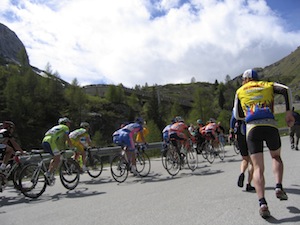
Long climbs of modest grades are the ideal terrain for Muscular Endurance
There are really two types of research available on virtually any topic related to cycling performance or physiology. There’s the research regarding what people are doing or what they think about a topic. These are people from many different perspectives; coaches, authors, bloggers, and we know that last category can include as many levels of proficiency that exist. A google search with the key terms will deliver plenty of results.
Then there is research regarding what the “Science” says. This research is found in medical and educational journals. Most often you must be a member of one of the governing bodies such as the ACSM (American College of Sports Medicine). While you might get some of the highlights in Google searches, the full studies are usually only able to be read by those who are members to the organization and have paid for access to said journals.
While you can simply use the free resources available, there is a distinct risk of basing your own work or conclusions on opinions or popular trends instead of hard science. However, that being said, this is part of the rationale for why Evidence Based Medicine is the only approach that makes sense for coming to conclusions that you will use for your own training or for that of your students. At the end of the day, EBC will be your own personal “proof in the pudding” as they say.
Muscular Endurance — Some Of The Science
I like to start with the science perspective — university, medical community, etc. I like to read the journals that the professional researchers read to get a solid foundation before I begin to let Mr. Google tell me he (and all of his many followers) think.
The first place I started was a position statement by the ACSM:
“Muscular strength and endurance are developed by the progressive overload principle, i.e., by increasing more than normal the resistance to movement or frequency and duration of activity. Muscular strength is best developed by using heavier weights (that require maximum or near maximum tension development) with few repetitions, and muscular endurance is best developed by using lighter weights with a greater number of repetitions (1).”
While this is clearly directed towards weight training, the application to cycling is also pretty obvious — the additional weight is represented by heavier gears (or steeper hills) and the greater number of repititions is represented by increasing cadence ranges.
In another article from the Journal of Medicine & Science in Sports & Exercise it says:
“…the extent of neuromuscular fatigue during pedaling exercise varies among different cadences and minimal fatigue is obtained at a considerably higher cadence (2).”
So from the above two statements we see the standard stress and adaptation principle being referenced and that there are cadence levels that result in lower muscular fatigue. Therefore this allows us to infer that there are cadence levels that encounter greater muscular fatigue, and hence it will be those levels that will promote the “progressive overload” we will need to force the adaptation or improvements in our muscular performance — either strength or endurance.
Muscular Endurance — Some Of The Practice
Here it is super easy to find out what so many coaches and instructors are doing to work on Muscular Endurance (ME). We see cadence guidelines that range between 65 RPM and 85 RPM across may different coaches, where the sweet spot is probably 70 to 80 RPM. However, when it comes to intensity or heart rate, there is considerable variation. The range typically starts at a low of T1 or Low Zone 3 (based on a 5 zone system with bottom of zone 5 your High Threshold), and goes to High zone 4. If we also throw out the lowest low and the highest high, we have an intensity level “sweet spot” that puts us between the middle of Zone 3 and the middle of Zone 4.
So in summary, the science confirms that we can create or promote the improvements in muscular endurance by specifying training rides within a cadence range of 70 to 80 RPM while working at an intensity level of Mid Zone 3 to Mid Zone 4.
The next question to look at is duration of the training, the amount of recovery between ME drills, and the number of ME workouts in a given week. Also, this begs the question if we workout at the low ends of both Cadence and Heart rate, would it take longer to see the training effects than if we worked at the high ends of both. In other words, if we do two weeks of 80 rpm (actually the higher RPM represents lower muscle fatigue) and mid Zone 3 work, will this produce less of an improvement than working at 70 rpm while in mid Zone 4.
If that would be true, then we can use this information to prescribe varying levels of ME work based on the fitness level or the time frame a coach and student are working with. Even more interesting would be the possibility of creating a numeric scale that we could use to “measure” the amount of ME work a student has been doing over a given period of time.
The next post will discuss how we can set up a study to do just that.
by John | May 22, 2012 | Big Box Instructor, Instructor Training, Master Instructor Blog

What's your strategy here?
It's a beautiful sunny Minnesota summer day here and I was enjoying it out on my old mountain bike. One of the reasons Minneapolis is as such a bicycle friendly city are the trails running everywhere. I really enjoy these smooth gravel paths because I can spend a couple hours JRA – Just Riding Along – link to a full description without any real conscious effort of watching for cars or the other things that tend to consume you when you're out in traffic.
I used JRA to describe that first ventilatory threshold, VT1. It's the place; above chatty yet below focused effort, communicating the VT1 to the students in my class. It's a wonderful place to spend a few hours and when I'm here, working aerobically, my creative juices really start flowing.
So I'm JRA, when I came upon the sign alerting me that the trail was underwater. “Oh great, now I'm going to get all wet,” I thought. If you spend any time on the road or on a mountain bike, you know that a wet stripe up your back or soaked feet doesn't really add to an enjoyable time outside 🙁
I've ridden this trail for years. I realized that “trail underwater” typically means there's two or 3 inches of water from the surrounding swamp (I refuse to call it a “wet-lands”… it's a swamp), covering the trail. And I was right.
There are two strategies you can use to cross these little mini rivers, while staying as dry as possible; If the water's only a few inches deep the trick is to peddle as slowly as possible, minimizing any spray up your back. A little deeper and you'll be pedaling your feet through water, so you'll sacrifice I wet back to keep your feet dry. This requires a bit more finesse and can challenge your bike handling skills. You accelerate to the speed that you think you're going to need in order to coast all the way to the other edge, keeping your feet level, up and out of the water. Doesn't always work perfectly. You sometimes stall before the end and wind up doing a sort of rocking motion with your feet, engaging the freewheel through a small segment of the circle, hoping to propel your self forward, while keeping your feet out of the water and not falling over – which would defeat the whole exercise.

The challenge is going just slow enough.
After successfully navigating the water hazard and resuming JRA, I was thinking about how we're always talking about the maximum in class; the highest, what's your threshold heart rate, find your FTP, how long can you sustain this, etc. But we rarely try to define the other side of it… how slow or low should you go?
If you've taught for any length of time you've experience the “spinner”. That person who seems to think they're accomplishing something while furiously pedaling with no resistance. Having indoor cycles with power changes that. As part of my initial orientation I give a new student, I'll have them peddle with no resistance and watch the display. On the FreeMotion bikes no resistance equals no power. And it's a wonderful illustration to help people understand the futility of peddling and not really accomplishing anything of value.
[wlm_firstname] I'm not sure that I have the whole answer here so feel free to share your ideas.
I'm a big believer that every minute of class should be of value. Just as there are times outdoors when you have to go slowly, you are being productive… still moving yourself forward.
I try to communicate this need for productivity in every class I teach. I'll frequently lament the fact that I only have them for an hour. 60 min. isn't really that long, so let's not waste our time doing nothing.
How I cue this is easier with power, but the feeling is the same. I'll have everyone start the class with zero resistance. I'll ask everyone to find a comfortable cadence and begin adding resistance. I'll explain that productivity for each of us is different, and yet if were honest with ourselves we understand when we're there. My morning classes are typically a bunch of “A” types and I'll make the comment that busy work is not the same as productive work. “Just going through the motions may give the appearance of work to others, but deep down you understand whether you're truly being productive or not.”
My feelings are that riding “productively” should bring everyone to a HR near to or right at VT1 / base of Zone three in a five Zone system.
I reinforce the need for productivity at the end of the long interval. Recovery should be productive. I'll suggest to everyone that once they have recovered to the point where they feel some calm in their breathing, they need to return to that place of productivity – catching their Heart Rate at VT1 / JRA.
There'll be plenty of time, to fully recover, once we've crossed to the other side.[plulz_social_like width=”350″ send=”false” font=”arial” action=”like” layout=”standard” faces=”false” ]
by Gino | May 12, 2012 | Master Instructor Blog
 So, my little ploy to try and get you to help me write this blog, and do some of this research has fallen flat — no response, no takers L Not to worry, we intrepid pioneers are used to surprises good and bad, obstacles and nay sayers. Heck, I no sooner had the first few blog posts up and the criticisms in the forums started.
Undaunted we press on. However, in the face of apathy or opposition, I find that you must have a very compelling and even personal stake in the subject at hand. Without that, your will and motivation to continue against a cowardly cloud of negativity will wane, and the lack of resolve will be your undoing; the study will end up incomplete or poorly executed.
Solve a Problem or Just Learn & Discover
Last post we talked about using some test subjects to help us form a statement of the problem we wish to solve or learning objective we hope to accomplish (yes, sometimes research is just meant to satisfy curiosity and the often insatiable desire to learn). In lieu of a group consensus, we will pursue something recent and applicable to some of the training we are working with at Cycling Fusionâ„¢. We (my partner Tom Scotto and I) have been trying to establish cadence and Heart Zone guidelines for Muscular Endurance and Tempo rides.
It is our contention, based on our collective experience in training for our own races, and training others for varying degrees of cycling, that these two components (heart rate and cadence) can be combined to insure a greater degree of training specificity, and that some of the specific training adaptations can be targeted by prescribing clear ranges for these parameters.
KISS (Keep It Simple Stupid)
While this acronym can apply to most of life, it is even more important in the field of science and scientific research. Its application here is fairly clear right from the start. To wit: since Muscular Endurance and Tempo rides target different adaptations, we will simplify our study by selecting Muscular Endurance alone as the subject of inquiry. This is the second step in setting up a research study after selecting a topic that is to simplify your subject of inquiry before going any further.
The next tangible step is to come up with a clear statement or working hypothesis (more on that in the next post). However, first we must do a relatively thorough review of the literature to see how much has already been done on the topic, and if that work is directly or indirectly pertinent. Armed with that information, we will be in a better position to form our guiding statement or hypothesis.
The Process So Far
- Select a topic of study
- Simplify the topic
- Conduct a review of the literature
You are welcome to join me by independently researching “Muscular Endurance for Cycling” and specifically its relationship to cadence and heart rate. We will report our findings in the next blog post.
by Gino | May 3, 2012 | Master Instructor Blog

If you’ve read the prior blogs (my hats off to you — I couldn’t get through them without nodding off), you know that the first place to start is with a review of the existing literature. Whatever you can find on the internet and/or conversations with other experienced cycling instructors and coaches should be thoroughly reviewed before beginning your first project.
Solve a Problem, Meet an Objective, But Be Specific
However, even the literature review is jumping the gun a bit. First and foremost you need to state the problem or objective you are trying to solve or achieve. For example, some of your students want to overcome a specific problem or limitation, or achieve a specific objective. You’ll have to dig deep to define exactly what to target in your Evidence Based Cycling (EBC) research.
For example, they might be complaining that the hills are always their “nemesis”, and that they must find a way to get better at handling the hills.
As stated, this problem is still so broad, it would not lend itself to any scientific process of investigation or discovery, so this is where you can begin using one of several types of research methodology — that of simple Exploration. Those students who are interested in taking the EBC journey with you will need to make their own observations and report them back to you. This process of reporting will do two things, it will help them begin to articulate more clearly what their perception of the problem is, and as these self reports are compared from one rider to another, patterns or common elements will begin to emerge.
The long and short of this step is to arrive at a statement of that is clear and specific enough that it can be applied to the basic steps of the scientific method of research. Here are those basic steps compliments of The Science Buddies:

Source: The Science Buddies - http://www.sciencebuddies.org
Rather than continue with a hypothetical example, let’s turn this blog into a collaborative EBC project. For those of you reading along, you are obviously already interested and are thus the most likely to be willing to participate and provide useful information. So this is what we are going to do:
- Select/recruit 2 to 4 Complete Riders (those who ride inside and out and value the benefits of both environments) who wish to improve their outdoor climbing
- Ask them to select one of their most variable climbing routes (the route with the most variety of climbs) and to collect both objective and subjective data for each significant climb on that route. A significant climb is any that is at least 4% grade or more, and lasts 1 minute or more)
- Ask them to ride the route making sure to lap their heart monitor at the beginning and end of each hill.
- In addition, they should make subjective observations or notes at the end of each route — yes that means stopping after completing each ascent and writing or if they have a smartphone they can simply voice record their thoughts and transcribe them later.
- Once collected, send the objective data to me, and we will look for the most common themes, and create our initial first step for an EBC project — an articulation of our question, or a definition of our problem that we can get started with. Email your questions as well to gene at cyclingfusion dot com.
by Gino | Apr 20, 2012 | Master Instructor Blog
 Gil our guinea pig is training for our next EBC (Evidence Based Cycling) project. The problem is his bike is in the shop, so he might just have to sit this one out.
Unless you have a whole team of guinea pigs as talented as Gil, you will have to recruit students or fellow riding buddies to participate in your quest for Evidence Based answers as it relates to cycling and cycling training. Naturally, fellow “data geeks” will be your low hanging fruit. However, since any over-concentration on one type of cycling demographic may skew results to just that population group, you will want to get as broad a representation of your cycling group as possible.
That being said, you can also do EBC that purposefully only applies to a given type or group of riders. For example, you may want to investigate the best ways to get a brand new rider used to the dreaded bike saddle. While opinions and experiences vary, the fact that this is an initial obstacle or deterrent to newbies would be something worth studying. This topic would easily be pertinent to just that type of rider (what we may refer to in the future as a demographic or population group).
Outside of those students that have a penchant for data and understanding the What, Where and Why of their cycling performance, you will need them to have training tools for measurement. While we do not pooh pooh subjective comments and the ever-popular RPE scale (well, maybe a little pooh pooh is justified at times), ultimately we will want to quantify our results. This in turn should lead us to a method of arriving at a more objective conclusion and testable recommendations.
Assuming you’ve identified the glorious geeks among us, you’ve confirmed that they own or have access to training tools, and you’ve got a good cross section represented in your EBC team, you’re ready to get started.
The next step is to select a topic of investigation; an initial project that will get your feet wet and help you and the group begin to learn about and experience the basic Scientific Method. Those fundamentals will be covered in the next post.