
by Jim Karanas | Apr 16, 2012 | Master Instructor Blog

By ICG® Master Trainer Jim Karanas
Last week’s post covered variations in intervals and ladders. This week’s covers variations in pyramids and steady-state workouts.
PYRAMIDS
A pyramid is a training technique that is essentially two ladders back to back, one ascending, one descending. The pyramid begins as an ascending ladder, but the top of the ladder becomes the midpoint, rather than the end. From the top of the pyramid, the progression of the training variable reverses and decreases in increments that are similar to the way in which it built.
Here is an example of a cadence pyramid that focuses on controlling leg speed: 80 RPM, 100 RPM, 120 RPM, 100 RPM, 80 RPM.
I should clarify that pyramids (and ladders) are not always about increasing and decreasing intensity. A cadence ladder or a cadence pyramid might adjust the resistance so as to keep the intensity consistent throughout.
Like ladders, pyramids can be done in either an interval or a continuous format. There are endless ways to approach them. A fairly standard intensity pyramid using intervals might be:
- 3 — 5 minutes of warm-up
- 30 seconds high intensity, 1 minute low intensity
- 45 seconds high intensity, 1 minute low intensity
- 60 seconds high intensity, 1 minute low intensity
- 90 seconds high intensity, 1 minute low intensity
- 60 seconds high intensity, 1 minute low intensity
- 45 seconds high intensity, 1 minute low intensity
- 30 seconds high intensity
- 3 — 5 minutes of cool down
Here are a few ways you can vary pyramids:
- Ladder up and down, using identical variables for each step in both the up and down ladder. The cadence pyramid above is an example of this.
- Ladder up and down, keeping one variable consistent while varying another. Use the cadence pyramid above and increase the intensity on the way up the pyramid. Then maintain the intensity on the downside.
- Invert the pyramid. Use the cadence pyramid above but begin at 120 RPM and build to a peak of intensity as the cadence slows. Then reduce the effort as the cadence increases.
My favorite pyramid is 11 minutes, as 3-2-1-2-3. This structure provides endless possibilities for class design.
STEADY STATE
In recent years, the concept of interval training has been popularized. Maybe over-popularized. Along with that, a rather major backlash against traditional forms of aerobic training (i.e., “fat burning”) has occurred. It’s common lately to read that low-intensity aerobic work is useless for fat loss, that everyone should always do intervals, that “regular” aerobic work causes muscle loss, and more. I’ve even read claims that aerobic exercise makes you fatter and stresses the adrenals.
In broad terms, steady state training is repetitive, rhythmic work that maintains a given level of intensity. The intensity is usually moderate and aerobic because the term refers specifically to exercise that’s maintained while workload, heart rate, oxygen consumption, and blood lactate remain constant. During steady state, the removal of lactate keeps pace with its production, preventing accumulation. As a result, the work can be maintained over a long time.
So this might be along the lines of 20 to 60 minutes at a steady heart rate. Steady state is a critical aspect of indoor cycling.
What are the benefits of steady-state training? Depending on the intensity, steady state may burn more calories during the exercise period than interval training. It’s also more appropriate for beginners. It can be done more frequently — daily or even more often. This last point depends on the duration, frequency and intensity, as well as the set-up of the rest of the training program.
Also, some research suggests that regular exercise encourages people to stick to a diet better. Considering that interval training shouldn’t be performed daily, steady-state activity might help people stay on their diets.
For indoor-cycling instructors, steady-state training is a chance for us to communicate, rather than just cue the next change. (Please see “The Art of Cueing” from several weeks ago for topic suggestions.)
Finally, high-intensity interval advocates tend not to take into account that you can go hard and long. Steady state doesn’t have to be limited to a recovery class. It might be a time-trial at 95-100 rpm at threshold heart rates, depending on duration.
These four elements of variation — intervals, ladders, pyramids, and steady state — are tools that enable you to create endless variations on similar class themes. This method uses both sides of your mind. Your creative thinking allows you to vary your approach and create concepts. Your ability to organize and structure what you’re doing creates a class that makes sense and is easy for the student to follow.
by Gino | Apr 5, 2012 | Master Instructor Blog
 Until I took the red pill (see initial post), I spent 95% of my working life in healthcare; specifically workflow methods and technology. As I got more and more involved on the clinical side of the equation, I began to learn about a distinct approach to the real life practice of delivering care to the patient called Evidence Based Medicine. In some ways, it looked to put to bed some of the same issues I feel burdened with as I continue to teach Indoor Cycling Instructors and coach competitive riders; that of competing opinions or treatment protocols for the same set of symptoms or circumstances.
In the case of practicing medicine, researchers and physicians in the day to day work of caring for patients were trying to answer the question “Is there a best practice here?” Instead of going with the status quo, or citing the research material that best support a given physician’s personal preferences, those who ascribed to tenants of Evidence Based medicine would often conduct their own research. This was often coupled with retrospectively looking at a lot of data from patients treated at their specific facility in order to uncover the patterns or practice protocols that yielded the best outcomes.
Perhaps this is why I started down this path early in my initial days after opening my own cycling studio in the suburbs of Pittsburgh. I started the studio from day 1 as a facility for mountain bikers, road cyclists & rails to trails recreational riders; to produce better fitness, better results, and more enjoyable riding.
Little did I know that there were entire groups of indoor riders who didn’t even ride outside. Little did I know that there were seasoned outdoor riders that would never ride inside if their life depended on it. Little did I know that there were techniques of riding inside that seemed to have nothing to do with how actual bikes are ridden. Little did I know that outdoor riders would actually trade good training and a comfortable environment for the status or challenge of enduring all manner of horrendous weather conditions, as a sort of “badge of honor” among the super dedicated.
Consequently, I was faced with groups that already had clear lines of demarcation and identification, and the harmonious “blending” of activities and venues I had a vision for was proving to be a bigger pipe dream than I had anticipated. The harmonizing I was looking for was much closer to dissonant jazz than a crooning quartet, and if I were to make any progress, it was clear that I was going to have to “prove my case”.
Now almost 5 years later, after pirating the practice methods, I’m borrowing the term and calling it Evidence Based Cycling.
by Jim Karanas | Apr 2, 2012 | Master Instructor Blog

By Team ICG® Master Trainers Jim Karanas & Joan Kent
A key difference between training and exercise, as touched on briefly last week, is that training brings consciousness to the process. In so doing, it takes a more mindful approach toward work that induces physical pain.
Training is not about always working out at a comfortable level so we can enjoy exercise. That leads to stagnation. It’s not about always kicking it into high gear. That leads to overtraining or injury. We need a balance between soft and hard. We must have challenge, both mentally and physically, but know when to recover.
Performance is the crux of the hard going. It provides the opportunity to experience our self-imposed limitations and better understand how to go beyond what our muscles can do. Doing something arduous teaches resilience, maybe the greatest lesson we can take from physical training.
Performance creates conflict and anxiety that bring the ego forward, along with ideas about what is or isn’t possible. It can bring up self-doubt and self-defeating thoughts that lead to self-defeating emotions. It seems counterintuitive, but these are good things.
We begin to worry about how well we’ll be able to perform in comparison: in comparison to our goal (or the coach’s goal for us), in comparison to past performances, in comparison to other people. We can’t get past the anxiety until we know it’s there and look at it closely.
The objective of performance training is to put ourselves in situations in which we can learn to be nonreactive to discomfort, pain, and even defeat. This isn’t ignoring pain or defeat. It’s learning to feel them, but not react. (For the record, we’re not talking about pain that can permanently injure you. The only benefit of not reacting to that kind of pain is when your life, or someone else’s, hangs in the balance.)
A feeling of achievement or confidence is related to ego, and that becomes secondary. Even increased self-efficacy, our concept of what we’re capable of doing, becomes secondary. The point is to go beyond reacting to the difficulty. It’s not that it doesn’t hurt. It’s just that it doesn’t matter.
Not that we should discount achievement. There’s nothing wrong with success as such, or acknowledging it. When we bolster our egos by seeing ourselves differently through achievement, however, we’ve lost touch with the absolute side of who we are. Achievement is fun, but carving out an identity from it is ego.
With regard to athletic potential, the ego is a limitation. No matter how big it gets or how confident we feel about our achievements, there will always be someone better. Also, whatever ability we have will diminish with time because we’re impermanent. Ego obscures our true ability.
An amazing performance from someone who didn’t expect to perform well and isn’t really sure what happened is a spiritual experience. Wanting to repeat it and do well again is ego.
It’s an interesting paradox: Continued training will generate better and better results. But, as we get away from ego and experience our being through training, we find ourselves caring more about the training and less about the results.
Ideally, performance results become secondary to the awakening process. The events enhance our transformation — through heightened senses during preparation, through aliveness, and through focus. To prevent being overwhelmed by the physical side of the experience, we go through preparation. That’s training.
The danger with performance is that it can bring out the ego. If we do well, the ego expands. If we don’t do well, the ego may go into self-pity — or refuse to continue because of the bad performance. That’s also an ego response. We’re just creating an identity for ourselves in a different way.
What happens in a performance event happens. There’s no good or bad result, even if it’s a DNF — just an opportunity to experience life and examine ourselves more closely.
Everything is impermanent except the aliveness of our being. Every experience, good or bad, can help us become more enlightened. Even suffering serves a purpose. It makes us more conscious and helps to awaken us. Then it’s no longer suffering. Buddhists say, “Suffering is necessary until it is no longer necessary.”
Sure, performance can be simply a physical test of fitness, but it can also be a chance to go beyond self-imposed limitations. We may do better than we expected. If we don’t do as well as we’d hoped, we may have a different perspective on it and feel good about having done a great effort. We may even find that helping others get past their limitations is as gratifying as, or more gratifying than, getting past our own.
Ultimately, training is a spiritual practice. As the culmination of training, performance is, as well. Training on the bike means riding in such a way that it brings balance to life. Performance on the bike can be the culmination of that balance.
The harder the event, the truer this may be.
by Gino | Mar 30, 2012 | Master Instructor Blog

I’ve decided to start a new Blog. It will be a cacophony of Rants, Research and Reality Checks. In 2007 I took the proverbial “red pill” see original Matrix movie if you are not familiar with that reference — it will be good for you :), for Indoor Cycling and the science of training, and ever since I’ve been wondering if I wouldn’t have been better off taking the blue pill. Ignorance is bliss after all.
Truthfully, I have no regrets. As in much of life, there is good news and bad news. The good news is that there is a very real difference between exercise and training, and that difference can be felt through and through; body, mind and spirit. Furthermore, the science behind creating this change in our fitness and performance on the bike is thoroughly captivating; compelling me to want to learn more and more.
However (you knew the other shoe would drop eventually, right?), the bad news is that seemingly opposite techniques can sometimes yield the same results. Educated, respected and credible sources can, and often do, disagree vehemently with each other with regards to methodology, technique and overall approach to training.
Each one will site well vetted and published research, making their respective cases as to why their methods are superior, or at least founded on science and therefore the proper way to achieve their desired results. So what’s the big deal you might ask. Everyone has their own way of doing things, right? The “big deal” is that I want to make sense out of this stuff, and it gets dog gone hard to separate fact from fiction, or formula from philosophy.
For example, there are studies showing VO2 increases from very intense H.I.T. type training, and there are studies showing VO2 increases from doing a ton of steady state riding in the low heart zones like zone 1 and 2. Likewise there are coaches that swear by weight training to augment your strength objectives, while there are others who won’t let their athletes near the gym; both siting research to support their position.
Yet we can see these extremely different methods produce equally successful athletes in many cases. It’s as if the body is somehow affected by the belief the athlete and coach have about what they are doing, and not the science behind it. Am I the only one that thinks this is completely illogical, weird and by the way, maddening?
So what’s a coach or educator supposed to do? Well, I’m not throwing up my hands… at least not on this account. Actually, not on most accounts. Instead, I have been doing the only thing we control freaks know how to do in the face of confusing facts and information. That is to take matters into our own hands, and do our own research. If one or more of these philosophies seems to ring true, we do our own homework, set up controlled studies, and we base our methods and techniques on the reality of our own findings – of what works — where we can see it, feel it, record it, and repeat it.
On my next post, I’ll try to explain how we wash this red pill down with enough spring water to yield this fruit.
by Joan Kent | Mar 19, 2012 | Health and Wellness, Master Instructor Blog

From http://wilsonbrothers.wordpress.com/2009/09/23/seebikesaw/
By ICG® Master Trainer Joan Kent
Some of your students may be severely limiting the amount of fat they eat — both good and bad — to lose weight. That’s likely to increase their consumption of carbohydrates — both good and bad. Because “bad carbs” can bring on some negative health consequences, it might pay to look at this.
Articles in science journals reference the “sugar/fat seesaw”, although research hasn’t really published an explanation for it. As the name implies, the sugar/fat seesaw is an inverse relation in dietary sugars and fats. I’d like to suggest a possible explanation for the phenomenon, in the interest of better nutrition balance for students.
When fat first enters the intestine, a hormone called CCK (cholecystokinin) is released. CCK is the most powerful satiety hormone in the body. Satiety is the feeling that we’ve had enough food and don’t need to keep eating. Fats activate a substantial release of CCK. CCK also curbs the desire for carbs. So, if fat is reduced too much (low-fat this, nonfat that, and so on), the desire for carbs may escalate.
Second, both sugars and fats trigger the release of beta-endorphin. That’s the brain chemical associated with the Runner’s High. As everyone who enjoys indoor cycling knows, you don’t have to run to get that high. Any solid cycling workout will do the trick, and the more intense the class, the greater the beta-endorphin effect.
There’s some evidence that the brain gets acclimated to a given level of beta-endorphin and that reducing beta-endorphin levels can cause withdrawal. It follows that strict limiting of fats might increase the desire for sugars as a sort of “beta-endorphin compensation.”
The third point involves saturated fat. Sat fats generate an insulin release, just like carbs. Cutting fats severely could decrease saturated fat severely. From a health perspective, that’s OK, but it could raise the desire for carbs, especially the ones that cause high insulin release.
Basically, it’s linear: the more insulin we release, the more serotonin the brain makes. Serotonin is a brain chemical best known for its antidepressant effect, but it also has other functions. High levels of serotonin have been shown to reduce carb consumption. The very, very low-carb Atkins Diet makes use of this fact to keep people away from carbs. Much of the fat they push is saturated. Between the CCK and the insulin/serotonin, the desire for carbs drops.
So what does all of this have to do with the diets of indoor cycling students?
“Good” fats, typically unsaturated ones like omega-3s and omega-9s, have health benefits in the body. These include anti-inflammatory effects and reductions in heart disease, joint pain, diabetic complications, and lots more. We don’t want our students to eliminate those benefits along with the fats they cut.
When someone tries to lose weight on a very low-fat diet — and I do see clients who are still avoiding fats big-time — major changes happen. CCK, beta-endorphin, and serotonin go down. The desire for carbs goes up, and — as suggested above — the most appealing carbs are the ones that set off the highest insulin secretion. Unfortunately, those are usually “bad” carbs, such as sugar and white flour. High levels of insulin are directly linked to serious health conditions (more on this in a future post).
The best solution — along with regular workouts! — is a good balance that includes some healthful fat with each meal or snack. The fats might be avocado, olive oil, fish or fish oil, seeds, raw walnuts, almonds or other raw nuts. Adding a small amount of good fat to each meal or snack will increase CCK and beta-endorphin, making sugars and junky carbs less appealing.
Another plus is that a little more fat in a student’s diet can increase endurance. Studies on runners have shown this, but, once again, runners aren’t the only ones who benefit.
by Tom Scotto | Mar 15, 2012 | Master Instructor Blog
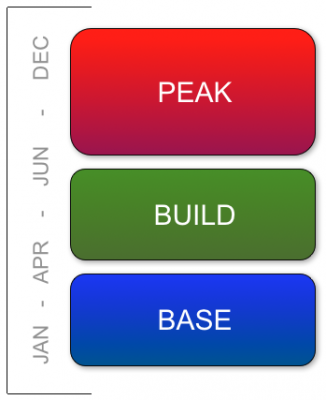 A number of instructors (and riders) have asked me how one should approach the next training phase and how to know their class is ready. These instructors are usually believers and followers of a periodized format for delivering the focus of their indoor classes. So considering we are rolling towards the end of March, this is the perfect time to address our focus beyond base training.
How Do We Know Our Class is Ready for More?
Let’s answer the easy question first. Well…sort of. The short answer is that it doesn’t matter. Hey, at least I didn’t say, “it depends”. The reason it doesn’t matter is because we have riders at all levels plus those that will pop into our class without notice, so we never really know who will be present from one week to another. Thus everyone will be in different places with their training and level of fitness. For this reason, I like to keep things on a general schedule for those faithful regulars that use our classes for consistent training (See the image for a general timeframe for each basic training phase). I also like to stay on the periodization model because it conveys the message that “we have a plan” in this class. Having a longer-term plan for how one delivers classes is also a great way to keep people coming back. For example, I will make the following announcement before introducing a new profile, “So as you know we have been focused on “X” (whatever that is) for the last 3-4 weeks and now we are going to build on that with today’s ride”. I’ve seen new riders turn to the person next to them to ask what type of rides they missed. I’ve even had people come to me after class and tell me that they are new (which I knew), wanting to know what was ahead for the next few weeks. The bottom line: they now want to be a part of what we are doing and don’t want to miss a class.
Obviously, as always, we need to provide options and give people permission to work at their own levels. Make sure to emphasis the point that everyone is at a different level and place in their training, so no one feels behind or unsuccessful during class.
What’s Next?
For those that have been following a periodized model, our focus has been on aerobic development / endurance, leg speed and muscular endurance (moderate climbing). With this foundation in place, from both a physical and educational sense, we can now get more specific in our focus and start shifting from volume to intensity. So what does this mean? The training done during base is designed to target general fitness and conditioning. The training performed during the next phase (often referred to as Build) begins to focus on developing muscular strength and power. With this shift in focus also comes an increase in intensity (bringing with it more recovery — hopefully). This can be a hidden trap for instructors because many will continue to increase the intensity, but not provide more time to recovery. In effect, intensity is not effectively increased because without appropriate recovery, people can work as hard as they need. Hence mediocre-ville and a dreaded plateau in fitness often follows.
This is often where taking the time to educate your class goes a long way. Having gone through 12 weeks of base training and understanding the purpose makes it easier to transition their mind to the concepts of training at a higher level.
Keep an eye out for my latest Audio PROfile entitled “CycleSTRONG” for an introduction to pure strength training — a perfect ride for the next phase of training.
