
by Jim Karanas | Feb 15, 2017 | Music

With over 1800 articles in our archives there's a good chance that our ICI/PRO members may have missed some of our best stuff. So every Wednesday we are republishing some our of our favorite articles and podcasts – enjoy!
By Team ICG® Master Instructor Jim Karanas
My last two articles were on video because it will affect our industry dramatically in 2012. Long before video, however, something else inspired us to ride bikes indoors: music. There’s no denying music’s powerful impact on the class experience. One way that happens is through emotion.
Music inspires emotion through genre, lyrics, vocals, harmony, tempo, rhythm, and more. But many indoor cycling instructors overlook emotion. It’s easy to understand why.
I taught my first aerobics class in 1977. Like other instructors at the time, I used popular music and older rock that was good for dancing. Then something happened. Workout Music.
Workout Music used a square rhythm of 32-count phrases, was always high-energy with a fast tempo, was typically dance or house music, and often remixed popular songs by speeding them up and punching the downbeat. Because teaching back then involved 32-count choreography, the energized remixes were useful and called
“aerobicized”.
(An example is “Let’s Get It Started” by the Black-Eyed Peas. Listen to the original, and then compare the workout mix made popular on The Biggest Loser.)
But while aerobicized mixes kicked up our workouts, they also buried a critical musical element — emotion.
Music stimulates every area of the brain. The emotion it evokes can be life-changing. Everyone has a special song from a special time that they’ll never forget. Odds are it was not a piece of workout music.
When Indoor Cycling was introduced 20 years ago, it completely reversed the workout-music trend. It was the very nature of cycling that did that. When you ride a bike, the road changes and forces changes in cadence and rhythm. Different music genres and tempi simulate those terrain changes, so “regular” music is back.
Indoor cycling also permits individual interpretation. Since people don’t have to be doing exactly the same thing at a given time, the movement doesn’t have to be synced to the music. This Freestyle approach is an effective way to ride to music. You ride more to the nuance or the feeling than to the beat. So emotion’s also back if we want it.
Emotion is a powerful tool for creating an indoor-cycling experience.
When creating a class profile, you might want to ID your own emotional response to a piece of music so you can use it at the right time. Download and listen to the following songs in the order below and note your response. You may even choose to ride to them.
Distinguish between good music and emotion. Music with a great beat may make you feel like riding, but focus on how you feel (happy, sad, neutral, etc.) if and when you try this.
Slid (Glid) Fluke
L.A. Woman (Single Edit) Billy Idol
This Is Us Mark Knopfler & Emmylou Harris
Stevenson George Winston
Link to this playlist in Spotify
Next week, I’ll predict how you felt and suggest ways to use emotion in your classes. I’ll also compare Freestyle and Beatmatch. Freestyle uses music as briefly mentioned above; Beatmatch pairs cadence with the beat and is practiced throughout the world. There are important reasons to bring both to teaching.
John's note: We're highlighting some of Jim Karana's past articles this week.

by Joan Kent | Feb 14, 2017 | Health and Wellness

On a few separate occasions, I’ve heard people from various health occupations declare that protein is “overrated.” It seemed to me those folks were thinking of “body” protein — for muscle building and the like — rather than brain protein. This brief post covers the top 3 reasons to take a different view of protein.
1. Protein provides amino acids.
Amino acids are the precursors of several key brain chemicals — dopamine, norepinephrine, and serotonin. Those neurochemicals affect the brain in a number of ways.
Dopamine and norepinephrine boost alertness and brain reward. Norepinephrine and serotonin improve mood and help fight depression and other “off” moods. All of them are brain feel-goods.
2. The female brain turns over serotonin at a faster rate than the male brain.
As a result, women need protein throughout the day. That provides the amino acid tryptophan in sufficient quantities to help the brain make enough serotonin and prevent various mood issues.
In addition, protein foods provide B vitamins. Vitamin B-6 helps to make serotonin synthesis (or re-synthesis) possible.
3. Protein is the macronutrient that offers the highest satiety.
Satiety is the feeling that we’ve had enough food and don’t need to go back for more. One underlying reason for this is that protein triggers production of cholecystokinin (CCK). It’s the most powerful satiety hormone the human body produces.
Yes, there are other reasons to eat protein, but let’s stick with these 3 for this post.
The above reasons are compelling ones to keep eating true protein foods — fish, chicken, grass-fed beef, eggs, shellfish, and more — throughout the day. If you’re against eating animal products, by all means substitute high-quality protein powders.
Vegetable proteins are having their moment right now. But for some people, the amount of protein available in kale, for example, won’t provide enough protein to make big changes in the brain. Vegetable protein powders, though, offer more.
Whatever form of protein you decide to use is up to you, of course. Just don’t skimp on protein if you’re seriously interested in alertness, better moods, and greater satiety.
by Jim Karanas | Feb 13, 2017 | Master Instructor Blog

By Team ICG® Master Trainer Jim Karanas
Body Language
Remember from Part 1 that teaching indoor cycling is a form of public speaking, which itself is an art. Employing some public speaking skills will impact your class dramatically. Great public speakers know that much of their impact comes from body language, including stance, gestures and facial expressions.
Stance
When you teach, a strong, disciplined position on the bike is essential for building credibility, expressing your emotions, and connecting with your students. Nothing discredits an instructor more than moving poorly — rounded back; hunched or protracted shoulders; no fluidity when changing positions; sitting up constantly, often unconsciously, to recover. You’ve lost the class before you’ve started.
Being strong on the bike is not just about your monster CV system. Your ride position, like a public speaker’s stance, must be solid to project confidence in front of a class. Students respond to instructors whose bodies are alive and disciplined. If someone filmed you while teaching, you might be amazed at how your posture sometimes portrays the opposite of what you tell your class to do.
Gestures
Use your hands to gesture every so often. On a bike, your hands belong on the handlebars, but you can keep one hand connected and use the other to emphasize a point or express emotion.
Sit up occasionally and use both hands as a public speaker would. When sitting up, I tell my students to keep their hands on the handlebars unless they need a back break.
Get off your bike at times, not only to work with individual students, but also to stand closer to the class and gesture with your entire body.
Facial Expression
Eye focus is the most important element of facial expressions, particularly to communicate sincerity. Don’t just look around the room as you speak to maintain general eye contact. Nothing connects you to your students better than focusing on one student long enough to deliver an entire phrase without looking at anyone else.
Pause when you finish and let it sink in for a moment.
This connection between you and one student can rivet the entire class. What did he say? Why didn’t she say that to me? The technique contributes significantly to comprehension and retention by giving the listener, and anyone else who tuned in, time to process the message.
Most instructors lose their facial expressions while teaching and “solidify” into a single look. Relax your face right from the start, and always greet your class with a smile. You won't smile throughout the class, but smile at least at the appropriate moments, like when you crack a joke that was actually funny. Somber and serious can be effective too, depending on training intensity.
It isn't natural to sit on a bike in front of a group. It's unusual and odd, so don’t try to be natural. Be larger and more powerful. It takes effort, skill and practice. Work on your body language to make the most of every class you teach.
Media Support
Steve Jobs was the maestro of using media with his public presentations. In 2005, he called Madonna on iChat after she signed an exclusive deal with iTunes and displayed the call on a big screen — a great use of media to enhance a presentation. Check the link: http://everystevejobsvideo.com/tag/madonna/
As instructors we can use voice, music and video to deepen our class presentation experience.
Voice
Our tone of voice shows our students whether or not we care. It tells them whether we’re in fun mode or feeling excitement, passion and enthusiasm about teaching. If the members think our class is boring, it may have nothing to do with the workout or music selection, but with a monotone that sounds dull.
Here are some suggestions for making classes more impactful through tone of voice:
- Pause before emphasizing an important word or concept.
- Speed up your speaking to show excitement.
- Tell a story. This will translate to your vocal quality.
- Define a moment in your class that might be considered a pinnacle: “Everything we’ve done to this point has prepared us for the next 2 minutes!”
Music
In public speaking, music is often used as background when participants enter a room to set the mood for a meeting or event. How much attention do you give to the music you play as your class enters? The proper music gets people in the right mood to work and adds a touch of drama to your class.
What do you play as the class is leaving? Music can reaffirm a pleasant atmosphere as your students exit.
Avoid turning music on or off suddenly. It should always fade in or out slowly.
This post is not about how to use music when you teach, but to expand on your use of music to set the right mood for the class before it begins and when it’s over. That’s what great public speakers do.
Video
Effective use of video to enhance our classes is a prime directive at ICG®. Forward-motion video can make your class more absorbing and exciting. Beautifully filmed, high-energy video that showcases destinations from around the world entertains and engages.
Remember, however, that video should never dominate your class. That important job is always left to you, the instructor. Video is just another asset that supports your class profile.
At its best, public speaking is flawless talk in a compelling sequence that persuades through command of the language. It’s well structured, well delivered, informative, educational and entertaining. Striving to be better public speakers can make us better indoor cycling instructors.
John's note: We're highlighting some of Jim Karana's past articles this week.
by Jim Karanas | Feb 12, 2017 | Instructor Training, Master Instructor Blog
 By Team ICG® Master Trainer Jim Karanas
More than anything else, members attend our classes for someone to work them out, to train them. My primary evaluation of a class is always whether I got a workout. I tell new instructors all the time to keep that in mind: with just the mindset of the typical class attendee, you’ll give a satisfactory performance.
With that said, we all know that a class can be so much more. When you approach class design and instructor performance as a form of public speaking, which they are, you may recognize the level of artistry to which teaching can be raised. The Presentation Secrets of Steve Jobs gives an idea of how some people prepare(d) for a public address.
Public speaking is an art. So is teaching an indoor-cycling class. Regard it as an art, no matter what your level of instruction, and you’ll be on a better path.
In public speaking, there are five basic elements, often expressed as, “Who is saying what to whom using what medium with what effects?” Does that sound familiar?
If we study the volumes that have been written about how to become a confident, compelling public speaker, the impact on our class presentation will be epic.
I’ve been involved with some form of public speaking since the 1980s, when I first joined Toastmasters. I was teaching aerobics then but didn’t draw a parallel between the two activities until much later in life. The following are a few speaking strategies to consider that parallel the Art of Teaching Indoor Cycling.
Plan Your Communication Appropriately
This goes beyond planning your workout and is completely separate from preparing your music or video playlist. Structure what you’re going to say during class. Apart from workout cues, which messages are you going to deliver? Exercise science? Training philosophy? Bicycle facts? Don’t just deliver these randomly. Plan how and when you’ll introduce this part of your presentation. Public speakers frequently use a tool called the 7 C’s of Communication: Be Clear, Concise, Concrete, Correct, Coherent, Complete and Courteous. There are variations on the 7 C’s that also include Credible and Creative.
Let’s say you’re teaching an endurance class and want to discuss the benefits of aerobic conditioning. I recently listened to an instructor do this. She spewed all the information during the first 10 minutes of class (not concise). She constantly talked over lyrics (not courteous). She was only about 75% correct in what she said and left out certain elements that could have connected the dots (not complete). She was clear in what she said. She also said it with authority (concrete) but rambled, not presenting the info in an organized fashion (not coherent).
Still, it was much more than many instructors take the time to do.
I was engaged and got a good workout. Clearly, this instructor understood the value of messaging during classes. It might have been the first time she presented it. She only needs to work a bit more on her presentation of this information to improve her overall communication.
Practice
Practice makes perfect. You probably won’t say something well the first time you say it (the example above). To practice, you must seek opportunities to speak in front of others. Repeat the same messaging in different classes you teach; don’t forget about it after you’ve said it. Before that, however, you must practice it plenty of times alone. As you practice, keep tweaking and re-tweaking your words until they flow smoothly and easily. You will often see me speaking out loud while driving.
Engage Your Audience
When you speak, try to engage your audience. This makes you feel less isolated and keeps everyone involved with your message. Force yourself to slow down by breathing deeply. Don't be afraid to gather your thoughts. Pauses are an important part of conversation and make you sound confident, natural, and authentic. Look at the students while you’re speaking and make eye contact. Speak to them directly.
I mentioned above that the instructor spoke over lyrics. I’m surprised at how many instructors speak over vocals in a song. I feel this is discourteous to the class because it’s confusing to listen to, but could even be considered discourteous to the artist. Learn your music so you can speak effectively in the interstices between the vocals — or insert an instrumental song when you want to deliver your message. This point was covered in my previous post on cueing.
Next week, we’ll discuss the importance of posture on the bike (body language in public speaking) and the use of various media (audio, video and voice tonality) to enhance your classes even more.
John's note: We're highlighting some of Jim Karana's past articles this week.
by Christine Hawthorne | Feb 11, 2017 | Instructor Training, Music
I've been using Ed Sheeran's Shape of You quite a bit recently as a fast flat road in my classes (around 99-100 rpm). It's perfect for keeping your riders focused on maintaining those upper range rpm's. I like to challenge my riders to maintain the pace and try adding just a bit more resistance each minute.
Shape of You iTunes link
If you're looking for something a little different, try the Galantis Remix…:
Shape of You Galantis Remix iTunes link
…or even the acoustic version for a cool down/stretch:
Shape of You-Acoustic iTunes link
by John | Feb 8, 2017 | Audio PROfiles
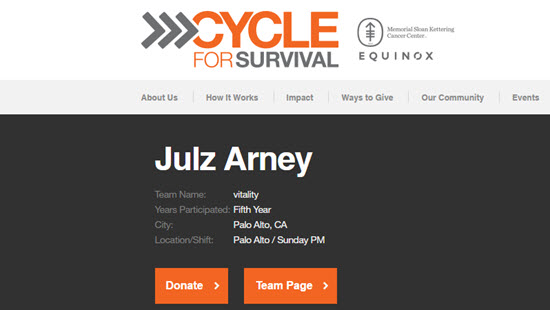
Former Schwinn Master Trainer Julz Arney needs your help and she's offering a nice gift in exchange – her latest class music playlist and profile for Moving Mountains!
Hello John
You are getting this email from me because in the past you so generously donated to this awesome cause, where 100% of the money raised goes directly toward research to cure rare cancers. Did you know that covers everything from ALL pediatric cancers to ovarian cancer, cervical cancer and thousands more?
As a thank you for your donation, I sent you an indoor cycling class design from my Saturday morning Cycle Beats class at Equinox ready to teach in your next workout, or a link to a special playlist on Spotify, or in years past…BOTH. I wanted to let you know that I'm at it again for 2017 and if you are able to donate at least 25.00, the deal is ON!
For fun, and because I already know you are a fantastic person, I've included the Spotify link to the music here. No pressure – it's all love! <3
Should you feel moved to give another 25.00 this year (here's the link), I'll email back the pdf of the 60:00 minute ride called “Moving Mountains” just as soon as I see your donation come through.
I. Appreciate. You. XOXO – Julz
