by Christine Hawthorne | Oct 28, 2016 | Instructor Training, Music
Little Mix‘s recent release Shout Out to My Ex has made a strong appearance on my playlists this week. It's the first single released from their upcoming album Glory Days. It's around 64 rpm and I've been using it for jumps on the chorus.
Apparently, since it's release, many fans have pointed out the similiarities between the song and G.R.L' s Ugly Heart (around the same rpm and a song I've also used for jumps on the chorus). Hmmm…. they do sound similar. Either way, they are both fun, upbeat (well, maybe except for the lyrics) songs that will work great in your next cycling class! Take a listen and decide for yourself.
Shout Out to My Ex iTunes Link
Ugly Heart iTunes Link
by Dennis Mellon | Oct 25, 2016 | Dennis Mellon

The world of group indoor cycling has recently collided with the realm of technology to give instructors access to and class participants the ability to experience three learning styles in each and every class. I like to call these learning styles being able to seeit, hear it and feel it. This means your senses are all stimulated and makes indoor cycling much more accessible to more types of people. Here’s how it works.
3 Types of Learning Styles
See It — Some of us are visual learners, where we learn best when aided by images, pictures or movies.
Hear It — Others are auditory learners who understand best when supported by music, sound, rhythm or voice.
Feel It — Kinesthetic learners do best when they can move, feel or experience what is being taught.
Cue-munication
At Stages Indoor Cycling we teach instructors the art of “Cue-munication”, which is anything you indicate that you would like your riders to absorb & retain. It could be a feeling, a sensation, an effort, or a physical way of doing something. Before group display technology was available, instructors were forced only to use language when trying to cue-municate. For the auditory learners this may have been fine, but for a significant portion of riders, this cue-munication style may not have resonated.
Cue-munication Tools & Their Limitations
Some might say that heart rate monitors and power meters would solve the visual learner’s frustration of being asked to decipher their instructor’s direction and translate it into how they should feel. Before the invention of group display systems, I would agree with those who said this. But there are limitations with both heart rate monitors and power meters.
Heart Rate Monitor Limitations:
Only a small percentage of exercisers use them. An instructor is lucky if 20% of class participants are using a heart rate monitor at any one time.
Heart rate simply isn’t the best way to monitor intensity. Too many factors affect heart rate on a day to day basis; factors like sleep, hydration, stress, caffeine, recovery, heat…. the list goes on and on.
There is a lag time associated with heart rate. Pulse rate reflects what an exerciser’s body did 15 to 30 seconds ago, not what it’s doing right now. In today’s HIIT (High-Intensity Interval Training) world, riders may be halfway through their recovery interval before their heart rate peaks from a hard effort.
The better option for monitoring intensity in indoor cycling is to use a power meter. A power meter shows a cyclist the exact amount of work being done second by second. If a rider’s wattage increases over time, that rider is doing an increasing amount of work. Power meters are now the “gold standard” when it comes to monitoring intensity in indoor and outdoor cycling.
Power Meter Limitations:
Although power meters give the visual learner the numbers they crave, for many riders, all these numbers and data are a lot to remember.
When using data for effective Power Zone Training (what we teach at Stages Indoor Cycling), a rider is required to memorize his/her zones or perform calculations on the fly.
The Power of Group Display
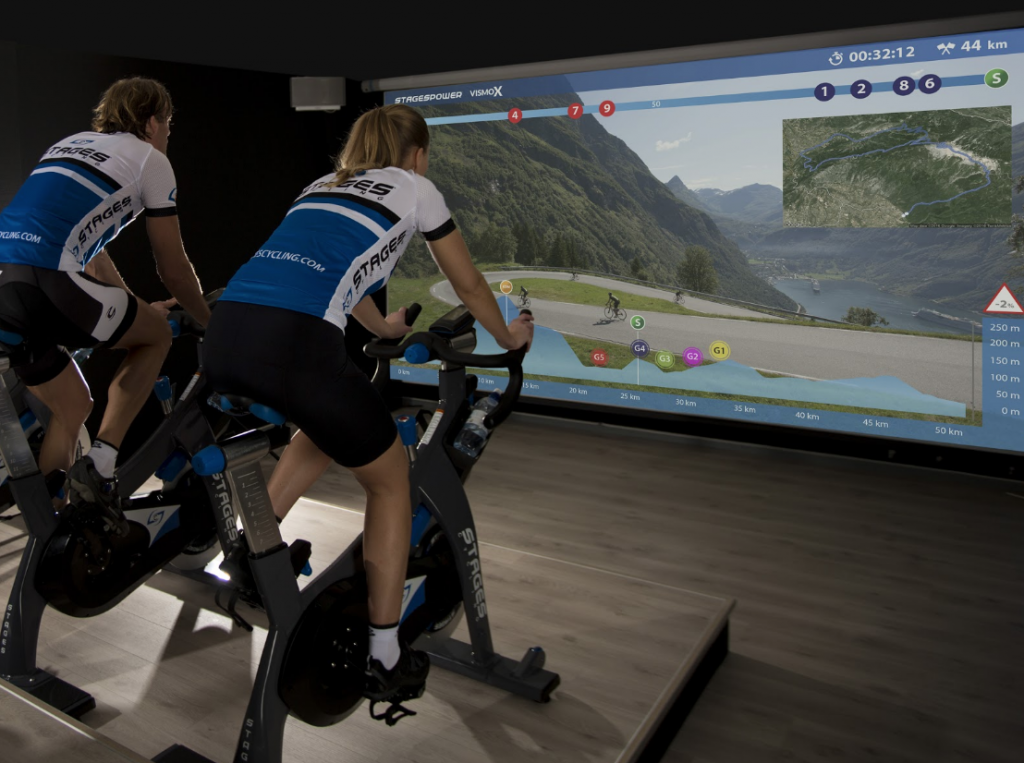
Group display systems, like VismoX, perform all the needed calculations and store each rider’s zones for them. Then when riding in an indoor cycling class, these zones can be displayed on a screen, so each participant knows exactly how hard they are working at any given moment.
See It — Visual learners love group display because their power zones are shown as numbers, colors, or a mix of both.
Hear It — Auditory learners are now supported with visual cues, which further enhances their experience.
Feel It — Group display systems assure kinesthetic learners that they are working at the right intensity with a simple glance at the screen. They can then anchor the associated sensations or feelings with that power zone or intensity.
Group display systems, like VismoX, have given instructors a way to SHOW their class participants how much work they’re doing. The visual systems simplify the complex world of exercise and training with data. They provide immediate feedback and support all three different learning styles. Instructors now have all the tools necessary to cue-municate the most effectively to EVERY cyclist in class.
Source: The Power to See it, Feel it & Hear it in Indoor Cycling – Stages Cycling – North America – Stages Cycling — North America
by Christine Hawthorne | Oct 21, 2016 | Instructor Training, Music
It doesn't get any better than when you find a song with just the motivational lyrics you are looking for. I like to use the song Work This Body by Walk The Moon and it always seems to get my classes working just a little harder. Here is another one that I've just started using by Sia called Move Your Body. Check out the original version and the remix. Both work great for a climb at around 64 rpm.
Move Your Body iTunes Link
Move Your Body remix iTunes link
Work This Body iTunes Link
by John | Oct 19, 2016 | Instructor Tips and Tricks, Instructor Training, KEEP IT FUN, Music
This is cool
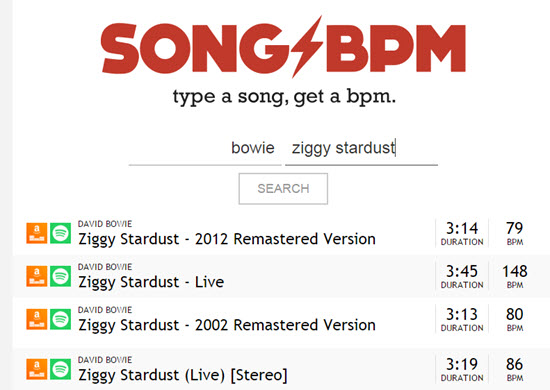
I saw this online tool, after following a link posted by Kor180 studio owner Maja Kermath on Facebook. After trying a few tracks that came to mind, it worked so well that I felt I should share it with you. https://songbpm.com
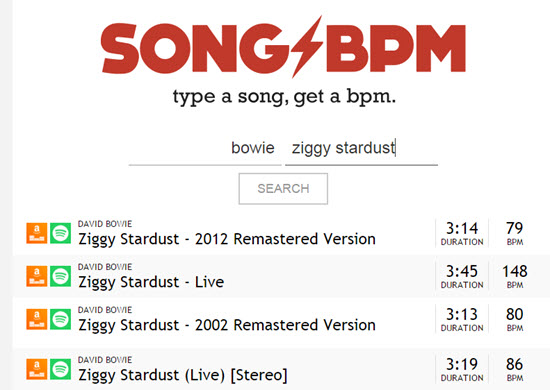
The songbpm.com tool searches the Spotify database and returns all the posibilities found. It's interesting to me how the various versions of Ziggy Stardust are all at a different BPM.
79BPM or 148BPM… what's the difference?
The live version of the song above is listed at 148BPM, while all the others are around 80BPM. Obviously the live version isn't played twice as fast. Rather if you know the original song you'll hear that the live version is a bit slower @ 74BPM – 1/2 of 148BPM. The software is counting this track differently, which is why I prefer using….
Tap-To-The-Beat Music Counting Tools
Following and riding to the beat of the music, does require you be able to hear the rhythm and then match your movement to it. That's why I've always recommended Instructors actually listen to each track and then tap out the beat using one of the simple tap-to-the-beat counters listed below.
The Windows version Tap-To-The-Beat counter isn’t pretty, but I’ve used it for years — download it here. It will show as an .exe file in your downloads folder. Double click to open it and start tapping the Enter key in time with the beat that you hear 🙂
This online Tap to the Beat counter works well.
There are a bunch of free iPhone Apps like this one you can use.
Android Users can download this free App.

by Joan Kent | Oct 17, 2016 | Health and Wellness

One thing I probably don’t write about enough is dehydration and the problems it causes. Dehydration can start with a drop of as little as 1.5% of the body’s water. The average level is around 60%.
One of many problems dehydration can cause is craving for sugar. This post is about how that happens.
Did Our Ancestors Crave Sugar When Thirsty?
When our bodies need water, it does make sense that we may feel an urge to seek food. I used to interpret that as a lack of awareness some of my clients had of the difference between thirst and hunger.
But there’s an evolutionary basis for it.
In the hunter/gatherer days, water wasn’t always readily available. The search for food to supply water and quench thirst was logical. The vegetables or fruits that were so often eaten were high in water content.
Obviously, food options have changed dramatically over many centuries, but the urge to seek food when we’re thirsty may still be with us. Dehydration activates both hunger and thirst centers in the brain’s hypothalamus.
The inability to distinguish between thirst and hunger may still indicate a lack of awareness. But there are a few other reasons dehydration may trigger sugar cravings.
What Workouts Can Do
Post-exercise, dehydration often occurs. If the workout is long enough to continue past the onset of dehydration, the body’s use of glycogen — carbohydrate stored in muscle — speeds up and reduces stored glycogen levels more rapidly. That makes a post-workout craving for carbs more likely, since carbs are used to create glycogen. The carbs we crave will often be for sugar.
In my experience, clients frequently crave fruit after a workout. That may reflect the evolutionary drive to obtain water from food.
Yet bananas are the most popular post-exercise fresh fruit choice I’ve observed — even though they contain less water (74%) than other fruits like watermelon, strawberries, grapefruit, cantaloupe (over 90%) or peaches, pineapple, raspberries and oranges (all around 88%).
So choosing a banana after a workout doesn’t seem to mesh with the “water seeking” hypothesis.
Bananas are, however, relatively high in sugar (18g per cup), compared with many other fresh fruits that contain more water. The choice seems to be less about water and more about sugar.
As an aside, fruit is usually seen as healthful but can be addictive for those who are carb- and/or sugar-sensitive. More importantly in this context, fruit is absolutely not the best fuel for recovery after a workout, as I’ve covered in previous posts.
Speaking of Fuel…
Dehydration can make it difficult for the liver, which uses water, to release glycogen and other components of stored energy. That can lead to food cravings, according to John Higgins, M.D., associate professor of cardiovascular medicine at the University of Texas in Houston and the chief of cardiology at Lyndon B. Johnson General Hospital.
Cravings for sweet foods are common at such times because the process of glycogen production involves water and glucose, the body’s circulating sugar. Dehydration makes it more difficult for the body to produce glycogen.
There’s Also Serotonin
Dehydration interferes with brain levels of serotonin. That can result in a lack of satiety — the feeling we’ve had enough food and don’t need to start a new meal for a while.
Low serotonin levels can trigger the desire to eat more, and also bring on food cravings, typically for carbs like sugar. It may even make us more impulsive, so the cravings become more difficult to resist.
Why Else Is Hydration Important?
Dehydration isn’t just about sugar cravings. Many other reasons exist to stay hydrated. These include fatigue; dry mouth and bad breath; decreased mental performance; decreased athletic performance and an increase in perceived exertion; dry skin and loss of skin elasticity; constipation; irritability and other “off” moods; headaches; muscle cramps; dizziness; and fever or chills.
In one study in Physiology and Behavior, the number of driving errors doubled during a 2-hour drive when drivers were dehydrated.
A going rule for water consumption is to divide your body weight in pounds by 2. That gives you the number of ounces of water to drink to stay optimally hydrated. By this rule, a 160-lb person would need to drink 80 ounces of water, or ten 8-ounce glasses of water per day. At the very least, gauge your urine color. It should be very pale yellow, even clear.
Don’t forget to figure in water losses for sweaty workouts and any dehydrating beverages you may drink, like coffee or cola. A tough cycling class, for example, may result in sweat losses of 1 to 2 quarts of water. Compensate by drinking more water.
Stay hydrated and healthy — and see if your cravings for sugar diminish.
by Christine Hawthorne | Oct 14, 2016 | Instructor Training, Music
Have you heard? Spotify has come out with a new feature called Daily Mix. This is great if you're like me, and feel like you can't wait for your Discover Weekly playlist to update, because you get a new mix of tracks every single day based on your listening habits! It's a great way to hear more of the music you love and find new tracks that you might like too. If you find something you love, make sure you save it to your favorites. Here is a basic overview of the new feature as well as some of your frequently asked questions answered—> Spotify Daily Mix
Here's a great one I found while checking out my latest mix. It works well if you need a longer song with a strong beat and no lyrics:
Leave a comment and let me know what you think about the new Daily Mix feature, or share one of your new discoveries!
